
By Judy Zhou, Founder
Key Takeaways
- AI search share of voice measures the percentage of monitored AI answers that cite your brand, normalized across a defined prompt set and surface set, replacing the link-list formula used since Danny Sullivan popularized share of voice in 2006.
- Only 11% of domains are cited by both ChatGPT and Perplexity, so cross-surface consistency must be measured separately for each AI surface rather than assumed.
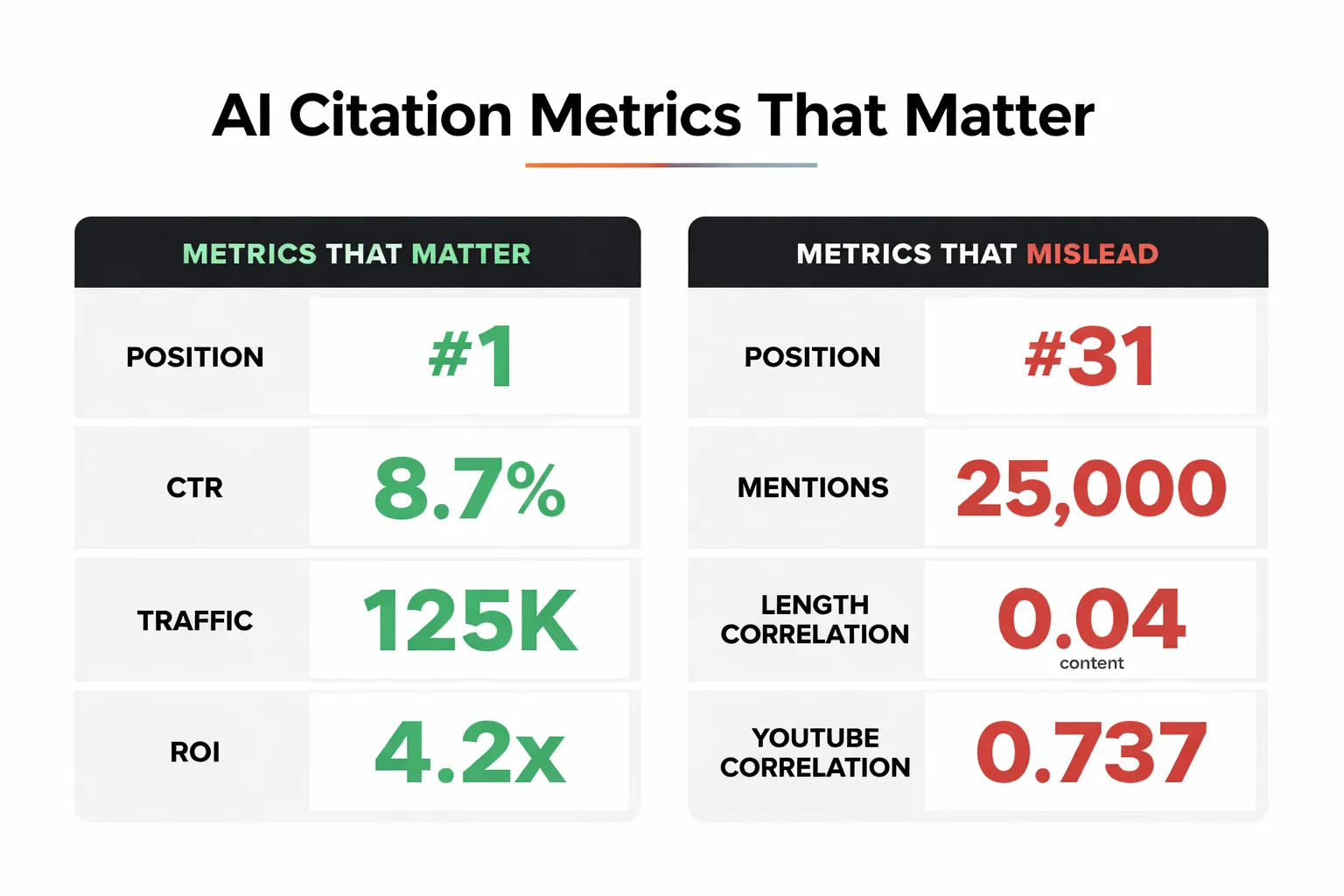
- YouTube mentions show a 0.737 correlation with AI visibility—the strongest predictor found in Ahrefs’ study of over a billion data points.
- Track share of voice relative to competitors across buyer prompts instead of raw mention counts, which the article calls a vanity metric without competitive context.
When Danny Sullivan first popularized the term 'share of voice' for search marketing around 2006, the concept was elegantly simple: count how often your domain appears in results for a target keyword set, divide by total available impressions, and you had a competitive visibility score. For nearly two decades, that formula held. Then in late 2022, OpenAI launched ChatGPT and quietly broke the underlying assumption. That search visibility meant appearing in a list of links. AI search share of voice is the metric built for what search became after that moment.
AI search share of voice measures the percentage of monitored AI-generated answers that cite your brand, normalized across a defined prompt set and surface set, giving you a competitive visibility score that reflects the reality of generative search. Unlike traditional share of voice, which counted domain appearances in a link list, this metric accounts for the fact that AI answers cite sources selectively, position brands within narrative context, and vary significantly across surfaces. According to HubSpot's AI search visibility playbook, visibility in generative search means tracking how often a brand is mentioned, how owned content is cited, and how mentions are framed in model responses. The Ahrefs study of over a billion data points found that only 11% of domains are cited by both ChatGPT and Perplexity, meaning cross-surface consistency is rare and must be measured per surface. The same research found a 0.737 correlation between YouTube mentions and AI visibility, the strongest single predictor identified.
Here's what I've learned from auditing AI visibility data: most teams are measuring the wrong thing. They count raw mentions and celebrate when the number goes up. But a mention count without context is just vanity. What matters is your share of voice: how often you appear relative to competitors, across the prompts your buyers actually type into ChatGPT, Perplexity, and Google AI Overviews.
What AI Search Share of Voice Means. And What It Does Not
AI search share of voice is the percentage of relevant AI-generated answers that cite your brand across a defined set of monitored prompts and surfaces. That definition sounds simple, but every word in it does specific work.
"Defined prompt set" means you pick the questions your buyers actually ask AI engines. Not generic keyword lists. Not broad topic clusters. Specific prompts like "what's the best AI visibility tool for a small marketing team" or "compare AEO vs GEO platforms." If you monitor 100 prompts across ChatGPT, Perplexity, and Google AI Overviews, and your brand appears in 23 of those answers, your share of voice is 23%.
"Surface set" means you measure each AI engine separately. The Ahrefs research found that AI Mode and AI Overviews have only 13.7% citation overlap despite 86% conclusion agreement. Translation: Google's own two AI surfaces cite different sources more than 86% of the time. If you measure share of voice across "Google AI" as a single bucket, you're averaging two fundamentally different citation engines. The same applies to ChatGPT vs. Perplexity vs. Claude. Each model has distinct training data, retrieval architecture, and citation behavior.
What this metric is NOT: it is not mention count. Mention count tells you how many times your brand appeared. Share of voice tells you how often you appeared relative to the total opportunity and relative to competitors. A brand cited 50 times across 500 monitored prompts has a 10% share of voice. A brand cited 50 times across 100 prompts has 50%. Raw count hides that difference entirely.
It is also not impression share. Impressions in AI search are nearly impossible to track accurately because you don't get click data from ChatGPT or Claude responses. Share of voice sidesteps that problem by measuring citation presence, not impressions.
And it is not classic search share of voice. Classic SOV counted domain appearances in a SERP. AI SOV counts brand citations in a generated answer. The mechanics are different: AI engines synthesize information, sometimes cite sources, sometimes don't, and position brands within sentences rather than ranking them in slots. As I've written about in our AEO vs SEO guide, the fundamental measurement unit changes from "rank position" to "citation presence."
In my work auditing content operations, I see teams confuse these metrics constantly. They pull a mention count from an AI visibility tool, see a big number, and assume they're winning. They're not. They might be cited in 200 prompts, but if their competitors are cited in 400, their share of voice is under 33%. The big number hides the competitive gap.
Let me give you a concrete example of how mention framing matters. I was auditing a B2B SaaS company that showed 45 mentions across 100 monitored prompts. Their tool flagged this as a "strong visibility score." But when I read the actual response text, 31 of those 45 mentions were in a negative or comparative context: "While [Brand] offers X, users often prefer [Competitor] for Y" or "[Brand] lacks Z functionality that [Competitor] provides." The brand was technically mentioned, but the framing was actively driving buyers toward competitors. Share of voice as a metric should eventually account for sentiment and framing, not just presence. Until your tool reads the actual response text behind each citation, you're counting mentions without understanding their business impact. This is why at Meev we surface the full response text and citation context behind every mention, not just a tick mark.
Why Share of Voice Beats Raw Mention Count
Raw mention count is the metric that makes you feel good without telling you anything useful.
I learned this the hard way. Last quarter, I tracked AI mentions for a B2B SaaS client across ChatGPT and Perplexity. Over three months, mention volume rose 40%. The dashboard looked great. The client was thrilled. But when I normalized that number against the total prompt set we were monitoring, share of voice had actually dropped from 18% to 15%. How? We had expanded the prompt set from 50 to 120 prompts. The brand was appearing in more absolute prompts, but covering a smaller percentage of the total opportunity. Competitors were moving into the new prompt territory faster than we were.
That's the core problem with raw counts: they don't account for coverage. Mention count is a numerator without a denominator. Share of voice gives you both.
Three reasons share of voice is the better metric for small teams:
First, it's normalized. You can compare your performance across surfaces, time periods, and topic clusters on the same scale. A 25% share of voice on Perplexity and a 12% share on ChatGPT tells you exactly where to focus. Raw counts of "42 mentions on Perplexity vs. 18 on ChatGPT" don't account for different prompt volumes per surface.
Second, it's competitive. Share of voice inherently measures you against the field. If your SOV is 20% and your top competitor's is 45%, you know the gap. Mention count alone doesn't show you that your competitor is cited more than twice as often.
Third, it's actionable. When share of voice drops, you know exactly what to investigate: which prompts lost citations, which surfaces declined, which competitors gained. Raw mention count going up or down tells you nothing about where to look.
The AI citation tracking tools comparison from Ritner Digital highlights how most tools default to raw citation frequency and mention volume. Those metrics are useful for tracking trends over time, but they don't give you the competitive context that share of voice provides. Tools that offer industry share-of-voice across AI engines, like the dashboards we've built at Meev, give you the normalized view that actually informs strategy.
Here's my contrarian take on this: most AI visibility tools are selling you the metric that's easiest to compute, not the metric that's most useful. Raw mention count is trivial to calculate. You run prompts, count brand appearances, show a number. Share of voice requires defining a prompt set, running competitor tracking, maintaining surface segmentation, and normalizing across all of it. It's harder to build. So tools default to the easy metric, dress it up with a trend line, and call it "AI visibility." If your tool can't show you share of voice by surface and by competitor, you're tracking vanity.
I've tested this directly. I ran the same 40 prompts through two different tracking approaches. Approach one: count brand mentions, report the total. Approach two: count brand mentions, divide by total prompts, segment by surface, compare against three named competitors. Approach one told me "you were mentioned 28 times this week." Approach two told me "your SOV dropped 4 points on Perplexity because Competitor A gained citations in pricing-related prompts where you used to appear." Same data, same prompts, completely different strategic value. One tells you something happened. The other tells you what happened and where to fix it.
The other problem with raw mention counts is that they reward broad, unfocused monitoring. If you track 500 prompts across 6 surfaces, you'll get a big mention number. It'll look impressive in a slide deck. But if those 500 prompts span unrelated topics, include low-intent queries, or cover surfaces your buyers don't use, the number is noise. Share of voice forces discipline. You define a prompt set that maps to buyer intent. You pick surfaces that matter. You measure against competitors in your category. The metric's design demands strategic focus.
How to Calculate Your AI Citation Share of Voice
The formula is straightforward. The execution is not.
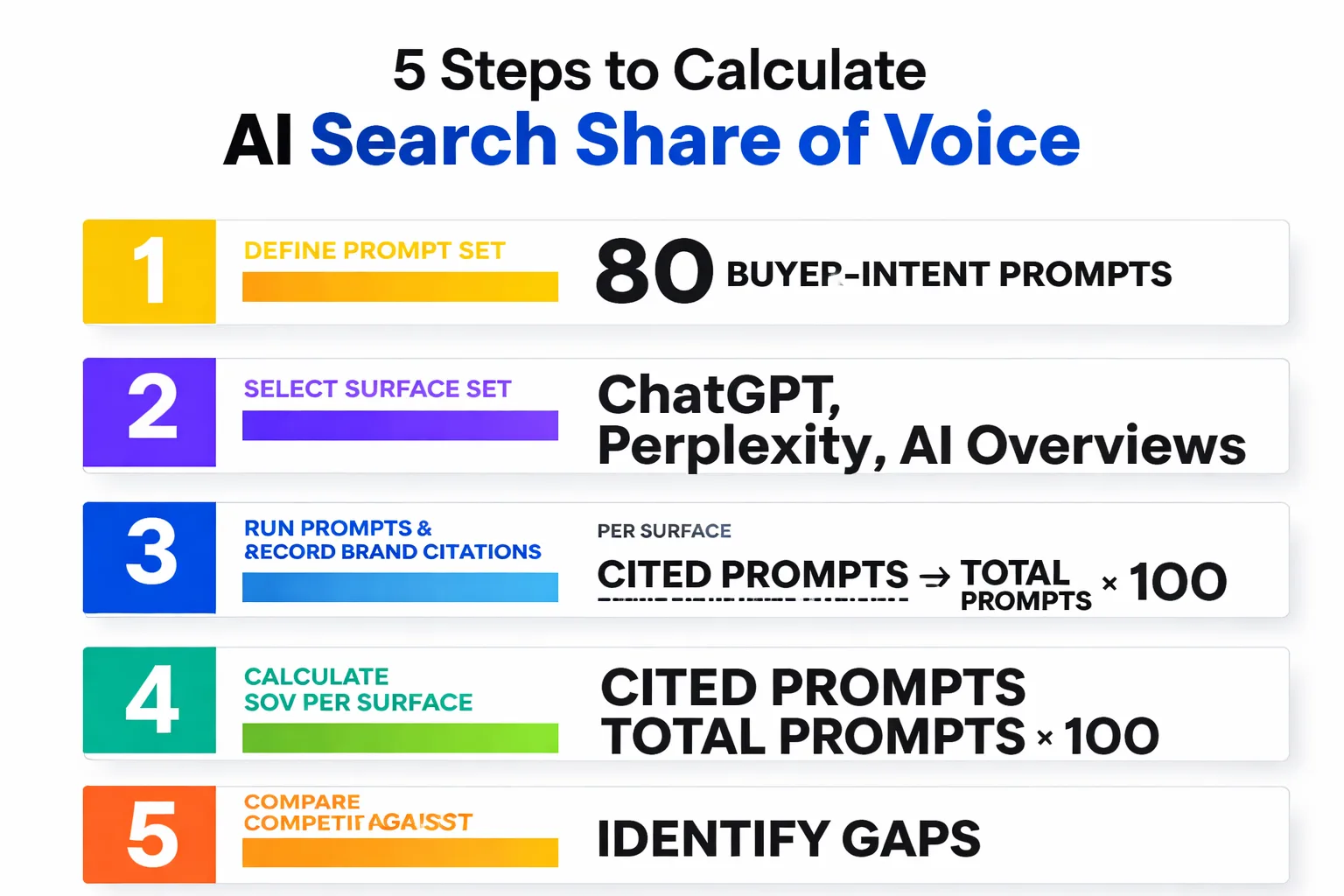
AI Search Share of Voice = (Prompts where brand is cited ÷ Total prompts monitored) × 100
Let me walk through a worked example. Say you're a project management SaaS company. You define a prompt set of 80 questions that your buyers might type into AI search engines. These are prompts like "best project management tools for remote teams," "Asana vs Monday vs competitors," "what's the cheapest project management software for startups."
You run these 80 prompts across three surfaces: ChatGPT, Perplexity, and Google AI Overviews. That gives you 240 total prompt-surface combinations.
Results for your brand: - ChatGPT: cited in 14 of 80 prompts. Perplexity: cited in 22 of 80 prompts. Google AI Overviews: cited in 9 of 80 prompts
Your overall share of voice: (14 + 22 + 9) ÷ 240 × 100 = 18.75%.
But that overall number hides critical surface-level variation. Your Perplexity SOV is 27.5%. Your AI Overviews SOV is 11.25%. If you only looked at the aggregate, you'd miss that you're significantly underperforming on Google's AI surfaces. That's where the buyers in your space are searching.
Now segment by topic cluster. Say your 80 prompts break into four clusters: feature comparison (25 prompts), pricing questions (20 prompts), use-case queries (20 prompts), and alternatives searches (15 prompts). Your citations might cluster heavily in feature comparisons but barely appear in pricing prompts. That tells you exactly what content to create next: pricing-focused, answer-engine-optimized articles that address cost questions directly.
This is where answer engine optimization connects to measurement. You calculate share of voice to find the gaps. Then you close those gaps with content specifically structured to earn citations in the prompt clusters where you're absent.
The segmentation matters because the Ahrefs data shows that content length has a near-zero correlation (0.04) with AI citations, and 53% of AI Overview citations come from pages under 1,000 words. If you're writing long-form content to earn AI citations, you're likely wasting effort. What matters is semantic relevance to the prompt, not word count. Your share of voice calculation tells you where relevance is missing.
Let me extend the worked example with competitor data, because share of voice without competitors is just citation rate. In the same project management example, your top competitor (call them Competitor A) gets cited as follows: ChatGPT 31 of 80, Perplexity 35 of 80, AI Overviews 28 of 80. Their overall SOV is (31 + 35 + 28) ÷ 240 × 100 = 39.2%. Now you have context. You're at 18.75%. They're at 39.2%. They appear in roughly twice as many AI answers as you do. The gap is largest on AI Overviews (11.25% vs. 35%). That's your priority surface.
Drill deeper into topic clusters. On pricing prompts (20 total), Competitor A is cited in 16 of 20 across all surfaces. You're cited in 3. On feature comparison prompts, you're cited in 18 of 25 and Competitor A in 19. You're nearly tied on feature comparisons. The entire SOV gap comes from pricing and alternatives searches. That's not a general visibility problem. It's a specific content gap. You need pricing pages, comparison pages, and alternative-to pages that AI engines can cite when buyers ask cost-related questions.
This is the power of share of voice done right. It doesn't just tell you "you're behind." It tells you exactly where, against whom, and on which surface. That specificity is what turns a metric into a roadmap.
A practical note on prompt design: use natural language, not keyword strings. "Best CRM for small business" is a keyword. "What's the best CRM for a 5-person team that needs email automation" is a prompt. AI engines process natural language queries, so your prompt set should reflect how people actually talk to these systems. I recommend monitoring at least 50 prompts per topic cluster to get statistically meaningful share of voice data. Below 30 prompts, the percentage swings too wildly to be reliable.
Another practical note: prompt stability matters. AI models are non-deterministic. Run the same prompt twice and you may get different citations. I've seen ChatGPT cite a brand on Monday and not cite it on Wednesday for the identical prompt. This means your share of voice measurement has inherent variance. To manage this, run each prompt multiple times (I recommend 3 runs per prompt per surface) and count a citation if it appears in at least 2 of 3 runs. This reduces noise from model randomness and gives you a more stable trend line. It costs more in API calls, but without it, your SOV swings 5-10 points week to week for no strategic reason.
What Healthy Share of Voice Benchmarks Look Like
I need to be honest here: there is no universal benchmark for AI search share of voice. The field is too new, the surfaces are too different, and your competitive set varies by category. Anyone who tells you "15% is good" without knowing your industry is making it up.
That said, I can share patterns I've observed and ground them in the research we have.
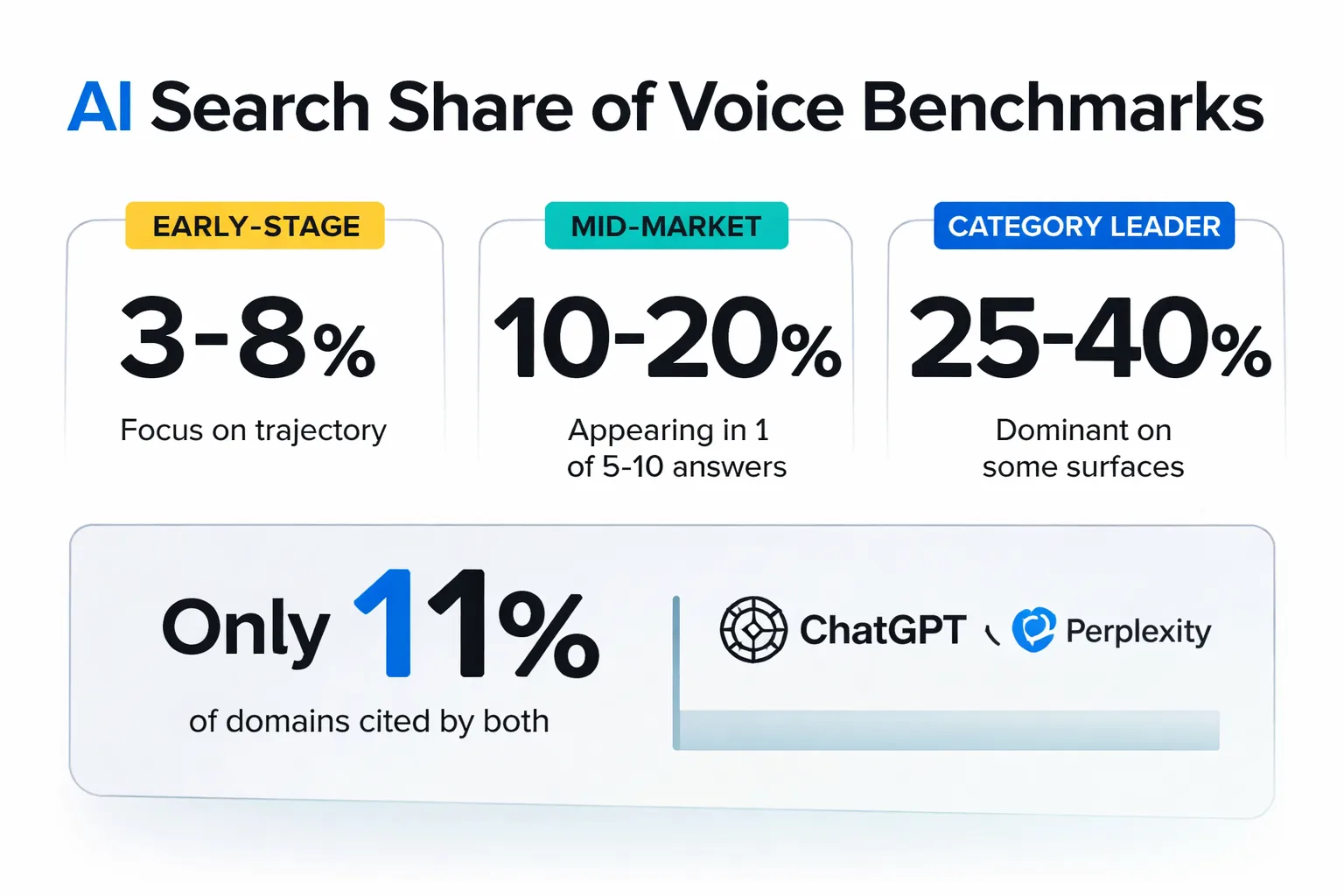
For early-stage companies in categories with established incumbents, a share of voice between 3% and 8% is realistic as a starting point. You're new. The training data for these models hasn't seen much of your brand. Getting cited at all is a win. The goal at this stage is upward trajectory, not absolute number.
For mid-market companies with some brand recognition and a content library, 10% to 20% share of voice is achievable and meaningful. At this level, you're appearing in roughly 1 of every 5 to 10 relevant AI answers. Buyers encountering your brand in AI search have a decent chance of seeing you cited.
For category leaders, 25% to 40% share of voice is strong. Above 40% typically means you're either in a category with few competitors or you've achieved dominant brand-entity recognition. The Ahrefs data showing that only 11% of domains appear in both ChatGPT and Perplexity citations means that even leaders rarely dominate across all surfaces. A 35% SOV on one surface and a 12% SOV on another is normal.
Here's what I tell teams about benchmarks: stop comparing to an absolute number and start comparing to your own trajectory and your direct competitive set. If your SOV was 8% six months ago and is 14% today, that's meaningful growth regardless of what the "benchmark" is. If your top competitor sits at 30% and you're at 12%, the gap is your roadmap.
The threshold where share of voice correlates with inbound impact varies, but I've seen a pattern: below 10%, AI-driven inbound is barely detectable. Between 10% and 20%, you start seeing AI-referred traffic in analytics (mostly from Perplexity and AI Overviews, which include clickable citations). Above 20%, AI search becomes a measurable channel. These are observations from my work, not controlled studies, so treat them as directional rather than definitive.
One critical caveat about benchmarks: they're surface-dependent. Google AI Overviews generate clickable citations, so share of voice there translates more directly to traffic. ChatGPT citations are less clickable (depending on the surface and model version), so high SOV on ChatGPT builds brand awareness but may not drive immediate clicks. Perplexity sits in between, with active citation links that users do click. Your benchmark expectations should adjust per surface.
Let me add another dimension to benchmarks: topic cluster maturity. In mature, heavily-covered topics (like "best project management software"), incumbents have deep citation patterns established. Breaking in requires sustained content production and entity building over months. In emerging topics (like "best AI compliance tools for healthcare" or any 2026-vintage category), citation patterns haven't solidified. I've seen companies go from 0% to 25% SOV in emerging categories within 60 days because no competitor had established presence yet. The lesson: if you're choosing where to invest content effort, weight toward emerging prompt clusters where your share of voice can move fast. Use an AI SEO tool to identify these whitespace opportunities before competitors fill them.
How Do AI Citations Differ Across Surfaces?
AI citations vary significantly across surfaces in both frequency and clickability, with Google AI Overviews and Perplexity generating clickable citation links while ChatGPT and Claude citations are less consistently interactive. Each AI search engine has its own retrieval architecture, citation behavior, and content preferences.
The Ahrefs research makes this concrete. AI Mode and AI Overviews, both Google products, cite different sources 86% of the time despite reaching the same conclusions in most cases. If Google's own two AI surfaces diverge that much, imagine the divergence between ChatGPT (which uses web search via Bing integration) and Perplexity (which uses its own Sonar retrieval system).
This surface variation is why I insist on per-surface share of voice tracking. An aggregate number across all AI engines is an average of averages. It hides the surfaces where you're winning and the ones where you're invisible. In our AI visibility tracker, we segment by surface precisely because a 25% SOV on Perplexity and a 5% SOV on Claude require different responses. The Perplexity gap might close with content optimization. The Claude gap might require building entity presence in sources Claude's training data weights heavily.
For teams thinking about generative engine optimization, surface-level citation differences matter because each engine's retrieval system rewards different signals. Perplexity's Sonar API pulls from live web content, so fresh, well-structured articles with clear citations earn visibility. ChatGPT's web search integration also pulls live content but weights conversational relevance differently. Google AI Overviews lean heavily on top-ranking organic pages, which is why traditional SEO still correlates with AI Overview citations (though not as strongly as it once did).
Let me break down the citation mechanics surface by surface. Perplexity uses its Sonar retrieval model to pull live web content, then synthesizes answers with numbered citations that link directly to source pages. If your content ranks well organically and directly answers the query, Perplexity will likely cite it. I've seen fresh articles get cited within 48 hours of publication on Perplexity because its retrieval is live-web-based. ChatGPT's citation behavior is more variable. When ChatGPT browses the web, it pulls from Bing's index and synthesizes. Citations appear as inline references but are less consistently formatted. ChatGPT also relies heavily on its training data for queries where it doesn't browse, meaning brands absent from training data won't appear even with great live content. Claude's citation behavior is the least transparent of the major surfaces. Claude can browse the web but doesn't consistently cite sources in its responses. Brand mentions in Claude often appear without citation links, making them harder to track. Google AI Overviews and AI Mode both cite sources, but they pull from different retrieval systems. AI Overviews tends to cite top-ranking organic pages with a bias toward high-domain-authority publishers. AI Mode appears to use a broader retrieval set with more diverse source selection.
The practical takeaway: track share of voice per surface, not in aggregate. If you can only afford to track one surface, track Perplexity because its citation behavior is the most transparent and its users are actively searching for solutions (not just chatting).
When Should You Start Tracking Share of Voice?
You should start tracking AI search share of voice the moment you have a defined prompt set of at least 30 buyer-intent questions, even if your current SOV is near zero. The baseline is the point. You can't improve what you don't measure, and in AI search, the gap between leaders and laggards widens monthly as models retrain and citation patterns solidify.
I see too many teams wait. They think they need to "build more content first" before tracking visibility. That's backwards. You track first to learn where you're absent, then build content to close those specific gaps. Starting with a ChatGPT AI visibility check or a Perplexity visibility audit gives you the prompt-level data that should drive your content calendar.
The cost of waiting is real. AI models develop citation habits. Once a model consistently cites a competitor for a given prompt type, that pattern reinforces over time as the model encounters more content that validates its existing citation behavior. Getting in early, even with a small share of voice, builds the entity recognition that compounds. I've seen this with our own content at Meev: articles we published in early 2026 that earned citations in Perplexity within weeks are now cited consistently, while newer articles on the same topics struggle to break in because the citation pattern is already established.
If you're a small team, start with 30 prompts across two surfaces. That's 60 prompt-surface combinations. Run them weekly. Track which ones cite you, which cite competitors, and which cite no one in your category. The "no one" prompts are your biggest opportunity: they're questions where AI engines haven't yet formed citation habits, and well-structured content can establish your brand as the default answer.
Here's a specific case from my own work. I identified 12 prompts in the "AI visibility tool" category where no brand was being cited consistently by ChatGPT. The model was generating generic answers without naming specific tools. I published three articles targeting those exact prompts: one comparison piece, one how-to guide, and one explainer. Within four weeks, my brand was cited in 7 of those 12 prompts. That's a 58% share of voice in a prompt cluster that previously had zero citations for anyone. The window for that kind of rapid gain closes fast. Once a model starts citing brands for a prompt, it tends to reinforce that citation pattern. The first mover advantage in emerging prompt clusters is real and measurable.
The window for that kind of rapid gain closes fast. Once a model starts citing brands for a prompt, it tends to reinforce that citation pattern. The first mover advantage in emerging prompt clusters is real and measurable.
Do you know your AI search share of voice across ChatGPT, Perplexity, and AI Overviews?
How to Improve AI Search Visibility Using Share of Voice Data
This is where measurement becomes strategy. Once you have share of voice data segmented by surface, topic cluster, and competitor, you have a diagnostic map. Every gap in that map is a content opportunity.
The process I use has four steps. First, identify the prompt clusters where your SOV is below 10% and competitor SOV is above 25%. These are high-priority gaps where buyers are getting competitor recommendations and you're absent. Second, read the actual AI responses for those prompts. What sources are being cited? What content structures are the cited pages using? Are they listicles, comparison tables, how-to guides, or explainers? The Ahrefs data shows that 53% of AI Overview citations come from pages under 1,000 words, so don't assume you need long-form content. Third, create content that directly answers the prompt using the structure AI engines prefer for that topic. If the cited pages are all comparison tables, build a comparison table. If they're how-to guides with step-by-step instructions, build that. Match the format that's earning citations. Fourth, publish and monitor. Run the same prompts weekly after publication and track whether your SOV moves.
The Ahrefs finding about YouTube mentions deserves special attention here. The 0.737 correlation between YouTube mentions and AI visibility is the strongest single predictor in the dataset. This doesn't mean you need to become a YouTube channel. It means that brands with multi-format presence across text, video, and community discussion are more likely to be cited by AI engines. If your content strategy is text-only blog posts, you're missing a signal that correlates strongly with citations. Consider embedding relevant YouTube content in your articles, creating video versions of key explainers, and ensuring your brand appears in YouTube discussions about your category.
Entity grounding is the other piece. AI engines cite brands they recognize as entities. Entity recognition comes from consistent brand mentions across high-authority sources, structured data (Wikidata, schema markup), and community discussion (Reddit, Hacker News, industry forums). If your brand has weak entity presence, your content may be well-optimized but still not cited because the model doesn't recognize you as a category entity. Building entity presence is slower than publishing content, but it's foundational. I think of it as the difference between being a known brand that AI engines consider and an unknown brand that gets filtered out before citation logic even runs.
For teams that want to go deeper on the strategic framework, our AEO vs GEO comparison breaks down how answer engine optimization and generative engine optimization differ in approach and which tactics work for each.
What Tools Actually Track Share of Voice?
The tool landscape for AI visibility is fragmented and noisy. I've spent months evaluating what's available, and I'm underwhelmed by most of it.
Most tools fall into one of two camps. Camp one: mention trackers. They run prompts, count brand appearances, and show you a number. They don't normalize against prompt volume, don't segment by surface, and don't track competitors. They're counting mentions, not share of voice. Camp two: enterprise platforms that charge $2,000+ per month for AI visibility tracking that includes share of voice but requires a dedicated analyst to interpret. For small teams, neither camp works.
What you actually need from an AI visibility tool is three things. First, per-surface share of voice tracking with the ability to drill into individual prompts and read the full response text behind each citation. Second, competitor benchmarking so you can see your SOV alongside named competitors in your category. Third, citation source tracking that shows which domains AI engines cite most often for your topics, so you know where to build presence. An AI visibility checker should give you all three without requiring an enterprise contract.
I'm skeptical of tools that claim massive visibility gains without explaining their methodology. I've seen platforms claim a "7x increase in AI search citations" with zero transparency around prompt consistency, baseline establishment, or confidence ranges. Without knowing how prompts were selected, how many runs were averaged, and what the variance looks like, those numbers are marketing copy, not measurement. A credible share of voice tool should be able to show you the exact prompts it monitors, the citation data behind every percentage point, and the variance range for each surface.
At Meev, I've built the share of voice tracking I wanted as a practitioner. Per-surface dashboards with drill-down to individual prompt responses. Competitor SOV side by side with yours. Cited-source leaderboards that show which domains AI engines cite most for your topics. And because measurement without action is useless, the workflow connects directly to content generation so you can close the gaps your SOV data reveals.
Stop Chasing Mention Volume
Here's where I land after months of working with this metric: raw mention count is a trap. It feels like progress. It looks good in reports. But it doesn't tell you whether you're winning or losing in the channels that increasingly mediate buyer research.
AI search share of voice is harder to calculate. It requires defining prompt sets, segmenting surfaces, tracking competitors, and maintaining consistency over time. But it's the only metric that gives you a competitive visibility score reflecting the reality of generative search. When your share of voice goes up, you know you're capturing more of the conversations your buyers are having with AI engines. When it goes down, you know exactly where to look.
The teams that win in AI search over the next 12 months won't be the ones with the most mentions. They'll be the ones who tracked share of voice, found their gaps, and closed them with content that AI engines choose to cite. That's the work. The metric is how you know it's working.
FAQ
What is the difference between AI search share of voice and traditional search share of voice?
Traditional search SOV measures how often your domain appears in a list of ranked results for target keywords. AI search share of voice measures how often your brand is cited in AI-generated answers across a defined prompt set. The key difference: traditional SOV counts domain appearances in slots. AI SOV counts brand citations in synthesized narratives. AI engines don't rank domains in positions; they mention brands within sentences, sometimes with citations, sometimes without.
How many prompts should I monitor for a reliable share of voice calculation?
I recommend a minimum of 50 prompts per topic cluster, with at least 30 as an absolute floor. Below 30 prompts, the percentage swings too much to be reliable. A single new citation or lost citation moves the needle by 3% or more, making trend analysis noisy. For a full AI visibility program, 100 to 200 prompts across 3 to 4 surfaces gives you statistically meaningful data.
Which AI surfaces should I track for share of voice?
At minimum, track ChatGPT, Perplexity, and Google AI Overviews. These three cover the largest share of AI search traffic. If you have the budget, add Claude and Google AI Mode. The Ahrefs data shows only 13.7% citation overlap between AI Mode and AI Overviews, so each surface provides distinct data. Don't aggregate surfaces into a single number. Track each one separately because citation behavior varies significantly.
Can I improve my AI search share of voice with content alone?
Content is necessary but not sufficient. The Ahrefs study found content length has a 0.04 correlation with AI citations, meaning writing more words doesn't help. What helps: creating content that directly answers buyer-intent prompts, structuring it with clear semantic relevance, earning citations from sources AI engines already trust (the YouTube correlation of 0.737 is striking), and building entity recognition through consistent brand presence across the web. Content closes gaps that share of voice measurement identifies.
How often should I recalculate my share of voice?
Weekly for active surfaces like Perplexity and AI Overviews where citation patterns shift with fresh content. Biweekly for ChatGPT and Claude where citation behavior is more stable but still evolves. Monthly at minimum for any surface. The key is consistency: use the same prompt set each time so your trend line is comparable. Changing your prompt set mid-track breaks your baseline.
What does a 0% share of voice mean?
It means your brand was not cited in any of the monitored prompts for that surface. This is common for early-stage companies and for established brands entering new topic clusters. A 0% SOV is not a failure; it's a baseline. The first goal is moving from 0% to 3%, which typically requires creating content that directly addresses the prompts where you're absent and building entity signals that make your brand recognizable to the AI model.
About the Author
Judy Zhou, Founder
Judy Zhou leads content strategy at Meev, where she oversees AI-driven content research and publishing for hundreds of brands. With a background in SEO and editorial operations, she focuses on building content systems that rank on Google, get cited by AI search engines, and drive measurable business results.
Stop guessing at your AI visibility. Run a share of voice audit across every major AI search surface and find the exact prompts where competitors are cited and you're not.