By Judy Zhou, Founder
Key Takeaways
- AI search adoption nearly doubled from 14% to 29.2% in 2025 while 89% of B2B buyers now use generative AI in their purchasing journey.
- AI search visitors convert at 4.4x the rate of traditional organic search visitors, yet Google AI Overviews already appear in 57% of US results.
- Gartner forecasts a 25% drop in traditional search engine volume by 2026, creating a measurement gap that standard rank trackers cannot fill.
- Marketers must now optimize for the answer instead of the algorithm by systematically tracking brand mentions inside ChatGPT, Perplexity, Claude, and Google AI Overviews.
'We optimized for the algorithm for twenty years. Now we have to optimize for the answer,' said Rand Fishkin during a 2025 SparkToro webinar on generative engine optimization. And the remark landed because every marketer in the room knew exactly what he meant. The rise of AI-generated responses has created a measurement gap that traditional SEO platforms were never designed to fill. AI citation tracking tools are the category that has grown up to close it, giving brands a systematic way to monitor, interpret, and improve their presence inside large language model outputs.
The stakes are concrete. AI search adoption nearly doubled from 14% to 29.2% in 2025, and Forrester reports that 89% of B2B buyers now use generative AI during their purchasing journey. Semrush's traffic study found that AI search visitors convert at 4.4x the rate of traditional organic search visitors. Meanwhile, Pew Research documented that Google AI Overviews now appear in 57% of all US search results, and Gartner forecasts a 25% drop in traditional search engine volume by 2026 due to AI chatbots and virtual agents. If your brand is absent from AI-generated answers, you are invisible to a growing slice of high-intent buyers.
This is where the measurement crisis hits. Traditional rank trackers tell you where you rank in a blue-link list. They were never built to tell you whether ChatGPT, Perplexity, Claude, or Google AI Overviews mentioned your brand in a generated answer. In my work leading content strategy at Meev, I have seen this gap play out dozens of times: a brand ranks top 3 in Google for a commercial keyword, gets zero mentions in AI responses for the same query, and has no idea the gap exists until someone runs an AI visibility audit.
What Is AI Citation Tracking?
AI citation tracking is the systematic practice of monitoring whether, how often, and in what context a brand, product, or page is cited by AI search engines in response to relevant prompts. It replaces the old question of "where do I rank?" with a harder one: "when a buyer asks an AI engine about my category, does my brand appear in the answer?"
This is not traditional brand monitoring. Brand monitoring tells you when someone types your name on the open web. Citation tracking tells you when an AI engine generates an answer that includes your brand as a recommended solution, a linked source, or a named entity. The distinction matters because AI engines do not simply mirror the web. They synthesize, summarize, and recombine information from training data and real-time retrieval. A brand can be mentioned thousands of times across the internet and still never surface in a generated answer.
It is also not traditional rank tracking. Rank tracking measures your position in a deterministic, ordered list of results. You are position 1 or position 7. The list is the same for everyone (roughly, accounting for personalization). AI answers are probabilistic. The same prompt run five times can produce five different responses, each citing different sources. This non-deterministic nature is why AI citation tracking tools require an entirely different methodology, which I will break down shortly.
The practice covers every major AI search surface: ChatGPT, Claude, Gemini, Perplexity, Grok, Google AI Overviews, Google AI Mode, and DeepSeek. Each surface has its own retrieval architecture, its own citation format, and its own biases toward certain source types. A brand cited prominently in Perplexity might be completely absent from Google AI Overviews for the same query. Citation tracking maps this surface-by-surface landscape so you know exactly where you stand and where you are missing.
What AI Citation Tracking Actually Measures
The core metrics fall into four categories. Each tells you something different about your AI search presence, and each requires a different interpretation framework.
Citation rate is the percentage of prompt runs where your brand appears in the AI-generated answer. If you run a prompt 10 times across Perplexity and your brand shows up in 4 of those responses, your citation rate for that prompt on Perplexity is 40%. This is the foundational metric. A low citation rate on a high-intent commercial prompt (like "best CRM for startups") means you are losing buyer attention to competitors before the buyer ever visits your website.
Source attribution identifies which specific pages and domains the AI engine is pulling from when it mentions (or does not mention) you. When Perplexity cites a source, it provides a link. When ChatGPT references a brand, it may draw from training data with no explicit link. Source attribution tracking tells you whether the AI engine is reading your blog post, a competitor's comparison page, a Reddit thread, or a Wikipedia article when it formulates its answer. This is actionable intelligence. If the AI engine is building its answer from a Reddit thread that positions your competitor favorably, you know exactly where to focus your answer engine optimization efforts.
The data here is revealing. Semrush's AI Citations Analysis found that Reddit accounts for 40.1% of all AI citations across major AI engines, significantly outpacing Wikipedia at 26.3% and YouTube at 23.5%. On Perplexity specifically, Reddit accounts for 46.7% of citations. This tells you that user-generated content on Reddit is a primary source material for AI answers, whether you like it or not.
Share of voice across AI surfaces measures what percentage of AI answers cite you versus each competitor. If you are cited in 20% of relevant prompts and your top competitor is cited in 60%, you have a share-of-voice gap that directly maps to lost buyer mindshare. This metric is most useful when tracked per surface, because competitive dynamics vary. You might dominate ChatGPT citations but trail badly in Google AI Overviews.
Citation sentiment and context is the hardest metric to measure and the one most tools get wrong. It is not enough to know that your brand was mentioned. You need to know how. Was your brand recommended as the top choice? Listed as an alternative? Mentioned with a caveat ("Brand X is good but expensive")? Framed as secondary to a competitor? In my experience with B2B content, favorable framing is the true metric that matters. An AI might cite your brand, but if the framing subtly steers the user toward a competitor, that citation is not driving business outcomes. Most tools in this category stop at counting mentions. The useful ones go further and classify the context.
Here is my contrarian take on this entire metric stack. Most AI visibility metrics are vanity numbers right now. I spent weeks tracking citation rates and share-of-voice scores, watching the dashboards tick up, and could not tie any of it to lead generation or pipeline. The raw mention count looked great in a report. It looked meaningless in a revenue conversation. The metric that actually matters is citation quality: are you cited on the prompts that map to buying intent, and is the framing favorable? A single citation on a high-intent prompt with positive framing is worth more than 50 passing mentions on informational queries. If your tool cannot distinguish between the two, you are paying for a flattering dashboard, not business intelligence.
How AI Citation Tracking Differs From Classic SEO Rank Tracking
This is the section where most marketers get confused, so I will be blunt. Rank tracking and citation tracking measure fundamentally different things, and pretending they are the same is why most SEO teams are blind to their AI visibility gap.
Classic rank tracking is deterministic. You input a keyword, the tool checks Google, and Google returns an ordered list of results. Position 1 today is (usually) position 1 tomorrow. The methodology is straightforward: query the search engine, parse the HTML, extract the ranking. The output is a number. It is stable, comparable, and trendable over time.
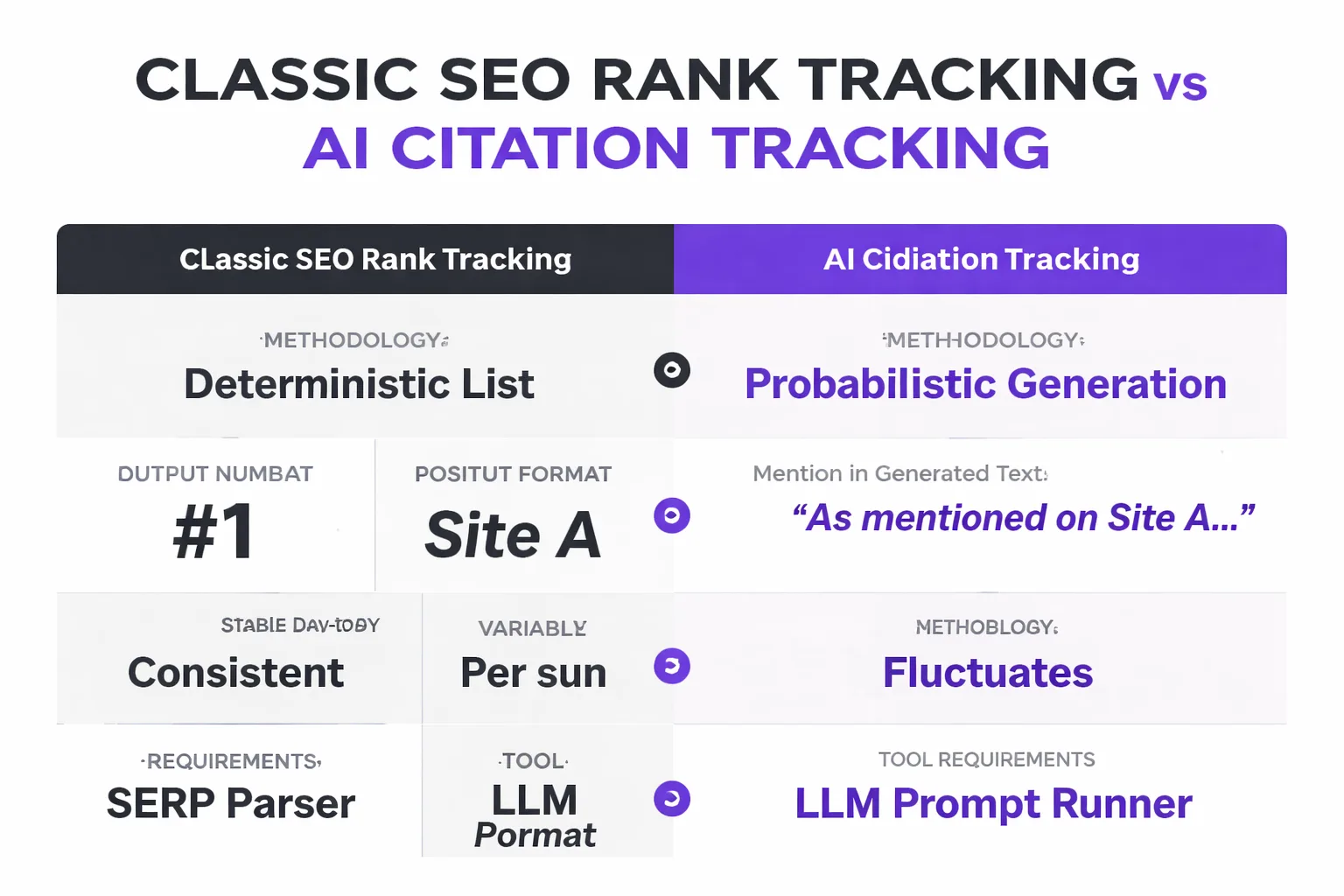
AI citation tracking is probabilistic. You input a prompt, the tool sends it to an LLM, and the LLM generates a unique response. The same prompt run five times might produce five different answers citing five different sets of sources. This is not a bug. It is the nature of generative models. Temperature settings, retrieval-augmented generation (RAG) variability, and model updates all introduce non-determinism. A brand cited in response to a prompt on Monday might not appear in the response to the same prompt on Friday.
This requires a fundamentally different methodology. Instead of running a query once and parsing a static result, you need to run each prompt multiple times across each AI surface, capture the full response text, extract brand mentions and source citations from each response, and aggregate the results into a statistical profile. It is closer to polling than to rank checking. You are measuring probability of appearance, not position in a list.
The toolset is different too. A traditional rank tracker needs a SERP parser and a database of keyword positions. An LLM visibility tool needs API integrations with every major LLM (each with its own rate limits, pricing, and response format), a prompt management system, a response analysis pipeline that can extract brand mentions from unstructured generated text, and a citation parser that can identify and classify source links. The infrastructure cost and complexity are orders of magnitude higher.
Here is where I see teams make the same mistake repeatedly. They try to bolt AI citation tracking onto their existing SEO rank tracker. They add a "ChatGPT position" column next to their Google position column and treat it the same way. This does not work. The ChatGPT "position" is not stable. It is not a number from 1 to 10. It is a mention (or absence) in a generated paragraph, and its meaning depends on the context of the surrounding text. Treating it like a rank position strips away the information that actually matters.
The right approach is to treat AEO vs SEO as parallel measurement systems that share a keyword universe but produce fundamentally different outputs. Your Google rank tracker tells you where you stand in the link economy. Your citation tracker tells you where you stand in the answer economy. Both matter. They are not the same.
Why Non-Deterministic Outputs Break Traditional Tracking
This deserves its own treatment because it is the single biggest technical challenge in AI citation tracking, and most tools gloss over it.
When you track Google rankings, you are querying a deterministic system. Google's algorithm weighs hundreds of signals and produces a ranked list. The list can shift day to day, but the shift is gradual and trendable. You can plot a rank trajectory over 90 days and see a clear line.
LLMs do not work that way. A generative model samples from a probability distribution at each token. The same prompt can produce different outputs on different runs, even with identical inputs, because the sampling process introduces variance. Retrieval-augmented generation adds another layer of variability: the documents retrieved to ground the response can change based on indexing updates, query reformulation, or retrieval pipeline tweaks.
This means a single prompt run is statistically meaningless. If you run "best project management software for small teams" through ChatGPT once and your brand appears, that tells you almost nothing. Maybe you got lucky. Maybe the retrieval pipeline happened to pull a page that mentions you. Run the same prompt 10 times and your brand appears in 3 of 10 responses. Now you have a data point: 30% citation rate with a wide confidence interval. Run it 100 times and it appears in 28 of 100. Now you have a reliable estimate.
Any tool that runs a prompt once and reports a citation as a binary yes/no is giving you noise dressed up as signal. The methodology that actually works is repeated sampling across multiple runs per prompt, per surface, aggregated into citation rate distributions. This is more expensive (each LLM API call costs money), but it is the only way to produce measurements that are stable enough to trend over time.
In my experience building Meev's tracking architecture, the cost question is real. Direct API calls to Perplexity's Sonar API run about $0.005 per call. Run 100 prompts across 5 surfaces with 10 runs each, and you are looking at meaningful API spend. This is why the hybrid tracking architecture matters: using direct Perplexity Sonar API calls ($0.005 vs $0.027 for alternatives) and direct DeepSeek and Grok integrations preserves measurement validity while cutting per-call cost roughly 5x. Cheap enough to run enough samples for statistical reliability. Expensive enough that you need a tool that has thought about the economics.
Who needs AI citation tracking and when?
The short answer is: if your buyers use AI search during their purchasing journey, you need citation tracking. In 2026, that is most B2B companies and an increasing share of DTC brands.
B2B SaaS founders need this because Forrester's data shows 89% of B2B buyers use generative AI during their purchasing journey. When a buyer asks ChatGPT "what is the best tool for X," and your competitor is cited and you are not, you have lost that buyer before they ever Google your name. You will not even know they were looking. At least with traditional SEO, you can see that you lost a ranking. With AI search, the loss is invisible unless you are actively tracking citations.
Marketers running generative engine optimization campaigns need citation tracking as their measurement layer. GEO (also called AEO, or answer engine optimization) is the practice of optimizing content to appear in AI-generated answers. Without citation tracking, you are flying blind. You publish content, you optimize your entity presence, you build knowledge graph signals, and then... what? How do you know if it worked? Citation tracking is the before-and-after measurement that tells you whether your GEO efforts moved the needle. A SwiftGeo case study documented a DTC brand that increased their AI citation score from 12 to 41 (a 3.4x improvement) in 60 days by restructuring content for AI engines. Without citation tracking, they would have had no way to measure that gain.
SEO teams adding AI surfaces to their reporting stack need citation tracking because their existing tools do not cover it. Google Search Console tells you about Google clicks and impressions. It tells you nothing about ChatGPT citations. Ahrefs tells you about backlinks and organic positions. It tells you nothing about Perplexity source attribution. The SEO team that shows up to a quarterly review with only Google data is presenting an incomplete picture of search visibility in 2026.
When should you start? Before you have a problem. The brands that wait until organic traffic is cratering to investigate AI visibility are already behind. Gartner's forecast of a 25% drop in traditional search volume by 2026 means the window for getting established in AI answers is narrowing. AI engines build their answers from sources they encounter repeatedly. Establishing your brand as a cited entity takes time. The brands that start building citation presence now will compound that advantage as AI search adoption continues to grow.
I will add a note of caution from my own experience. We ran a small experiment with 5 articles that hit top 3 organic rankings in Google. Over a 3-month period, those same articles received zero AI citations. Organic visibility does not guarantee AI visibility. The broader data backs this up: only about 11% of domains are cited by both ChatGPT and Perplexity. The overlap between Google rankings and AI citations is real but incomplete. If you assume your Google rankings will carry over to AI answers, you are making a bet that the data does not support.
The Reddit Factor in AI Citations
This deserves a dedicated discussion because it surprises everyone I talk to.
Semrush's analysis of approximately 150,000 AI citations found that Reddit is the single most-cited domain in AI systems, accounting for 40.1% of all AI citations across Perplexity, Google AI Overviews, and ChatGPT combined. Wikipedia sits at 26.3%. YouTube at 23.5%. Q&A and comparison threads dominate Reddit citations, representing over 50% of Reddit-sourced AI citations.
The breakdown by engine is even more striking. Reddit accounts for 46.7% of Perplexity citations, 21% of Google AI Overviews citations, and 11.3% of ChatGPT citations. Perplexity relies on Reddit more than any other single source.
This has implications for how you think about citation tracking and generative engine optimization. If your brand is being discussed on Reddit, those discussions are feeding AI answers. If your brand is not being discussed on Reddit, you are missing one of the largest source pools that AI engines draw from.
But before you rush to seed Reddit threads, understand the risk. The Semrush research notes that Reddit's citation dominance "is not stable" and "can be undone, almost overnight, by a single quiet change inside one model." A Reddit-dependent SEO strategy is fragile. If OpenAI decides to down-rank Reddit sources in a model update, your citation strategy collapses overnight.
The practitioner takeaway from the research is a 95/5 value-to-promotion ratio: 95% genuine value contribution, 5% brand mention. Months of credibility building before any brand mentions. A 90-day playbook structured as Days 1-30 (foundation), Days 31-60 (credibility), Days 61-90 (strategic integration). Manufactured sentiment or campaign bursts do not work. Reddit communities detect and reject promotional content with ruthless efficiency.
For citation tracking purposes, this means your tool needs to monitor Reddit as a source attribution channel. When an AI engine cites a Reddit thread in an answer that mentions your brand, you need to know which thread, what it says, and whether the sentiment is favorable. This is source attribution tracking applied to the most important source in the AI citation ecosystem.
Do you know which AI engines are citing your competitors right now?
What AI Citation Tracking Cannot Tell You
I want to be honest about the limits of this category, because the marketing around AI visibility tools overpromises relentlessly.
Citation tracking cannot tell you why an AI engine cited (or did not cite) your brand. The selection process inside LLMs is a black box. Google and OpenAI have made it implicitly clear that source attribution is a dynamic, non-deterministic process. You can see that you were cited. You cannot see the weight of each signal that produced that citation. Was it your backlink profile? Your entity presence in Wikidata? Your content structure? A Reddit thread from 2024? You can hypothesize, but you cannot isolate variables the way you can in a controlled SEO experiment.
Citation tracking cannot guarantee that improving your metrics will increase actual AI citations. I have seen this firsthand. We spent weeks optimizing for citation rate and share-of-voice metrics, tracking diligently, and saw zero measurable lift in organic AI citations. The tools showed progress on their proprietary scores. The AI engines did not care. The fundamental issue is that LLM training data selection and output generation are far more complex and opaque than these tools let on. It is not a simple input-output game where optimizing a few metrics guarantees a mention.
Citation tracking cannot reliably tie mentions to revenue yet. I tried focusing purely on raw mention volume for a client. The numbers looked great in the dashboard. Tying those mentions to lead generation or sales was incredibly hard. The attribution chain from "AI mentioned my brand" to "prospect became a lead" is long, fragmented, and mostly untrackable with current tools.
And citation tracking cannot predict future citation behavior. A model update can shift citation patterns overnight. A brand cited in 40% of responses in January might drop to 15% in March after a quiet retrieval pipeline change. The volatility is real, and any tool that promises predictive accuracy is selling you something the underlying technology cannot deliver.
This is why I approach this category with cautious pragmatism. Citation tracking is valuable as a diagnostic and monitoring tool. It tells you where you stand today, whether your position is improving or deteriorating, and which surfaces and prompts need attention. It is not a control mechanism. You cannot steer LLM outputs the way you can steer Google rankings with targeted link building and on-page optimization. The best you can do is build strong entity signals, publish fact-verified content that AI engines encounter repeatedly, and monitor whether those efforts are moving the citation needle over time.
The Measurement Methodology That Actually Works
After months of experimentation, here is the methodology I have settled on. It is not perfect, but it produces measurements that are stable enough to trend and actionable enough to guide decisions.
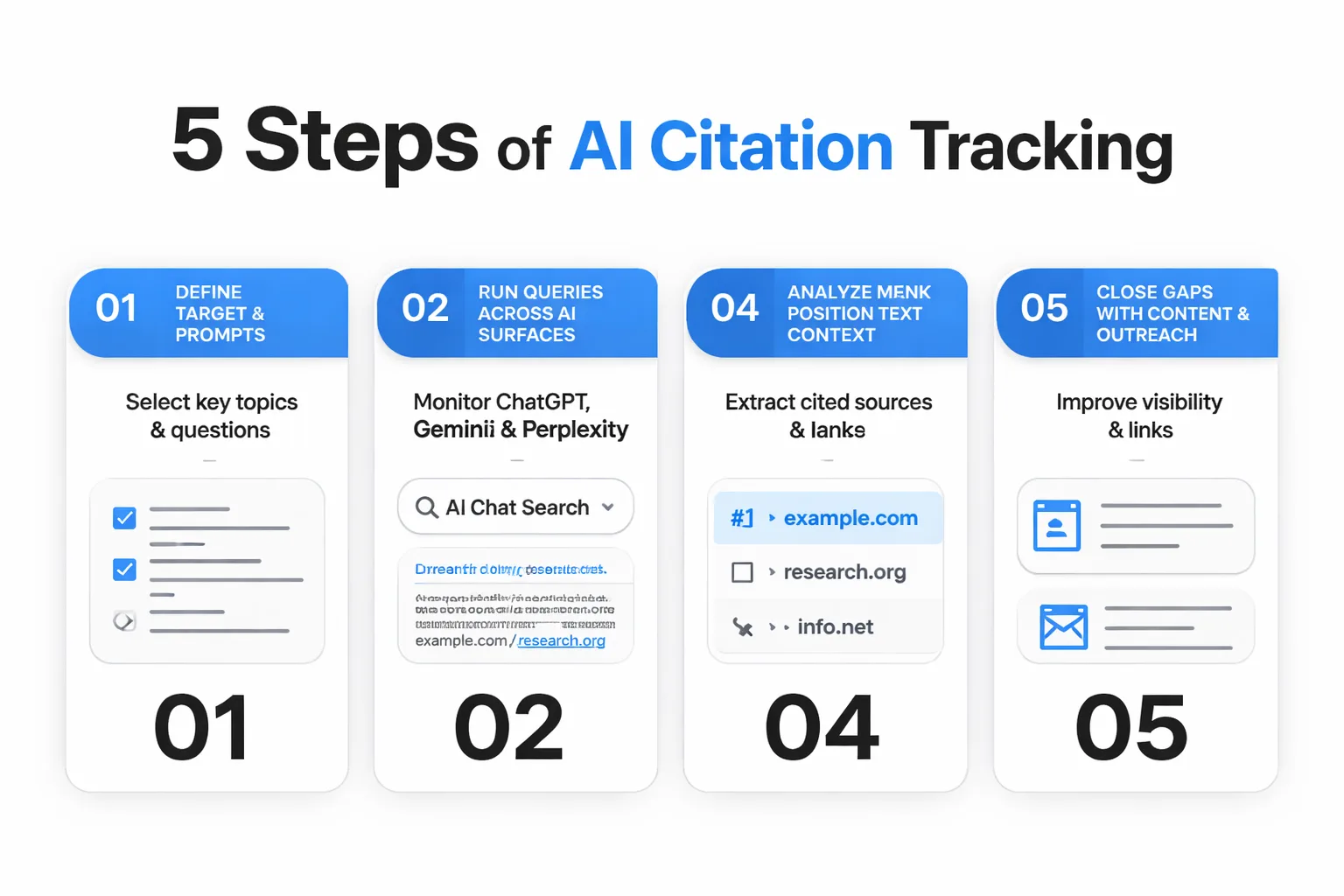
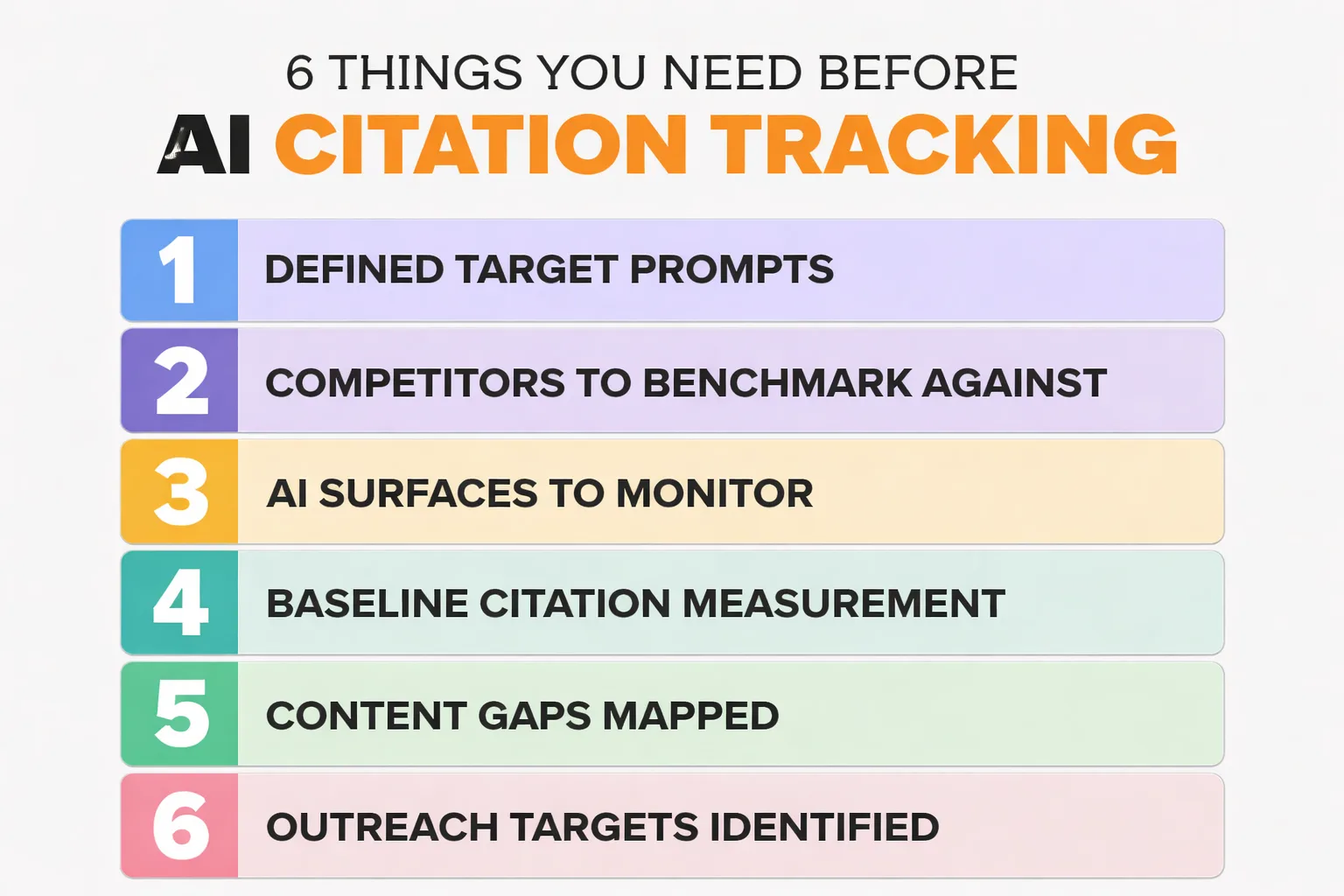
First, define your prompt set carefully. These are not keywords in the traditional SEO sense. They are natural-language questions that a buyer would actually type into ChatGPT or Perplexity. "Best CRM for startups" is a keyword. "What is the best CRM for a 10-person startup that needs email automation and pipeline tracking?" is a prompt. The latter is what real users ask AI engines. Build a set of 20-50 such prompts covering your core commercial categories, comparison queries, and problem-solving queries.
Second, run each prompt multiple times per surface. I recommend a minimum of 5 runs per prompt per surface to establish a baseline citation rate. More runs give you tighter confidence intervals but cost more. For high-priority commercial prompts, run 10-15 times. For broader monitoring, 5 runs is sufficient to detect presence vs. absence.
Third, capture the full response text and all source citations for every run. Do not just record a binary "mentioned / not mentioned." You need the actual text surrounding your brand mention to classify context and sentiment. You need the source links to understand which pages the AI engine is reading.
Fourth, aggregate into per-prompt, per-surface citation rates. Track these over time with weekly or biweekly refreshes. Look for trends, not single-run results. A citation rate that moves from 20% to 35% over 8 weeks is a signal. A single run where you were cited is noise.
Fifth, layer in competitive benchmarking. Run the same prompts and track competitor mentions alongside yours. Your citation rate in isolation is less useful than your citation rate relative to competitors. If you are at 30% but your top competitor is at 70%, you are losing share of voice regardless of your absolute number.
This methodology is what Meev's AI visibility tracker is built around. The platform runs your prompt set across every major AI search surface, captures response text and citations, and aggregates the results into trend dashboards. It also identifies content gaps where competitors are cited and you are not, so you know exactly where to focus your content and outreach efforts.
Putting Citation Tracking Into Practice
If you are starting from zero, here is the sequence I recommend.
Run a baseline AI visibility audit across your top 20-50 commercial prompts. This tells you where you stand today. Expect the results to be worse than you think. Most brands I have worked with are surprised by how invisible they are in AI answers, even when their Google rankings are strong. The DTC brand in the SwiftGeo case study had zero AI citations across 8 test queries despite strong organic rankings. This is the norm, not the exception.
Once you have your baseline, identify the gaps. Which prompts are you absent from? Which surfaces are you weakest on? Which competitors are consistently cited where you are not? Which source pages are AI engines reading when they formulate answers about your category?
Then start closing gaps. The most effective approach combines three tactics. Publish fact-verified, archetype-aware content that directly answers the prompts where you are absent. Build your entity presence in knowledge graphs (Wikidata, schema markup, LLMs.txt files) so AI engines can identify and attribute your brand correctly. And pursue citation path outreach to the publishers AI engines actually cite for your topics, getting your brand mentioned on the source pages that feed AI answers.
Re-run your citation tracking on a weekly or biweekly cadence. Look for trends over 60-90 day windows. Single-week movements are noise. 60-day trends are signal. If your citation rate on a high-intent prompt moves from 10% to 25% over 60 days after you publish targeted content and build entity signals, you have evidence that your efforts are working.
Do not expect overnight results. AI engines do not re-index the web the way Google does. Training data updates happen on long cycles. Retrieval-augmented generation can pick up new content faster, but the speed depends on the engine and the source. The SwiftGeo case study showed measurable gains in 60 days, which is roughly the timeline I have seen in practice for content restructuring to start moving the citation needle.
The Real Cost of Ignoring AI Citations
I want to end with the business case, because that is what actually drives adoption.
Organic traffic is declining. HubSpot customers saw organic traffic drop 27% year-over-year. Gartner forecasts a 25% drop in traditional search engine volume by 2026. Meanwhile, AI-referred traffic grew 527% year-over-year between January and May 2025, according to Insightland's analysis. The traffic is not disappearing. It is shifting to a channel you cannot see with traditional tools.
The buyers who use AI search during their purchasing journey are your highest-intent prospects. Semrush found that AI search visitors convert at 4.4x the rate of traditional organic search visitors. These are people asking specific commercial questions and expecting specific recommendations. If your brand is not in the answer, you are not in the consideration set. Period.
The cost of ignoring AI citations is not a missed ranking. It is a missed buyer. And unlike traditional SEO, where you can at least see that you lost a ranking and diagnose why, AI search losses are invisible. The buyer asks ChatGPT for a recommendation, gets an answer that lists your competitors, and moves on. You never see the query. You never see the click. You never see the lost opportunity. Citation tracking is the only way to make that invisible loss visible.
Start before you have a problem. The brands that establish citation presence now will compound that advantage as AI search adoption continues to grow. The brands that wait will find themselves trying to catch up in a non-deterministic system where the rules are opaque and the leverage points are unclear. AI citation tracking tools are how you stop guessing and start measuring.
FAQ
How accurate are AI citation tracking tools?
Accuracy depends entirely on sampling methodology. A tool that runs each prompt once and reports a binary citation is giving you noise. A tool that runs each prompt 5-15 times per surface and aggregates into a citation rate distribution is giving you a statistically meaningful estimate. Ask any vendor how many times they run each prompt and how they handle non-deterministic outputs before subscribing. If they cannot answer clearly, their data is not reliable.
Can AI citation tracking improve my Google rankings?
No, not directly. AI citation tracking is a measurement practice, not an optimization tactic. It tells you where you stand in AI-generated answers. Improving your Google rankings requires traditional SEO work (technical hygiene, content quality, backlinks). That said, many of the content and entity signals that improve AI citations (structured data, fact-verified content, authoritative source links) also support traditional SEO. The two disciplines are complementary, not substitutive.
What is the difference between AI citation tracking and brand monitoring?
Brand monitoring tracks mentions of your brand name across the open web (social media, news sites, blogs, forums). AI citation tracking tracks mentions of your brand inside AI-generated answers (ChatGPT responses, Perplexity citations, Google AI Overviews). Brand monitoring tells you what people are saying about you. AI citation tracking tells you what AI engines are recommending to buyers. The audiences and methodologies are completely different.
How often should I run AI citation tracking?
For active campaigns, weekly tracking on your top 20-50 prompts gives you enough data density to spot trends without excessive API cost. For broader monitoring across 100+ prompts, biweekly or monthly cadence is sufficient. The key is consistency. Run the same prompts on the same cadence and track the trend over 60-90 day windows. Single-run results are meaningless. Trends are signal.
Do I need a dedicated tool for AI citation tracking, or can my SEO platform handle it?
Most traditional SEO platforms (Ahrefs, Semrush, Moz) have added some AI visibility features in 2026, but their coverage is typically limited to Google AI Overviews and sometimes Perplexity. Full citation tracking across ChatGPT, Claude, Gemini, Perplexity, Grok, Google AI Overviews, AI Mode, and DeepSeek requires a dedicated tool with direct API integrations to each LLM. If you only care about Google AI Overviews, your existing SEO platform may suffice. If you care about the full AI search surface landscape, you need a dedicated solution.
Is AI citation tracking worth the investment for small teams?
If your buyers use AI search during their purchasing journey (and in 2026, most B2B buyers do), then yes. The cost of being invisible to AI search is losing buyers you never knew you had. The cost of a citation tracking tool starts around $49/month for entry-tier monitoring. The cost of a lost enterprise deal because ChatGPT recommended your competitor is exponentially higher. Start with a baseline audit, identify your biggest gaps, and decide whether the investment is justified based on what you find.
About the Author
Judy Zhou, Founder
Judy Zhou leads content strategy at Meev, where she oversees AI-driven content research and publishing for hundreds of brands. With a background in SEO and editorial operations, she focuses on building content systems that rank on Google, get cited by AI search engines, and drive measurable business results.
Run a free AI visibility audit and see exactly where your brand appears, where it is missing, and which sources AI engines are reading instead.