
By Judy Zhou, Founder
Key Takeaways
- An AI search visibility audit measures four metrics traditional SEO misses: brand mention rate across LLMs, actual cited sources, prompt coverage gaps versus competitors, and mention position (first, middle, or last) inside answers.
- Perplexity cites Reddit in 47% of answers while Google AI Overviews cite it in 21%, so map which sources feed your category before optimizing.
- Perplexity Pro scored 3.8 out of 5 on citation quality across 50 research queries, confirming the surfaced sources are traceable and worth earning.
- Run the audit to check whether AI engines know your brand exists for category questions, rather than only checking Google rankings.
In 2023, something quietly fractured the thirty-year-old contract between search engines and content creators. That was the year generative AI answer engines. ChatGPT with Browse, Perplexity, and Google's Search Generative Experience. Began intercepting queries before a single blue link was clicked. Within eighteen months, an entirely new discipline emerged: answer engine optimization, built on entity grounding, knowledge graph presence, and LLM citation tracking. Today, an AI search visibility audit is the foundational diagnostic that separates brands navigating this shift intentionally from those simply hoping their old playbook still holds.
An AI search visibility audit measures four things your traditional SEO audit completely misses: brand mention rate across LLMs, which sources AI engines actually cite, prompt coverage gaps where competitors appear and you don't, and mention position within answers (first, middle, last). In my work auditing content ops for B2B SaaS brands, I've seen companies discover that they're cited for the wrong use case, or that a competitor owns an adjacent prompt they didn't know existed. Perplexity cites Reddit in roughly 47% of answers, while Google AI Overviews cite Reddit in about 21% of answers. If you don't know which sources are feeding your category's AI answers, you're flying blind. Perplexity Pro scored 3.8 out of 5 across 50 research queries in a recent benchmark, with citation quality rated as genuinely useful. That means the citations these engines surface are traceable and worth fighting for. Here's how to run the audit yourself.
What an AI Search Visibility Audit Actually Measures
A classic SEO audit tells you where you rank on Google. An AI search visibility audit tells you whether AI engines even know you exist when someone asks a question about your category. These are fundamentally different questions.
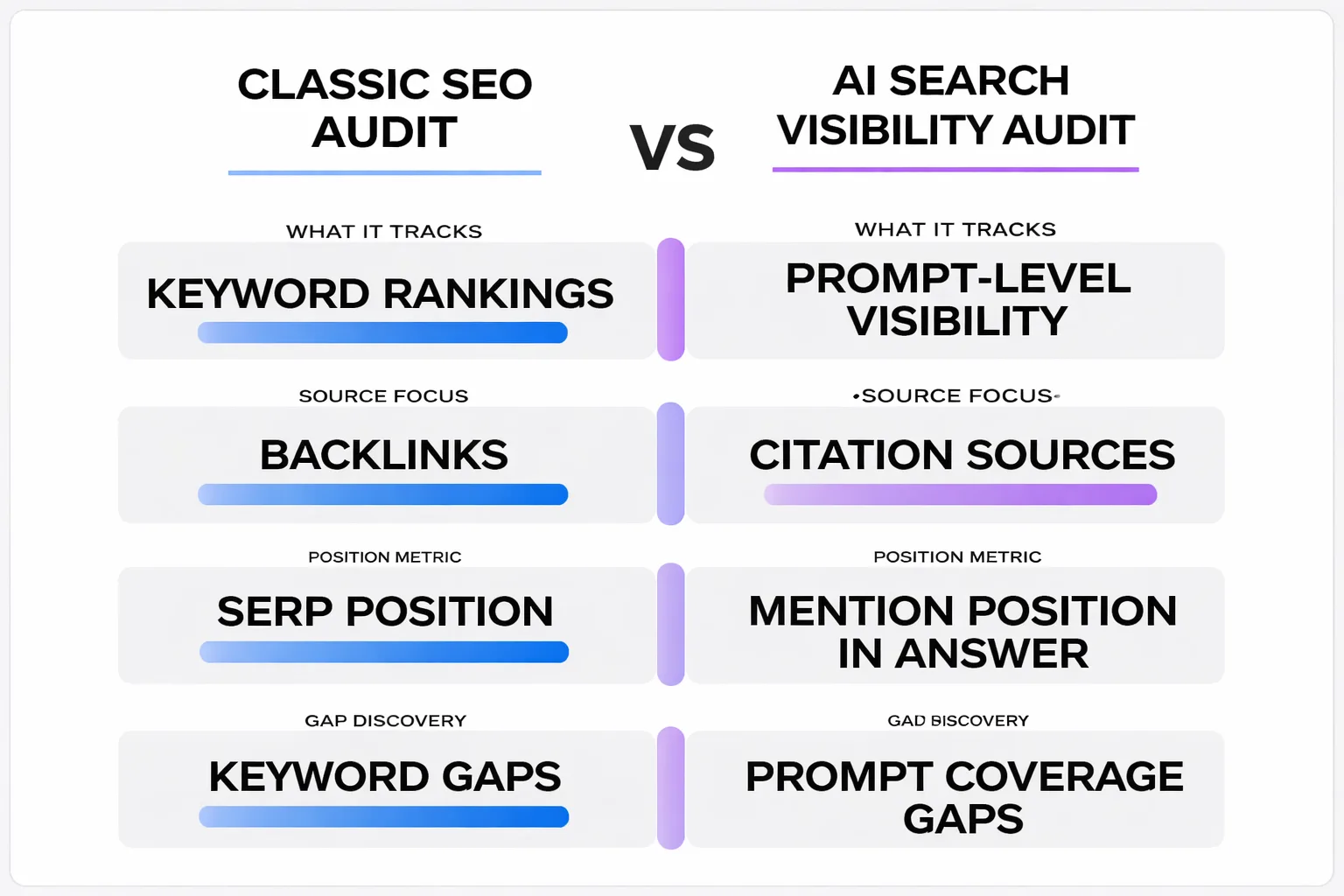
The audit covers four dimensions. First, brand mention rate: across a set of category-relevant prompts, how often does your brand appear in the answer at all? Second, citation source tracking: when an AI engine cites a source for your topic, which domains does it pull from? Third, prompt coverage gaps: which prompts trigger competitor mentions but not yours? Fourth, mention position: when you do appear, are you first in the list, buried at the bottom, or mentioned as an afterthought?
Here's why this matters. In a traditional SEO audit, you check rankings for keywords you already know about. In an AI search visibility audit, you're testing prompts you may have never considered. A user might ask ChatGPT "what's the best tool for tracking AI citations" and get a list of five brands. If you're not on that list, you've lost the lead before they ever search Google. The AEO vs SEO distinction is not academic. It's the difference between being in the conversation and being invisible.
An AI search visibility audit is a structured diagnostic that measures how often a brand is mentioned and cited across major AI search engines (ChatGPT, Claude, Gemini, Perplexity, Grok, Google AI Overviews, AI Mode, DeepSeek), identifies which sources those citations come from, and maps coverage gaps where competitors appear instead. It differs from a classic SEO audit because it evaluates prompt-level visibility rather than keyword rankings, tracks citation sources rather than backlinks, and measures mention position within generated answers rather than SERP position.
I've seen teams run their first audit and discover they're cited for features they deprecated two years ago. Or that a competitor with half their backlink profile owns the prompt for their core use case because they published one well-structured explainer. The audit surfaces these mismatches. That's its job.
The deeper you go into the data, the more the audit reveals about the gap between how you describe yourself and how the internet describes you. AI models don't read your homepage and take your word for it. They synthesize signals from dozens of sources: your site, review platforms, news articles, forum discussions, Wikipedia, Wikidata, and structured data across the web. If those sources describe you inconsistently, the model builds an averaged understanding of your brand that may not match your actual positioning. The audit is the first time many teams see this averaged version staring back at them.
Step-by-Step: Running the Audit Across ChatGPT, Gemini, and Perplexity
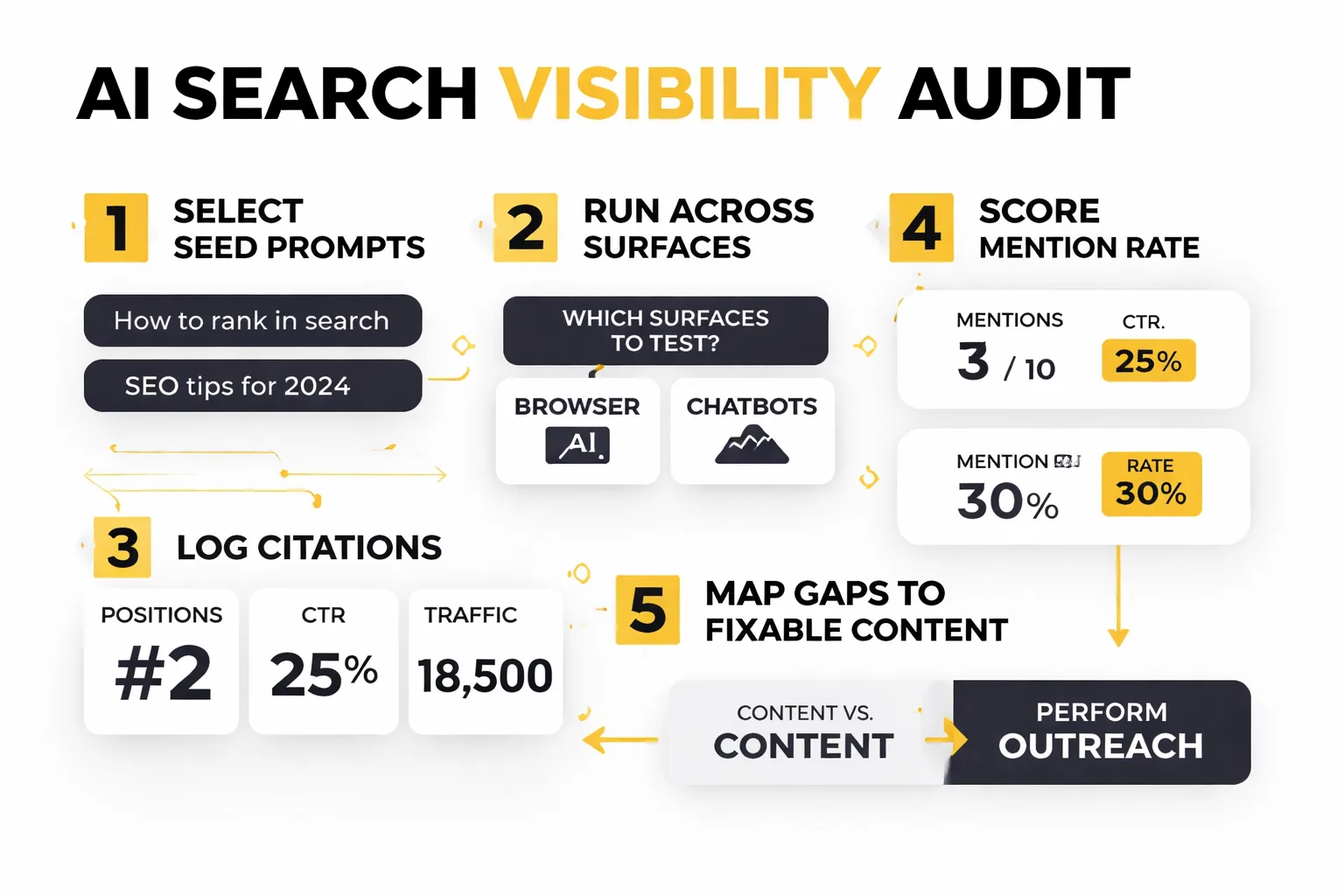
This is where the work happens. I'll walk you through the five steps I use when auditing a brand's AI visibility. You can run this manually for a small set of prompts, or use a tool like the AI visibility checker to automate across surfaces at scale.
Step 1: Select Your Seed Prompts
Start with 20 to 50 prompts that mirror how real users ask about your category. Not keywords. Prompts. The difference matters. A keyword is "project management software." A prompt is "what's the best project management tool for a 5-person remote team that needs time tracking?"
Pull prompts from three sources. First, ask your sales team what questions prospects actually ask in demos. Second, scan Reddit threads in your category for how people phrase problems. Third, check Google Search Console for question-form queries that already drive traffic. The goal is prompts that represent real buyer intent, not prompts that make your brand look good.
One mistake I see consistently: teams only test prompts where they expect to win. If you sell an email marketing tool, you test "best email marketing tool" and call it a day. But buyers ask broader questions long before they narrow to a category. They ask "how to improve open rates" or "what's the best way to segment a B2B email list." Those prompts reveal whether you're part of the consideration set during research, or only when the buyer has already decided on a category. Include at least 10 prompts that are problem-first, not product-first. Those are the prompts where AI engines cite educational content, and where you can establish authority before the buyer is even comparing tools.
Step 2: Run Prompts Across Every Major Surface
This is where most manual audits fail. People test ChatGPT and call it a day. But different AI engines cite different sources. Perplexity cites Reddit in roughly 47% of answers, while Google AI Overviews cite Reddit in about 21%. That's a massive divergence. If you only test one surface, you're auditing a fraction of your visibility.
Run each prompt across ChatGPT, Gemini, Perplexity, Claude, and Google AI Overviews at minimum. If you have access to Grok and DeepSeek, include those too. Log the full response text for each. Don't just note whether you were mentioned. Capture the exact sentence, the position in the answer, and whether your brand was cited with a source link or mentioned in passing.
The ChatGPT AI visibility checker and the Perplexity AI visibility checker can automate this for those specific surfaces. For a fully manual approach, use incognito mode and run each prompt three times to account for response variation. LLMs are non-deterministic, meaning the same prompt can produce different answers on different runs. If you test once and log the result, you may capture an anomaly. Three runs give you a sense of whether your brand consistently appears or only shows up occasionally.
Step 3: Log Citation Sources
When an AI engine cites a source for your topic, that source is doing your work for you (or against you). For every prompt, record which domains the engine cited. You'll start to see patterns. Maybe Perplexity always cites G2 for your category. Maybe Google AI Overviews pull from a specific industry blog.
This is the step where the audit becomes actionable. If you know that a specific site is the primary citation source for your category, that's your outreach target. Getting mentioned on that site is worth more than ten generic blog posts. This connects directly to the concept of generative engine optimization: you're not just optimizing your own content, you're optimizing for the sources that feed AI answers.
Build a citation source leaderboard for your category. For each AI surface, list the top five most-cited domains across your prompt set. You'll find that a small number of domains dominate. In B2B SaaS categories, I typically see G2, Capterra, Reddit, and one or two industry publications accounting for the majority of citations. If your brand isn't mentioned on those sites, you're absent from the sources AI engines trust most. The fix isn't publishing more on your own blog. The fix is getting your brand onto the sites that AI engines already cite.
Step 4: Score Mention Rate and Position
For each prompt and each surface, assign a score. I use a simple framework:
- 4 points: Brand mentioned first or as the primary recommendation - 3 points: Brand mentioned in a list, above the fold - 2 points: Brand mentioned in a list, below the fold - 1 point: Brand mentioned but with caveats or comparisons that favor competitors - 0 points: Brand not mentioned at all
Calculate your average score per prompt and per surface. A prompt with a 0 across all surfaces is a blind spot. A prompt with a 4 on Perplexity but a 0 on ChatGPT tells you the citation source feeding Perplexity is working, but ChatGPT's model doesn't have enough signal about your brand yet.
The scoring framework matters because it forces you to confront position, not just presence. A brand mentioned seventh in a list of ten is technically "visible," but practically invisible. Buyers rarely read past the first three recommendations in an AI answer. If you're consistently in position five or lower, your visibility score looks fine on paper but generates zero pipeline. Score honestly. A mention with caveats ("Brand X is good for small teams but lacks enterprise features") is a 1, not a 3, because the AI engine is actively steering the buyer away from you.
Step 5: Map Gaps to Fixable Content
This is where the audit becomes a strategy. Take every prompt where you scored 0 or 1 and ask: what content would need to exist for an AI engine to cite me here? Sometimes the answer is a new explainer article on your site. Sometimes it's getting mentioned on a third-party site that AI engines cite. Sometimes it's updating your Wikidata entry or knowledge graph presence so models have accurate entity data about your brand.
The answer engine optimization framework gives you the structure for this. Each gap maps to a content archetype: a how-to for use-case prompts, an explainer for category prompts, a comparison for versus prompts. The audit tells you what to write. The framework tells you how to write it.
For each gap, document three things: the prompt that exposed it, the competitor who currently owns it, and the content type needed to close it. This becomes your content backlog. Every item in the backlog is traceable to a specific prompt, a specific surface, and a specific competitor. That's how you justify the content investment to stakeholders who want to know why you're writing an explainer about a topic that doesn't directly pitch your product.
What the Data Usually Reveals
The first audit is always the most surprising. Teams expect to find gaps. They don't expect to find what they actually find. Here are the three patterns I see most consistently in B2B SaaS audits.
Brands Cited for the Wrong Use Case
This one stings. You built your product for a specific use case. Your marketing reinforces it. But AI engines have decided you're something else entirely. I've seen a project management tool cited as a CRM alternative, a billing platform mentioned as an invoicing tool for freelancers, and a security product recommended for a use case it doesn't support.
This happens because AI models build their understanding of your brand from a mix of sources: your website, third-party reviews, forum discussions, and news coverage. If those sources describe you inconsistently, the model averages them into something that doesn't match your positioning. The fix isn't more content. The fix is consistent entity data across every source the model reads. That means your Wikidata entry, your Wikipedia page (if you have one), your G2 and Capterra profiles, and your own site all need to describe your brand the same way.
I worked with a B2B analytics platform that was consistently cited by ChatGPT as a "data visualization tool for marketing teams." The problem? Their product was built for engineering teams. They had never positioned themselves for marketing analytics. But a handful of G2 reviews from marketing users, combined with a few blog posts that used marketing-related keywords, had caused the model to categorize them in the wrong lane. Every prompt about engineering analytics returned competitor names. Every prompt about marketing analytics returned their brand. They were winning visibility in a category they didn't serve and losing it in the one they did.
Competitors Owning Adjacent Prompts
This is the pattern that motivates teams to act. You audit your core prompts and find you're mentioned. Good. Then you audit adjacent prompts (the ones a buyer asks before they reach your category) and find a competitor there every time.
A concrete example. A B2B SaaS company I worked with was well-cited for "best [category] tool." But when I tested "how to solve [problem the category addresses]," a competitor appeared in every answer. The competitor had published a problem-first explainer that didn't even pitch their product. It just answered the question well. AI engines cited it because it was the most extractable answer. The competitor wasn't winning on brand awareness. They were winning on content structure.
This pattern reveals something important about how AI engines select citations. They don't reward comprehensiveness. They reward extractability. A 3,000-word guide that buries the answer in the fourth paragraph won't get cited. A 1,200-word article that opens with a direct answer under a question heading will. The competitor in the example above didn't outspend my client. They out-structured them. One well-placed answer did more for their AI visibility than ten generic blog posts.
Source Pages That Drive Citations vs Pages That Don't
Your audit will reveal that some pages on your site get cited by AI engines and others never do. The pattern is consistent: pages with direct answers under question headings get cited. Pages with narrative intros, buried key information, and no structured data don't.
I shifted to insisting that articles include direct answers under question headings and structured data wherever possible. 44% of AI citations come from the first third of a page, so front-loading direct answers and tables became critical. The pages that get cited are the ones that make it easy for an AI to extract a clean, quotable answer.
When you log citation sources in Step 3, pay attention to which of your own pages are getting cited. You'll typically find one or two pages driving the majority of your AI visibility. These are your citation engines. Protect them. Update them regularly. Ensure the information is current and the structure remains clean. Meanwhile, the pages that never get cited are draining resources without returning AI visibility. Either restructure them for extractability or stop investing in that format.
How to Turn Audit Findings Into a Prioritized Fix List
Running the audit is the diagnostic. Building the fix list is the treatment plan. Here's the framework I use to prioritize which gaps to close first.
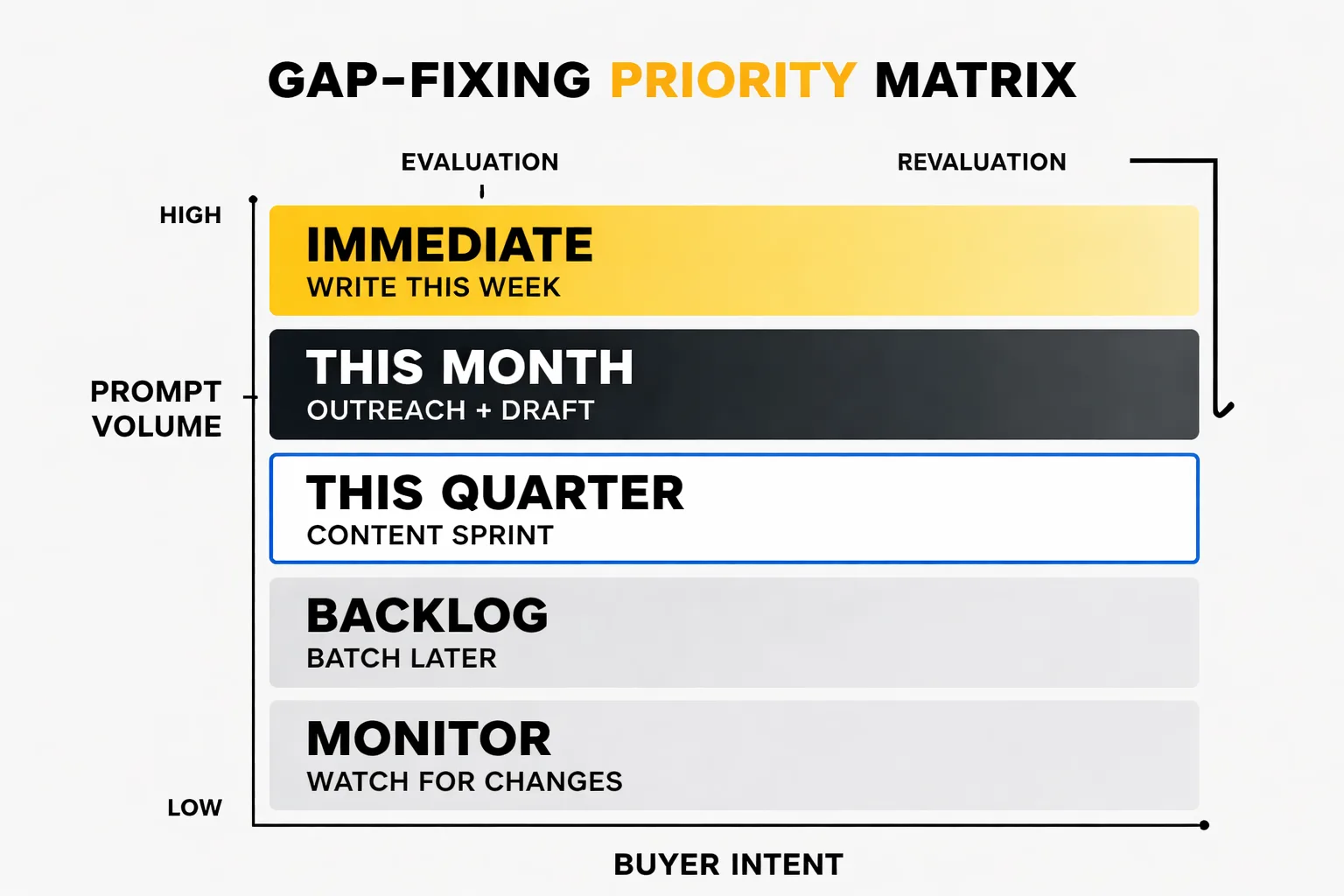
Score each gap on three dimensions. First, prompt volume: how many people are asking this question? You can estimate this by running the prompt through Google Keyword Planner or checking Search Console for related queries. A gap on a high-volume prompt is more urgent than a gap on a niche prompt. Second, buyer intent: does this prompt come from someone evaluating tools, or someone doing research? A prompt like "what is [category]" is top-of-funnel. A prompt like "best [category] for small teams" is bottom-of-funnel. Close bottom-of-funnel gaps first because they directly affect pipeline. Third, content effort: how much work is it to close this gap? Some gaps need a single well-structured article. Others need third-party mentions on sites you don't control.
Here's how to think about the matrix:
| Priority | Prompt Volume | Buyer Intent | Content Effort | Action |
| 1 (Immediate) | High | High | Low | Write the article this week |
| 2 (This month) | High | High | High | Start outreach + draft content |
| 3 (This quarter) | Medium | High | Medium | Plan content sprint |
| 4 (Backlog) | Low | Low | Low | Batch when capacity allows |
| 5 (Monitor) | Low | High | High | Watch for changes |
The framework exists so you don't spin up a full content operation to fix every gap at once. You won't. You shouldn't. Pick the top three Priority 1 gaps and close those first. Measure the impact. Then move to Priority 2.
One contrarian point. Most teams prioritize gaps where they're completely absent. I prioritize gaps where they're mentioned but with caveats or in a weak position. Here's why. Moving from 0 to 1 (absent to mentioned) requires creating new entity signals, which is slow. Moving from 2 to 4 (bottom of list to top) often requires only a content update on a page that's already being cited. The effort is lower and the impact is immediate. Fix what's already working before building what doesn't exist.
The matrix also helps you communicate priorities to leadership. When your CEO asks why you're writing an explainer about a topic that doesn't mention your product, you can point to the audit data. "This prompt gets asked approximately X times per month. Competitor Y is cited every time. One well-structured article could capture that visibility." That's a data-driven argument, not a hunch.
How Often Should You Re-Run an AI Visibility Audit?
The cadence question is the one I get most often. The answer depends on what's changing in your market and in the AI engines themselves.
Run a full audit quarterly at minimum. AI models update their training data and retrieval behavior constantly. A prompt where you were cited in January might return a completely different answer by March. Quarterly cadence catches these shifts before they compound. For brands in fast-moving categories (AI tools, cybersecurity, dev tools), monthly is better. The landscape shifts weekly.
Re-run immediately when three things happen. First, when a major LLM releases a model update. OpenAI, Anthropic, and Google push updates that change citation behavior. If you notice a traffic shift from AI referrals, re-audit. Second, when a competitor launches a significant content push. If they published ten new articles and you see their share of voice climbing, re-audit to understand what changed. Third, when you publish a major piece of content designed to close a gap. You want to measure whether it worked.
For ongoing tracking between full audits, use an AI visibility tracker to monitor your key prompts weekly. This gives you a trend line without the effort of a full manual audit. The tracker catches drift. The full audit explains why.
I've been skeptical of tools that claim massive visibility gains without transparent methodology. Companies like Profound have claimed a 7x increase from 3.2% to 22.2% in AI search citations, but without knowing their prompt consistency, baseline methodology, or confidence ranges, these claims are impossible to verify. The same skepticism applies to your own audit results. Run the same prompts the same way each time. Document your methodology. If your numbers move, you should be able to explain why.
What Does Generative Engine Optimization Add to the Audit?
Generative engine optimization (GEO) is the practice of structuring content specifically for extraction by AI answer engines. Where AEO is the strategy (understanding what prompts to target and how to position your brand), GEO is the execution (how to format and structure content so AI engines can actually cite it). The AEO vs GEO distinction matters because you need both. An audit without GEO principles tells you where you're invisible. GEO tells you how to become visible.
When you run an AI search visibility audit, you're implicitly testing whether your GEO is working. If your pages aren't getting cited despite being topically relevant, the problem is usually structural. The content exists but it isn't extractable. AI engines need clean, quotable answers positioned where they can find them. They don't read pages the way humans do. They scan for semantic markers: question headings, direct answer blocks, structured data, and entity references.
The audit reveals GEO failures in specific ways. If a competitor's page is cited instead of yours for a topic you've covered extensively, compare the two pages. You'll typically find that the competitor's page opens with a direct answer to the question, uses question-form headings, and includes structured data markup. Your page probably opens with a narrative introduction, buries the key information in the third paragraph, and lacks schema markup. The content quality might be equal. The extractability is not.
This is why the audit should include a structural review of your most important pages. For each page that should be driving citations but isn't, check three things: does the page open with a direct answer to a question? Does it use question-form headings? Does it include structured data (Article, FAQ, HowTo schema)? If the answer to any of these is no, you've found your GEO gap. The best GEO tools can help you identify these structural issues at scale, but a manual review of your top ten pages takes an afternoon and often reveals the same patterns.
Do you know which AI engines mention your brand and which ones don't?
How Does Entity Grounding Affect AI Citations?
Entity grounding is the process of ensuring AI models have accurate, structured data about your brand as an entity. This includes your Wikidata entry, knowledge graph presence, structured data on your site, and consistent brand information across third-party sources. The audit measures whether entity grounding is working by checking if AI engines correctly identify your brand, categorize it accurately, and attribute the right features and use cases to it.
When entity grounding fails, the audit reveals it immediately. You'll see brands cited with the wrong product category, wrong features, or wrong target audience. I've seen companies cited as free tools when they're enterprise-only, or as alternatives to products they don't compete with. These errors come from inconsistent or missing entity data.
The research on entity grounding is mixed. Some practitioners claim it directly boosts citations. Others report no measurable impact. What I've observed is that entity grounding doesn't directly cause citations. It prevents misattribution. If your entity data is wrong, you might get cited for the wrong thing. If your entity data is correct, you're eligible to be cited for the right thing. Correct entity data is necessary but not sufficient. You still need the content and the third-party signals to earn the citation.
Here's what to check in your audit. Search for your brand name on Wikidata. Is the entry accurate? Does it list the correct industry, founding date, and product category? If you have a Wikipedia page, does it accurately describe your current product? Are your G2 and Capterra profiles categorized correctly? These are the entity signals that AI models use to understand who you are. If they're wrong, every citation you earn might be in the wrong category.
What About Ecommerce and Agentic Commerce?
The audit process changes significantly for ecommerce brands. In B2B SaaS, the audit focuses on informational prompts. In ecommerce, you need to audit transactional prompts: "best [product] for [use case]," "where to buy [product]," and "compare [product A] vs [product B]." You also need to audit agentic commerce prompts, where AI agents autonomously compare and recommend products.
Research published in Harvard Business Review by Dr Jafar Sabbah and Oguz A. Acar highlights that traditional marketing doesn't work in agentic commerce. AI shopping agents don't respond to traditional SEO signals the way Google does. They look for structured product data, agent-discoverable signals, and consistent entity information across platforms. An ecommerce site optimized only for Google Search but not for agentic commerce platforms will be invisible when AI agents compare and purchase products on behalf of users.
For ecommerce brands, the audit should include product-level prompts, not just brand-level prompts. Test prompts like "what's the best [product category] under $100" and "which [product] is most durable." Log whether your products appear in the recommendations and whether the AI engine links to your product pages. If your products never appear, the issue is usually structured data. AI agents need product schema, availability signals, and pricing data to surface your products in recommendations.
What This Actually Means for Your Team
The brands winning in AI search right now are not the ones with the most content. They're the ones who ran the audit, found their gaps, and closed the three that mattered most. An AI search visibility audit is not a one-time exercise. It's a recurring diagnostic that should sit alongside your rank tracking and traffic analytics as a core part of your search strategy.
If you've never run one, start small. Pick ten prompts. Test them on ChatGPT and Perplexity. Log what you find. The first set of results will tell you whether you need a deeper audit or whether you're in better shape than you thought. Either way, you'll know.
In my work at Meev, I've seen the difference between brands that audit and brands that guess. The auditors build content with intent. The guessers publish into the void. The audit is what turns AI visibility from a guessing game into a measurable, improvable metric. Run yours.
FAQ
What is the difference between an AI search visibility audit and a traditional SEO audit?
A traditional SEO audit checks keyword rankings, backlinks, and technical site health on Google. An AI search visibility audit measures brand mentions and citations across AI answer engines like ChatGPT, Perplexity, and Google AI Overviews. It tracks prompt-level visibility rather than keyword positions, identifies which sources AI engines cite for your topic, and maps coverage gaps where competitors appear instead of your brand. The two audits answer different questions and should be run in parallel.
How many prompts should I test in my first audit?
Start with 20 to 50 prompts for a first audit. Pull them from three sources: questions your sales team hears in demos, Reddit threads where people describe problems in your category, and question-form queries from Google Search Console. The goal is prompts that represent real buyer intent, not prompts designed to make your brand look good. For ongoing tracking, narrow to 10 to 15 high-priority prompts you monitor weekly.
Which AI engines should I include in the audit?
Test across ChatGPT, Gemini, Perplexity, Claude, and Google AI Overviews at minimum. Different engines cite different sources and produce different answers for the same prompt. Perplexity cites Reddit in roughly 47% of answers while Google AI Overviews cite Reddit in about 21%, which means testing only one surface gives you an incomplete picture. If you have access to Grok and DeepSeek, include those too for broader coverage.
Can I run an AI search visibility audit manually or do I need a tool?
You can run a manual audit for a small set of prompts using incognito mode in each AI engine. Run each prompt three times to account for response variation, and log the full response text, your brand's position, and cited sources. For larger prompt sets or ongoing tracking, a tool like the AI visibility tool automates the process across surfaces with daily or weekly refreshes. Manual works for a first pass. Automation becomes necessary for ongoing monitoring.
How long does it take to see results after closing audit gaps?
Results depend on the type of gap you close. If you update an existing page that's already being cited, you may see position improvements within one to two weeks as AI engines re-index the content. If you're creating new content or building third-party mentions, expect four to eight weeks before AI engines pick up the new signals. Entity data changes (Wikidata, knowledge graph) can take longer because models update their entity understanding on their own training cycles, not on demand.
What does it mean if my brand is cited for the wrong use case?
This means AI models have built an inaccurate understanding of your product based on inconsistent signals across sources. The fix is entity consistency: ensure your Wikidata entry, review site profiles, and website all describe your brand the same way. If your site says you're a project management tool but G2 reviews describe you as a CRM, the model averages those signals and may cite you for the wrong category. Fix the inconsistent sources first, then re-audit to confirm the model's understanding has shifted.
About the Author
Judy Zhou, Founder
Judy Zhou leads content strategy at Meev, where she oversees AI-driven content research and publishing for hundreds of brands. With a background in SEO and editorial operations, she focuses on building content systems that rank on Google, get cited by AI search engines, and drive measurable business results.
Run your first AI search visibility audit today and find the citation gaps costing you leads.