
By Judy Zhou, Founder
Key Takeaways
- Only 11% of domains are cited by both ChatGPT and Perplexity, so organic Google rankings alone do not guarantee AI mentions. Your AI citation baseline is calculated as citations earned divided by total prompt runs times 100, segmented by engine, prompt type, and competitor. 44% of AI citations come from the first third of a cited page, making content structure and direct-answer formatting as important as content quality. Run weekly re-audits to catch citation drift early, because AI engines update retrieval logic continuously and rates can shift overnight.
In 2023, when OpenAI introduced browsing capability in ChatGPT, most SEOs treated it as a novelty. By early 2024, as Perplexity crossed 10 million daily active users and Google began embedding AI Overviews into the majority of informational queries, a new discipline was quietly crystallizing: answer engine optimization. At its core sat a deceptively simple question. Which sources do AI models actually cite, and why? That question gave rise to the concept of an AI citation baseline: a structured, repeatable method for measuring where your brand stands inside the generative web before you try to move the needle.
Building an ai citations baseline means running 10-20 buyer-intent prompts across every major AI search surface, recording which brands get cited and in what position, then calculating your citation rate (citations earned ÷ total prompt runs × 100). Ahrefs' study of 75,000+ brands and millions of AI citations found that topical authority and source trust signals drive the majority of generative citations. Only 11% of domains are cited by both ChatGPT and Perplexity, which means ranking on Google is no longer a reliable proxy for earning AI mentions. 44% of AI citations come from the first third of a cited page, making content structure as important as content quality. A 20-prompt audit across two engines is the minimum viable baseline recommended by the AI Citation Tracking Guide, but in my work auditing content ops at Meev, I push teams to 20 prompts across five engines for a baseline that actually reflects market reality.
Here is the problem I keep seeing. Marketing teams spend months publishing content, building links, and chasing organic rankings. Then someone asks the CEO to ask ChatGPT about their product category. The brand is absent. Not mentioned. Not cited. Not even acknowledged as a competitor. The team has no idea why because they never measured their starting position. You cannot improve what you have never measured, and most teams are flying blind on AI search visibility.
I have lived this. In my work leading content strategy at Meev, I oversee AI-driven content research and publishing for hundreds of brands. I ran a small experiment with five articles that hit top 3 organic rankings on Google but saw zero AI citations over a three-month period. That directly contradicts the idea that organic visibility alone drives AI mentions. The broader data backs this up: only 11% of domains are cited by both major LLMs, according to Ahrefs' generative engine optimization research. We need to stop thinking purely about Google's algorithm and start understanding what influences LLM recommendations directly.
That starts with a baseline.
How to define prompts that matter?
Your baseline is only as good as the prompts you feed into it. Most teams get this wrong by testing branded queries like "What is [Company Name]?" or generic queries like "What is CRM software?" Branded queries will always return your brand. Generic queries return whoever spent the most on PR last quarter. Neither tells you anything useful.
You need buyer-intent prompts. These are the questions a real prospect types into ChatGPT, Perplexity, or Claude when they are actively evaluating a purchase in your category. Think "best project management tool for remote teams" or "how to choose an email marketing platform for ecommerce." These prompts sit in the consideration and decision stages of your funnel, and they are where AI engines shape buyer opinion.
Here is the framework I use, broken down by funnel stage:
Top-of-funnel (awareness) prompts. 3-5 prompts: These are educational questions your buyer asks before they know they need a solution. "What is answer engine optimization?" or "How do AI search engines choose which sources to cite?" Your brand does not need to appear in every one of these, but you should know whether you appear in any.
Mid-funnel (consideration) prompts. 7-10 prompts: This is where buyers compare options. "Best AI SEO tools for small teams," "Alternatives to [Competitor Name]," "ChatGPT vs Perplexity for research." These prompts are your battleground. If your brand is absent here, you are invisible during the evaluation phase.
Bottom-of-funnel (decision) prompts. 3-5 prompts: These are specific buying questions. "Is [Your Brand] worth it," " [Your Brand] vs [Competitor] pricing comparison," " [Your Brand] reviews 2026." You should win these. If you do not, you have a brand awareness problem that no amount of content will fix.
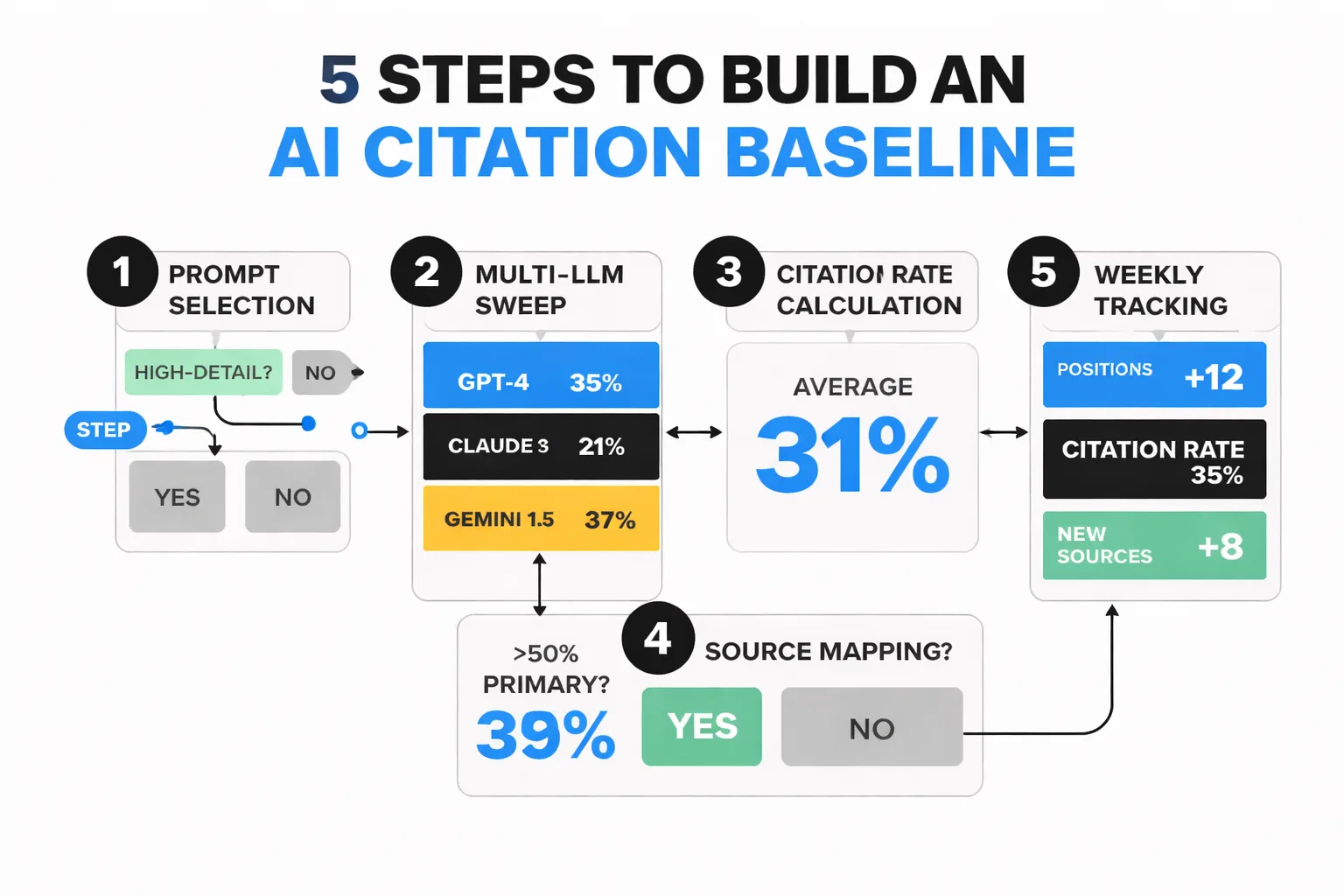
Write down your 10-20 prompts in a spreadsheet. Keep the phrasing natural and conversational, not keyword-stuffed. AI engines process language the way humans speak, so your prompts should reflect how a person actually talks to an AI assistant. If you need a starting point for understanding how these prompts fit into the broader answer engine optimization framework, I recommend reviewing our guide to answer engine optimization.
One more thing on prompt selection. Include at least three prompts where your competitor is the named brand. "Alternatives to [Competitor]" and "Is [Competitor] worth it" are goldmines of competitive intelligence. If AI engines recommend alternatives to your competitor and you are not on the list, you now know exactly where to focus your content investment.
How to run a multi-LLM sweep?
This is where the work gets mechanical but critical. You need to run your prompt set across every major AI search surface and record exactly what comes back. I mean ChatGPT, Claude, Gemini, Perplexity, and Grok at minimum. Each engine has a different underlying model, different training data, and different citation logic. **Ahrefs' study of 75,000+ brands](https://ahrefs.com/blog) analyzed millions of AI citations across ChatGPT, Google AI Overviews, Perplexity, and Gemini, and the divergence between engines is significant. What gets cited in Perplexity may never appear in ChatGPT.
Here is how to run the sweep manually if you are starting out:
Open each AI engine in a clean session (no conversation history, no custom instructions). Paste your prompt exactly as written. Wait for the full response. Then record four data points for each prompt-engine combination: which brands are mentioned, in what position (first mention, in a list, last mention), whether a source link is attached to the mention, and what that source URL is.
That last point matters more than people realize. Perplexity cites inline source links for most claims. ChatGPT with browsing sometimes includes citations and sometimes does not. Google AI Overviews links to source pages directly. Claude rarely cites specific URLs but will name sources. The presence or absence of a clickable citation is a massive signal. A named mention without a link is brand awareness. A named mention with a link to your content is direct traffic and authority transfer. Understanding the difference between AEO vs SEO helps frame why this distinction matters so much.
Run each prompt three times per engine. LLM outputs are non-deterministic, meaning the same prompt can return different answers on different runs. I have seen a brand appear in position one on the first run and disappear entirely on the second. Three runs give you a stability signal. If your brand appears in two of three runs, that is a 67% citation rate for that prompt on that engine. If it appears in one of three, you are on the edge.
I want to be blunt about something here. I have seen companies push "AI visibility tools" that promise to predict or influence ai citations by tracking things like citation rate or competitive gaps, and I am immediately skeptical. We spent three weeks testing whether tracking source authority and brand mention metrics would correlate to increased LLM citations. It did not. LLM training data selection and output generation are far more complex and opaque than these tools let on. It is not a simple input-output game where optimizing a few metrics guarantees a mention. That is why your manual sweep matters. You are capturing ground truth, not a proprietary score someone invented.
For a structured approach to checking specific engines, you can use a ChatGPT AI visibility checker or a Perplexity AI visibility checker to streamline the process. These tools help standardize how you query and record results across engines.
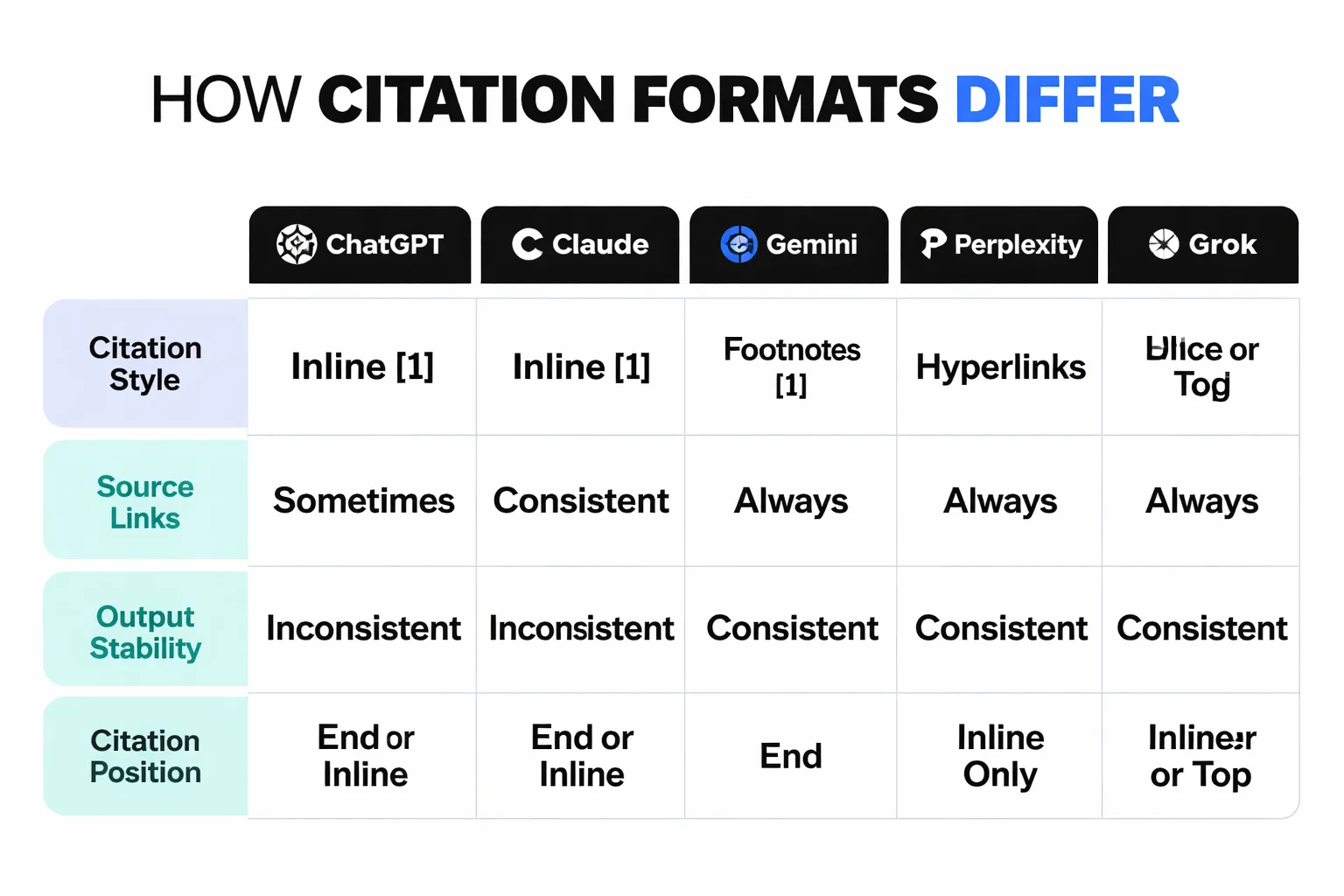
Record everything in your spreadsheet. One row per prompt per engine per run. Columns: prompt text, engine name, run number, brands mentioned (in order), your brand position, source URL cited, and notes on response tone (positive, neutral, negative). This spreadsheet is your raw data. Everything else builds on it.
Step 3. Calculate Your Starting Citation Rate
Now you do the math. This is the number that becomes your north star for the next 90 days.
Citation rate = (citations earned ÷ total prompt runs) × 100
If you ran 15 prompts across 5 engines with 3 runs each, that is 225 total prompt runs. If your brand was cited in 45 of those runs, your citation rate is 20%. That is your baseline. Write it down. Circle it. This is the number you are trying to move.
But the aggregate number is just the beginning. The real insight comes from segmentation. Break your citation rate down three ways:
By LLM: Your citation rate on Perplexity might be 35% while your rate on Claude is 5%. That tells you Perplexity's retrieval system favors content structures you already have, while Claude's model does not surface you at all. Different engines reward different signals. Perplexity leans heavily on real-time web search and tends to cite recently published, well-structured content. Claude relies more on training data and tends to cite established, authoritative sources with longevity. Understanding which engine ignores you tells you what kind of content gap you have.
By prompt type: Group your prompts by funnel stage. If your citation rate on bottom-of-funnel prompts (your brand name queries) is 90% but your rate on mid-funnel consideration prompts is 10%, you have a discoverability problem. Buyers who already know your name find you. Buyers comparing options do not. That is a content investment signal: prioritize comparison and alternatives content.
By competitor: For each prompt, record which competitors were cited and in what position. If Competitor A appears in 70% of your mid-funnel prompts and you appear in 15%, Competitor A has a 4.7x citation advantage in the consideration phase. That is a concrete, quantifiable gap you can present to leadership. It is not a vibe. It is a number.
Here is what frustrates me about the current market for ai citation tracking tools. Tools like AirOps, BrightEdge, Conductor, and others split into monitoring-only versus improvement-focused categories, but most surface a proprietary "visibility score" that is disconnected from any actionable metric. A visibility score of 73 out of 100 means nothing if you cannot translate it into "I was cited in 45 of 225 prompt runs." The math has to be transparent and reproducible. That is why I insist on the raw citation rate calculation. It is simple, it is honest, and anyone on your team can verify it.
I also want to flag something I have learned the hard way. Do not average your citation rates across engines and treat that as your single number. The engines are too different. A 30% average that combines a 60% Perplexity rate with a 5% Claude rate hides the real story. Report by engine, then aggregate. Never aggregate first.
Step 4. Trace Cited Sources Back to Their Roots
This step separates a real audit from a vanity exercise. When an AI engine cites a source, that source is not random. It was selected because the retrieval system (for search-augmented engines like Perplexity and Google AI Overviews) or the training data (for models like Claude and GPT-4) identified it as authoritative and relevant for that query. Your job is to figure out why.
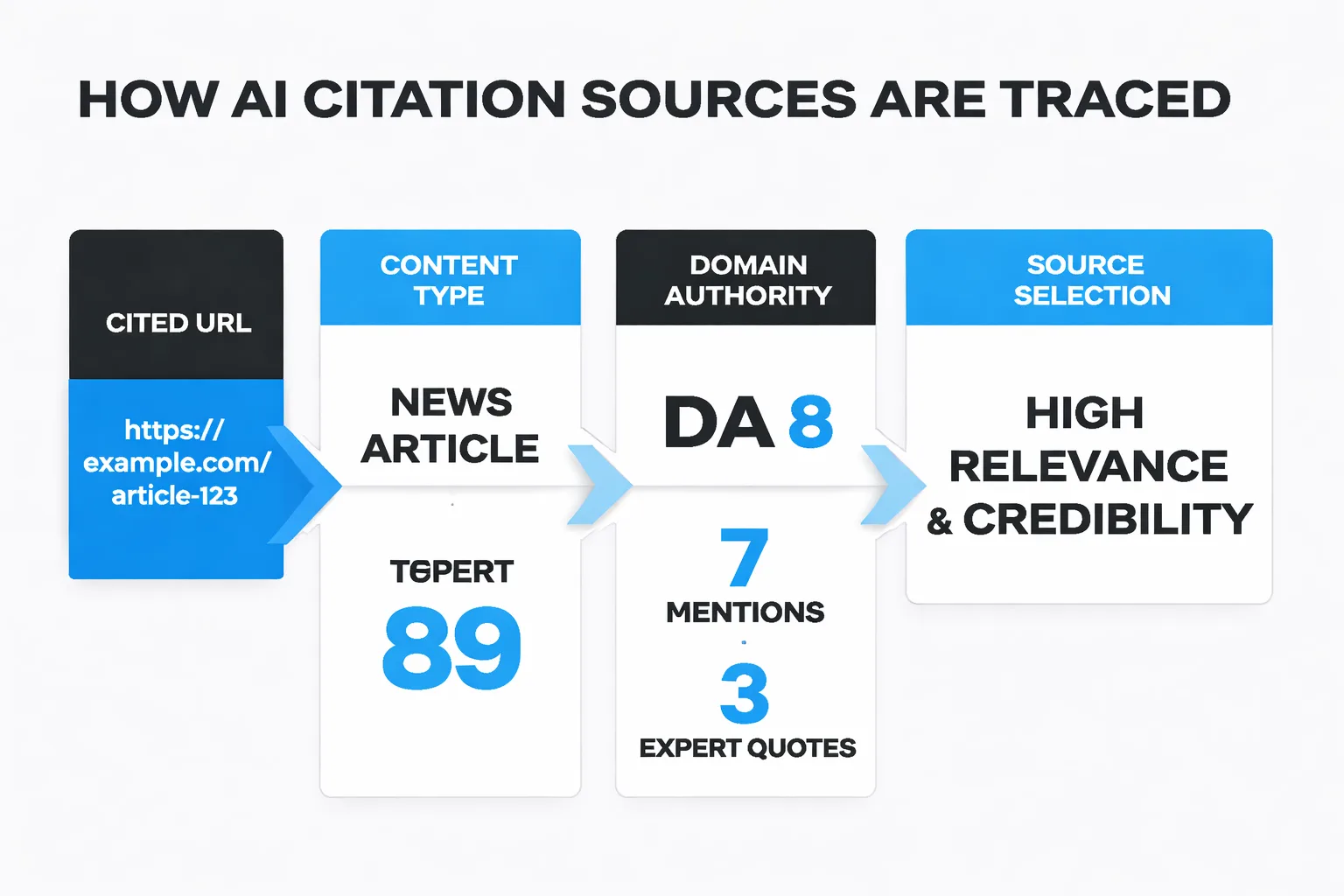
For every citation you recorded in Step 2, trace the source URL back to three things: content type, domain authority, and entity signals.
Content type: Is the cited source a listicle, a how-to guide, a product page, a review site, a forum thread (Reddit, Quora), a news article, or a research report? I have seen teams obsess over getting their product pages cited when AI engines overwhelmingly cite editorial content, comparison articles, and third-party reviews. 44% of AI citations come from the first third of a page, so the cited content is almost always structured with direct answers up top. If the AI is citing listicles and you are publishing thought leadership essays, you have a format mismatch.
Domain authority: What is the domain rating or authority score of the cited source? If AI engines cite domains with DR 70+ for your category and your site sits at DR 35, you are not going to get cited directly no matter how good your content is. In that case, your strategy shifts. You need to get cited indirectly by being mentioned on the high-DR sites that AI engines trust. That means digital PR, expert commentary, and contributor content on publications the AI already favors.
Entity signals: This is the piece most teams miss entirely. AI engines do not just match keywords to pages. They match entities to concepts. If your brand is not recognized as a distinct entity in the knowledge sources AI models rely on (Wikidata, Wikipedia, structured data across the web), the model has no anchor to connect your brand to the category. I spent months integrating schema markup and building out an internal knowledge base, expecting a direct correlation to AI visibility. The lift was minimal. What actually moved the needle was third-party editorial mentions and community discussion on platforms like Reddit and Hacker News. The AI needs external corroboration to treat your brand as real.
This is where llm citation tracking gets genuinely difficult. The cited URL tells you what the AI surfaced, but it does not tell you why. You have to infer the "why" from patterns. If your competitor gets cited for "best CRM for startups" and the cited source is a G2 comparison page where they rank #3, the entity signal is G2's category authority, not the competitor's content. Your competitor did not create that citation. G2 did. To replicate that citation, you need to be on G2's comparison page, not publish a better blog post.
If you want to go deeper on the distinction between optimizing for answer engines versus generative engines, our breakdown of AEO vs GEO covers the tactical differences. The short version: AEO focuses on getting your content structured for direct extraction, while GEO focuses on building the authority and entity signals that make AI models prefer your content as a source.
Build a source map. For each cited URL, record: URL, domain, domain authority, content type, whether your brand is mentioned on that page, and whether you have any relationship with that domain (existing backlink, contributor account, PR contact). This source map becomes your outreach target list in Step 5 and beyond.
Do you know which AI engines cite your brand today?
Step 5. Set Benchmarks and Automate Weekly Tracking
You have your baseline citation rate. You have your source map. Now you need to make this a repeatable system, not a one-time audit.
First, store your baseline data somewhere durable. A Google Sheet works fine for small teams. If you are running this across multiple domains or for clients, you need a structured database. The key fields are: date of audit, prompt set version (label it v1 so you know which prompts were used), per-engine citation rates, aggregate citation rate, top competitor citation rates, and source map version.
Second, set a realistic 90-day target. I see teams set absurd goals like "double our AI citations in 30 days." That is not realistic given how slowly LLM training data and retrieval indexes update. Perplexity and Google AI Overviews can reflect new content within days because they use real-time search. ChatGPT and Claude update on model training cycles, which means months. Set a 90-day target of a 25-35% improvement on your baseline citation rate. If you are starting at 20%, aim for 25-27% in 90 days. That is achievable with focused content investment in the gap areas your audit revealed.
Third, automate the re-runs. Manual sweeps are fine for your first baseline. They are not sustainable for ongoing tracking. You need to re-run your prompt set weekly to catch drift. Drift happens when AI engines change their retrieval logic, when competitors publish new content, or when your own content changes how engines perceive your brand. I have seen citation rates drop 15 points overnight because Google AI Overviews changed how it sources comparison content. Without weekly tracking, you find out about these shifts weeks late, after the damage is done.
This is where a dedicated AI visibility tracker becomes essential. At Meev, we built our tracking workflow to run daily refreshes on SERP-driven surfaces (Google AI Overviews, AI Mode) and rolling refreshes on LLM-driven surfaces (ChatGPT, Claude, Perplexity, Grok, DeepSeek). The system records mention position, citation links, and the actual response text behind every mention. You see the full answer, not just a score. That matters because context changes everything. A mention in a sentence that says "[Your Brand] is a budget option" is very different from a mention in a sentence that says "[Your Brand] is the top choice for small teams."
For weekly tracking, I recommend using a structured LLM visibility tool that can automate prompt execution across engines and store results longitudinally. The value is not in any single week's data point. The value is in the trend line over 12 weeks. That trend line tells you whether your content investments are working. If your citation rate on Perplexity climbs from 20% to 28% over eight weeks after you publish five new comparison articles, you have causal evidence. If it stays flat, you need to change your approach.
If you are evaluating tools for this phase, our roundup of the best GEO tools covers options that handle both tracking and content optimization. The key criteria are: does it track every major AI search surface (not just one or two), does it record the actual response text (not just a score), and does it store historical data so you can see trends.
When This Process Fails
I want to be honest about where this five-step process breaks down, because pretending it works universally would be dishonest.
First, it fails for brand-new companies with zero web presence. If your company launched three months ago and has no Wikipedia page, no third-party reviews, no press coverage, and no backlinks, your citation rate will be close to zero across all engines. That is not a failure of the methodology. It is a reflection of reality. AI models cannot cite what they do not know exists. For these companies, the baseline tells you nothing actionable because the problem is not content optimization. The problem is brand building. You need PR, reviews, and entity establishment before content investment will move the citation needle.
Second, it fails in highly regulated industries where AI engines refuse to make recommendations. Ask ChatGPT for the "best medical malpractice attorney" or "safest prescription for anxiety" and you will get a hedged response that names no brands. Your citation rate will be zero, and no amount of content optimization will change that because the engine's safety guardrails prevent brand recommendations. In these categories, shift your strategy from "get cited as the best" to "get cited as a source of educational information."
Third, it fails when your prompt set is wrong. I have seen teams build beautiful baselines with 20 carefully chosen prompts that do not match how real buyers actually search. They tested "project management software comparison" when buyers actually ask "what is the best alternative to Asana." If your prompts do not reflect real buyer language, your baseline measures the wrong thing. Validate your prompt set by asking five customers what they typed into ChatGPT or Perplexity during their evaluation process. Use their exact words.
What This Actually Means
The teams that win in AI search are not the ones with the most content. They are the ones who measured their starting position, identified the specific gaps, and invested in the exact content types and entity signals that AI engines reward. An AI citation baseline is not a dashboard. It is a decision-making framework that tells you where to spend your next content dollar.
If your baseline shows you are cited on Perplexity but absent on Claude, you invest in the authority signals Claude rewards. If your source map shows AI engines cite G2 and Capterra for your category, you prioritize getting listed and reviewed on those platforms. If your prompt segmentation shows you win branded queries but lose consideration queries, you publish comparison and alternatives content.
Every one of those decisions starts with the baseline. Without it, you are guessing. With it, you are executing against a measurable target. In my experience, the teams that build a baseline in the first quarter of their AI search program outperform teams that skip straight to content production by a wide margin. Measure first. Then build. Then measure again. That is the entire methodology, and it works because it is grounded in data rather than hope.
FAQ
What is an AI citation baseline?
An AI citation baseline is a structured measurement of how often your brand is mentioned and cited across AI search engines for a defined set of buyer-intent prompts. You calculate it by running 10-20 prompts across multiple AI engines, recording which brands appear and in what position, then dividing citations earned by total prompt runs. The resulting percentage is your starting citation rate.
How many prompts should I test per engine?
I recommend 10-20 prompts per engine, run three times each. Three runs account for LLM non-determinism. If your brand appears in two of three runs for a given prompt, that is a 67% citation rate for that prompt on that engine. Fewer than 10 prompts gives you too small a sample. More than 20 becomes unwieldy for manual tracking.
How often should I re-run my AI citation audit?
Weekly. AI engines update their retrieval logic and training data continuously. A citation rate that looks fine on Monday can drop by Friday because Google AI Overviews changed how it sources comparison content. Weekly tracking catches drift early. Daily tracking is ideal for SERP-driven surfaces like Google AI Overviews and AI Mode.
What citation rate should I target?
It depends on your category and competitive landscape. A 20-30% citation rate is a reasonable starting point for most B2B SaaS categories. Set a 90-day improvement target of 25-35% above your baseline. If you start at 20%, aim for 25-27% in 90 days. Faster improvement is possible on real-time engines like Perplexity but unlikely on training-cycle engines like Claude.
Do I need a tool to track AI citations, or can I do it manually?
You can build your first baseline manually using a spreadsheet and clean sessions in each AI engine. Manual tracking is fine for a one-time audit. For ongoing weekly tracking across five or more engines with 15+ prompts, automation becomes necessary. The volume of prompt runs (225+ per week) makes manual tracking unsustainable for most small teams.
What is the difference between a brand mention and a citation in AI search?
A brand mention is when an AI engine names your brand in its response. A citation is when the engine links to a specific source URL. Perplexity and Google AI Overviews frequently include source links. ChatGPT sometimes includes them. Claude rarely does. A mention without a link builds awareness. A mention with a link drives traffic and transfers authority. Both matter, but they signal different things about how the AI perceives your brand.
About the Author
Judy Zhou, Founder
Judy Zhou leads content strategy at Meev, where she oversees AI-driven content research and publishing for hundreds of brands. With a background in SEO and editorial operations, she focuses on building content systems that rank on Google, get cited by AI search engines, and drive measurable business results.
Run your first AI citation baseline this week and see exactly where your brand stands across every major AI search surface.