By Judy Zhou, Founder
Key Takeaways
- Track AI citations with this exact 5-step workflow: define prompts, run baseline checks on ChatGPT/Gemini/Perplexity, record sources, calculate citation rate, and monitor weekly in a spreadsheet.
- Only 11% of domains are cited by both ChatGPT and Perplexity, proving Google rankings are not a proxy for LLM recommendations.
- Nearly 40% of web traffic now comes from AI search, so run the structured process instead of buying proprietary citation tools or doing nothing.
- Spend 30 minutes a week on direct AI citation tracking to close the gap most marketing teams ignore.
The weekly marketing sync is wrapping up. Someone pulls up the SEO dashboard. Impressions are up, average position is holding, nothing alarming. Then a product manager asks a question nobody has a clean answer to: 'Does anyone know if ChatGPT is recommending us when people ask about solutions like ours?' A few people glance at each other. Someone mentions they heard Perplexity cited a competitor last week. The meeting ends with a follow-up action item that never quite gets scheduled. This scene is playing out in marketing teams everywhere right now. And the fix is more straightforward than most realize.
The core workflow for tracking AI citations comes down to five steps: define your prompts, run baseline checks across every major AI surface, record which sources each engine pulls from, calculate your citation rate, and set up weekly monitoring. Nearly 40% of web traffic now comes from non-traditional discovery methods like AI search, yet most published GEO case studies measure visibility, not pipeline. If you can't track whether your brand is cited in AI answers, you can't fix the gap.
I've spent the last year building content systems at Meev that track AI citations across every major AI search surface. What I've learned is that most teams either overcomplicate this or skip it entirely. They either buy expensive tools that promise proprietary "citation scores" (which Google and OpenAI don't officially recognize), or they do nothing and hope organic rankings will carry over. Neither works. What works is a structured, repeatable process you can run with a spreadsheet and 30 minutes a week.
Here's the honest framing: only 11% of domains are cited by both ChatGPT and Perplexity, which means the overlap between traditional SEO success and AI citation success is thinner than most marketers assume. Ranking on Google is not a proxy for getting recommended by an LLM. You need to track AI citations directly, and you need to do it systematically.
What prompts do your buyers use?
Your tracking data is only as good as the prompts you feed it. This is the step most teams rush through, and it's the one that quietly determines whether your entire tracking effort produces actionable insight or just noise.
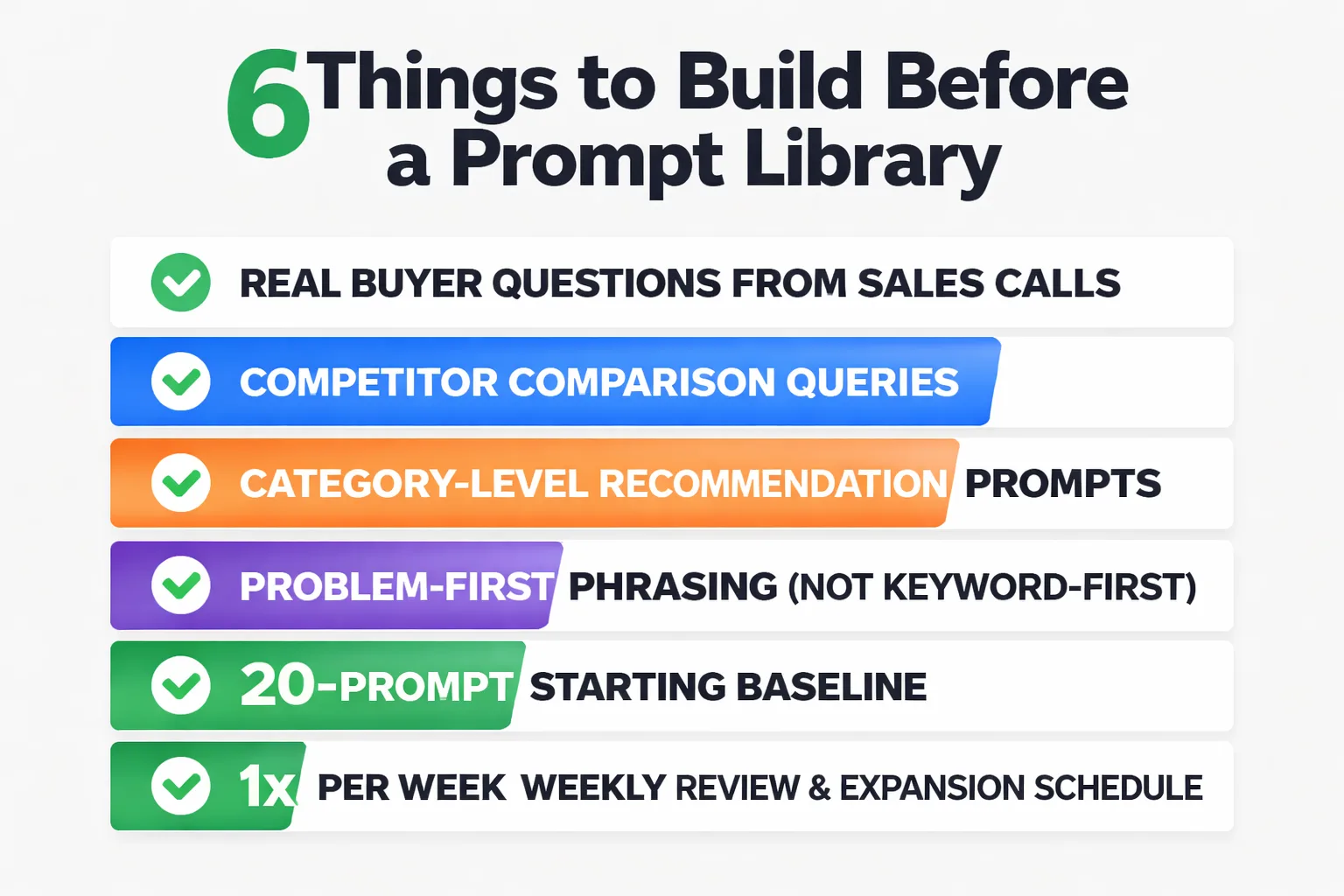
Start by building a prompt library from three sources. First, real buyer questions. Talk to your sales team. Ask them: what do prospects ask you in demos? What problems do they describe before they mention your category? Those questions are your prompts. If you sell project management software, your buyers aren't searching "best project management tool." They're asking ChatGPT "how do I track tasks across a remote team of 50 people without spending hours in meetings?" That's the prompt you track.
Second, competitor comparison queries. "How does [your brand] compare to [competitor]?" and "what's the difference between [competitor A] and [competitor B]?" These prompts reveal whether AI engines position you accurately relative to competitors. I've seen cases where a brand is mentioned in AI answers but described using a competitor's value proposition. That's worse than not being mentioned at all.
Third, category-level searches. "What are the best [your category] tools?" and "recommend a [your category] for [use case]." These are the prompts where AI engines make direct recommendations, and they're the ones most likely to influence a buyer's shortlist.
Aim for 20 prompts to start. That number comes from Omnia's citation tracking guide, which recommends 20 prompts across two engines as a baseline audit. I agree with that baseline. Twenty prompts is enough to spot patterns without creating a data entry nightmare. You can always expand later.
Document each prompt in a spreadsheet with these columns: prompt text, intent type (problem-solving, comparison, recommendation), target persona, and priority. This structure matters because when you review your tracking data in Step 5, you'll want to filter by intent type to see whether you're cited in recommendation prompts (high commercial value) but absent in problem-solving prompts (top-of-funnel influence).
One more thing: write your prompts the way people actually talk to AI assistants, not the way they type into Google. Google queries are keyword fragments. AI prompts are full sentences with context. "CRM for small business" is a Google query. "What's a good CRM for a 12-person startup that integrates with Slack and doesn't require a dedicated admin?" is an AI prompt. Track the latter.
Here's a concrete example of what a 20-prompt library looks like for a B2B SaaS company in the project management space. Prompts 1-7 are problem-first: "how do I reduce standup meeting time for a distributed engineering team," "what's the best way to visualize sprint progress for stakeholders who don't use Jira," "how do I track cross-team dependencies without a dedicated project manager." Prompts 8-14 are comparison-first: "Asana vs Monday vs ClickUp for a 200-person company," "which project management tool has the best free plan for startups," "how does Notion compare to dedicated PM tools for engineering teams." Prompts 15-20 are recommendation-first: "recommend a project management tool for an agency with 30 clients," "what's the best PM software for a remote-first startup under 50 people," "which project management platform integrates natively with GitHub and Slack."
Notice the pattern. Every prompt contains specifics: team size, use case, integrations, constraints. That's how real buyers talk to AI assistants. If your prompt library is just "best project management software" repeated with minor variations, your tracking data will be shallow and your insights will be wrong.
How to run baseline citation checks?
Once your prompt library is built, you need to run each prompt across every major AI search surface and log what comes back. This is your baseline. Everything you measure going forward compares against this snapshot.
The surfaces that matter right now are ChatGPT, Claude, Gemini, Perplexity, Google AI Overviews, Google AI Mode, Grok, and DeepSeek. Each one handles citations differently, and those differences affect what you track.
Perplexity is the most transparent. It provides inline citations with numbered superscripts that link directly to source pages. You can see exactly which domains it's pulling from. Perplexity's visibility checker is something we built specifically because Perplexity's citation format is the most trackable of any AI surface.
Google AI Overviews also provides source links, typically displayed as cards or linked text below the generated answer. The attribution is visible but less granular than Perplexity. You see which domains are cited, but not always which specific passage triggered the citation.
ChatGPT is trickier. With web search enabled, it provides inline citations similar to Perplexity. Without web search, it generates answers from training data and may mention your brand without citing any source. That distinction matters. A mention without a citation means your brand exists in the model's training data but isn't backed by a live source. That's the mention-citation gap we'll calculate in Step 4.
Gemini provides source links in some contexts (especially when grounded in Google Search results) but not in others. Claude currently provides minimal citation attribution. Grok and DeepSeek vary based on their web search integration.
For your baseline run, log each prompt-surface combination in your spreadsheet. Create a row for every prompt across every surface. That's 20 prompts times 8 surfaces, or 160 cells. For each cell, record: brand mentioned (yes/no), brand mentioned first (yes/no), competitor mentioned (yes/no), source cited (URL or domain), and the full response text.
Yes, this is tedious the first time. But you only do the full manual baseline once. After that, weekly monitoring is a lighter pass.
The full response text matters more than people realize. When you review your data in Step 5, you'll need to read the actual responses to understand context. Being mentioned as "a budget option" when you're positioned as a premium product is not a win. The response text tells you whether the AI engine understands your brand correctly.
Here's a real pattern I've seen in my work running these baselines. A SaaS company runs 20 prompts across ChatGPT and Perplexity. On Perplexity, they get cited in 6 of 20 prompts, always with a link to their pricing page. On ChatGPT with web search, they get cited in 3 of 20 prompts, but the sources are a G2 review page and a Reddit thread, not their own website. On ChatGPT without web search, they're mentioned in 11 of 20 prompts but with zero source citations. That's three different visibility profiles on the same surface depending on the mode. If you only track one mode, you're missing the full picture.
Also pay attention to where in the response your brand appears. First mention carries more weight because AI answers often front-load the most prominent recommendation. If your brand is mentioned third in a list of five, buyers are less likely to evaluate you. Track mention position: first, in a list, last, or mentioned in passing. This is what AEO vs SEO practitioners focus on. Position in an AI answer is the new rank position.
If you're using an AI SEO tool that automates this across surfaces, the baseline run takes minutes instead of hours. But even with automation, review the raw responses yourself for the first baseline. The nuances matter.
Step 3. Record Which Sources Each Engine Is Pulling From
This is where most tracking efforts stop too early. Knowing whether your brand is mentioned tells you something. Knowing which sources the AI engine cited to build that answer tells you everything.
When Perplexity cites your brand, it links to a specific page. That page might be your homepage, a blog post, a G2 review, a Reddit thread, or a competitor's comparison page. Each of those scenarios tells you something different about how the AI perceives your brand and what you need to do about it.
Here's what I've seen in practice. For B2B SaaS companies, the most commonly cited sources are: G2 and Capterra (review platforms), Reddit (community discussions), TechCrunch and similar publications (news coverage), Wikipedia (for established brands), and the brand's own website (usually the homepage or pricing page). If an AI engine cites your G2 profile but not your website, that tells you your G2 profile is doing more work for your AI visibility than your own content. That's actionable.
Create a separate tab in your spreadsheet called "Cited Sources." For every prompt where a source was cited, log: prompt, AI surface, cited domain, cited page URL, page type (review site, blog, news, forum, brand site, documentation), and whether the cited page is yours, a competitor's, or neutral.
After 20 prompts across 8 surfaces, you'll have a cited-source leaderboard. This leaderboard reveals your entity grounding problem. AI models triangulate brand understanding from third-party sources. If those sources are sparse, outdated, or inaccurate, your AI visibility suffers regardless of how good your own content is.
This is the source-layer diagnosis that reveals what content to create or improve. If no review sites are cited for your category, that's an opportunity to build reviews on G2. If Reddit threads dominate the citations, you need a Reddit strategy. If competitors are cited but you aren't, you need to understand what their cited pages say that yours don't.
The Semrush finding that only 6% to 27% of brands mentioned in AI responses are also cited as the source is worth pausing on. That means the majority of AI mentions are built on third-party sources, not the brand's own content. Your external entity authority matters more than your on-site optimization for AI citations.
Let me give you a concrete example of how this source-layer diagnosis works. I looked at a B2B analytics company that was mentioned in 8 of 20 Perplexity prompts but cited with a source link in only 2. The cited sources were a TechCrunch article from 2024 and a G2 listing. Their own website was never cited. The diagnosis: their brand exists in the model's training data (from the TechCrunch coverage) but they have no crawlable, structured content that Perplexity's live web search can find and cite. The fix wasn't more blog posts. The fix was creating data-rich, quotable comparison pages and ensuring their G2 profile was complete and current.
Here's another pattern. A consumer ecommerce brand was cited in 12 of 20 Google AI Overview prompts, but the cited sources were always Reddit threads and Wirecutter articles, never their product pages. The diagnosis: Google's AI Overviews are pulling from editorial review content, not product pages. The fix was getting reviewed by more editorial sites and structuring their product pages with comparison tables and spec data that AI could extract and cite.
The source leaderboard also reveals competitive intelligence you can't get anywhere else. If you see that a competitor is cited in 15 of 20 prompts and the cited source is always their blog, you need to read that blog. What are they writing about? How are they structuring their content? What makes their pages citable? That's reverse-engineering their AI citation strategy, and it's only possible if you track sources, not just mentions.
Step 4. Calculate Your Citation Rate and Mention-Citation Gap
Now you have data. Time to turn it into metrics that drive decisions.
Citation rate is the percentage of prompt runs where your brand is cited with a source link. The formula is simple: (number of prompts where your brand is cited with a source) divided by (total prompts run), multiplied by 100. If you ran 20 prompts on Perplexity and your brand was cited with a source link in 4 of them, your Perplexity citation rate is 20%.
Mention rate is different. That's the percentage of prompt runs where your brand is mentioned at all, with or without a source citation. If your brand appears in 8 of 20 Perplexity responses but only 4 have source links, your mention rate is 40% but your citation rate is 20%.
The gap between those two numbers is your mention-citation gap. In this example, it's 20 percentage points. That gap represents prompts where the AI knows about your brand (from training data) but doesn't back the mention with a live source. Closing that gap means creating content that AI engines can find and cite in real time.
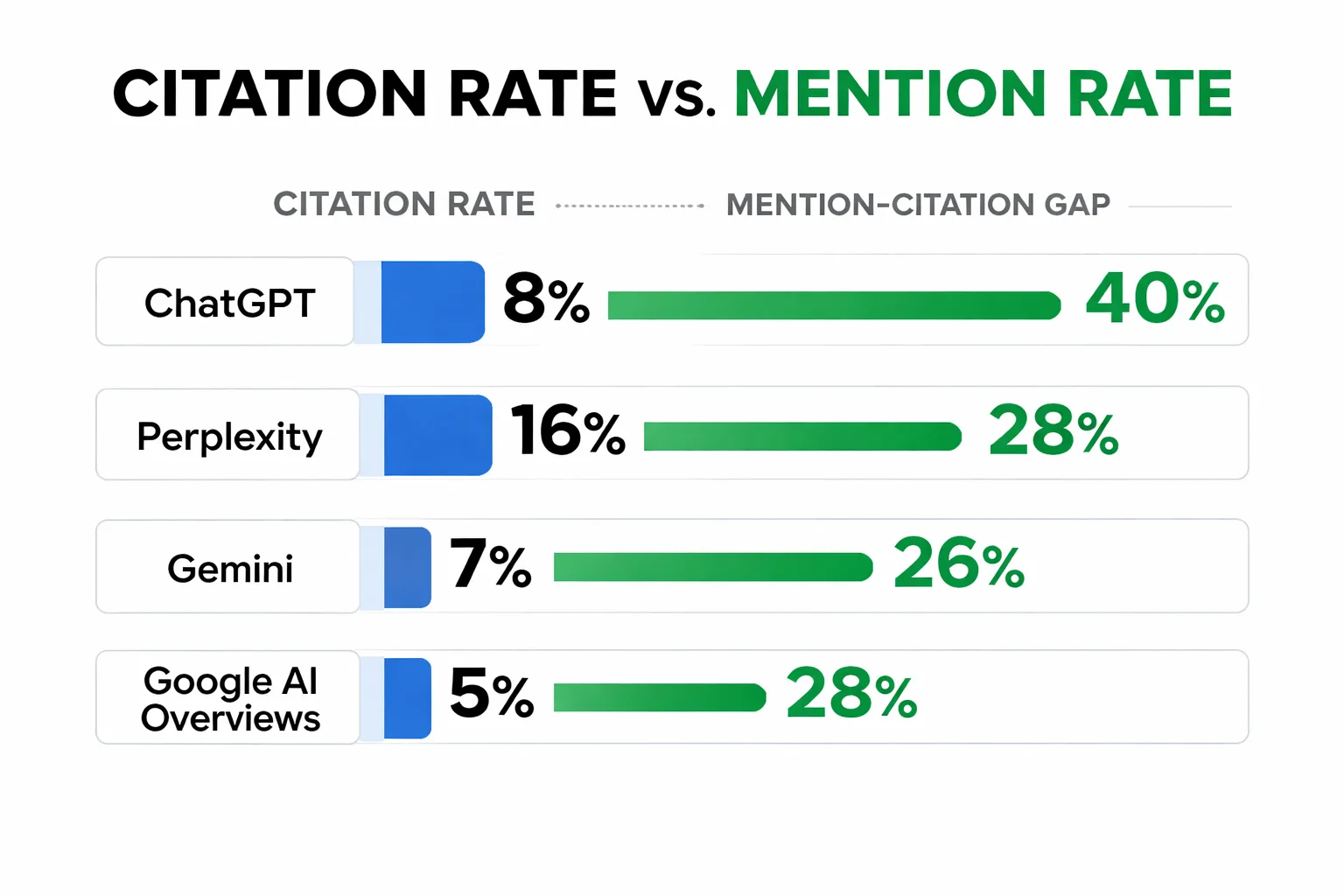
What's a healthy baseline? From what I've seen in my work, most brands start with a citation rate under 10% across all surfaces. Brands with active generative engine optimization programs typically reach 25-35% within six months. The top performers I've observed hit 50%+, but that requires sustained effort across content creation, PR, and review platform management.
Track these metrics per surface, not just in aggregate. A 30% overall citation rate might look great until you realize it's 60% on Perplexity and 0% on ChatGPT. Surface-level breakdowns tell you where to focus.
Also track your share of voice: out of all prompts where any brand in your category is mentioned, what percentage mentions yours? If competitors appear in 15 of 20 prompts and you appear in 4, your share of voice is roughly 21%. That number is more meaningful than raw citation count because it accounts for category competition.
Here's how to set up the spreadsheet formulas. In column A, list your 20 prompts. In column B, enter 1 if your brand was mentioned (any reference) and 0 if not. In column C, enter 1 if your brand was cited with a source link and 0 if not. In column D, enter 1 if your brand was mentioned first and 0 if not. In column E, enter 1 if any competitor was mentioned and 0 if not. Citation rate = SUM(C:C)/COUNT(A:A)100. Mention rate = SUM(B:B)/COUNT(A:A)100. Mention-citation gap = mention rate minus citation rate. Share of voice = SUM(B:B)/(SUM(B:B)+SUM(E:E))*100. These four formulas give you the core metrics for every surface you track.
One warning about metrics. I've tested tools that promise proprietary "citation scores" and "AI visibility indices." In my experience, these metrics are not grounded in anything Google or OpenAI has publicly endorsed. They're proprietary calculations that may or may not correlate with actual business outcomes. Stick to the raw numbers: mentions, citations, source domains, share of voice. They're transparent, reproducible, and you control the methodology.
I also want to flag a metric I've seen called "Share of Model" (SoM), which some tools position as a 2026 replacement for Share of Voice. The concept is sound: measuring what percentage of AI model responses mention your brand. But the execution varies wildly between tools. Some count any mention, others only count first mentions, others weight by response length. Until there's an industry standard, define your own methodology and stick to it. Consistency matters more than the specific formula you choose.
Step 5. Set Up a Weekly Monitoring Cadence
Your baseline is a snapshot. AI answers change. Models update. New sources get indexed. A one-time audit tells you where you stand today. Weekly monitoring tells you whether you're moving.
Here's how to structure a weekly cadence without burning out. Pick a day. Friday afternoon works for most teams because you can review the week's data and plan content for the following week. Re-run your 20 prompts across your priority surfaces. You don't need to run all 8 surfaces every week. Pick the 3-4 that matter most for your audience. For most B2B companies, that's ChatGPT, Perplexity, Google AI Overviews, and Gemini.
Log the same data points as your baseline: brand mentioned, brand mentioned first, competitor mentioned, source cited, response text. Then compare to the previous week. Flag three things: new citations (your brand appeared where it didn't before), citation drops (your brand disappeared from a prompt where it was previously cited), and source changes (the cited source shifted from one domain to another).
Citation drops are the most urgent signal. If your brand was cited in a high-value prompt last week and disappears this week, something changed. It might be a model update. It might be a competitor publishing better content. It might be a source page that went down. Investigate immediately.
Source changes are subtler but equally important. If Perplexity was citing your blog post and now cites a competitor's comparison page, your content is being out-ranked at the source level. That's a content quality signal, not a brand visibility signal.
Connect your tracking data to content decisions. If you're cited in 15% of recommendation prompts but 0% of comparison prompts, your content gap is comparison content. Write comparison pages, buyer's guides, and "vs." articles. If you're mentioned but never cited, your content exists in the model's training data but isn't findable as a live source. That means you need more crawlable, well-structured content on your own site.
This is where answer engine optimization connects to tracking. The tracking tells you what's broken. AEO tells you how to fix it.
For teams that want to skip the manual spreadsheet work, Meev runs these prompt checks automatically across every major AI search surface with daily refresh on SERP-driven surfaces and rolling refresh on LLM-driven surfaces. You see your citation rate, mention position, share of voice, and the actual response text behind every mention. When a citation drops, you get flagged. When a competitor gets cited where you aren't, you see the opportunity. The point isn't to replace the methodology I've described. It's to automate the tedious parts so you can spend your time on the analysis and content decisions that actually move the needle.
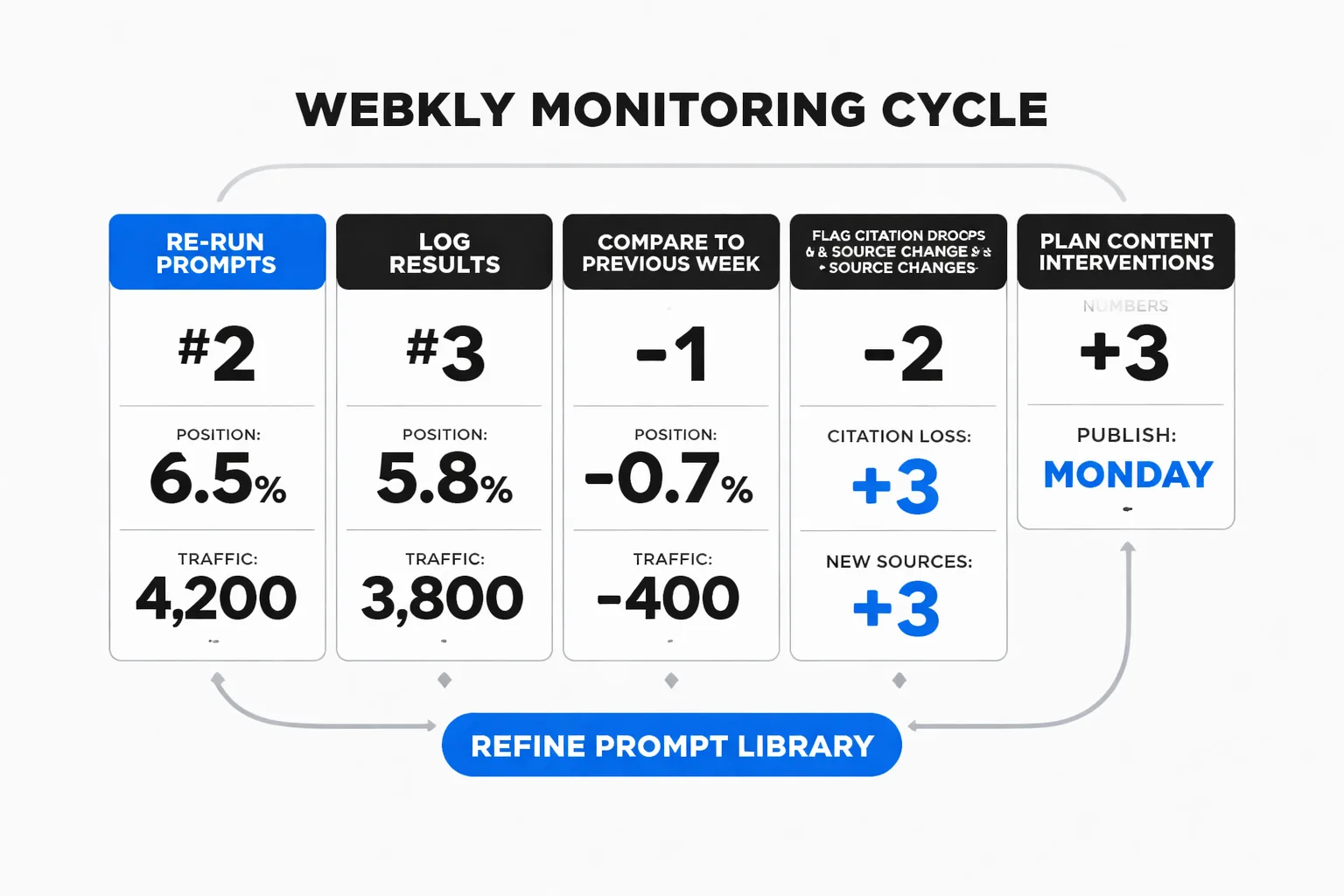
Let me walk through what a weekly review actually looks like in practice. You open your spreadsheet. Last week you had 7 citations across 20 prompts on Perplexity. This week you have 5. Two citations dropped. You read the response text for both. In one, your brand was replaced by a competitor who published a new comparison guide last Tuesday. In the other, the response changed format entirely and no brands were cited, just a generic category description. The first drop is actionable: you need to improve your comparison content. The second drop is a model behavior change: nothing you can do except monitor and see if it reverts.
That's the value of weekly monitoring. You catch changes while they're fresh enough to act on. Monthly monitoring would have missed the timing of the competitor's content publish. You wouldn't know what caused the drop. Weekly gives you the resolution to connect cause and effect.
Do you know if ChatGPT recommends your brand when buyers ask about your category?
Why Most Teams Skip Step 3
Step 3, recording cited sources, is the step most teams skip. I understand why. It's the most labor-intensive part of the process. Logging whether your brand was mentioned takes one cell. Logging the cited domain, page URL, page type, and ownership for every citation in every response takes five cells per data point and requires actually reading the response.
The tradeoff is real. If you have limited time, you might rationally skip source tracking and focus on mention tracking. But you'll be flying blind on the most important question: why is the AI citing what it's citing? Without source data, you can't diagnose whether your citation gap is a content problem, a PR problem, or a review platform problem. You'll know you're not cited, but you won't know what to do about it.
My recommendation: do the full source tracking for your first baseline. It's a one-time investment. After that, track sources only for your top 5 highest-value prompts during weekly monitoring. That gives you enough signal without creating a data entry bottleneck.
What This Won't Fix
This tracking methodology will tell you exactly where your brand stands in AI answers. It won't fix the underlying problems it reveals. If your brand isn't cited because no third-party sources discuss you, tracking won't create those sources. You need PR, review platform management, and community presence for that. If your brand is mentioned but described inaccurately, tracking won't correct the description. You need content that establishes your accurate positioning and gets indexed by the sources AI engines cite.
Tracking is diagnosis, not treatment. But you can't treat what you haven't diagnosed. And right now, most teams are treating blindly. They're publishing content, hoping it influences AI citations, and never checking whether it worked.
What this actually means
The teams that win in AI search over the next 12 months won't be the ones with the most content or the biggest budgets. They'll be the ones who track what's actually happening and respond fast. The gap between knowing you have a citation problem and fixing it is where competitive advantage lives in 2026.
Nearly 40% of web traffic now comes from non-traditional discovery methods. Pepper Content documented a 177% revenue increase on a two-year healthcare program by connecting AI search visibility to pipeline. But they also acknowledged that most published GEO case studies measure visibility, not pipeline. That's the honesty gap in this industry. Tracking citations is step one. Connecting those citations to revenue is step two. Most teams haven't done either.
If you're starting from zero, do the baseline this week. Twenty prompts, four surfaces, one spreadsheet. You'll know more about your AI visibility by Friday than 90% of your competitors do. Then build the weekly cadence. Then connect what you find to content decisions. The methodology is simple. The discipline is hard. But the data you get from ai citation tracking tools, whether manual or automated, is the foundation for everything else.
Start with the AI visibility checker if you want to skip the manual setup and see where you stand across all major AI surfaces today. The five-step methodology works whether you use a spreadsheet, a tool, or both. What matters is that you start tracking before your competitors do.
FAQ
What are ai citation tracking tools and do I need one?
AI citation tracking tools monitor whether your brand is mentioned and cited in responses from AI search engines like ChatGPT, Perplexity, and Gemini. You need one if your buyers use AI search to research solutions in your category. Most B2B and ecommerce brands do. You can start with manual tracking using the five-step methodology above, then graduate to a tool when manual tracking becomes too time-consuming. The key is to start somewhere, even if it's a spreadsheet.
How is LLM citation tracking different from traditional rank tracking?
Traditional rank tracking measures your position in Google's organic results for specific keywords. LLM citation tracking measures whether your brand appears in AI-generated answers, where in the answer you appear (first, in a list, last), and which sources the AI cited to build that answer. The metrics, surfaces, and methodologies are fundamentally different. Ranking #1 on Google does not guarantee citation by ChatGPT. The overlap between Google rankings and AI citations is thinner than most marketers assume, with only 11% of domains cited by both ChatGPT and Perplexity.
How often should I track AI citations?
Weekly is the right cadence for most teams. AI answers change more frequently than organic rankings because models update and web sources shift. Daily monitoring is ideal but usually overkill unless you're in a highly competitive category or running an active content campaign. Monthly is too infrequent because you'll miss citation drops and won't be able to connect them to specific events. Weekly gives you enough resolution to connect cause and effect when citations change.
Can I track AI citations for free?
Yes. The five-step methodology in this article can be executed with a spreadsheet and manual prompt runs. It costs nothing but time. Free tools like our ChatGPT visibility checker and LLMs.txt validator can supplement manual tracking. Paid tools become worthwhile when you need to track more than 20 prompts across more than 4 surfaces, or when you want automated alerts for citation changes. Start free, upgrade when the manual workload becomes unsustainable.
What's a good AI citation rate to target?
Most brands start under 10%. A reasonable six-month target is 25-35% citation rate across your priority surfaces. Top performers reach 50%+, but that requires sustained content creation, PR, and review platform management. Track your rate per surface rather than in aggregate, because surface-level differences reveal where to focus your effort. A 30% aggregate rate that's actually 60% on Perplexity and 0% on ChatGPT tells you exactly where your gap is.
Does tracking AI citations guarantee more citations?
No. Tracking is diagnosis, not treatment. It tells you where you're cited, where you're not, and which sources AI engines use. Closing citation gaps requires creating content that AI engines find and cite, building presence on the third-party sources they reference, and structuring your content for AI extractability. Tracking tells you whether those efforts are working. Without it, you're publishing content blind and hoping for the best.
About the Author
Judy Zhou, Founder
Judy Zhou leads content strategy at Meev, where she oversees AI-driven content research and publishing for hundreds of brands. With a background in SEO and editorial operations, she focuses on building content systems that rank on Google, get cited by AI search engines, and drive measurable business results.
Run your first AI visibility audit across every major AI search surface and see exactly where you're cited, where you're absent, and what to fix first.