

By Judy Zhou, Founder
Key Takeaways
- 96% of AI Overview citations come from sources with strong E-E-A-T signals (Wellows, 2025) — meaning credibility is a pre-filter, not a ranking factor, and weak E-E-A-T disqualifies you before relevance scoring begins.
- Only 38% of AI Overview citations pull from top-10 organic rankings (Ahrefs, 2026), so ranking well on Google does not guarantee AI citation — topical authority for AI search requires a separate strategy.
- The four signals that build AI topical authority are content depth with information gain, publishing consistency under named author entities, cross-domain citation building, and structured entity markup — volume alone does not move the needle.
- Measuring AI topical authority requires running target queries across Perplexity, ChatGPT, and Google AI Overviews, tracking citation frequency, and auditing the mention-citation gap — none of which Google Search Console reports.
Marcus had published 300 blog posts in eighteen months. His editorial calendar was color-coded, his content clusters were meticulously mapped, and his organic traffic had climbed steadily through 2024. Then, almost overnight, his inquiries dried up. Prospects told him they'd asked ChatGPT for recommendations in his niche and received three competitor names. None of them his. His content existed. It just didn't exist, as far as the AI was concerned. What Marcus lacked wasn't output. It was topical authority for AI search, and he'd never heard the term.
Topical authority for AI search is not the same thing as ranking well on Google. That distinction is the entire argument of this guide. AI engines like ChatGPT, Perplexity, and Google AI Overviews select citation sources based on trust signals, content depth, and entity coverage. Not link equity. The pattern I keep seeing, across brands that rank in the top three organically but go uncited by AI, is that they optimized for crawlers and forgot to build credibility for language models. According to Wellows' 2025 analysis of 2,400 AI Overview citations, 96% came from sources with strong E-E-A-T signals. That number should stop you cold. Ahrefs found that only 38% of AI Overview citations pull from the top 10 organic rankings — meaning most cited sources aren't even the top-ranked pages. And a large-scale study of 55,936 queries across LLM-based search engines confirmed that citation behavior varies dramatically between systems, with no single ranking signal predicting citation likelihood across platforms.
Topical Authority in Traditional SEO vs. AI Search. What Changed
In classic SEO, topical authority meant owning a subject through breadth and backlinks. You published a pillar page on, say, "email marketing," built out cluster content on deliverability, segmentation, and automation, and earned links from adjacent domains. Google's PageRank system interpreted those links as votes of confidence. The more votes, the more authority. The model was fundamentally social: other sites vouching for yours.
AI search flips the evaluation mechanism. Language models don't crawl a graph of links at query time. They retrieve from a pre-trained knowledge base, or in the case of retrieval-augmented systems like Perplexity, they pull from indexed sources based on semantic relevance and credibility signals they can parse directly from the content itself. The shift is from link equity to information density. A page with zero backlinks but original research, named author credentials, structured entity markup, and consistent factual coverage of a topic can outperform a heavily linked competitor in AI citation frequency.
The practical consequence is brutal for legacy content operations. A brand that spent five years building a backlink profile but never invested in E-E-A-T signals. Author bios, primary research, third-party validation, structured data. May rank on page one of Google while being completely invisible to every major AI search surface. Marcus's story isn't unusual. It's the default outcome for teams that optimized for the old game without noticing the rules changed.
There's also a coverage depth distinction that matters. Traditional SEO rewarded breadth: more pages, more keywords, more cluster nodes. AI search rewards depth within a coherent entity framework. A site with 40 genuinely comprehensive articles that answer adjacent questions, cite primary sources, and demonstrate consistent expertise in a narrow domain will outperform a site with 400 thin cluster pages that technically "cover" the topic. The AI is trying to identify the most credible source for a specific claim. Thin content that exists to capture keyword traffic provides no signal it can use.
How AI Engines Decide Which Sources 'Know' a Topic
Different AI systems use meaningfully different retrieval architectures, and conflating them is a mistake I see constantly in generative engine optimization discussions.
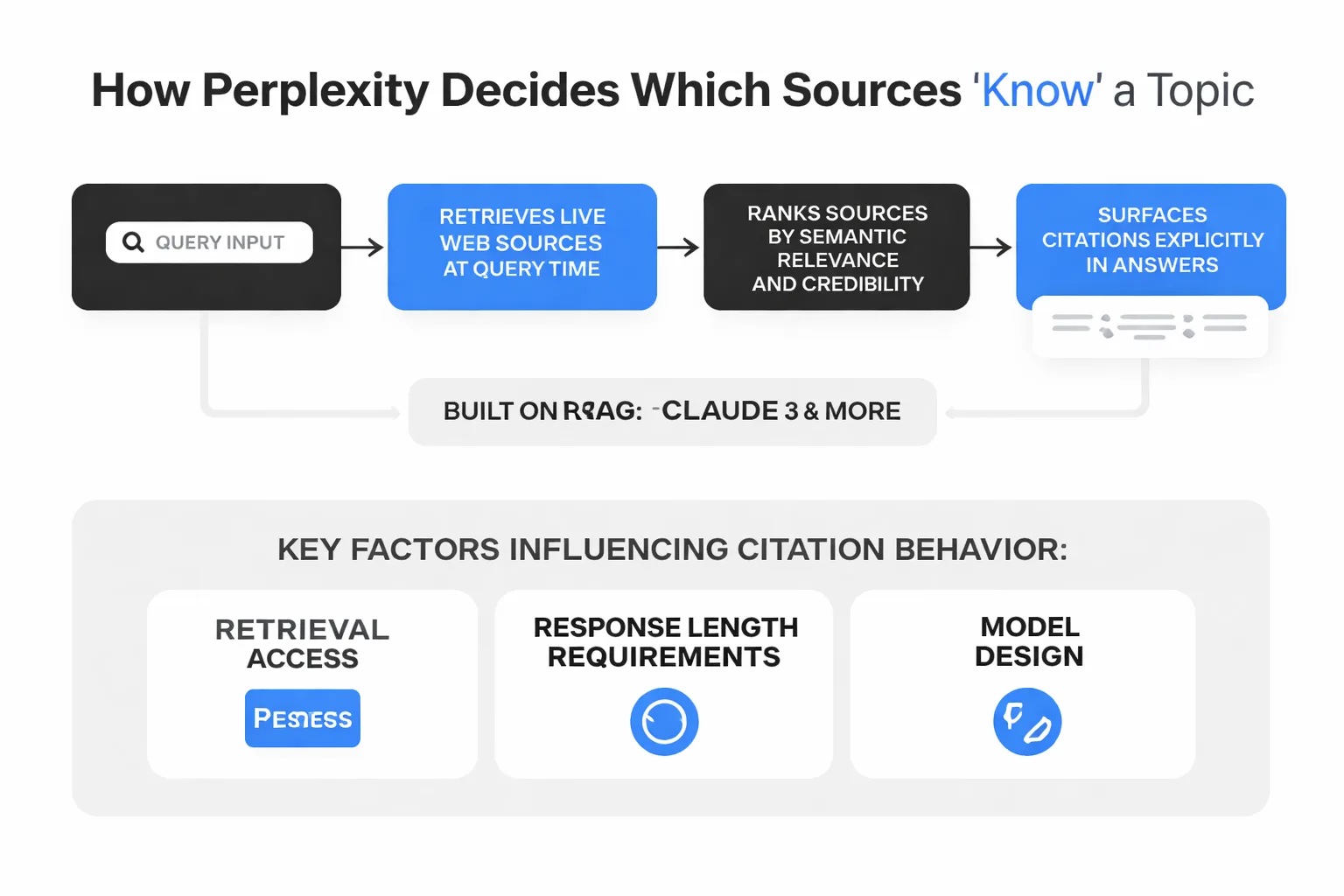
Perplexity is a citation-driven answer engine that retrieves live web sources at query time, ranks them by semantic relevance and credibility, and surfaces the citations explicitly in its answers. Because it uses retrieval-augmented generation (RAG), your content needs to be indexable, structured, and dense enough in relevant entities that the retrieval layer selects it over competitors. Perplexity's citation behavior is shaped by retrieval access, response length requirements, and model design. Not by your domain authority score. If you want to understand where you currently stand, running your target queries through a Perplexity AI visibility checker gives you a baseline before you start optimizing.
ChatGPT (when using web search) pulls from Bing's index and applies its own relevance and trust filters on top. The Search Atlas analysis of 5,504,399 responses from 748,425 queries found clear structural differences in citation behavior between ChatGPT, Gemini, and Perplexity. Shaped by each system's retrieval access and model design. There is no single strategy that optimizes equally for all three. An AI model comparison across these surfaces reveals that what earns a citation on Perplexity (real-time retrieval, explicit sourcing) differs from what earns inclusion in a ChatGPT response (pre-trained knowledge + Bing retrieval) or a Google AI Overview (Google's own index with heavy E-E-A-T weighting).
Google AI Overviews sit closest to traditional SEO in their inputs, but the output logic is different. Google is synthesizing an answer, not just ranking pages. The Wellows analysis showing 96% of AI Overview citations come from strong E-E-A-T sources suggests Google applies a credibility pre-filter before relevance ranking kicks in. If your content can't pass that filter. Because it lacks author entities, original data, or structured markup. It's excluded from the candidate pool regardless of keyword optimization.
The common thread across all three systems is citation co-occurrence. When authoritative sources in a domain consistently cite or reference the same entity, that entity's credibility signal amplifies. This is why cross-domain citation building matters for LLM optimization in a way that's distinct from traditional link building. You're not trying to pass PageRank. You're trying to appear in the training data and retrieval indexes as a recognized, credible entity within your topic domain.
The 4 Signals That Build Topical Authority for AI Search
Signal 1: Content Depth with Information Gain
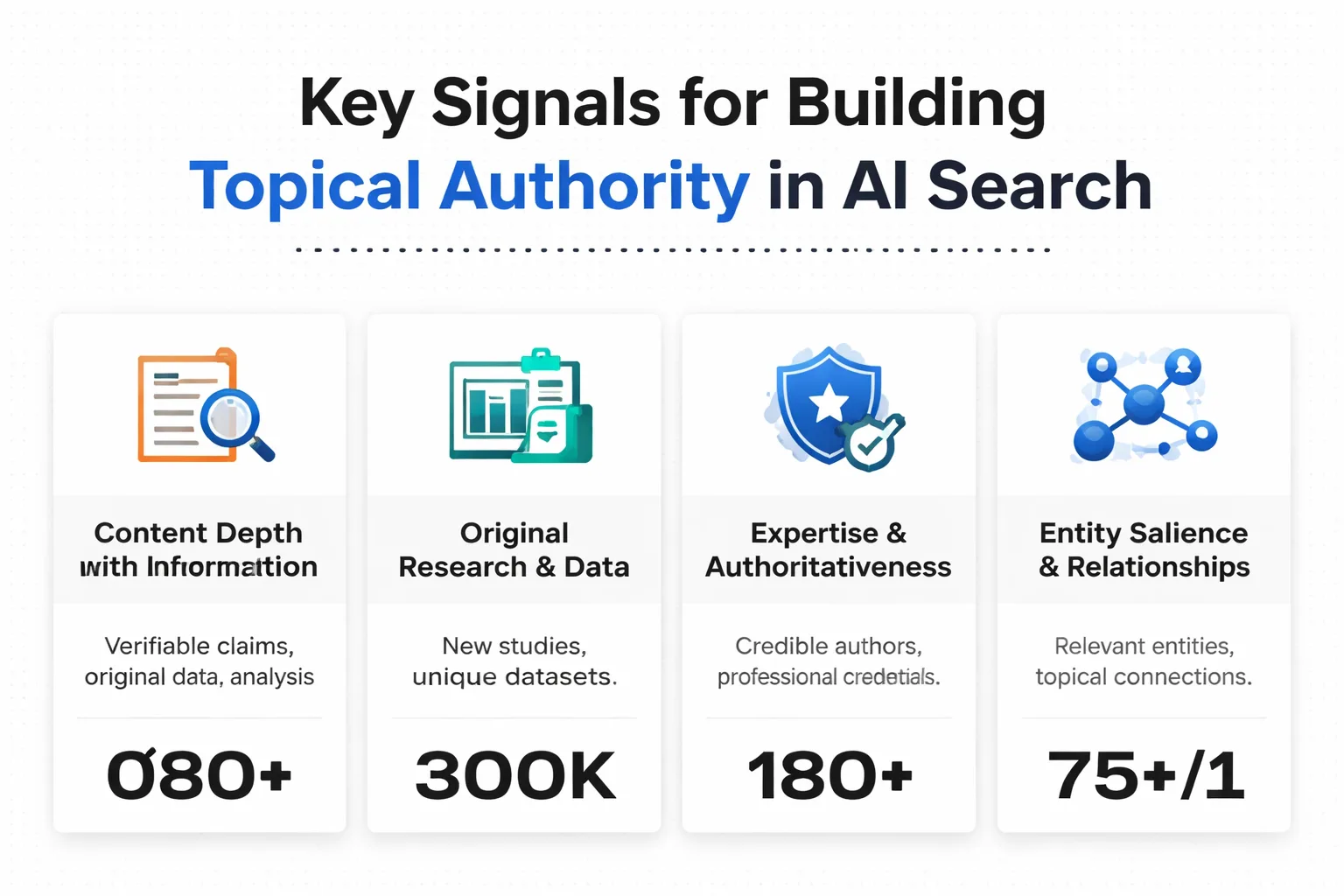
AI engines are not impressed by word count. They're looking for information gain. Content that adds a verifiable claim, original data point, or expert interpretation that isn't already present in the consensus of existing sources. Perplexity's architecture, built on retrieval-augmented generation using models including Anthropic's Claude 3, selects sources that contribute meaningful information backed by proper attribution. A 3,000-word article that restates what Wikipedia already says provides zero information gain. A 900-word article with original survey data, a named methodology, and a counterintuitive finding earns citations.
The practical move: identify the specific claims in your niche that are either unsourced, outdated, or contested. Then produce content that resolves that gap with primary research, expert interviews, or documented case analysis. This is what answer engine optimization actually requires at the content level. Not more coverage, but better evidence.
Signal 2: Publishing Consistency Within a Coherent Entity Framework
Consistency here doesn't mean volume. It means that every piece of content you publish reinforces a coherent entity identity: the same named authors, the same topic domain, the same organizational voice. AI systems build representations of entities over time. A brand that publishes 10 deeply sourced articles on SaaS pricing strategy, all attributed to the same named expert with verifiable credentials, develops a stronger entity signal than a brand that publishes 100 articles across 30 topics under generic bylines.
Author entity profiles matter more than most content teams realize. When a language model encounters a claim, it can (in retrieval contexts) evaluate whether the source has a trackable record of accurate claims in that domain. A named author with a LinkedIn profile, published bylines on recognized industry sites, and consistent topical focus is a parseable entity. A generic "Staff Writer" byline is not.
Signal 3: Cross-Domain Citation Building
The Omniscient Digital analysis of 23,000+ AI citations found that reviews and social proof claimed 57% of citations, while directory listings and brand profiles took 17%. This surprised me when I first read it. It tells you that AI citation selection is not purely about the quality of your own content. It's about your presence across the broader information ecosystem that AI systems index.
This is where publisher pitching for AI citations becomes a distinct strategy from traditional PR or link building. You're not trying to earn a backlink for PageRank. You're trying to get your brand mentioned, cited, or profiled on the domains that AI engines already trust and cite frequently. Meev's Citation Path feature identifies exactly which publishers AI engines cite most often for your topic cluster, finds verified contact information, and drafts outreach pitches grounded in your knowledge base. Closing the gap between knowing you need citations and actually getting them.
One important caveat from the research: outreach cannot be fully automated. Finn McKenty's documented AI outreach methodology found that 25% of AI-generated prospect lists required manual removal as unfit after human review. AI can identify targets and draft pitches. Humans need to validate fit and personalize the approach.
Signal 4: Structured Entity Coverage
Schema markup is not dead. It's more important than ever, because structured data gives AI retrieval systems explicit, parseable signals about what your content covers, who authored it, and what claims it makes. Article schema with named author entities, FAQ schema on question-answering content, HowTo schema on instructional pieces. These all increase the probability that a retrieval system correctly classifies your content as authoritative for specific query types.
Semrush's research found that informational queries trigger AI Overviews at the highest rate. If your content on informational topics lacks structured markup that signals its informational intent and expertise, you're relying on the AI to infer what you should have stated explicitly. Don't make the AI guess.
Want to see which AI engines are citing your competitors — and where you're invisible?
How Does E-E-A-T Function Differently for AI Search?
This is the question I get most often from content teams, and the honest answer is that E-E-A-T for AI search functions as a pre-filter, not a ranking signal. In traditional Google search, E-E-A-T influenced quality rater assessments that fed into algorithmic updates. In AI search, it operates earlier in the process.
The Wellows analysis finding that 96% of AI Overview citations come from strong E-E-A-T sources implies a binary gate: sources that can't demonstrate credibility markers are excluded from the candidate pool before relevance scoring begins. You don't get a partial score for having some E-E-A-T signals. You either clear the bar or you don't appear in the answer.
There's an active debate in the SEO community about whether LLM-optimized content without explicit human authorship markers can satisfy E-E-A-T requirements. Duane Forrester frames it clearly: "trust and verifiable expertise, not just rankings, will decide which brands are visible when AI systems write the answers." His position is that human-authored authority signals are non-negotiable because AI systems cannot verify expertise that isn't attributable to a real, traceable human entity.
I think he's right, and here's why. A PMC study on human vs. LLM creativity found that LLMs can achieve comparable linguistic mechanisms to humans. But linguistic quality is not the same as verifiable expertise. An AI can write a technically fluent article on cardiothoracic surgery. It cannot have performed a cardiothoracic surgery. The E-E-A-T framework, especially the first "E" (Experience), requires that someone with actual domain experience produced or validated the content. Brands that publish AI-generated content without human expert review and named attribution are betting that AI search systems won't notice. That bet is getting riskier every month.
The contrarian take that nobody wants to hear: most brands don't have an E-E-A-T problem because they're publishing AI content. They have an E-E-A-T problem because they never built verifiable author entities in the first place. The AI content question is secondary.
How to Measure Whether You Have Topical Authority in Your Niche
Auditing topical authority for AI search requires a different methodology than a traditional SEO audit. Here's the process I use.
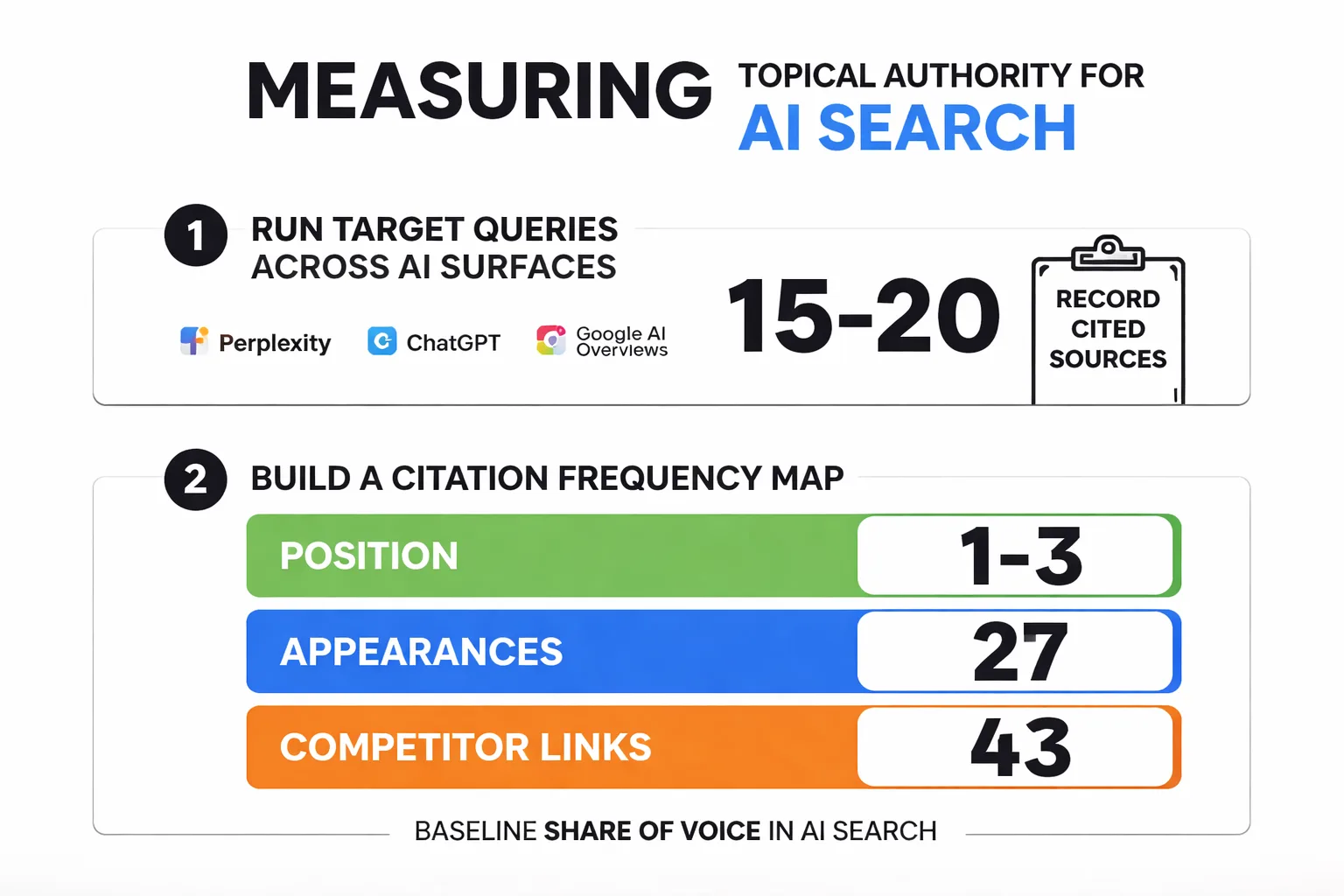
Step 1: Run your target queries across AI surfaces. Pick 15-20 queries that represent your core topic domain. The questions your ideal customer would ask ChatGPT, Perplexity, or Google before buying. Run each query and record which sources are cited in the answers. Do this across at least three surfaces: Perplexity, ChatGPT with web search enabled, and Google AI Overviews. A free AI SEO audit can give you a starting snapshot of where you currently appear.
Step 2: Build a citation frequency map. Tally how often your domain appears in the answers, where in the response it appears (first citation, buried in a list, not at all), and which competitors are cited most frequently. This is your baseline share of voice in AI search. Meev's AI visibility tracking does this automatically across every major AI search surface, with weekly trend data and the actual response text behind each mention.
Step 3: Identify the mention-citation gap. This is the gap between how often your brand is mentioned in AI answers without being cited as a source, versus how often it's cited with attribution. A large mention-citation gap indicates that AI systems know your brand exists but don't classify your content as authoritative enough to cite. That's an E-E-A-T and content depth problem, not a visibility problem.
Step 4: Audit competitor citation sources. For the competitors that are being cited, identify which external publishers are linking to or mentioning them in contexts that AI engines index. These are your highest-priority outreach targets. The cited-source leaderboard in Meev's platform shows exactly which domains AI engines cite most often for your topic cluster. Which tells you where to focus publisher pitching efforts.
Step 5: Score your own content against the 4 signals. For each piece of content in your core topic cluster, assess: Does it contain original data or information gain? Is it attributed to a named author with verifiable credentials? Has it been cited or mentioned by domains that AI engines trust? Does it use structured entity markup? Content that scores low on all four signals is a liability, not an asset, in AI search.
"Winning" topical authority in AI search doesn't look like a traffic spike. It looks like consistent citation presence across multiple AI surfaces for your core queries, a named author entity that appears repeatedly in AI-generated answers, and a shrinking mention-citation gap over 90-day measurement windows. The AI visibility tool category exists specifically because Google Search Console doesn't show you any of this data. You need a dedicated measurement layer.
One thing I want to be direct about: this is not a 30-day project. The pattern I keep seeing is that brands expect topical authority for AI search to respond like a technical SEO fix. You implement the change, you see the result. It doesn't work that way. AI systems update their knowledge representations on their own schedules. Building the signals takes 90 to 180 days of consistent, quality-gated publishing and citation outreach before you see measurable shifts in citation frequency. The brands winning in AI search right now started this work in late 2025.
FAQ
How is topical authority for AI search different from domain authority?
Domain authority is a third-party metric that approximates Google's assessment of your site's link profile. Topical authority for AI search is about whether language models classify your content as a credible, citable source for a specific subject. A site with low domain authority but strong E-E-A-T signals, original research, and consistent entity coverage can earn AI citations that a high-DA site with thin content cannot. They measure different things and require different strategies.
Does publishing more content help with AI topical authority?
Volume alone doesn't. The research is clear that AI citation selection prioritizes information gain and credibility signals over content quantity. Publishing 50 thin articles that restate existing consensus adds no topical authority signal. Publishing 10 articles with original data, named expert authorship, and structured entity coverage builds measurable authority. Quality-gated publishing. Where weak drafts are blocked before they reach your CMS. Is more effective than high-volume output.
Can small brands or solo founders compete for AI citations against large publishers?
Yes, in narrow topic domains. AI systems don't weight citation selection purely by brand size. A solo founder with a tightly focused knowledge base, consistent named authorship, and original research in a specific niche can outperform a large media brand that covers the same topic superficially. The constraint is topic breadth: the narrower and deeper your focus, the more achievable topical authority becomes for a smaller operation.
How often do AI engines update their citation sources?
It varies by system. Perplexity retrieves live web content at query time, so new content can appear in citations within days of indexing. ChatGPT's base knowledge has a training cutoff, but web search mode pulls from Bing's live index. Google AI Overviews reflect Google's index with its normal crawl cadence. There's no single refresh schedule. Which is why continuous monitoring across surfaces matters more than a one-time audit.
What's the fastest way to close a mention-citation gap?
Publisher outreach targeting the domains AI engines already cite for your topic cluster. If Perplexity consistently cites three industry publications when answering queries in your niche, getting your brand mentioned or profiled on those publications is the highest-leverage move available. This is faster than waiting for AI systems to discover and elevate your own content organically. The outreach needs to be personalized and human-validated. Automated mass outreach produces low acceptance rates and can damage brand reputation with the publishers you most need.
About the Author
Judy Zhou, Founder
Judy Zhou leads content strategy at Meev, where she oversees AI-driven content research and publishing for hundreds of brands. With a background in SEO and editorial operations, she focuses on building content systems that rank on Google, get cited by AI search engines, and drive measurable business results.
Meev tracks your citation presence across every major AI search surface and shows you exactly which publishers to target to close the gap. Start your free trial today.