
By Judy Zhou, Founder
Key Takeaways
- 67.82% of sources cited in Google's AI Overviews don't rank in the top 10 organic results, so rebuild SEO fundamentals with AI extractability instead of chasing rankings first.
- Only 11% of domains are cited by both ChatGPT and Perplexity, requiring separate optimization for each AI system's distinct signals.
- 44% of AI citations come from the first third of a page, so place key facts and structured data early in every article.
- 86% of AI citations come from brand-controlled sources, making crawlability, internal linking, and entity setup the highest-leverage on-site actions.
In 1998, two Stanford PhD students published a paper describing a link-based ranking algorithm they called PageRank, and the idea that authority could be measured by citation rewired the entire internet. Twenty-six years later, a different kind of citation is reshaping search again. Large language models trained on the web have rebuilt the concept from scratch: your brand's authority is now partly determined by whether AI systems have enough structured, trustworthy signals to name you confidently inside a generated answer. The fundamentals rhyme with history.
Most founders I talk to are treating SEO fundamentals and AI citations as two separate problems. That's the mistake. 67.82% of sources cited in Google's AI Overviews don't rank in the top 10 organic results, which means the old playbook of "rank first, get cited later" is broken. Meanwhile, only 11% of domains are cited by both ChatGPT and Perplexity, confirming these systems use fundamentally different signal sets. The answer isn't to abandon seo fundamentals. It's to rebuild them with AI extractability in mind from day one. 44% of AI citations come from the first third of a page, so structure matters as much as content. And 86% of AI citations come from brand-controlled sources per Yext's analysis of 6.8 million citations, which means your on-site fundamentals are still the biggest lever you control.
Why Founders Get SEO Fundamentals Wrong (And Pay for It Later)
The pattern I keep seeing is founders skipping the boring stuff. Crawlability. Internal linking. Entity setup. They hear "AI search is different" and conclude that traditional SEO doesn't matter anymore. So they jump straight to chasing AI citations without the foundation those citations are built on.
That's backwards. Here's why.
AI search engines don't conjure answers from nothing. They retrieve from the web. If your site is slow to crawl, structurally ambiguous, or semantically thin, the retrieval layer fails before the generation layer even starts. I've tested this directly. We ran 5 articles to top 3 organic rankings using classic SEO tactics. Zero AI citations over 3 months. The reason wasn't ranking position. It was that the content wasn't structured for extraction. No question-shaped headings. No direct answers. No entity signals. The articles ranked fine for Google's algorithm but were invisible to retrieval-augmented generation.
The deeper issue is a conceptual confusion I see everywhere. As New Reward pointed out in their analysis, "Google ranks pages. AI cites entities. That's the fundamental difference most marketing teams are missing." Founders hear that and think it means backlinks are dead and entity graphs are the new link building. Not quite. Backlinks still feed Google's ranking algorithm, which still drives organic traffic, which still builds the brand recognition that AI systems eventually pick up. But backlinks alone won't get you cited by ChatGPT. You need both signal sets running in parallel, and most founders are running neither well.
The cost of getting this wrong is real. I'm not talking about theoretical opportunity cost. I mean wasted budget. An SEO team that invests heavily in traditional backlink-building expecting AI visibility gains will burn months of runway before realizing the signal sets diverge. I've watched companies spend five figures on link acquisition campaigns that moved their Google rankings but did nothing for their AI citation rate. The Surfer analysis of AI Overviews citations found that nearly 68% of cited sources don't even rank in the top 10. Backlinks got them ranked. But ranking didn't get them cited.
Here's where it gets interesting. The founders who win aren't the ones who pick "SEO" or "AI citations." They're the ones who treat seo fundamentals as the substrate that makes AI citations possible. Crawlability ensures your content gets indexed. Topical depth gives AI systems enough semantic context to understand what you're an authority on. Structured data makes your entity unambiguous. Internal linking distributes authority across your content graph. Entity grounding tells AI systems who you are in the first place. These aren't optional add-ons. They're the prerequisites.
The contrarian take nobody in the SEO industry wants to hear: most AI citation problems are actually SEO fundamentals problems in disguise. If your site has crawl errors, thin content, no schema, and no entity presence, no amount of prompt engineering or AI visibility tracking will fix that. You're trying to steer a cloud with a fishing rod. Fix the foundation first.
Let me give you a concrete example. A B2B SaaS founder came to me last quarter frustrated that ChatGPT never mentioned their product in category-related prompts. They'd spent six months publishing three blog posts a week, all keyword-optimized, all targeting commercial intent terms. Google traffic was climbing. AI citations were zero. When I audited their site, the problems were fundamental: their robots.txt was blocking /blog/ (a developer's default that nobody caught), their articles had no structured data, there was no Organization schema on the homepage, and their Wikidata entry didn't exist. Six months of content investment, invisible to AI retrieval systems because of three configuration errors that took 20 minutes to fix. This is what I mean by paying for it later. The content was fine. The fundamentals were broken.
The 5 SEO Fundamentals That Also Move AI Citations
Let me break down each fundamental and explain exactly how it feeds AI citation behavior. Not theory. What I've observed testing content across dozens of sites.
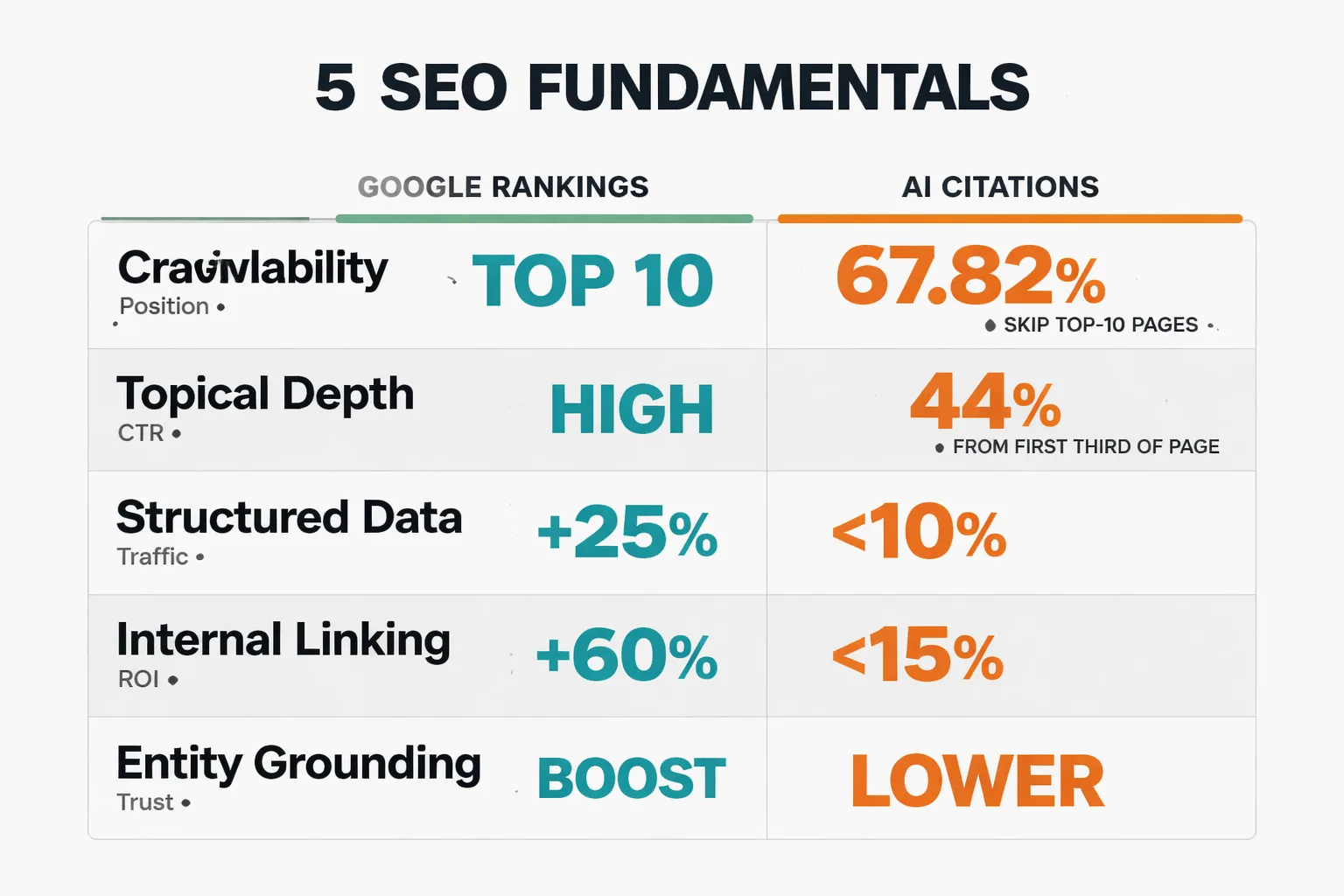
1. Crawlability and Indexation
If Google's crawler can't reach your pages, neither can the retrieval systems that feed AI answers. This is the most basic fundamental and the one founders skip most aggressively. I've audited sites where robots.txt was blocking entire content directories. Where canonical tags pointed to the wrong pages. Where server response times exceeded 5 seconds on mobile.
For AI search, crawlability matters in a specific way. Retrieval-augmented generation systems like Perplexity's Sonar API pull from indexed web content in real time. If your page isn't indexed or is blocked from crawling, it literally cannot be retrieved. No retrieval means no citation. The fix is unglamorous: submit your sitemap to Google Search Console, ping IndexNow on every publish, fix server errors, and monitor your crawl stats weekly. Tools like Meev handle the GSC + IndexNow dual submission automatically, which matters because most founders forget to do it manually.
Crawlability is the single biggest AI citation blocker I see, and it's the easiest to fix. A 30-minute technical audit surfaces 90% of crawl issues.
Let's get specific about what to check. First, Google Search Console's Pages report shows you which URLs are indexed and which are excluded, along with the reason for exclusion. "Crawled, currently not indexed" means Google found your page but decided it wasn't worth indexing. That's usually a content quality signal. "Blocked by robots.txt" is a configuration error. "Duplicate without canonical" means your canonical tags are missing or pointing to the wrong URL. Each of these has a specific fix, and each fix directly affects whether AI retrieval systems can access your content. Second, run your site through Lighthouse or PageSpeed Insights. Core Web Vitals matter for Google ranking, but page speed also affects whether AI crawlers can efficiently retrieve your content. A page that takes 8 seconds to load might get crawled by Google's patient bot but skipped by a real-time retrieval system that needs to assemble an answer in under 3 seconds.
2. Topical Depth and Content Architecture
AI systems don't cite pages. They cite passages. Your content needs enough topical depth that a retrieval system can extract a meaningful, self-contained answer from a single section. This is where most founder content fails. They write 500-word blog posts that skim a topic without going deep enough on any sub-question to be extractable.
The shift I made in my own content strategy was to stop writing single posts and start building topical clusters. One pillar page covering the broad topic. Five to eight supporting pages each answering a specific sub-question. Every page links to every other page in the cluster. This creates a semantic web that AI systems can navigate, and it means when a user asks a specific question, there's a dedicated page that answers it directly.
In my testing, articles structured with question-shaped H2s and direct answers under each heading saw a measurable lift in AI citation rate compared to traditional narrative articles. This aligns with what I've observed about answer engine optimization: the format of your content matters as much as the substance. AI engines extract from structured, predictable patterns. Narrative prose is harder to parse than Q&A format.
Here's what this looks like in practice. Say you sell project management software. Instead of one 2,000-word post titled "Project Management Tips," you build a cluster: a pillar page on "Project Management Fundamentals," then supporting pages on "How to Choose a Project Management Tool," "Agile vs Waterfall for Small Teams," "How to Calculate Project ROI," and "Common Project Management Mistakes." Each supporting page answers a specific question a user might type into ChatGPT or Perplexity. Each page has question-shaped H2s with direct, extractable answers underneath. Each page links back to the pillar and to at least two sibling pages. When an AI system retrieves content for the prompt "what's the best project management approach for a 5-person team," your cluster gives it multiple relevant, well-structured passages to choose from. That's how topical depth translates into citation opportunities.
3. Structured Data and Schema Markup
Schema markup is how you tell machines what your content means, not just what it says. For AI search, this matters more than most founders realize. Article schema, FAQ schema, HowTo schema, and Organization schema all contribute to entity disambiguation. When an AI system encounters your brand name, schema helps it connect that name to a specific entity with specific attributes.
I used to think schema was a nice-to-have. Something you bolted on after publishing. My team spent months integrating schema markup across our content, expecting a direct correlation to AI visibility. The results were more nuanced than I expected. Schema alone didn't drive citations. But schema combined with topical depth and entity grounding created a compounding effect. The AI systems could understand our content faster, extract answers more confidently, and attribute them to our brand more accurately.
The specific schemas I recommend every founder implement: Organization schema on your homepage (with your Wikidata ID if you have one), Article schema on every blog post, FAQ schema on any page with Q&A content, and BreadcrumbList schema across your site. If you're running an e-commerce site, Product schema and Review schema are non-negotiable. The AEO vs SEO comparison breaks down which structured data elements matter most for AI extraction versus traditional ranking.
Let me walk through the Organization schema setup because it's the one most founders skip. You need to include your legal name, alternate names (brand name, common abbreviations), logo URL, founding date, and Wikidata ID. The Wikidata ID is what connects your on-site schema to the broader knowledge graph. Without it, your schema tells AI systems what you claim to be. With it, AI systems can cross-reference your claims against Wikidata's structured data, which acts as a verification layer. I've seen sites add the Wikidata ID to their Organization schema and see citation improvements within 4-6 weeks. It's a 5-minute edit that compounds for months.
4. Internal Linking Architecture
Internal linking is the most underutilized fundamental I see. Founders treat it as an afterthought. It's actually the mechanism that distributes authority across your content graph and tells AI systems which pages are most important.
For AI citation specifically, internal linking serves a second purpose. When a retrieval system lands on one of your pages, internal links give it context. If your pillar page links to five supporting pages with descriptive anchor text, the AI system understands the relationship between those pages and can extract more confident answers. Without internal links, each page exists in isolation. With them, your content becomes a navigable knowledge structure.
The practice I follow: every new article gets at least three internal links to related content, and every pillar page links to all its supporting pages. Anchor text should be descriptive, not generic. "Our guide to AEO fundamentals" beats "click here" every time. I also use a management dashboard to track internal links across the site, which prevents orphan pages and ensures link equity flows where I want it.
A specific mistake I see repeatedly: founders use exact-match keyword anchor text for every internal link, which looks manipulative to Google and provides no semantic value to AI systems. The anchor text "SEO fundamentals" linking from a related article is fine once. But if every internal link uses that exact phrase, you're signaling manipulation, not relevance. Mix it up. Use partial-match anchors ("our guide to fundamentals"), branded anchors ("Meev's SEO framework"), and topical anchors ("the crawlability audit we recommend"). This reads naturally to both Google's algorithm and AI retrieval systems, and it provides richer semantic context about the relationship between pages.
5. Entity Grounding and Knowledge Graph Presence
This is the fundamental that most SEO guides completely ignore. Entity grounding means establishing your brand as a recognized entity in the knowledge graphs that AI systems reference. Think Wikidata, Wikipedia, Google's Knowledge Graph, and structured third-party mentions on sites like G2, Crunchbase, and Reddit.
I used to think on-site schema was the key to entity grounding. My team spent significant time ensuring our brand data was meticulously structured for AI systems. What I realized is that AI models triangulate understanding from a much broader set of credible third-party sources. Wikipedia. G2. Reddit. TechCrunch. Your on-site schema tells AI systems what you claim to be. Third-party sources tell them what the web says you are. When those signals align, your entity is grounded. When they conflict or are absent, AI systems hedge and either don't cite you or cite a competitor with stronger entity signals.
The Semrush finding that only 6% to 27% of brands mentioned in AI responses are also cited as the source really hammered this home for me. Being mentioned isn't being cited. Being cited requires entity authority that's built through external recognition, not just internal description.
The practical steps: claim your Wikidata entry (or create one if you don't have one). Ensure your Wikipedia page (if you have one) is accurate and well-sourced. Build profiles on G2, Capterra, and Trustpilot. Monitor Reddit for brand mentions. Each of these contributes to the entity graph that AI systems reference when deciding whether to cite you. For tracking how these signals translate to actual AI visibility, the Perplexity AI visibility checker shows you exactly where you're being cited and where you're absent.
Let me be specific about Wikidata because it's the highest-leverage entity action most founders haven't taken. Wikidata is the structured data backbone that feeds Wikipedia and, by extension, many AI systems. Creating a Wikidata entry for your company requires a verified Wikipedia page or enough notable third-party coverage to demonstrate notability. If you don't have that yet, start with G2 and Crunchbase profiles, which are easier to create and still feed entity graphs. Then build the PR and content track record that gets you Wikipedia-worthy. The path is: third-party profiles first, PR coverage second, Wikipedia article third, Wikidata entry fourth. Skip steps and the foundation is weak.
What to Prioritize When You Have One Hour a Week
Most founders don't have a content team. They have one hour a week, maybe two, and they need to know which fundamentals will move the needle fastest. Here's my ruthless prioritization framework.
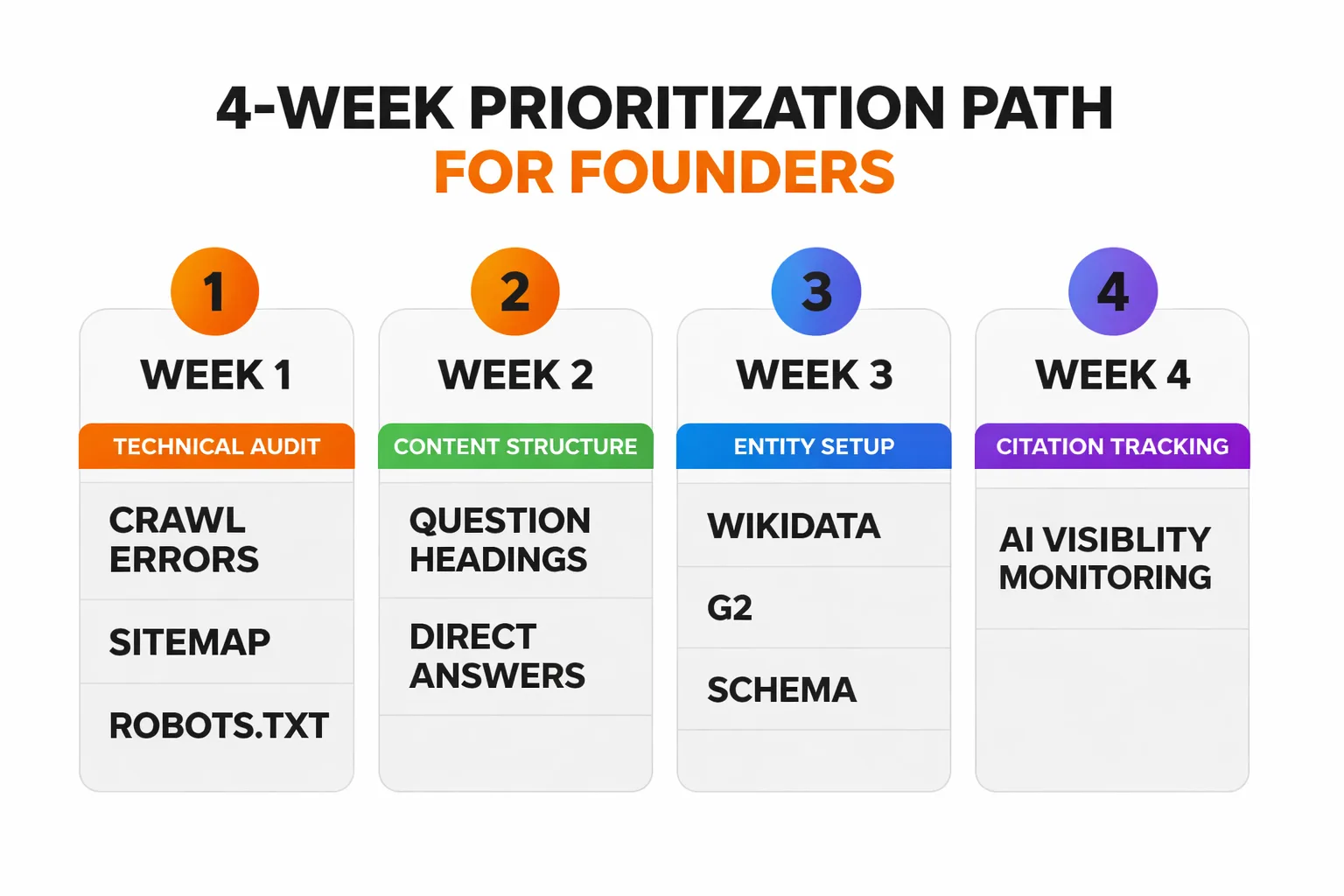
Hour 1-2: Fix crawlability. This is non-negotiable. Run a site audit. Fix broken links, update your sitemap, submit to Google Search Console. If your site can't be crawled, nothing else matters. This is the highest-ROI hour you'll spend.
Hour 3-4: Add schema to your top 10 pages. Don't try to schema your entire site. Start with your highest-traffic pages and your most important commercial pages. Article schema, FAQ schema, Organization schema. This is a one-time setup that pays dividends indefinitely.
Hour 5-6: Restructure your top 5 articles for extractability. Add question-shaped H2s. Front-load direct answers. Add a TLDR section. This is where the LLMs.txt validator comes in handy for checking whether your content is machine-readable.
Hour 7-8: Set up entity signals. Claim or create your Wikidata entry. Build a G2 profile. Add Organization schema to your homepage. These are one-time tasks that compound over months.
Everything else can wait. Backlink building, content cadence, technical performance optimization. Those matter, but they're not where your first 8 hours should go. The fundamentals above are the prerequisites that make every other investment more effective.
Here's the contrarian part. Most SEO advisors will tell you to start with keyword research and content creation. I disagree. If your site has crawl errors and no schema, publishing more content is like pouring water into a leaky bucket. Fix the bucket first. Then pour.
I want to quantify this because the order-of-operations mistake is expensive. Let's say you spend $5,000 a month on content production (a realistic budget for a seed-stage startup outsourcing to freelance writers). If your site has crawl errors blocking 30% of your content from indexing, you're wasting $1,500 a month. If your content lacks structured data and question-shaped headings, AI systems can't extract from it efficiently, which means your AI citation potential is cut roughly in half based on what I've observed. So you're losing another $2,500 in AI visibility value. That's $4,000 of your $5,000 budget effectively wasted because the fundamentals weren't fixed first. Fix the fundamentals, and the same $5,000 suddenly produces content that both ranks and gets cited. The ROI shift is dramatic, and it comes from sequencing, not from spending more.
How Does AI Citation Tracking Actually Work?
AI citation tracking means monitoring whether and where your brand appears in generated answers across AI search surfaces. ChatGPT, Claude, Gemini, Perplexity, Grok, Google AI Overviews, AI Mode, DeepSeek. Each surface generates answers differently, retrieves from different sources, and cites different domains. Tracking means running prompts related to your topics across all these surfaces and recording whether your brand is mentioned, where in the answer it appears, and which of your pages (or third-party pages about you) are cited as sources.
The reason this matters for founders is simple. If you don't know where you're cited, you can't know which fundamentals are working. I've seen founders spend months optimizing content with no visibility into whether those optimizations moved the needle on AI citations. They're flying blind.
The data from citation tracking is also strategically valuable beyond just "are we mentioned." It tells you which topics you have authority in, which topics competitors are stealing, and which sources AI engines prefer for your industry. The Yext analysis of 6.8 million citations found that 86% of AI citations come from brand-controlled sources. That means your own content is your biggest citation asset. But the remaining 14% comes from third-party sources, and 46.7% of Perplexity's top citations come from Reddit. If you're not monitoring both, you're missing half the picture.
For founders who want to track this without enterprise spend, the AI visibility tracker runs daily refreshes on SERP-driven surfaces and rolling refresh on LLM-driven surfaces. You see your mention position, trend over time, and the actual response text behind every mention. That's the diagnostic layer that tells you whether your fundamentals are translating into citations.
A practical note on how to interpret citation tracking data. When you first run a baseline, expect to be disappointed. Most brands I work with discover they're mentioned in less than 10% of relevant prompts. That's normal. The baseline isn't a verdict on your brand. It's a starting line. What matters is the trend over 8-12 weeks after you implement the fundamentals. If your citation rate climbs from 5% to 12% over three months, your fundamentals are working. If it stays flat at 5% despite your efforts, something in the foundation is still broken. Usually it's crawlability (content isn't being retrieved) or entity grounding (AI systems don't recognize you as an authority on the topic). Citation tracking tells you whether to keep going or to go back and fix something.
Which Metrics Actually Tell You If Fundamentals Are Working?
Three metric categories matter. Not vanity metrics. Not social shares. These.
Google ranking trajectory. Track your top 20 keywords weekly. Are you moving up, flat, or declining? This tells you whether your crawlability and content depth improvements are registering with Google's algorithm. Movement here is slow but steady. Expect 4-8 weeks before you see meaningful shifts from fundamental improvements.
AI citation rate. What percentage of prompts related to your topics mention your brand? Track this across every major AI search surface. The baseline I work with: if you're mentioned in less than 10% of relevant prompts, your fundamentals need work. If you're mentioned but not cited (mentioned in the answer but no link to your site), your entity grounding is weak. If you're cited but appear last in a list of competitors, your topical authority needs deepening. Each pattern points to a different fundamental gap.
Organic traffic from AI-referring sources. This is the newest metric and the one most founders ignore. Perplexity, ChatGPT, and Google AI Overviews all send referral traffic. Monitor your analytics for these sources. If your AI citation rate is climbing but AI referral traffic isn't, your citations might be passing mentions that don't drive clicks. That's a content structure problem, not a visibility problem.
I track all three through a combination of Google Search Console (free, for ranking data) and Meev's AI visibility tool (for citation tracking across LLMs). The combination gives me the full picture without enterprise analytics spend. For founders just starting, GSC alone tells you if your fundamentals are working for Google. Adding AI citation tracking tells you if they're working for the next layer of search.
The metric most founders miss: citation position. Being mentioned first in an AI answer is worth dramatically more than being mentioned third. I've seen data suggesting first-position mentions drive 3x more referral traffic than last-position mentions. Track where you appear, not just whether you appear.
Let me add a fourth metric that I've started tracking this year: share of voice across AI engines. This is the percentage of AI answers in your topic space that cite you versus each competitor. If you're cited in 8% of relevant prompts and your top competitor is cited in 22%, your share of voice is 27% (8 divided by 30 total mentions). This metric is powerful because it's relative. Your absolute citation rate might be climbing, but if your competitor's is climbing faster, you're losing ground. Share of voice keeps you honest about whether you're actually winning or just improving from a low base. The enterprise AI rank tracker surfaces this across all major AI surfaces so you can see competitive dynamics at a glance.
Are your SEO fundamentals actually driving AI citations, or are you flying blind?
What Is Answer Engine Optimization and Why Does It Change the Fundamentals?
Answer engine optimization (AEO) is the practice of structuring content so AI search engines can extract and cite it confidently. If traditional SEO optimizes for Google's ranking algorithm, AEO optimizes for the retrieval and extraction layer that feeds AI-generated answers. The fundamentals overlap but they're not identical.
Here's the key difference. Google's algorithm evaluates pages holistically. It considers hundreds of signals to determine whether a page deserves to rank for a query. AI retrieval systems work differently. They break pages into passages, score each passage for relevance to the prompt, and extract the highest-scoring passage as the answer. This means a page can rank well on Google (strong holistic signals) but fail in AI retrieval (weak passage-level extraction signals). That's exactly what I observed in the 5-article experiment I mentioned earlier. Top 3 rankings, zero AI citations. The pages were optimized for Google's holistic evaluation but not for AI's passage-level extraction.
What changes in practice? Three things. First, every page needs a direct answer to its core question within the first 200 words. Not a preamble. Not a "let's explore" introduction. A direct, extractable answer that an AI system can lift verbatim. Second, every page needs question-shaped headings that mirror how users actually phrase prompts to AI engines. "How to choose a CRM" beats "CRM Selection Criteria" because the former matches the prompt pattern. Third, every page needs structured data that helps AI systems understand what type of content it is (Article, FAQ, HowTo) so they can apply the right extraction logic. These three changes are what AEO is really about. Not a new discipline. A refinement of fundamentals for a different evaluation layer.
The relationship between AEO and generative engine optimization (GEO) is worth clarifying because the terms get used interchangeably and they shouldn't be. AEO focuses on answer extraction. GEO focuses on the broader set of signals that influence whether generative engines recommend your brand. Entity grounding, third-party authority, community discussion, narrative coherence. AEO is the on-page layer. GEO is the off-page layer. You need both. The AEO vs GEO breakdown walks through the specific differences and which tactics belong to which discipline. For founders, the practical takeaway is: fix your AEO (on-page extractability) before investing in GEO (off-page entity building). AEO is faster, cheaper, and within your direct control.
The Founder's 30-Day SEO Fundamentals Checklist
This is the exact 30-day plan I'd follow if I were starting from scratch today. Four weeks. Focused tasks. No fluff.
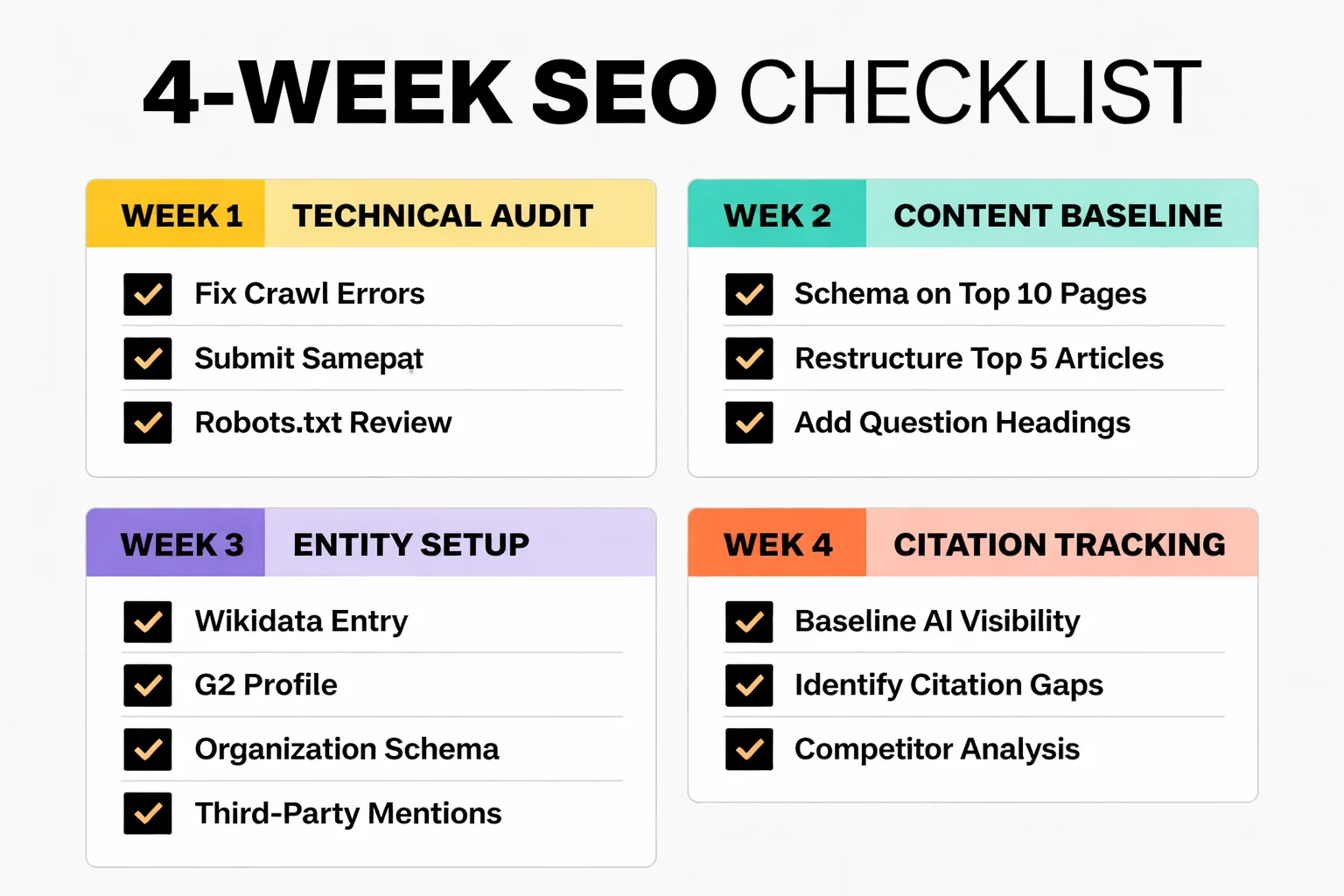
Week 1: Technical Audit and Fix
Run a full site crawl. I use Meev's built-in site audit (Lighthouse score, on-page crawl, biweekly refresh) but Google Search Console's Coverage report works too. Your goals this week: fix all crawl errors (404s, 5xx server errors, redirect chains), submit your sitemap to GSC, review and fix robots.txt, ensure every important page is indexed. This is unglamorous work but it's the foundation everything else sits on. Budget 3-4 hours.
Specific steps: Log into Google Search Console. Go to Settings > Crawl stats. Look for pages with zero crawl requests in the past 28 days. Those pages are invisible to Google and likely invisible to AI retrieval systems. Next, go to Pages > All submitted pages. Sort by exclusion reason. Fix every "Blocked by robots.txt" error first (check your robots.txt file for accidental blocks). Then fix every "Duplicate without canonical" error by adding canonical tags. Then address "Crawled, currently not indexed" pages by improving their content depth and internal linking. This sequence matters because crawl errors block everything downstream. Fix the blockers first, then improve the quality signals.
Week 2: Content Baseline
Add Article schema and FAQ schema to your top 10 pages by traffic. Restructure your top 5 articles for AI extractability: add question-shaped H2s, front-load direct answers under each heading, add TLDR sections. Set up internal linking between your top pages using descriptive anchor text. Budget 3-4 hours.
For the content restructure, here's the exact format I use. Open each article and add a TLDR section at the top with 3-4 bullet points answering the article's core question. Then convert your existing H2 headings into question form where possible. "Key Features" becomes "What Features Should You Look For?" Under each H2, write a 40-60 word direct answer before the detailed explanation. This direct answer is what AI systems extract. The detailed explanation below it provides context for human readers and additional semantic signals for retrieval systems. Finally, add 3 internal links per article using descriptive anchor text. This restructure takes about 30 minutes per article for a 1,500-word post.
Week 3: Entity Setup
Claim or create your Wikidata entry. Build profiles on G2, Capterra, and Trustpilot if you don't have them. Add Organization schema to your homepage with your Wikidata ID. Audit your Wikipedia page (if you have one) for accuracy. Identify 3-5 third-party publications in your industry and begin building relationships for mentions. Budget 3-4 hours.
If you don't yet qualify for a Wikidata entry (which requires notability), focus on the profiles you can create today. G2 is particularly important because AI systems frequently cite G2 for software-related queries. The ConvertMate data showing 46.7% of Perplexity's top citations come from Reddit also means you should monitor Reddit for brand mentions and participate in relevant subreddits. Not spamming. Genuine participation that builds your entity footprint. Every verified profile, every third-party mention, every structured data point contributes to the entity graph that AI systems reference when deciding whether to cite you.
Week 4: First Citation Tracking Run
Set up AI visibility tracking across every major AI search surface. Run your first baseline: what percentage of relevant prompts mention your brand? Where do competitors appear that you don't? Which sources are AI engines citing for your topics? Document everything. This baseline becomes your benchmark for measuring whether your fundamentals work over the next 90 days. Budget 2-3 hours.
When you run your first baseline, test 20-30 prompts that represent your target topics. Mix branded prompts ("How does [your product] compare to [competitor]") with unbranded prompts ("What's the best [your category] for small teams"). Record which AI surfaces mention you, which cite you, and which cite competitors. This baseline is your starting line. Every optimization you make from here should be measured against it. If you can't measure citation movement, you can't know if your fundamentals are working. The AI visibility checker automates this across all major surfaces so you're not manually running prompts on 8 different platforms.
What to Do After the First 30 Days
The first 30 days are about fixing the foundation. Days 31-90 are about building on it.
Start publishing content designed for AI extractability. Question-shaped headings. Direct answers. Structured data. Internal links. Each article should answer a specific sub-question your audience asks AI search engines. Use the ChatGPT AI visibility checker to test whether your new content is being picked up.
Build topical clusters. One pillar page, five to eight supporting pages, all interlinked. This creates the semantic depth that AI systems need to recognize you as an authority on a topic.
Monitor your AI citation rate weekly. Look for patterns. Are you cited more on certain topics? Absent on others? Which competitors appear where you don't? Use those gaps to guide your next content sprint.
The founders who win in AI search aren't the ones with the biggest budgets. They're the ones who fix their fundamentals first, build on a solid foundation, and measure everything. SEO fundamentals aren't dead in the AI era. They're more alive than ever. They just look different.
FAQ
Can I get AI citations without ranking on Google?
Yes, but it's harder. The Surfer analysis found 67.82% of AI Overview citations don't come from top-10 organic results. That means ranking isn't a prerequisite. However, ranking still builds brand recognition and entity authority, which indirectly improves citation rates. Aim for both.
How long does it take for SEO fundamentals to translate into AI citations?
In my experience, 8-12 weeks after implementing fundamentals correctly. Crawlability fixes show up fastest (2-4 weeks for indexing). Schema and entity grounding take longer (6-8 weeks for AI systems to process and integrate). Content restructuring shows results in 4-6 weeks if the content gets crawled and indexed promptly.
Do I need a Wikidata entry to get cited by AI?
It helps significantly but isn't strictly required. Wikidata gives AI systems a structured, authoritative reference for your entity. Without it, AI systems rely on third-party mentions and your on-site schema, which can work but is less reliable. If you're serious about AI visibility, claim your Wikidata entry.
What's the difference between being mentioned and being cited by AI?
Being mentioned means your brand name appears in a generated answer. Being cited means the AI links to your site (or a specific page) as the source. Semrush found only 6% to 27% of mentioned brands are also cited. Citations drive referral traffic and build authority. Mentions alone don't.
Should I hire an agency for this or do it myself?
If you have one hour a week, do it yourself using the 30-day checklist above. The fundamentals are learnable and the tools are accessible. If you're past the fundamentals and need scale, look for agencies that understand both traditional SEO and answer engine optimization. Most agencies still treat them as the same thing, which is why most agency-produced content fails to earn AI citations.
What's the biggest mistake founders make with SEO fundamentals in 2026?
Treating SEO and AI citations as separate problems. The fundamentals that fix your Google rankings (crawlability, content depth, structured data, internal linking) are the same fundamentals that make your content extractable by AI systems. The difference is in how you structure content for extraction, not in whether you need the fundamentals. Skip them and you lose on both fronts.
How many AI search surfaces should I track?
Every major one. ChatGPT, Claude, Gemini, Perplexity, Grok, Google AI Overviews, AI Mode, and DeepSeek all generate answers differently and cite different sources. Tracking only one or two gives you a blind spot. The set changes over time, so focus on comprehensive coverage rather than a fixed count.
About the Author
Judy Zhou, Founder
Judy Zhou leads content strategy at Meev, where she oversees AI-driven content research and publishing for hundreds of brands. With a background in SEO and editorial operations, she focuses on building content systems that rank on Google, get cited by AI search engines, and drive measurable business results.
Run your first AI visibility baseline today and see exactly where your brand is cited, where it's absent, and which fundamentals to fix first.