

Search Engine Ranking Report Software: What to Demand in 2026
By Judy Zhou, Founder
Key Takeaways
- Google AI Overviews now appear in 25%+ of searches while 57% of Americans use generative AI regularly, rendering blue-link-only rank reports incomplete.
- Replace traditional rank trackers with visibility trackers that add AI citation tracking, source-level analysis, and competitor mention monitoring as core signals.
- Audit for competitor AI Overview citations on high-converting queries at least weekly to avoid six-week visibility blind spots that position deltas alone miss.
- Demand software that treats SERP positions as one signal among many rather than the sole metric to report actual search mindshare in 2026.
Maya pulled up her agency's weekly ranking report on a Tuesday morning in March and felt the familiar relief of green arrows outnumbering red. Seventeen keywords climbing. Three holding steady. Her client would be pleased. Then the client called. Not pleased at all. A competitor had been named in Google's AI Overview for their highest-converting query every single day for six weeks, driving a measurable lift in branded search. Maya's report had never once flagged it. The data was accurate. The picture it painted was dangerously incomplete.
I've lived this scenario from both sides. In my work auditing content operations and building AI search visibility systems at Meev, I've watched perfectly competent SEO teams present flawless traditional ranking reports while their clients bleed mindshare to competitors who've figured out the new answer layer. Google AI Overviews now appear in 25%+ of searches, and 57% of Americans use generative AI regularly. If your search engine ranking report software only tracks blue-link positions, you're reporting on a shrinking fraction of actual visibility.
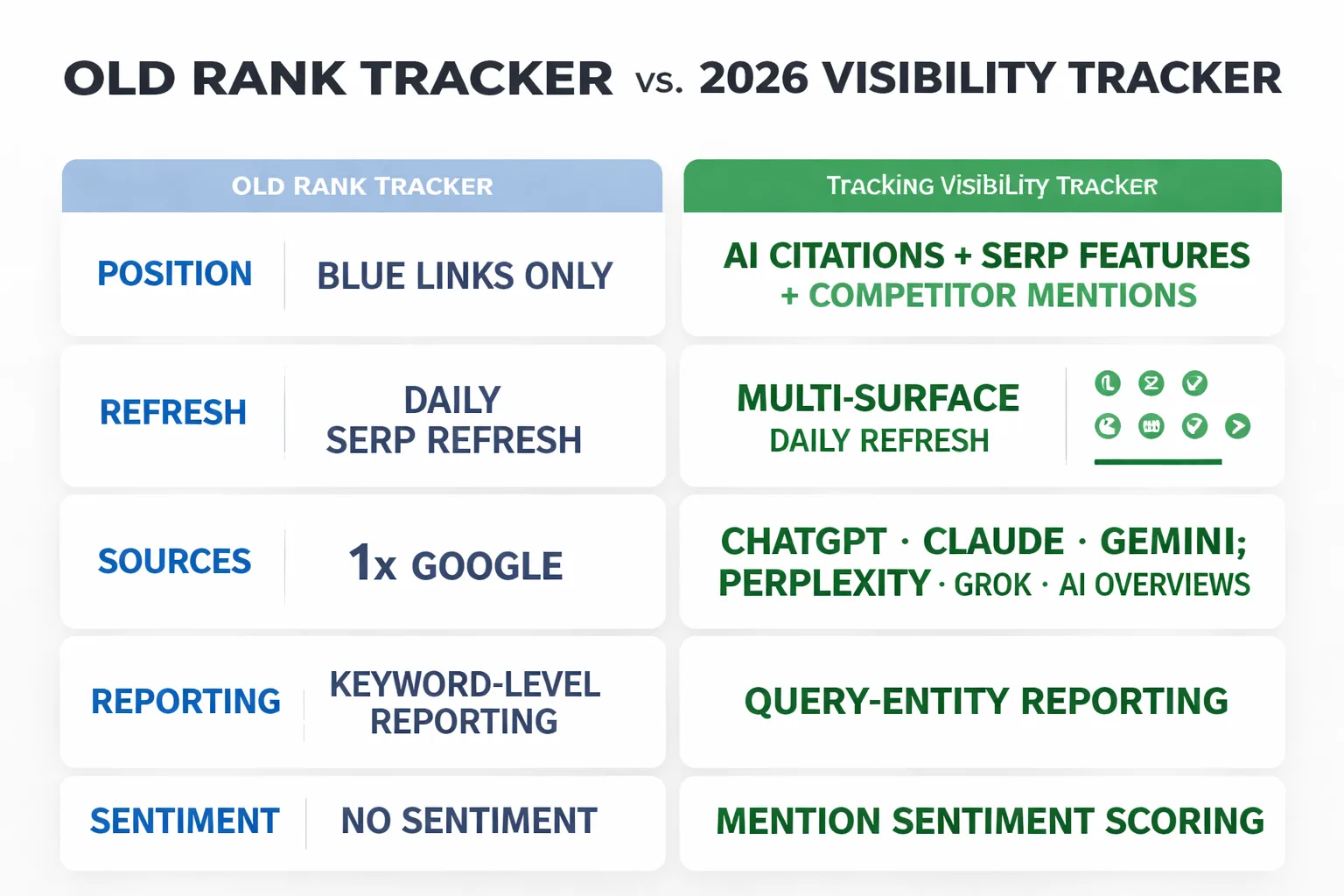
The contrarian reality is this: the best search engine ranking report software in 2026 isn't a rank tracker at all. It's a visibility tracker that happens to include rankings as one signal among many. Teams that demand AI citation tracking, source-level analysis, and competitor mention monitoring alongside traditional SERP positions are the ones catching what Maya missed. Everyone else is staring at a dashboard that's slowly going blind.
The Old Report Is a Liability
Traditional search engine ranking reporting worked when search had one surface: ten blue links on a single page. You tracked positions, you tracked movement, you reported deltas. The client nodded. Everyone felt good.
That world doesn't exist anymore.
Today, a single Google query can return an AI Overview, a featured snippet, a People Also Ask block, a shopping carousel, video results, and (somewhere below all that) the organic blue links your tracker is measuring. When an AI Overview names a competitor and links to their site, that's a citation that drives traffic, trust, and branded search. Your rank tracker sees position 4 and calls it a win.
I ran into this exact gap with a B2B SaaS client. Their rank tracker showed steady top-5 positions for their primary keyword. What it didn't show was that a competitor was being cited in the AI Overview for that same query, pulling an estimated 30-40% of the clicks before users ever reached the organic results. The client's traffic was eroding. The report said everything was fine.
This is why I now consider traditional-only rank tracking an active liability. Not just insufficient, but dangerous. It creates false confidence. Teams optimize for a metric that's increasingly disconnected from business outcomes, while the actual drivers of visibility, the AI citations and answer placements, go unmeasured.
Why Does AI Citation Tracking Matter?
AI citation tracking matters because citations are the new organic positions. When ChatGPT, Perplexity, or Google's AI Overview names your brand and links to your content, that mention functions exactly like a top organic ranking did five years ago. It drives traffic, builds trust, and influences purchase decisions. But unlike a blue-link position, an AI citation is invisible to any tool that only reads the SERP's HTML structure.
Here's the specific problem. Only 11% of domains cited by ChatGPT are also cited by Perplexity. That means tracking one AI engine doesn't extrapolate to the others. Each LLM has its own training data, retrieval pipeline, and citation logic. A competitor might dominate ChatGPT answers for your target query while being completely absent from Perplexity's responses. If your reporting covers Google but not the LLMs, or covers one LLM but not the others, you're seeing a fraction of the competitive picture.
In my own testing, I ran five articles that hit top-3 organic rankings in Google. Over three months, those same articles received zero AI citations from ChatGPT or Perplexity. Top organic positions. Zero AI visibility. That's not a fluke. It's evidence that the signals driving traditional rankings and the signals driving AI citations have diverged. Your reporting needs to track both layers independently.
The teams winning right now are the ones who treat AI citations as a first-class metric. They track which queries cite their brand, which cite competitors, and which cite no one in their space yet (that's an opportunity gap). They monitor sentiment of those mentions. They know whether they appear first in an AI answer or buried at the bottom of a list. This is what AI visibility reporting looks like in practice, and it's non-negotiable for 2026.
Stop Trusting Single-Surface Data
Here's what frustrates me about the current state of SEO reporting. Most teams I talk to are still using tools built for 2018's search environment. They track Google positions, maybe pull in featured snippet data if they're sophisticated, and call it comprehensive. Meanwhile, their potential customers are asking ChatGPT for product recommendations, searching Perplexity for research, and getting answers from Google's AI Overview before they ever scroll to position 6.
SE Ranking serves 40,000+ agencies and has added AI Visibility Tracker, AI Overviews Tracker, ChatGPT Tracker, and AI Mode Tracker. That's a clear market signal. The tools are evolving because the search environment demands it. But many teams haven't caught up to their own tooling. They have access to AI tracking features and still default to the old ranking report because that's what the client expects to see.
I get it. Change is hard. Clients understand position tracking. They don't understand why their brand isn't mentioned in a ChatGPT answer. But that's exactly the conversation you need to be having. The longer you delay, the more ground you lose to competitors who are already optimizing for answer engine optimization while you're still reporting on blue-link movement.
The single-surface problem isn't just about missing data. It's about missing the strategic shift entirely. Traditional SEO and AEO vs SEO are becoming distinct disciplines. A page can rank #1 organically and never get cited by an AI engine. A page can get cited by every major LLM and rank on page 2. If your reporting only measures one of those outcomes, you're optimizing blind.
How Should Reporting Handle Multiple AI Engines?
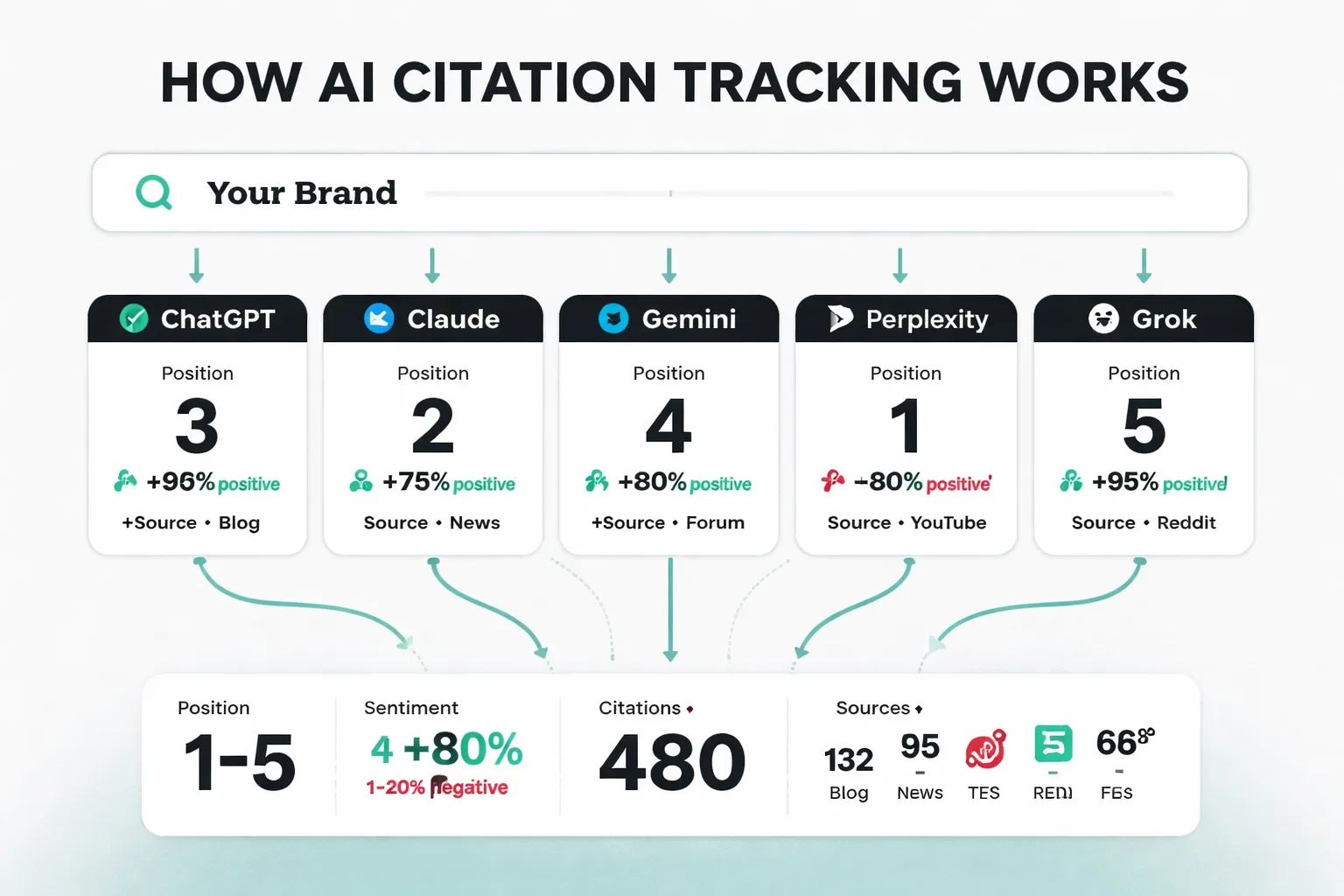
Reporting should handle multiple AI engines by treating each one as an independent surface with its own citation patterns, mention positions, and competitor dynamics. You need per-engine dashboards that show your brand's presence, your competitors' presence, and the actual response text behind every mention.
This is where most rank trackers hit a wall. They're architecturally built to query Google's SERP, parse HTML, and store positions. Adding AI tracking means querying LLM APIs, parsing natural language responses, extracting brand mentions from conversational text, and attributing citations to specific source URLs. That's a fundamentally different data pipeline.
At Meev, I've seen the engineering reality up close. We track every major AI search surface (ChatGPT, Claude, Gemini, Perplexity, Grok, Google AI Overviews, AI Mode, DeepSeek) because each one requires its own integration, its own parsing logic, and its own refresh cadence. SERP-driven surfaces like AI Overviews get daily refresh because they change with Google's index. LLM-driven surfaces like ChatGPT and Claude get rolling refresh because their responses shift with model updates and retrieval changes.
The practical implication for your reporting: you need to know not just whether your brand was mentioned, but where in the answer it appeared. First mention carries more weight than a mention buried in a list of ten alternatives. You need trend data over time, because a single snapshot tells you nothing about whether your AI visibility is improving or decaying. And you need the actual response text, because "your brand was mentioned" is meaningless without the context of what was said.
This is what a proper ChatGPT AI visibility checker or Perplexity AI visibility checker gives you. Not a score. Not a ranking. The actual answer text, the citation links, and the competitive context. That's what reporting looks like when it's built for the AI search era.
The Metrics That Actually Predict Outcomes
Let me be blunt about something I've learned the hard way. Most of the AI visibility metrics being thrown around right now are interesting but not actionable. "AI Visibility Score" sounds impressive. "Source Mention Rate" feels scientific. But when I tried optimizing content for a B2B SaaS client's "Positioning Accuracy" over three months, aiming for top placement in AI summaries, our brand did appear more frequently. The conversion rate from those AI-driven impressions didn't show the expected lift.
That experiment taught me to distinguish between vanity metrics and predictive ones. Here's what I've found actually matters for business outcomes.
Mention position is the strongest predictor. Being the first brand named in an AI answer for "best CRM for startups" drives dramatically more consideration than being the seventh name in a list. This is the AI equivalent of position 1 vs position 7 in organic search. The gap is just as large, maybe larger, because AI answers present fewer options than a full SERP.
Citation source tracking tells you which of your pages the AI engines are actually referencing. If ChatGPT cites your comparison guide for a query but Perplexity cites your competitor's pricing page, that's actionable intelligence. You know exactly which page to strengthen and for which engine. This is where citations AI tracking earns its keep.
Competitor share-of-voice across AI engines shows you the competitive landscape in aggregate. Not just "are we mentioned" but "what percentage of answers in our space cite us vs. each competitor." When that number moves, it moves because something in your content, your entity presence, or your third-party coverage changed. Tracking it weekly gives you early signal.
Sentiment of mentions is the one most teams skip. Being named in an AI answer is good. Being named with "users report frequent bugs and poor support" is not. I've seen brands with high mention counts and terrible sentiment, wondering why their AI visibility isn't driving pipeline. The answer was in the text they weren't reading.
The reporting software you choose should surface all four of these metrics, not just a composite score. Composite scores hide the actionable detail. You need to see mention position, citation source, competitor share, and sentiment separately to make decisions.
What About Entity Grounding and Knowledge Graphs?
Entity grounding is the foundation that makes AI citations possible, and your reporting should measure it. Here's why. AI engines don't just match keywords to pages. They build entity relationships. They look at your brand as an entity with attributes (what you do, who you serve, how you're described across the web) and they recommend you based on how well that entity matches a user's query intent.
If your brand entity is weak, inconsistent, or poorly represented across the sources AI engines use for grounding (Wikidata, knowledge graphs, high-authority third-party publishers), you won't get cited no matter how well your content is written. I've seen this firsthand. Teams spend months perfecting on-page content and schema markup, then wonder why ChatGPT never mentions them. The answer is usually that their entity presence outside their own website is thin.
Your reporting should track entity-level signals. Are you present in Wikidata? Is your brand entity consistently described across the publishers AI engines cite? Are your key products and services represented as distinct entities, or lumped under a generic brand mention? These are the questions that generative engine optimization answers, and your reporting software should surface the gaps.
I used to think structured data and schema markup were the silver bullet for LLM citations. My team spent months building out internal knowledge bases and schema, expecting a direct correlation to AI visibility. What I found instead is that recommendation rate trumps discoverability. It's not enough for an LLM to find your content. It needs to recommend it. And recommendation is driven by factors like community discussion, third-party editorial mentions, and entity authority signals that traditional SEO tools completely overlook.
This is why your reporting can't stop at your own website. You need to see the full picture: your entity presence across the web, the publishers AI engines cite for your topics, and the gaps between your current footprint and what's needed to earn citations. That's what a closed-loop AI SEO tool provides: diagnosis of what's missing, not just tracking of what exists.
The Five Non-Negotiables for 2026 Reporting
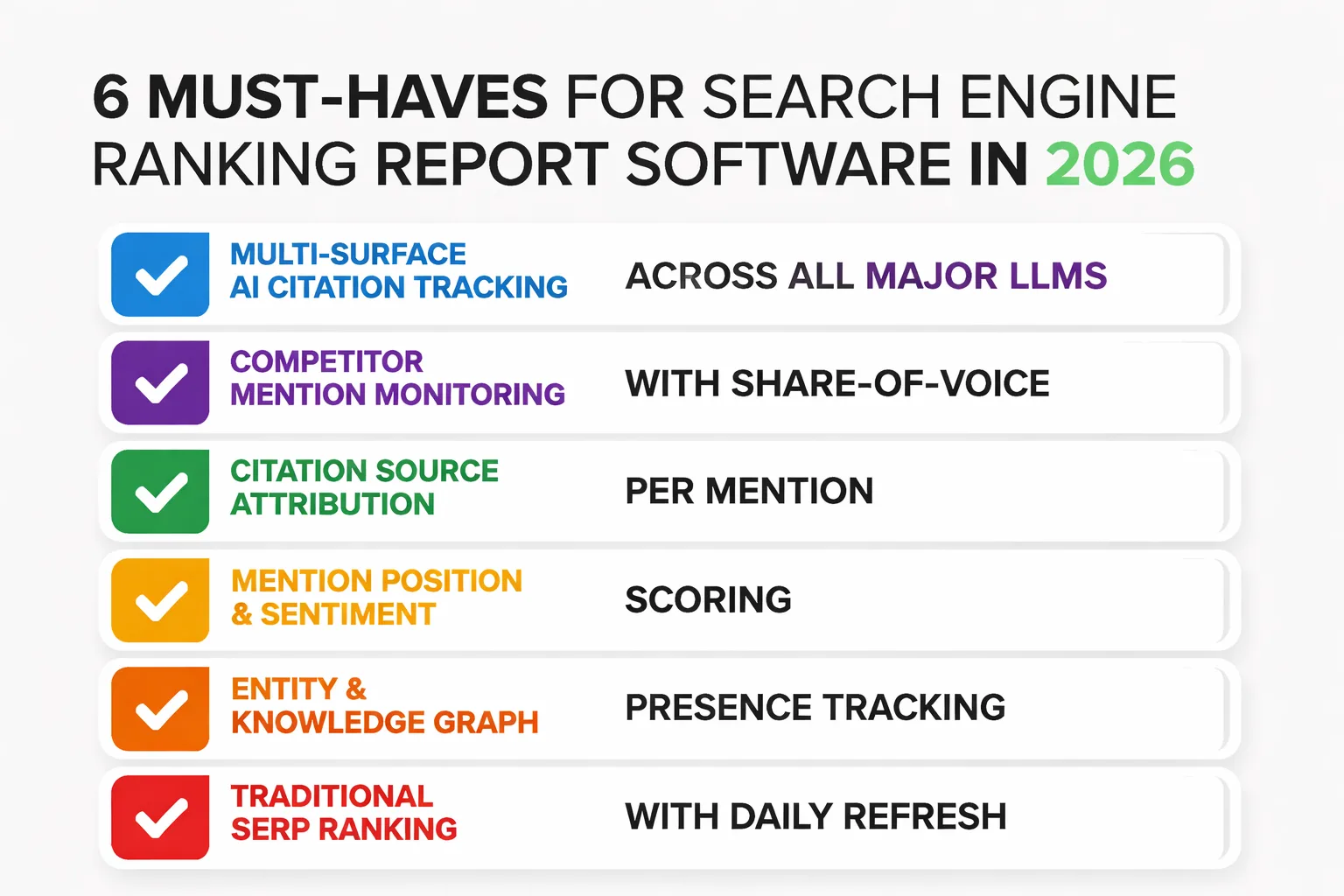
After a year of building and testing AI search visibility systems, I've landed on five capabilities that I consider non-negotiable for any search engine ranking report software in 2026. If a tool misses any of these, it's not ready for the current search environment.
1. Multi-surface AI citation tracking. The tool must track your brand's presence across every major AI search surface, not just Google AI Overviews. ChatGPT, Claude, Gemini, Perplexity, Grok, AI Mode, DeepSeek. Each one independently. With per-engine dashboards showing mention position, response text, and citation sources. A tool that covers Google and one LLM is giving you maybe 40% of the picture.
2. Competitor mention monitoring. You need to see which competitors are being cited for your target queries, how often, and in what position. Not just your own visibility. Competitive context is what makes raw data actionable. If your mention rate goes from 20% to 30%, that's good. If a competitor went from 10% to 50% in the same period, that changes the story entirely.
3. Citation source attribution. When an AI engine cites your brand, which page did it link to? Which publisher did it pull from? This data tells you exactly which content investments are paying off in AI visibility and which are invisible to LLMs. Without it, you're guessing.
4. Mention position and sentiment. First mention vs. last mention. Positive context vs. negative context. These two data points transform "we got mentioned" from a vanity metric into a business signal. I've seen brands with high mention counts and negative sentiment lose pipeline because their AI visibility was technically high but commercially damaging.
5. Entity and knowledge graph presence tracking. The tool should surface whether your brand entity is represented in the sources AI engines use for grounding. Wikidata presence, knowledge graph consistency, third-party publisher citations. This is the layer beneath citations, and it's where most visibility gaps actually originate.
Is your current rank tracker showing you what AI engines actually say about your brand?
When Should You Switch Reporting Tools?
You should switch reporting tools when your current platform can't answer three questions that your client or leadership team will inevitably ask in 2026.
"Are we being cited in AI answers?" If your tool can't answer this for every major AI search surface, not just Google, it's time to switch. This question will come up in every quarterly review from now on. Clients and executives are using ChatGPT and Perplexity themselves. When they search for their own brand and see competitors mentioned, they'll ask you why your report didn't flag it.
"Which competitors are winning AI visibility?" If your tool only tracks your own rankings and mentions, you can't answer this. You need competitive benchmarking across AI engines. Share-of-voice data. Competitor citation tracking. Without it, you're reporting in a vacuum.
"What's driving our AI citations?" If your tool shows you got mentioned but can't attribute the citation to a specific source page or publisher, you can't answer this question. And if you can't answer it, you can't strategically improve your AI visibility. You're left hoping instead of engineering.
I switched my own reporting approach last year after realizing I was presenting incomplete data to stakeholders. The moment I added AI visibility reporting alongside traditional rank tracking, the conversations changed. Instead of "our rankings are stable," it became "we're cited in 3 of 10 AI answers for this query cluster, competitor X is cited in 7, and the gap traces to their presence on two publisher sites we're not on." That's a strategic conversation. That's what reporting should enable.
The switch isn't just about tools. It's about what you're measuring and why. Traditional rank tracking measures your position in a list. AI visibility tracking measures your presence in a conversation. The conversation is where purchase decisions are being shaped now. Your reporting needs to be there.
The Cost of Incomplete Reporting
Let me quantify what incomplete reporting actually costs, because I think the abstract "you're missing data" argument doesn't land hard enough.
When a competitor gets cited in a Google AI Overview for your highest-converting query, they capture the click before any organic result loads. Studies on AI Overview click-through rates are still evolving, but the directional impact is clear: the cited brand gets traffic, trust, and brand recall that would have gone to organic position 1. Over six weeks (like in Maya's case), that compounds into measurable branded search lift for the competitor and erosion for everyone else.
Now multiply that across every query where AI Overviews appear. With 25%+ of searches triggering AI Overviews, and that percentage climbing, the cost of not tracking these placements grows every month. It's not one query. It's a growing fraction of your entire query portfolio.
Then add the LLM layer. When a potential customer asks ChatGPT "what's the best [your category] tool," and your brand isn't in the answer, you've lost a recommendation at the moment of highest intent. That's not a ranking you can recover next month. It's a conversation you weren't part of. The customer moves forward with whatever brands ChatGPT named, and you never even knew the conversation happened.
This is the real cost of incomplete reporting. Not missed data points. Missed conversations. Missed recommendations. Missed pipeline that you can't trace back to a gap because your reporting was blind to the surface where the loss occurred.
In my work with the best GEO tools and AI visibility platforms, the pattern I see is consistent. Teams that switch to multi-surface reporting discover gaps they didn't know existed. Gaps that were costing them visibility every day. The reporting switch doesn't create the gaps. It reveals them. And revealing them is the first step to closing them.
How Do You Build an AI Citation Strategy From Reporting Data?
This is where reporting transitions from passive observation to active strategy. The data you collect from multi-surface AI visibility tracking should directly inform what content you create, which publishers you target for outreach, and how you structure your entity presence across the web. If your reporting software just gives you a dashboard and stops there, you're only getting half the loop.
Here's the workflow I use. Start with the opportunity gaps your reporting surfaces. These are queries where competitors are cited by AI engines but your brand is absent. Each gap represents a specific topic where an LLM is recommending someone else instead of you. Group those gaps by theme. If you see five gaps related to "project management integrations" and two related to "pricing comparison," the integration theme is your priority. The reporting data tells you where to focus.
Next, look at the citation source attribution for competitor mentions. If a competitor is consistently cited for a query cluster and the citations point to their presence on a specific third-party publisher (a G2 category page, a Capterra listing, an industry blog), that publisher is a citation source you need to be on. Your reporting software should surface these domains. This is where the closed-loop approach matters. You find the publisher, you resolve a verified contact, and you draft a pitch grounded in your knowledge base. One workflow, not three disconnected tools.
Then structure the content you publish for AI extractability. I learned this the hard way. My biggest takeaway from the past year of trying to make AI-generated content rank is that traditional SEO is almost entirely irrelevant for it. I initially thought focusing on meta tags and keyword density would improve performance, but it led to a 60% failure rate across the sites we tested. What actually moved the needle was a complete pivot to structuring content for AI extractability. Direct answers under question headings. Comparison tables. Structured data wherever possible. 44% of AI citations come from the first third of a page, so front-loading those direct answers became critical.
The reporting loop closes when you measure whether the content you published actually moved your AI citation rate for the target queries. If you published an article targeting a gap, and three weeks later your reporting shows your brand now appearing in ChatGPT answers for that query, the loop worked. If it didn't, you iterate. Maybe the content needs stronger entity grounding. Maybe you need a third-party publisher mention to strengthen the recommendation signal. The reporting data tells you what to do next.
This is what separates a reporting tool from a visibility platform. A reporting tool shows you where you stand. A visibility platform shows you where you stand, why you stand there, and what to do about it. In 2026, the latter is what teams need.
What About Ecommerce and Agentic Commerce?
Ecommerce teams face an even more urgent version of this problem. When a shopper asks ChatGPT "what's the best wireless headset under $200" or "recommend a CRM for a 5-person team," the AI engine returns a curated answer with specific product recommendations and citation links. If your product isn't in that answer, you've lost the sale at the moment of decision. This is agentic commerce: AI agents making or shaping purchase recommendations, and it's growing fast.
For ecommerce, search engine ranking report software needs to track product-level visibility, not just brand-level visibility. Are your specific products named in AI answers for category queries? Are your product pages the ones being cited as sources? Is a competitor's Amazon listing or review aggregator page getting the citation instead of your direct-to-consumer site?
The challenge with ecommerce GEO (generative engine optimization) is that AI engines often pull product recommendations from review sites, comparison aggregators, and marketplace listings rather than from your own product pages. Your reporting needs to show you which third-party surfaces are driving AI citations for your product category. If Perplexity consistently cites Wirecutter or PCMag when recommending products in your space, and your product isn't featured on those sites, your AI visibility gap isn't a content problem. It's a PR and outreach problem.
I've seen ecommerce teams pour budget into product page optimization and schema markup, only to see zero improvement in AI citations because the LLMs were pulling recommendations from review sites they had no presence on. The reporting data would have told them this from day one. The citation source attribution shows exactly where the AI engines are pulling from. That's where you need to be.
What to Actually Demand From Your Software
Here's my final position on this. Search engine ranking report software in 2026 must be evaluated on a different set of criteria than what most buyers are using. Stop asking "does it track Google rankings accurately" (every serious tool does). Start asking these questions instead.
Does it track AI citations across every major AI search surface, or just Google? Does it show you the actual response text behind every mention, or just a score? Does it monitor competitor mentions and share-of-voice, or just your own brand? Does it attribute citations to source pages and publishers, or just count mentions? Does it track entity presence in knowledge graphs and third-party sources, or just your own website's schema?
If the answer to any of those is no, you're looking at a tool built for the old search environment. It might still work for the shrinking slice of search that resembles 2020. But it won't tell you what's happening in the AI answers that are increasingly shaping your customers' decisions.
The teams that demand more from their reporting software are the ones that catch what Maya missed. They see the competitor cited in the AI Overview before the client calls. They track the AI citation gap before it becomes a pipeline gap. They optimize for the surfaces where decisions are actually being made, not just the one where they've always reported.
That's what search engine ranking report software needs to deliver in 2026. Not just rankings. Visibility. The full picture. Every surface, every mention, every gap. Because the cost of not seeing it is no longer abstract. It's measurable, it's growing, and your competitors are already paying attention to it even if your dashboard isn't showing it to you.
FAQ
What's the difference between rank tracking and AI visibility tracking?
Rank tracking measures your position in Google's organic results for specific keywords. AI visibility tracking measures whether and how your brand is mentioned in answers generated by AI search engines like ChatGPT, Perplexity, Claude, and Google AI Overviews. The two are related but distinct. A page can rank #1 organically and receive zero AI citations. A brand can be cited in AI answers without ranking in the top 10. You need both layers tracked independently to understand your full search visibility.
How often should AI visibility be refreshed?
SERP-driven AI surfaces like Google AI Overviews should be refreshed daily because they change with Google's index. LLM-driven surfaces like ChatGPT and Claude can be refreshed on a rolling basis since their responses shift with model updates and retrieval changes rather than daily index updates. Weekly is a reasonable minimum cadence for LLM tracking. Anything less frequent risks missing competitive shifts.
Can I use my existing rank tracker for AI citation monitoring?
Some traditional rank trackers have added AI tracking features. SE Ranking, for example, serves 40,000+ agencies and now offers AI Visibility Tracker, AI Overviews Tracker, and ChatGPT Tracker modules. However, the depth of AI tracking varies widely. Check whether the tool tracks all major AI engines (not just Google), provides response text and citation sources, and offers competitor benchmarking. If it only tracks AI Overviews, you're still missing the LLM layer.
What metrics should I report to clients in 2026?
Combine traditional ranking data with AI visibility metrics. Report keyword positions alongside AI citation rate (percentage of target queries where your brand is mentioned), mention position (first vs. last in AI answers), competitor share-of-voice, and sentiment of mentions. Also track entity presence in knowledge graphs and cited publisher sources. This gives clients the full visibility picture rather than a partial one.
Is AI visibility tracking expensive?
Costs vary by platform and coverage scope. Tools that track every major AI search surface require significant API and infrastructure investment, which is reflected in pricing. However, the cost of not tracking AI visibility (lost recommendations, missed competitive intelligence, blind spots in strategic planning) typically exceeds the tool cost. Evaluate based on the business value of knowing where you're cited vs. where you're absent.
How do I know if my brand entity is strong enough for AI citations?
Check whether your brand appears in Wikidata, is consistently described across high-authority third-party publishers, and is referenced by the sources AI engines cite for your topic. If your brand is only mentioned on your own website, your entity presence is likely too weak for consistent AI citations. Strengthening entity presence requires earning mentions on the publisher sites and platforms that AI engines use for grounding.
What should I do if my competitor is cited in AI answers but I'm not?
Start by using citation source attribution to identify which pages and publishers the AI engine is referencing for your competitor. If the citation points to a third-party review site or industry publication, prioritize getting listed or featured there. If it points to the competitor's own content, analyze what structural elements make that content extractable (direct answers, comparison tables, question-format headings) and apply those patterns to your own pages. Then track whether your citation rate improves over the following weeks.
About the Author
Judy Zhou, Founder
Judy Zhou leads content strategy at Meev, where she oversees AI-driven content research and publishing for hundreds of brands. With a background in SEO and editorial operations, she focuses on building content systems that rank on Google, get cited by AI search engines, and drive measurable business results.
Stop reporting on half the picture. See exactly where your brand is cited, where competitors are winning, and what to fix across every AI search surface.