

By Judy Zhou, Founder
Key Takeaways
- Marcus lost all organic traffic after publishing 800 AI-generated articles in eleven months that failed Google's E-E-A-T quality signals.
- Semrush analysis of 500+ topics projects AI search visitors will surpass traditional search visitors by early 2028.
- Deploy quality firewalls, human oversight gates, and fact-verification systems before any AI content goes live.
- Treat AI as an assistant for drafting while requiring human review to meet Google's content-quality standards rather than origin rules.
Marcus had published 800 articles in eleven months. His AI SEO agent ran nightly, pulling trending queries, drafting posts, and pushing them live before sunrise. Traffic climbed steadily through Q1, then flatlined in April, then disappeared in a single weekend. No manual action notice, no reconsideration request path. Just a site that Google had quietly stopped crawling with any real frequency. He'd done everything the autoblogging playbooks said. The problem was that those playbooks were written in 2023, and the search landscape they described no longer existed.
The short answer is no, Google does not penalize AI content. Google's official guidance confirms that ranking systems reward high-quality content based on E-E-A-T (expertise, experience, authoritativeness, trustworthiness) regardless of production method. The penalty Marcus experienced wasn't for using AI. It was for publishing 800 articles that failed every quality signal Google now measures. Research from Semrush analyzing 500+ digital marketing topics projects AI search visitors will surpass traditional search visitors by early 2028, meaning the stakes for content quality are about to get exponentially higher. Teams practicing safe autoblogging in 2026 use quality firewalls, human oversight gates, and fact-verification systems to prevent the exact failure that destroyed Marcus's site.
The distinction between AI-generated and AI-assisted content has become the defining factor in whether automated publishing survives or collapses. Google's How Search Works documentation makes clear that the focus is on content quality, not origin. Roughly a decade ago, Google faced a similar inflection point with mass-produced human content and chose to improve quality-detection systems rather than ban the production method. The same principle applies now. AI content SEO in 2026 is not about hiding the use of AI. It is about ensuring the output meets a quality bar that earns rankings and citations.
The Quality Problem, Not the AI Problem
The sites that fail are not failing because a machine wrote their content. They are failing because the content is bad. This is the single most misunderstood dynamic in the entire AI SEO space.
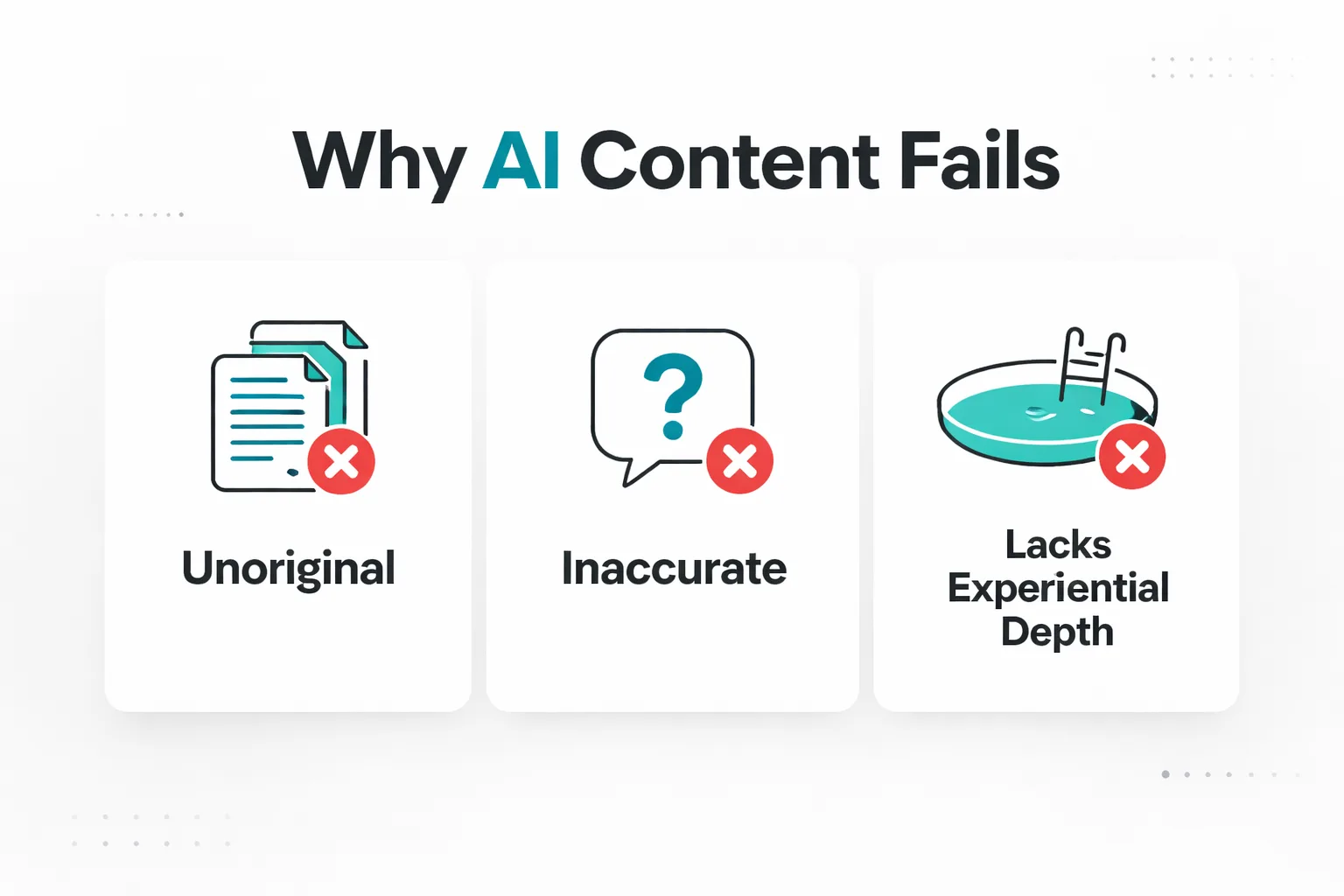
When practitioners report that their "AI content got penalized," the actual mechanism is almost always one of three things. First, the content is unoriginal. It rephrases what already exists on page one without adding new data, new analysis, or a new angle. Second, it is inaccurate. Models hallucinate statistics, fabricate sources, and state falsehoods with confidence. Third, it lacks experiential depth. It reads like a summary of other summaries, offering no evidence that anyone with real expertise touched the piece.
Google's post-2025 Helpful Content updates shifted enforcement toward user satisfaction signals rather than detection. Analysis of Google's AI content policy notes this focus on user satisfaction over origin detection, reflecting what practitioners observing 200+ AI startups have reported anecdotally. The algorithm does not care whether a human or a model typed the words. It cares whether a real reader who clicked through from search results found what they needed, stayed on the page, and did not bounce back to try another result.
This is why the question "will Google penalize AI content" is the wrong question entirely. The right question is whether the content satisfies user intent better than the alternatives already ranking. If an AI-generated article provides a more complete, more accurate, more useful answer than what currently exists on page one, it will rank. If it provides a thinner, less accurate, less useful version of what already exists, it will fail. The production method is irrelevant to the outcome.
Why Does Google Not Penalize AI Content?
Google's ranking systems evaluate content against E-E-A-T criteria: expertise, experience, authoritativeness, and trustworthiness. These criteria are production-method-agnostic. A piece of content can demonstrate all four qualities regardless of whether a human, an AI model, or a hybrid workflow produced it. Google's official position is that automation has always been used to generate helpful content, and ranking systems are designed to reward helpful content regardless of how it is produced.
The historical precedent matters here. About ten years ago, content farms employing armies of low-cost human writers flooded the web with thin, keyword-stuffed articles. Google did not ban content farms or penalize the use of human writers at scale. Instead, the company improved its quality-detection systems to identify and demote low-value content regardless of who wrote it. The same pattern is playing out now with AI-generated content. The Google Search Central blog explicitly states that the focus is on quality, not detection.
What Google does penalize is spam. Specifically, the spam policies target content generated at scale to manipulate search rankings without providing value to users. The critical distinction is intent and outcome. If an AI SEO agent publishes 500 articles that each genuinely help a reader solve a problem, answer a question, or make a decision, that is not spam. If the same agent publishes 500 articles that exist solely to capture keyword traffic without delivering value, that is spam. The AI is not the trigger. The lack of value is.
What Safe Autoblogging Actually Requires
Safe autoblogging in 2026 is not about finding the right settings on an AI writing tool. It is about building a content production system with multiple quality gates that prevent bad content from reaching your CMS. The teams succeeding with automated publishing treat it like a manufacturing process: raw materials go in, quality checks happen at defined stages, and defective products never ship.
The first requirement is a quality firewall. This means every AI-generated draft must pass automated quality checks before it is eligible for publication. These checks should evaluate at minimum: originality (does this content say something new?), factual accuracy (are claims sourced to real, verifiable references?), structural completeness (does the article fully answer the question the title poses?), and E-E-A-T signals (does the content demonstrate expertise and authority?). Articles that score below a defined threshold get blocked, not published.
The second requirement is human oversight at strategic intervals. Not every article needs a human editor. But the system needs a human reviewing a sample of published content regularly to catch quality drift, tone inconsistencies, and factual errors that automated checks miss. The goal is not to edit every word. The goal is to maintain a quality standard that the automated system is held accountable to.
The third requirement is archetype-aware generation. A listicle, a how-to guide, and an explainer article have fundamentally different structures, different reader expectations, and different quality criteria. An AI SEO platform that treats every topic the same will produce uniformly mediocre content across all archetypes. Safe autoblogging requires the system to adapt its retrieval weights, structure, and quality criteria to the specific content type being generated.
Is your AI content passing Google's quality signals or heading for a rankings collapse?
How Do E-E-A-T Signals Work for AI Content?
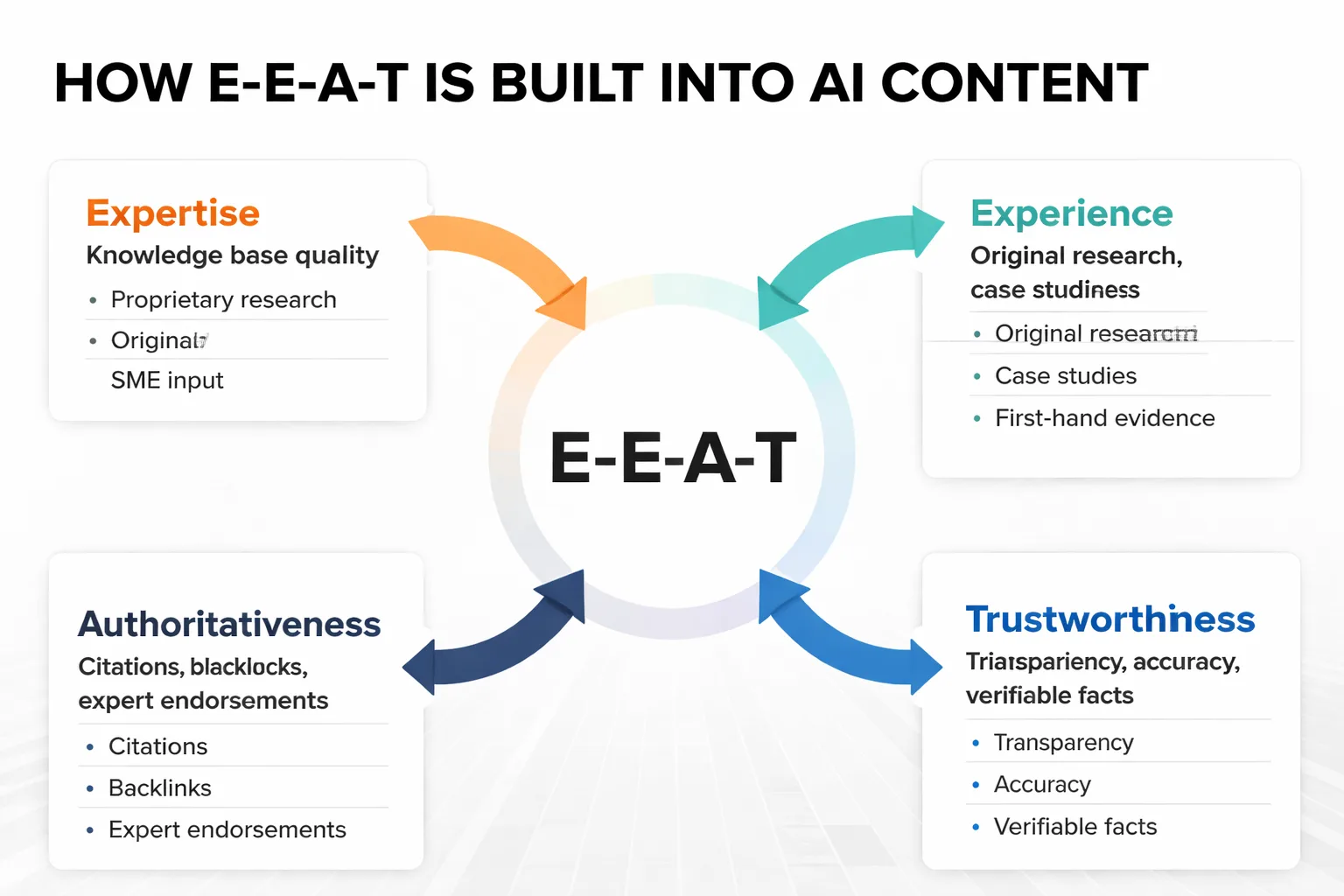
E-E-A-T (expertise, experience, authoritativeness, trustworthiness) is Google's framework for evaluating content quality. For AI-generated content, each component requires specific, deliberate construction. E-E-A-T is not a checkbox. It is a set of signals that must be designed into the content production pipeline from the start, not bolted on after publication.
Expertise comes from the knowledge base feeding the AI. If the system retrieves information from generic web content, the output will reflect generic expertise. If it retrieves from proprietary research, original data, and subject-matter expert input, the output reflects genuine expertise. This is why knowledge base quality is the single biggest differentiator between AI content that ranks and AI content that fails.
Experience is the hardest signal to manufacture with AI. Google wants evidence that the content creator has first-hand experience with the topic. For AI content, this means incorporating original research, case studies, proprietary data, and practitioner insights into the knowledge base before generation. The AI cannot fabricate experience. It can only synthesize and present the experience that humans have fed into it.
Authoritativeness comes from external validation. Are other authoritative sources citing the content? Are recognized experts associated with the publication? This is where building topical authority maps for AI search becomes essential. Authoritativeness is earned through consistent, high-quality publishing over time, not through any single article.
Trustworthiness comes from transparency and accuracy. Content must cite real sources, link to authoritative references, and present information that a fact-checker would verify as correct. Every claim should be traceable to a primary source. This is non-negotiable for safe autoblogging.
Stop Optimizing for Keywords Alone
The fundamental shift in 2026 is that keyword optimization is necessary but no longer sufficient. Teams that treat AI content purely as a keyword-capture strategy are building on a foundation that is actively eroding. The data makes this clear: Semrush's analysis of 500+ digital marketing and SEO search terms projects AI search visitors will surpass traditional search visitors by early 2028. When that crossover happens, content that was optimized for traditional keyword matching but not for AI citation will lose visibility on both fronts.
The shift requires thinking beyond traditional search engine optimization tools and toward answer engine optimization. When a user asks ChatGPT, Perplexity, or Google AI Overviews a question, the engine synthesizes an answer from multiple sources. Getting cited in that answer requires a different optimization approach than ranking in the traditional ten blue links. Content needs to be structured for extraction: clear claims, specific numbers, named sources, and self-contained answers that an AI engine can pull and attribute. Understanding what AEO is and how it differs from traditional SEO is now baseline knowledge for anyone publishing content at scale.
This is where the concept of safe autoblogging expands beyond Google's quality guidelines. Safe autoblogging in 2026 means producing content that is safe for Google's ranking systems AND optimized for AI search engine citation. The two are related but distinct. Google rewards comprehensive, authoritative content that satisfies user intent. AI search engines reward content that is structured for extraction, with clear quotable claims and verifiable sources. Content that satisfies both is content that will survive regardless of how search evolves.
When Should You Use an AI SEO Agent?
AI SEO agents are powerful when deployed for the right tasks and destructive when deployed for the wrong ones. The distinction comes down to what the agent is authorized to do autonomously versus what requires human gates.
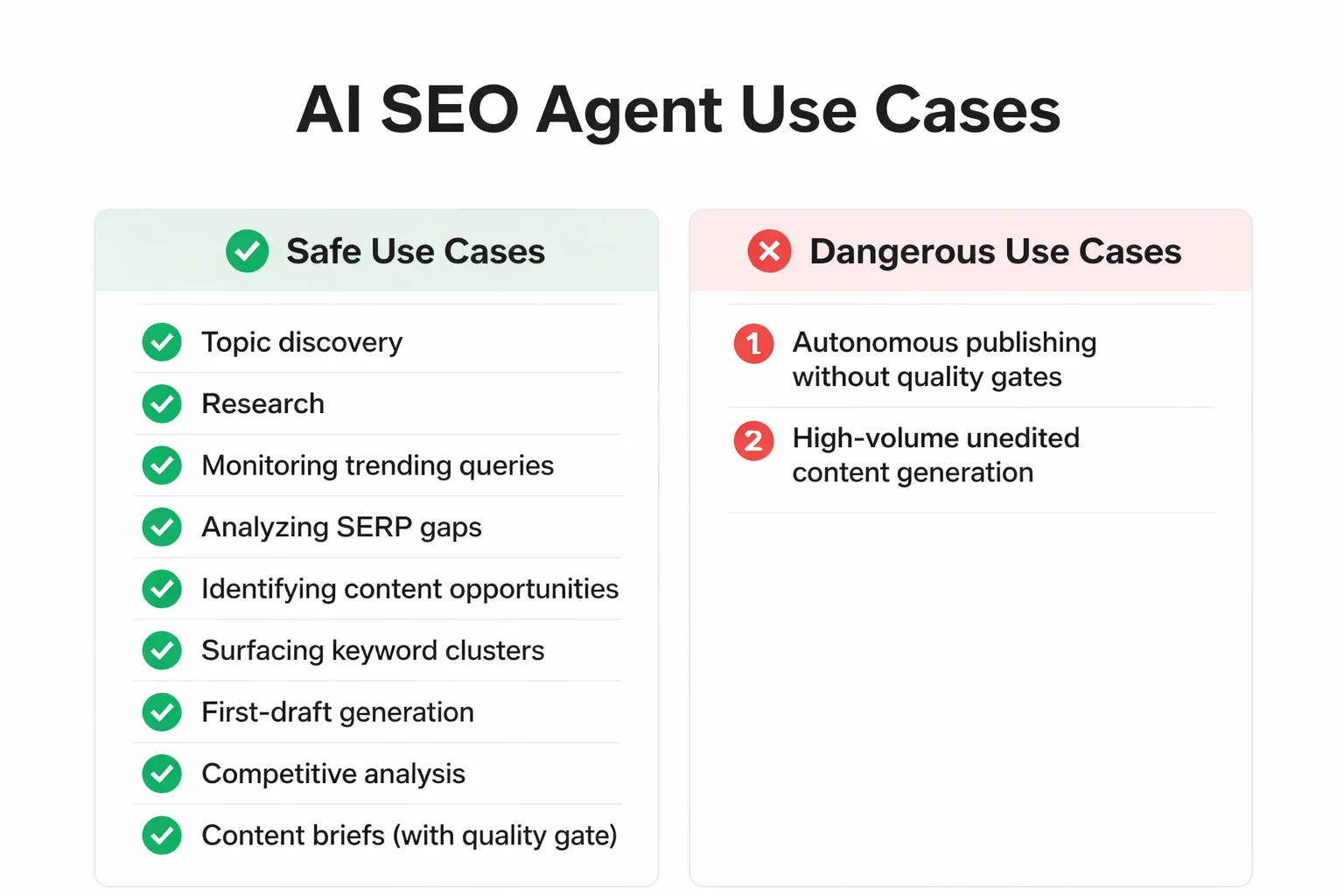
Safe use cases for AI SEO agents include topic discovery and research. An agent that monitors trending queries, analyzes SERP gaps, identifies content opportunities, and surfaces keyword clusters is operating in a low-risk zone. Even if the agent makes a suboptimal recommendation, the cost is wasted time, not damaged rankings. The agent can also handle first-draft generation, competitive analysis, and content briefs without significant risk, as long as the output goes through a quality gate before publication.
Dangerous use cases include autonomous publishing without quality gates. An agent that generates content and pushes it directly to the CMS without any quality check is a liability. The early adopters who went all-in on high-volume, unedited AI content generation saw their site visibility and search rankings plummet. The core issue was not the AI itself but the absence of quality control. An AI SEO agent without a quality firewall is like a factory with no quality inspection station. Defective products ship to customers, and the brand suffers the consequences.
The practical implementation looks like this. The agent discovers topics, researches keywords, analyzes competitors, and generates drafts. A quality firewall evaluates each draft against multiple dimensions: originality, factual accuracy, structural completeness, E-E-A-T signals, and Google penalty risk. Drafts that pass the firewall are eligible for publication. Drafts that fail are blocked and either regenerated or flagged for human review. A human reviews a sample of published content weekly to ensure the quality firewall is calibrated correctly.
The Citation Economy Changes Everything
Here is the contrarian take that most content teams are missing in 2026: owned content SEO is no longer the dominant play for AI visibility. The data is compelling. Research indicates that 84% to 89% of AI-generated answers come from earned media, meaning third-party coverage in credible publications rather than the brand's own website.
This means that a brand publishing 100 high-quality AI-assisted articles on its own blog is less visible in AI search results than a brand cited in 10 articles on authoritative third-party sites. The implication for safe autoblogging is profound. The content production system cannot exist in isolation. It must be connected to a citation strategy that identifies which publishers AI engines actually cite for relevant topics, and then pursues mentions from those sources.
This is what some practitioners are calling Machine Relations, or MR. The concept is analogous to media relations but oriented toward AI engines rather than journalists. Instead of pitching stories to editors, the strategy involves getting cited in the sources that AI engines synthesize answers from. The workflow starts with identifying which domains AI engines cite most often for a given topic, then pursuing coverage from those domains through outreach, guest contributions, or PR.
For teams using an ai seo platform that tracks visibility across every major AI search surface, this data is already available. The system can show which prompts trigger competitor citations, which domains are most frequently cited, and where citation gaps exist. Closing those gaps is the highest-leverage activity for AI search visibility in 2026.
Building a Content System That Survives
The teams that will thrive in the AI search era are not those who generate the most content. They are the ones who build systems that consistently produce quality content optimized for both traditional search and AI citation. This requires infrastructure, not just tools.
A safe autoblogging system in 2026 needs several integrated components. Topic discovery from multiple keyword sources ensures the content pipeline is fed with opportunities that have real search demand and AI citation potential. Archetype-aware generation ensures each article type is structured correctly for its purpose. A quality firewall with at least 11 article-quality signals and a Google penalty risk matrix ensures weak drafts never reach publication. Fact verification ensures every claim is source-traced before publish. Author entity profiles ensure E-E-A-T signals are present. Internal linking with archetype-aware anchor placement ensures topical authority is built systematically.
None of these components are optional. Remove the quality firewall and the system publishes slop. Remove fact verification and the system publishes inaccuracies. Remove author entities and the system fails E-E-A-T. Remove internal linking and the system fails to build topical authority. The system is only as strong as its weakest component.
For teams evaluating ai seo tools or considering whether to work with an ai seo service, the evaluation criteria should focus on system completeness rather than feature count. A tool that generates content but has no quality firewall is a liability. A tool that tracks rankings but has no AI visibility monitoring is incomplete. A tool that publishes but has no indexing integration is leaving discovery to chance. The right system covers the full loop: from topic discovery through generation, quality control, publishing, indexing, and visibility tracking.
How Does AI Content Fit Into Generative Engine Optimization?
Generative Engine Optimization (GEO) is the practice of optimizing content to be cited and synthesized by AI search engines. Research published on arXiv on Generative Engine Optimization establishes the academic foundation for this discipline. For AI-generated content, GEO principles must be built into the generation pipeline, not applied as a post-publishing optimization layer.
The practical implementation involves several specific techniques. First, content must contain self-contained, quotable statements that AI engines can extract and attribute. Each major claim should be a complete sentence with a specific number or named source. Second, content must cite authoritative sources inline, prioritized by domain authority, because AI engines use citation patterns to determine trustworthiness. Third, content must be structured with clear headings, concise answers, and logical progression, because AI engines parse structure to identify relevant sections for synthesis.
Fourth, and this is where most AI content fails, the content must offer something that no other source on the topic offers. AI engines synthesize multiple sources to construct answers. If the AI-generated content says the same thing as every other source, it adds no value to the synthesis and will not be cited. The content must contribute a unique perspective, original data, or a novel analysis that enriches the AI engine's answer. This is why knowledge base quality is so critical. The AI can only produce unique content if it is fed unique inputs.
Understanding the distinction between AEO vs GEO and AEO vs SEO helps clarify the optimization strategy. Traditional SEO targets ranking in search results. AEO targets being cited in AI-generated answers. GEO targets being synthesized into the AI engine's generated response. All three require quality content, but they reward different structural and strategic choices. Safe autoblogging in 2026 optimizes for all three simultaneously.
The Ethics of Scale
Transparency matters. Not because Google requires disclosure of AI use (it does not), but because trust matters to readers and to the long-term health of a brand. The question is not whether to disclose AI use but how to ensure that AI-assisted content meets the same quality standard a reader would expect from human-written content.
The ethical framework for safe autoblogging is straightforward. If the content is accurate, useful, and original, the use of AI is irrelevant to the reader's experience. If the content is inaccurate, unhelpful, or derivative, the use of AI is an aggravating factor but not the root cause. The ethical obligation is to the reader, not to the production method. Teams that maintain this orientation will produce content that survives algorithm changes, AI search evolution, and whatever comes next.
The teams that fail ethically are not those using AI to write content. They are those using AI to generate content without verifying accuracy, without ensuring originality, and without maintaining quality standards. The ethical failure is in the negligence, not the technology.
What This Actually Means
The landscape has shifted. Google does not penalize AI content. It penalizes bad content. The teams that understand this distinction and build systems accordingly will dominate the next era of search. The teams that do not will repeat Marcus's experience: a brief traffic spike followed by a catastrophic collapse.
Safe autoblogging in 2026 requires three things. A quality firewall that blocks weak content before publication. Human oversight that calibrates the system and catches what automated checks miss. A citation strategy that extends beyond owned content to the third-party sources AI engines actually cite. Teams that build this infrastructure will produce content that ranks in Google, gets cited by AI search engines, and drives measurable business results. Teams that skip these steps will publish content that disappears.
The question is not whether to use AI for content. The question is whether the system that uses AI is built to produce quality at scale. That is the difference between safe autoblogging and digital litter. The data is clear. The guidelines are clear. The only variable is execution.
FAQ
Does Google detect AI-generated content and penalize it?
No. Google's ranking systems evaluate content quality based on E-E-A-T signals (expertise, experience, authoritativeness, trustworthiness) rather than detecting whether content was AI-generated. Google's official guidance confirms that automation has always been used to generate helpful content, and the focus is on quality, not production method. Sites that experience ranking drops after publishing AI content are being penalized for quality issues, not for AI usage.
What makes AI content low quality in Google's eyes?
Low-quality AI content typically exhibits three characteristics: it is unoriginal (rephrases existing content without adding new value), it is inaccurate (contains hallucinated statistics or fabricated sources), and it lacks experiential depth (reads like a summary of summaries without evidence of real expertise). Google's Helpful Content updates target these quality deficiencies regardless of whether a human or AI produced the content.
Can I safely auto-publish AI content without human review?
Safe auto-publishing requires a quality firewall that evaluates every draft before it reaches the CMS. This firewall should check originality, factual accuracy, structural completeness, E-E-A-T signals, and Google penalty risk. Drafts scoring below a defined threshold (for example, 70 out of 100) should be blocked from auto-publishing. Human review of a weekly sample of published content is still recommended to catch quality drift and calibrate the firewall.
How do I optimize AI content for AI search engines like ChatGPT and Perplexity?
AI search engines cite content that contains self-contained, quotable statements with specific numbers and named sources. Content should be structured with clear headings, concise answers, and inline citations to authoritative sources. Each major claim should be a complete, extractable sentence. Content must also offer unique value that no other source provides, because AI engines synthesize multiple sources and will not cite content that merely duplicates what already exists.
What is the difference between AI-assisted and AI-generated content?
AI-generated content is produced entirely by AI without human input beyond the initial prompt. AI-assisted content uses AI as a tool within a human-directed workflow, where humans provide the knowledge base, review output, and maintain quality standards. Google does not distinguish between the two for ranking purposes, but AI-assisted content typically scores higher on quality because human oversight catches errors and ensures originality.
Should I disclose that my content is AI-generated?
Google does not require disclosure of AI use. The ethical question is not about disclosure but about quality. If the content is accurate, useful, and original, the production method is irrelevant to the reader's experience. The ethical obligation is to ensure that AI-assisted content meets the same quality standard a reader would expect from any content, regardless of how it was produced.
About the Author
Judy Zhou, Founder
Judy Zhou leads content strategy at Meev, where she oversees AI-driven content research and publishing for hundreds of brands. With a background in SEO and editorial operations, she focuses on building content systems that rank on Google, get cited by AI search engines, and drive measurable business results.
Stop guessing whether your AI content will survive. Track your visibility across every major AI search surface and publish with a 16-dimension quality firewall that blocks weak drafts before they reach your CMS.