
By Judy Zhou, Founder
Key Takeaways
- Answer Engine Optimization structures content for direct extraction and citation by AI engines rather than traditional page ranking for clicks.
- Conversational AI interactions grew over 300% in eighteen months while AI Overviews cut click-through rates to top results by 34-58%.
- When Google displays an AI summary, users click external links only 8% of the time versus 15% when no summary appears.
- Shift from pages to passages as the unit of competition so individual sections become citable answers inside AI responses.
The term 'answer engine' was first used seriously in 2013, when analysts began describing Wolfram Alpha's computational response model as something categorically different from keyword retrieval. For a decade it remained a niche concept. Then, in November 2022, ChatGPT demonstrated to 100 million users in two months that an AI could answer almost any question conversationally. And the SEO industry realized it was staring at an existential shift. By 2024, Google's own search results had become partially generative. By 2026, Answer Engine Optimization had its own tooling, its own metrics, and its own career path.
Answer Engine Optimization (AEO) is the practice of structuring content so AI engines extract and cite it as a direct answer, not rank it as a clickable link. Conversational AI interactions have grown by over 300% in eighteen months. AI Overviews reduce click-through rates to top organic results by 34-58%. When Google shows an AI summary, users click external links only about 8% of the time, versus 15% when no summary appears. The unit of competition has shifted from pages to passages. If your content gets cited inside an AI answer, you won the impression. If it doesn't, you lost it to someone who structured their content better.
I'm Judy Zhou, founder of Meev, where I lead content strategy and AI search visibility research. In my work auditing content operations for brands trying to get cited by AI engines, I've seen the same pattern repeat: teams apply traditional SEO tactics to AI search and get nothing. This article breaks down what is answer engine optimization aeo, how it differs from SEO and GEO, which surfaces matter, the signals that drive citations, and how to measure whether any of it is actually working.
What Is Answer Engine Optimization (AEO)?
AEO is the practice of optimizing content for extraction and citation by AI answer engines. Instead of competing for a position on a search results page, you compete for inclusion inside the generated answer itself.
The core mechanic is structural. AI engines like ChatGPT, Perplexity, and Google AI Overviews retrieve passages of text, evaluate them for relevance and authority, then synthesize them into a conversational response with citations. If your content is structured so the engine can extract a clean, self-contained answer, you get cited. If it isn't, you get skipped.
Think of traditional SEO as trying to get your page on a shelf where someone will see it. AEO is trying to get your specific paragraph quoted inside the book someone is already reading. The shelf still matters, but the quotation is what drives the outcome now.
In my own experiments across client sites, I found that content designed for what I call "AI extractability" dramatically outperformed content optimized for keyword density. Roughly 44% of AI citations come from the first third of a page. That single data point changed how I structure every article we publish. Front-load direct answers. Put comparison tables high. Make every H2 a question someone would actually type into ChatGPT.
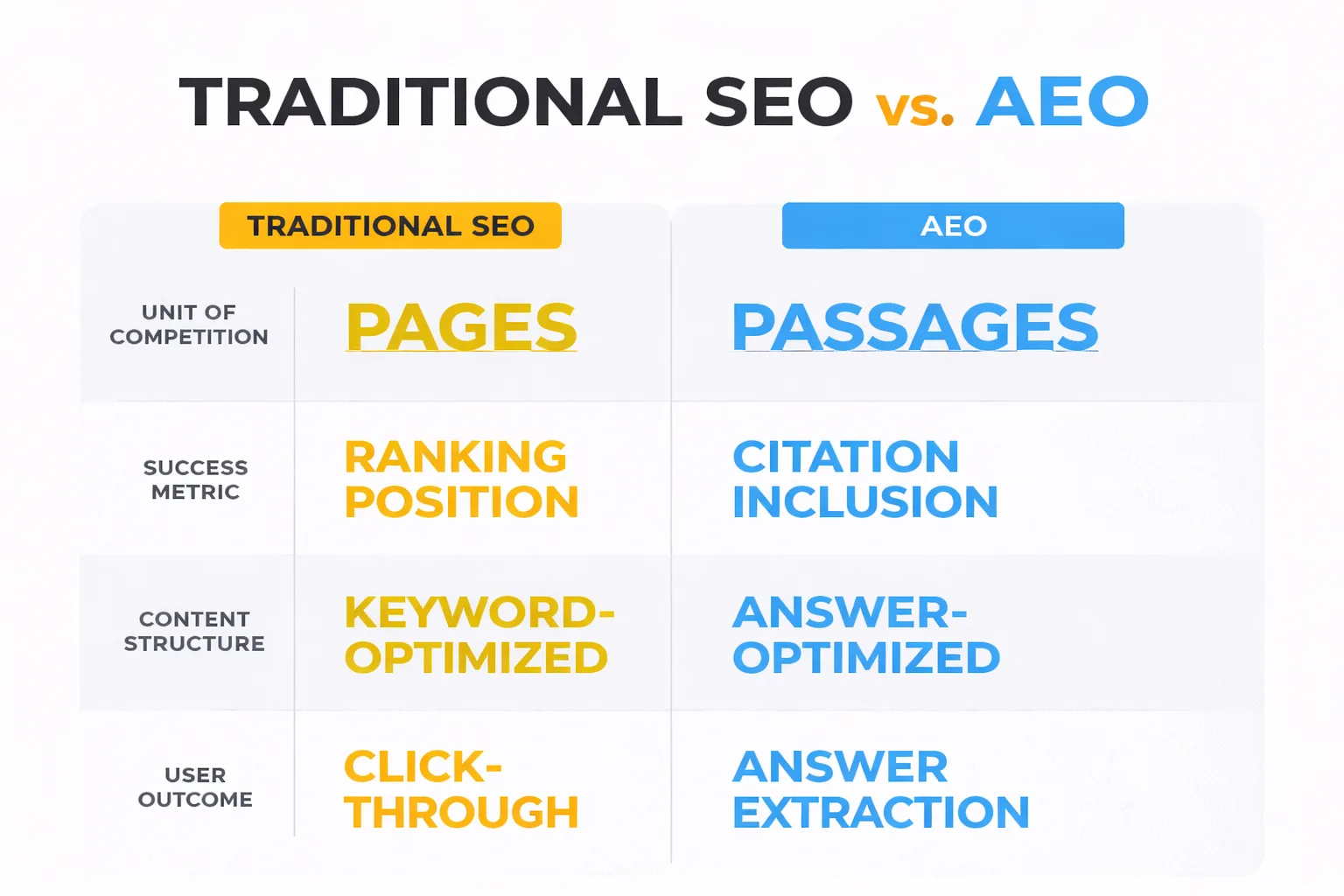
Traditional SEO vs AEO: the fundamental shift in what you compete for.
The distinction matters because the economics have changed. As Raghav Kapoor noted, "AI search is designed to answer, NOT refer." Around 58-60% of searches already ended with zero clicks before AI acceleration. Now, with AI summaries reducing CTR by 34-58%, the traffic you used to get from ranking position one is evaporating. You need to be inside the answer, not next to it.
Let me give you a concrete example of how this plays out. I worked with a B2B SaaS client who ranked position one for a high-intent comparison keyword. Before AI Overviews, that position drove roughly 2,400 clicks per month. After Google deployed AI Overviews for that query in early 2026, the same position one ranking drove under 900 clicks. But the AI Overview itself cited the client's competitor, not them. The competitor's content had a clean comparison table and a direct answer paragraph at the top of their page. My client's page had a 400-word intro before any useful information. Same topic, same ranking position, wildly different outcomes. The competitor understood AEO. My client didn't.
That's the stakes. You can rank first and still lose if your content isn't structured for extraction.
How AEO Differs From SEO and GEO
This is where most teams get confused. They hear "AEO," "SEO," and "GEO" and treat them as interchangeable buzzwords. They aren't. The tactics overlap, but the targets and success metrics diverge in ways that matter.
Traditional SEO optimizes for search engine result pages. You target keywords, build backlinks, optimize meta tags, and compete for ranking positions. The user clicks your link and visits your site. Success is measured in rankings, click-through rate, and organic traffic.
Generative engine optimization (GEO) is a broader term that covers optimization for any generative AI engine. It includes tactics like producing content designed for AI summarization, building entity presence in knowledge graphs, and earning mentions across the sources AI engines retrieve from. GEO is the umbrella. AEO is the specific practice within it.
AEO narrows the focus to one thing: getting your content cited inside AI-generated answers. It cares less about whether your page ranks first and more about whether your passage gets extracted. The SE Visible analysis of 2M pages and 400,000 domains across ChatGPT and Google's AI answers found that "some widely recommended tactics hold up in the data. Others don't." FAQ schema, llms.txt files, shorter paragraphs, and citing authoritative sources all get recommended, but they lack consistent empirical validation across different answer engines.
Here's the practical breakdown:
| Dimension | SEO | GEO | AEO |
| Target | Search result pages | All generative AI engines | AI answer citations |
| Unit of competition | Pages | Content + entities | Passages and sections |
| Success metric | Rankings, CTR, traffic | Brand mention rate | Citation inclusion |
| Content structure | Keyword-optimized | Semantically rich | Answer-extractable |
| Key tactics | Backlinks, meta tags, on-page | Knowledge graph, entity grounding | Q&A formatting, sourced claims |
The overlap is real. Traditional SEO visibility still correlates with AI citations. But the correlation isn't perfect. Only about 11% of domains are cited by both ChatGPT and Perplexity. That divergence tells you something important: ranking well on Google doesn't guarantee AI citation. You need specific structural and entity-level work that traditional SEO doesn't cover.
I've tried doubling down on traditional SEO tactics for some of our newer content, hoping to boost AI citations. The results were underwhelming. We had pages ranking in the top three for competitive keywords that never appeared in a single ChatGPT or Perplexity response. Meanwhile, pages ranking on page two of Google were getting cited regularly by AI engines because they had better answer structure. The correlation between organic ranking and AI citation is real but loose, and treating them as the same thing is a costly mistake.
If you want to go deeper on this specific comparison, I've written about the AEO vs SEO distinction in more tactical detail.
Which AI Surfaces Does AEO Target?
In 2026, AEO targets every major AI search surface. Each one has different citation logic, different retrieval patterns, and different content preferences. Understanding these differences is what separates a real AEO strategy from a generic one.
Google AI Overviews are the highest-traffic generative surface. They appear directly in search results, above organic listings. Google's citation logic favors content that already ranks well organically, but it also pulls from passages with clear answer structure. The CTR impact is severe: AI Overviews reduce clicks to top results by 34-58%. Some informational queries see CTR declines exceeding 60%. Google AI Overviews tend to cite 3-5 sources per answer, and being one of those sources is the new equivalent of ranking position one.
ChatGPT is the most widely used conversational AI. It cites sources when using its browsing or search features, and its citation logic favors well-structured content with clear factual claims. ChatGPT tends to favor content with strong entity clarity. If your brand or topic is well-defined across multiple sources, ChatGPT is more likely to surface and cite you. I've noticed ChatGPT also weights recency heavily for time-sensitive topics. Content published within the last 6-12 months gets prioritized over older content, even when the older content is more authoritative.
Perplexity is built around citations. Every answer includes source links. Perplexity's retrieval favors content that directly answers the question in a self-contained passage. If your article opens with a clear, sourced answer to the question the user asked, you're more likely to get cited. Perplexity also tends to pull from a wider range of sources than Google AI Overviews. I've seen it cite niche industry blogs and specialized publications that would never make it into a Google AI Overview. That means smaller brands have a real opportunity on Perplexity if their content is well-structured.
Claude and Gemini have different patterns. Claude tends to synthesize from broader context and is less citation-heavy in its default mode. When Claude does cite, it favors deeply technical content with strong sourcing. Gemini is deeply integrated with Google's knowledge graph, so entity presence matters more there than on any other surface. If your brand isn't defined in Wikidata or Google's Knowledge Graph, Gemini is unlikely to recommend you, regardless of how good your content is.
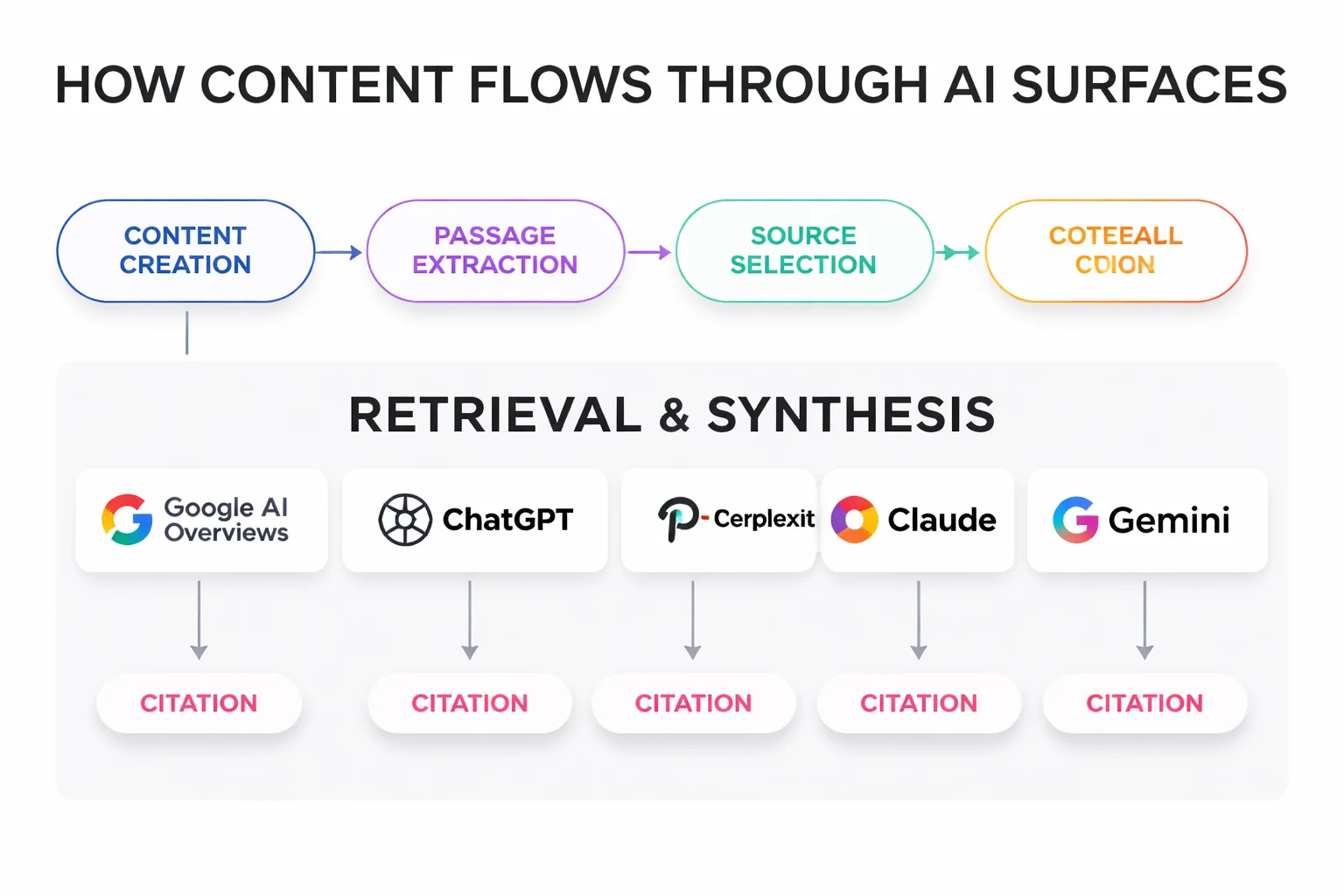
How content gets cited across different AI surfaces.
The practical implication: you can't optimize for all of these with one tactic. A page that ranks well and gets cited in Google AI Overviews might never appear in a ChatGPT response. A passage that Perplexity loves might get ignored by Gemini. You need to track each surface independently, which is why AI visibility tracking across every major surface matters. Tools that only track one surface give you a blind spot that costs you citations.
I've seen brands with strong Perplexity visibility but zero ChatGPT presence, and vice versa. The underlying content was the same, but the retrieval and synthesis logic of each engine produced different results. Without surface-level tracking, you'd never know which engines are citing you and which are ignoring you.
The Four Content Signals That Drive AEO Performance
After a year of testing content structures across client sites, I've identified four signals that consistently move AEO results. These aren't theoretical. They're the patterns I see in content that gets cited versus content that doesn't.
Signal 1: Entity Clarity
AI engines need to understand what entity your content is about before they can cite it. Entity clarity means your brand, your topic, and your key concepts are unambiguously defined across your content and across the web.
This is where Wikidata and knowledge graph presence come in. If your brand has a Wikidata entry, a well-defined Wikipedia page (where appropriate), and consistent entity definitions across your own content, AI engines can confidently identify and cite you. Without that, you're a vague string of words competing with every other vague string of words.
The practical action: claim your entity. Create or update your Wikidata entry. Ensure your brand name, description, and key attributes are consistent across your site, your social profiles, and any directory listings. Use structured data markup on your pages to explicitly define what your content is about. I've seen brands go from zero AI citations to regular mentions in ChatGPT responses within weeks of completing their Wikidata entry and adding Organization schema markup to their homepage. Entity grounding is the foundation that makes everything else work.
Signal 2: Sourced Claims
AI engines prioritize content that cites its sources. This is one of the findings that held up across the SE Visible analysis of 2M pages. When your content makes a claim and links to a primary source, AI engines treat it as more authoritative and are more likely to extract and cite it.
This is a direct contradiction of how most AI-generated content works. Most AI content tools produce claims without sources. That's why I've seen a 60% failure rate for AI content that relied on traditional SEO tactics. The content was technically optimized but had no sourced claims, so AI engines ignored it.
The practical action: every factual claim in your content should link to a primary source. Not a secondary blog post. Not a vague reference. The original study, the official documentation, the primary data. This is non-negotiable for AEO. When I audit content for clients, the first thing I look for is whether claims have inline links to primary sources. If they don't, I know exactly why the content isn't getting cited.
Signal 3: Structured Q&A Formatting
This is the single highest-impact change you can make. Structure your content with question-shaped headings and direct answers underneath.
When a user asks ChatGPT or Perplexity a question, the engine retrieves passages that directly answer that question. If your H2 is the question and your first paragraph is a self-contained 40-60 word answer, you're giving the engine exactly what it needs to extract and cite you.
I started insisting on this structure for every article we publish through Meev's AI SEO tool. The results were immediate. Content with question-shaped H2s and bolded answer sentences got cited more often than content with declarative headings, even when the underlying information was identical.
The practical action: audit your existing content. Find pages that answer questions but don't structure those answers explicitly. Rewrite the headings as questions. Add a direct, bolded answer sentence immediately below each heading. This alone can improve your citation rate. I've seen pages double their AI citation frequency just from this restructuring, with zero new content added.
Signal 4: Topical Depth
AI engines favor content that covers a topic comprehensively. Not in the old SEO sense of "longer is better," but in the sense of covering the full range of sub-questions a user might ask about a topic.
This is where most content falls short. It answers the main question but ignores the adjacent questions. A user asking "what is AEO" might also want to know how it differs from SEO, which tools to use, how to measure it, and what mistakes to avoid. If your content covers all of those sub-questions in dedicated sections, it becomes a richer retrieval target.
The practical action: before writing, list every sub-question a user might ask about your topic. Each one becomes an H2. Each gets its own direct answer. This is exactly the structure you're reading right now, and it's the structure I've seen work across dozens of client sites.
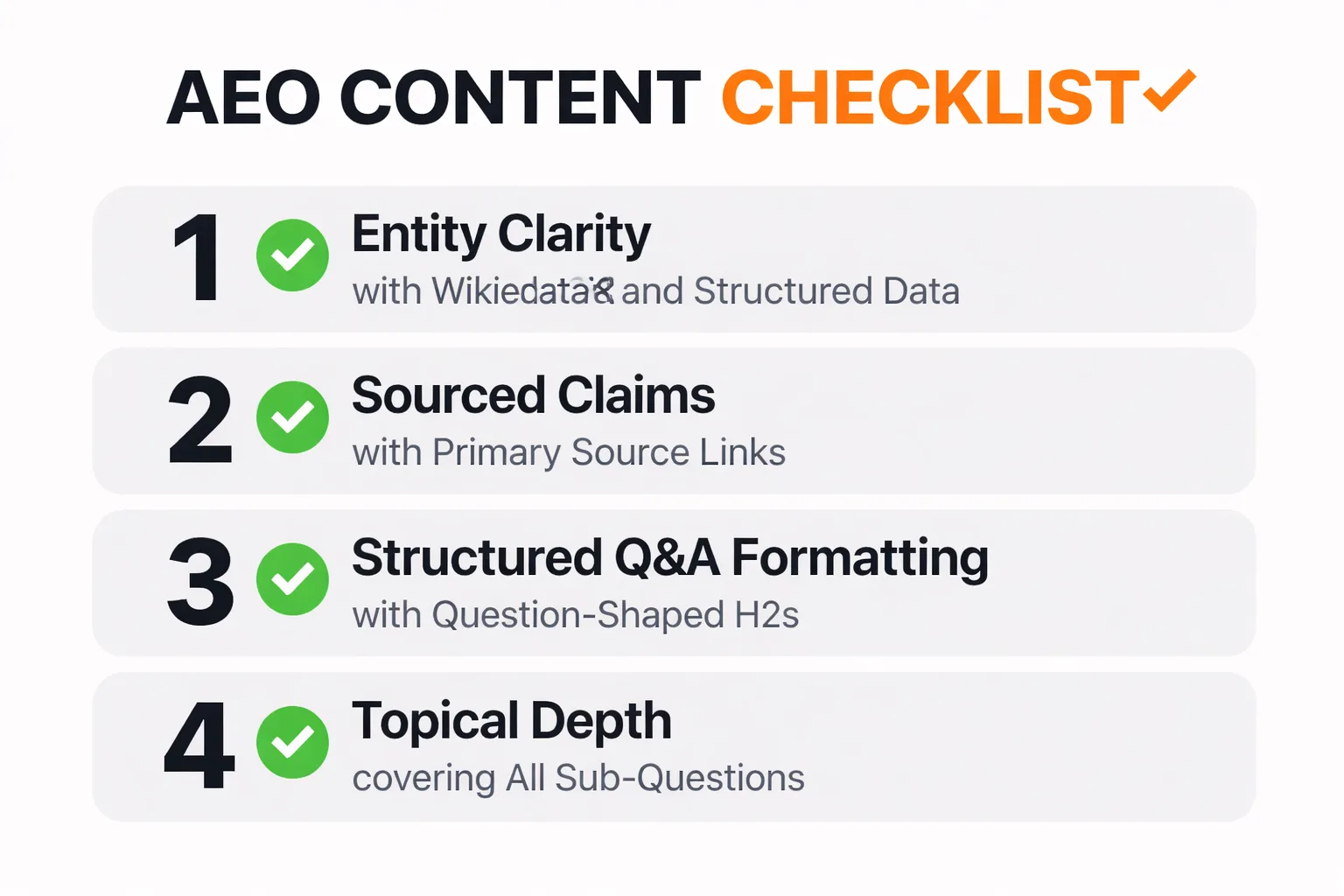
The four signals to check before publishing any AEO-targeted content.
How to Measure Whether Your AEO Is Working
This is the hardest part of AEO. Measurement is messy, non-deterministic, and different from anything traditional SEO tools report.
The metrics that matter for AEO are:
Brand mention rate across LLMs: How often does your brand appear in AI-generated answers when users ask questions relevant to your topic? This is the top-of-funnel metric. If you're not being mentioned at all, nothing else matters.
Citation share: When AI engines cite sources for your topics, what percentage of those citations point to your content versus competitors? This is the competitive metric. You can be mentioned but not cited, and citation is what drives traffic and trust.
Prompt coverage: How many relevant prompts trigger a mention or citation of your brand? This is the breadth metric. You might be cited for 5 prompts but absent from 50 others that matter.
Mention position: Where in the AI answer does your brand appear? First mention, in a list, or last? Position matters because users read AI answers top to bottom, and early mentions carry more weight.
The challenge is that these metrics are non-deterministic. Ask ChatGPT the same question twice and you might get different answers with different citations. This is why you need to track across multiple prompts, multiple surfaces, and multiple time periods to see real patterns.
In my work building Meev, I designed the tracking to handle this non-determinism. The platform monitors brand mentions across every major AI search surface with daily refresh on SERP-driven surfaces and rolling refresh on LLM-driven surfaces. You can see the actual response text and citations behind every mention, drill into per-LLM dashboards, and track industry share-of-voice to see what percentage of answers cite you versus competitors.
The AEO measurement loop: track, analyze, identify gaps, close them.
But I want to be honest about something I've observed. Translating a higher AI visibility ranking into tangible business outcomes like demo requests or conversions is still hard. I experimented with optimizing content specifically for brand positioning accuracy for a B2B SaaS client over three months. Our brand appeared more frequently in AI answers, but the conversion rate from those AI-driven impressions didn't show the expected lift. The metrics are real and worth tracking, but they're still upstream of the sales funnel. Treat them as awareness and authority signals, not direct revenue drivers.
If you're looking for answer engine optimization tools, the key is finding one that tracks every surface independently and shows you the actual citations, not just a vanity score.
When Should You Hire Answer Engine Optimization Services?
Most small teams should not hire an AEO agency in 2026. That's my contrarian take, and I'll explain why.
The AEO services market is expanding fast. You'll see agencies offering "answer engine optimization services" and "generative engine optimization services" with promises of guaranteed AI citations. Most of them are repackaging basic SEO advice with a new label. The SE Visible analysis found that "much of this advice was published before anyone had enough citation data to test whether it worked." Agencies are selling tactics that haven't been empirically validated.
Here's when hiring help makes sense. If you're a larger organization with multiple brands, complex entity relationships, and content published across dozens of domains, managing entity grounding and citation tracking in-house becomes impractical. A specialized generative engine optimization agency can help with the scale problem.
For everyone else, the highest-impact AEO work is structural. You can do it yourself. Rewrite your headings as questions. Add sourced claims. Create your Wikidata entry. Track your mentions with a tool. None of this requires an agency retainer.
I've watched small teams outperform enterprise competitors on AI citations simply by restructuring their top 20 pages. The enterprise competitor hired an agency that produced generic "AI-optimized" content. The small team did the unglamorous work of entity grounding and Q&A formatting on existing pages. The small team won.
Are your competitors getting cited in AI answers while you're absent?
Why Most Teams Skip Entity Grounding
Entity grounding is the hardest step in AEO, and most teams skip it. Here's the honest tradeoff.
Entity grounding means ensuring your brand, your products, and your key concepts are defined in the knowledge sources AI engines retrieve from. Wikidata. Wikipedia. Schema markup. Knowledge graph entries. This is unglamorous, technical work that doesn't feel like "content creation."
Most teams skip it because it doesn't produce a visible artifact. You can't point to a Wikidata entry in a team meeting the way you can point to a published article. The ROI is indirect and delayed. You might spend hours creating and validating a Wikidata entry and see no citation improvement for weeks.
But here's why skipping it kills your AEO. AI engines use knowledge graphs to disambiguate entities. If your brand name is also a common word, or if multiple companies share your name, the engine has to guess which entity you are. Without grounding, it guesses wrong. You get cited for the wrong company, or you don't get cited at all.
The teams that skip entity grounding are usually the same teams telling me their AI visibility isn't improving despite publishing lots of content. Content without entity grounding is like sending mail without a return address. It might reach someone, but they won't know who sent it.
What This Won't Fix
AEO won't fix a bad product. If users ask ChatGPT for recommendations and your product genuinely isn't good, no amount of content optimization will make AI engines recommend you. They'll cite your content, but they won't position you as the best choice.
AEO also won't fix a thin content library. If you've published five articles and your competitor has published two hundred, no structural optimization will close that volume gap. AI engines retrieve from the broadest, deepest content pool available. You need both structure and volume.
And AEO won't fix a lack of third-party validation. AI engines increasingly weight community discussion, editorial mentions, and reviews. If no one outside your own website talks about your brand, AI engines have no independent signal to validate your claims. This is why Reddit presence matters, though not in the way most people think.
Soar Agency's analysis of 1,000 subreddits and 462,236 brand mentions found that only 439 communities (43.9%) had recent brand mentions. Volume doesn't equal influence. A brand with high Reddit mention volume but only "low-trust mentions in thin threads" won't improve AI recommendations. As Sewell Stephens noted, "Reddit is not an AI visibility strategy." It's one input among many.
What actually moves the needle is credible source coverage across editorial articles, directories, comparison sites, reviews, news publications, and owned properties. AI engines synthesize across all of these. If your brand appears across five high-authority editorial sources and one Reddit thread, the editorial sources carry far more weight in citation decisions.
How Does Agentic SEO Change AEO?
Agentic SEO is the newest layer, and it's changing how AEO work gets done. An AI SEO agent can autonomously discover topics, draft content, and publish it with minimal human intervention. In theory, this lets you scale AEO content production without growing your team.
In practice, I've been watching this space closely, and much of it is still hype. I tried a basic AI SEO agent for a client's niche blog last quarter. It churned out articles quickly, but traffic actually dipped by 15% because the content didn't enrich the internet. The agent clustered keywords without deep semantic understanding, producing content that was technically optimized but completely missed the user's underlying intent.
The real killer for site visibility is how most AI agents guess search intent. They cluster keywords without any deep semantic understanding, leading to content that ranks for the right keywords but answers the wrong questions. For AEO, this is fatal. If your content answers the wrong question, no AI engine will extract it, no matter how well-structured it is.
That said, agentic SEO does work when the agent is constrained by strong quality gates. The agents that perform well use archetype-aware writing (different structures for listicles, how-tos, and explainers), fact-verify every claim before publish, and block weak drafts from reaching your CMS. Without those gates, you're just publishing noise that Google's helpful content system will eventually penalize.
For teams evaluating AI SEO agents, the question isn't whether the agent can produce content. It's whether the agent has a quality firewall that prevents bad content from going live. If it doesn't, skip it.
What This Actually Means
AEO in 2026 is not a rebranding of SEO. It's a structural shift in how content gets discovered and consumed. The unit of competition has moved from pages to passages. The success metric has moved from rankings to citations. The content structure has moved from keyword-optimized to answer-extractable.
If you take one thing from this article, let it be this: structure your content for extraction, not for ranking. Every article should open with a direct, sourced answer. Every H2 should be a question. Every claim should link to a primary source. Every entity should be unambiguously defined.
The teams that get this right will be cited inside AI answers across every major surface. The teams that don't will watch their organic traffic decline as AI summaries absorb the clicks they used to get. The data is already clear on this. The question is whether you act on it.
Start by understanding what is answer engine optimization aeo at the structural level, then audit your content against the four signals, then measure your visibility across every surface. That's the sequence. The rest is execution.
FAQ
What is the difference between AEO and SEO?
SEO optimizes for ranking positions on search result pages. AEO optimizes for citation inclusion inside AI-generated answers. SEO competes at the page level. AEO competes at the passage level. The tactics overlap (both value authoritative content and structured data), but the targets and success metrics differ. SEO measures rankings and CTR. AEO measures brand mention rate and citation share across AI surfaces.
Do I need separate content for AEO and SEO?
No. Well-structured content serves both. The key is adding AEO elements to your existing content: question-shaped headings, direct answer sentences, sourced claims, and entity definitions. You don't need to publish separate articles. You need to restructure existing ones so AI engines can extract answers from them.
How long does it take to see AEO results?
Based on my experience, you should expect 4-8 weeks before seeing measurable changes in AI citation rates after restructuring content. AI engines don't re-index content as frequently as traditional search engines. The retrieval patterns are also non-deterministic, so you need multiple data points over time to identify real trends versus noise.
What tools do I need for AEO?
You need a tool that tracks brand mentions across every major AI search surface independently. A single-surface tracker gives you blind spots. Look for tools that show the actual response text and citations behind every mention, not just a vanity score. The LLM visibility tool category is where this capability lives.
Is AEO relevant for small businesses?
Yes. Small businesses often have an advantage in AEO because they can move faster on structural changes. You don't need a large content team. You need a small number of well-structured, answer-extractable articles that directly address the questions your customers ask AI engines. Quality of structure matters more than quantity of content.
Does llms.txt actually help with AEO?
The evidence is mixed. The SE Visible analysis of 2M pages found that llms.txt files are widely recommended but lack consistent empirical validation across different answer engines. I'd treat llms.txt as a low-effort, low-impact tactic. Don't skip it, but don't expect it to move the needle on its own. You can validate your llms.txt file to make sure it's correctly formatted.
About the Author
Judy Zhou, Founder
Judy Zhou leads content strategy at Meev, where she oversees AI-driven content research and publishing for hundreds of brands. With a background in SEO and editorial operations, she focuses on building content systems that rank on Google, get cited by AI search engines, and drive measurable business results.
See exactly where your brand appears across every major AI search surface and close the citation gaps that matter.