

By Judy Zhou, Founder
Key Takeaways
- 68% of US Google searches ended without a click to any website in Q1 2026, while the top organic result loses 58% of its CTR when an AI Overview appears.
- AI-referred traffic to US retail grew 393% year-over-year in Q1 2026, requiring submission to the infrastructure feeding both crawlers and answer engines like Perplexity and Gemini.
- GEO tactics such as citations, quotations, and statistics lift AI visibility by up to 40%, per the Princeton and Georgia Tech research paper.
- Manual site submission still matters in 2026 because discovery via inbound links does not guarantee indexing or inclusion in AI responses.
Picture your SEO dashboard on a Monday morning. Crawl coverage: 98%. Sitemap submitted. Core Web Vitals: all green. By every traditional metric, your site is perfectly indexed. Then a colleague runs your brand name through five AI answer engines. Perplexity, ChatGPT search, Google AI Overviews, Copilot, and Gemini. Your domain appears in exactly one response, buried in a footnote. Your competitors, some with weaker backlink profiles, are cited as authoritative sources in four out of five. That gap is what modern site submission strategy is actually designed to close.
68% of US Google searches ended without a click to any website in Q1 2026. The top organic result loses roughly 58% of its click-through rate when an AI Overview appears, according to SparkToro's research. Meanwhile, AI-referred traffic to US retail grew 393% year-over-year in the same quarter. If you are only optimizing for Google's blue links, you are optimizing for a shrinking surface. You need to submit site to search engine infrastructure that feeds both crawlers and answer engines. GEO tactics (citations, quotations, statistics) can lift AI visibility by up to 40%, according to the original GEO research paper from Princeton and Georgia Tech. Submission is no longer a one-button action. It is a multi-layer visibility strategy.
Does Submitting Your Site Still Matter in 2026?
The short answer is yes, but the mechanics have shifted. Google's crawler is efficient. If you have a single inbound link from a crawled page, Googlebot will find you. I have seen this happen within 48 hours for new domains. So why bother with manual submission? Because discovery is not indexing.
I have audited enough sites to know the difference. A page can be discovered, crawled, and then left in "Crawled. Currently not indexed" purgatory for months. This is the reality of Google's quality-gated approach. The crawler finds you, but the indexer is not convinced you deserve storage. Manual submission through Google Search Console does not override that quality gate. What it does is accelerate discovery for pages that lack strong external signals, and it gives you diagnostic data to understand why you are stuck.
Bing operates differently. In my experience, Bing is far more reactive to direct submission methods. If you submit a URL to Bing Webmaster Tools, it tends to get crawled and indexed faster than the equivalent Google submission. This makes Bing a quicker win for initial visibility. The problem is that most teams ignore Bing entirely because Google has 90% of the search market. That was a defensible position two years ago. It is not defensible now, because Bing's index feeds Copilot and other AI surfaces. If you are absent from Bing, you are absent from a slice of the AI answer pie.
Then there is the AI layer. ChatGPT, Perplexity, Claude, and Google AI Overviews do not have a "submit your site" button. They build their answers from content they have ingested through crawling, licensing deals, and real-time retrieval. You cannot submit a URL to ChatGPT and expect it to appear in answers. You can, however, ensure your content is technically crawlable, structurally clear, and entity-rich enough that when an AI agent retrieves it, it understands what you are and cites you as a source. That is the new submission. It is about making your site legible to machines that summarize, not just machines that rank.
The conventional wisdom is that submission is obsolete because crawlers handle everything. That is wrong. Submission is not obsolete; it has been redefined. It now encompasses sitemap submission, IndexNow pinging, structured data implementation, and entity grounding. If you skip the manual steps, you are leaving discovery speed and diagnostic data on the table. If you stop at the manual steps, you are invisible to AI. You need both.
Step 1. Submit to Google Search Console
Google Search Console (GSC) is the primary interface for telling Google about your site. It is free, it is direct, and it provides diagnostic data you cannot get anywhere else. If you are not using it, you are flying blind.
Verify Site Ownership
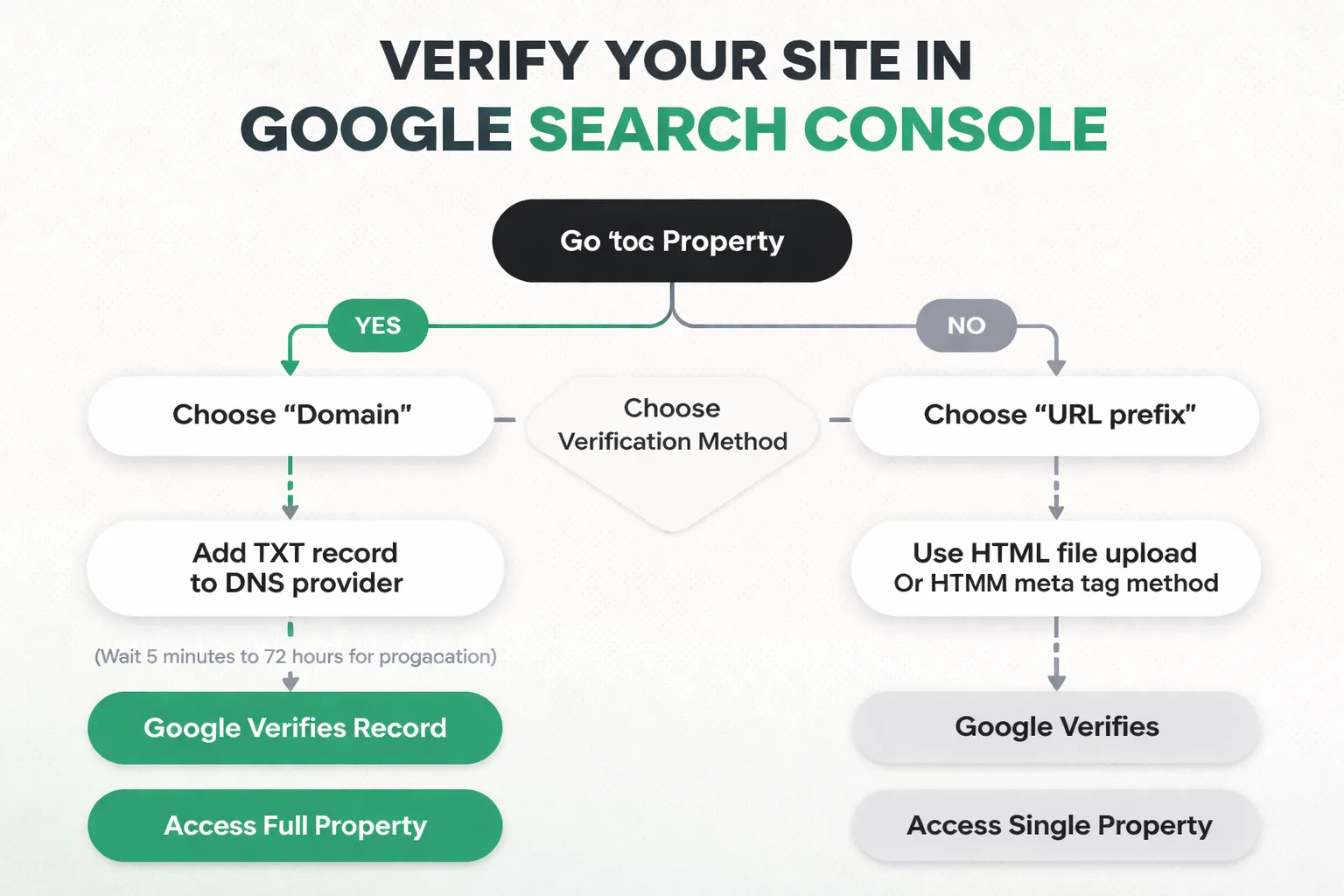
Before you can submit anything, you must prove you control the domain. GSC offers several verification methods. The domain-level verification (adding a TXT record to your DNS) is the one I recommend because it covers all subdomains and protocol variations (http, https, www, non-www). If you do not have DNS access, the HTML file upload or the HTML meta tag method works for single properties.
The verification process is straightforward. Go to GSC, click "Add Property," choose "Domain" or "URL prefix," and follow the instructions. For domain verification, you will get a TXT record to add to your DNS provider. Propagation can take anywhere from 5 minutes to 72 hours. Once Google verifies the record, you have access to the full property.
Submit Your XML Sitemap
Once verified, submit your sitemap. Go to the "Sitemaps" section in GSC, enter your sitemap URL (typically yoursite.com/sitemap.xml), and click submit. GSC will tell you how many URLs were discovered and if there are any errors.
Do not just submit and forget. Check the coverage report weekly for the first month. I have seen sitemaps with 500 URLs where only 12 get indexed. The coverage report tells you why. Common issues include redirects in the sitemap, non-canonical URLs, and pages blocked by robots.txt. Fix these before submitting more content.
Request Indexing for Priority Pages
For high-priority pages (product launches, announcements, time-sensitive content), use the URL Inspection tool. Paste the URL into the GSC search bar, wait for the report to load, and click "Request Indexing." This pushes the URL into Google's prioritized crawl queue.
How do I check if Google can crawl my site? The URL Inspection tool answers this directly. Enter any URL, and GSC tells you whether the page is indexed, when it was last crawled, and if there are any blocking issues (robots.txt, noindex tags, or rendering errors). If the tool says "URL is not on Google," click the tab to see why. The most common reasons are "Discovered. Currently not indexed" (Google found it but has not prioritized it) and "Crawled. Currently not indexed" (Google crawled it but decided not to store it). Both indicate quality signals need improvement, not technical fixes.
In my work auditing content operations, I have seen pages remain in "Crawled. Currently not indexed" for over three months despite proper submission. This is frustrating. You tell Google a page exists, and it sits in limbo. My takeaway: Google prioritizes content quality, mobile-friendliness, and robust internal linking far more for actual indexing. I have shifted my focus to ensuring every new page has strong internal links and is optimized for mobile from day one, rather than just waiting for Google to find it.
Step 2. Submit to Bing Webmaster Tools and Other Engines
Bing matters more than it used to. Its index powers Copilot, and its Webmaster Tools platform is genuinely useful. The submission process is similar to GSC but with one critical addition: IndexNow.
Bing Webmaster Tools Setup
Create a Bing Webmaster Tools account, add your site, and verify ownership (same methods as GSC). Submit your sitemap in the same way. Bing's interface is less polished than Google's, but it provides similar diagnostic data including crawl errors, indexing status, and keyword performance.
IndexNow. The Fastest Multi-Engine Submission Path
IndexNow is a protocol developed by Microsoft and Yandex that allows instant notification to multiple search engines when content changes. Instead of waiting for crawlers to discover your updates, you ping the IndexNow API and participating engines (Bing, Yandex, Naver, Seznam, and others) immediately know to recrawl.
Here is why IndexNow is a big deal. Traditional submission is passive. You submit a sitemap and wait. IndexNow is active. You publish a page, ping the API, and within minutes the participating engines know about it. For sites that publish frequently or update product catalogs regularly, this is the fastest path to multi-engine visibility.
To implement IndexNow, you generate a key, host a text file with that key at your root directory, and send a POST request to api.indexnow.org with your URL list. Many CMS platforms and SEO plugins now support IndexNow natively. If you are publishing through a platform like Meev, IndexNow pinging happens automatically on every publish alongside GSC sitemap submission. The point is that you should not have to think about it. It should be part of your publishing infrastructure.
DuckDuckGo and Other Engines
DuckDuckGo does not have a webmaster tools interface or a manual submission option. It sources its results from Bing's index. If you submit to Bing, you are covered for DuckDuckGo. Yandex has its own Webmaster Tools interface, which is useful if you target Russian-speaking markets. For most English-language sites, the priority stack is Google, Bing (via IndexNow), and then structured data for AI surfaces.
Step 3. Make Your Site Crawlable Before You Submit
Submitting a site that has technical blockers is like mailing a letter with no address. The post office processes it, but it never arrives. Before you touch any submission tool, run through this pre-submission checklist.
Review Your robots.txt File
How to check the robots.txt file? Navigate to yoursite.com/robots.txt in your browser. This file tells crawlers which pages they can and cannot access. A misconfigured robots.txt file is the single most common reason submitted pages do not get indexed.
The critical lines to check are Disallow: directives. If you see Disallow: / in your robots.txt, you are blocking all crawlers from your entire site. This happens more often than you would think, usually due to a staging environment configuration that was not updated for production. Check for overly broad disallow rules like Disallow: /*? which blocks all URL parameters (common in ecommerce and can block product filtering pages you actually want indexed).
Validate Your XML Sitemap
Your sitemap should contain only canonical, indexable URLs. I have seen sitemaps that include redirected URLs, parameter URLs, and pages with noindex tags. These confuse crawlers and dilute your crawl budget. Use a sitemap validator (GSC has one built in) to check for errors before submitting. Every URL in your sitemap should return a 200 status code, be canonical, and be linked from at least one other page on your site.
Check Canonical Tags
Canonical tags tell search engines which version of a URL is the "master" version. If your canonical tags point to the wrong URL, Google may index the wrong page or skip it entirely. Check that every priority page has a self-referencing canonical tag. If you have duplicate content (common in ecommerce with product variants), ensure the canonical points to the version you want indexed.
Page Speed and Mobile-First
Google uses mobile-first indexing. If your mobile experience is broken, your desktop experience does not matter. Run your priority pages through PageSpeed Insights. A slow page is not a technical blocker for indexing, but it is a quality signal that affects whether Google decides your page is worth storing. Aim for a Largest Contentful Paint under 2.5 seconds and a Cumulative Layout Shift under 0.1.
The Blockers That Make Submission Pointless
Here is the honest list of things that make all your submission effort wasted. A robots.txt file blocking your CSS or JavaScript files prevents Google from rendering your page correctly, which means it cannot understand your content. A server returning 5xx errors during crawl attempts tells Google your site is unstable. Pages with thin content (under 100 words of unique text) get crawled but rarely indexed. If any of these conditions exist, fix them before submitting. Submission does not override quality signals. It just tells the engine where to look. If what they find is broken or thin, they leave.
Is your site visible in AI answers, or just indexed?
What Submission Does Not Do for AI Search
This is where most guides stop. They tell you to submit to Google and Bing, verify ownership, and move on. That advice was complete in 2019. In 2026, it is dangerously incomplete.
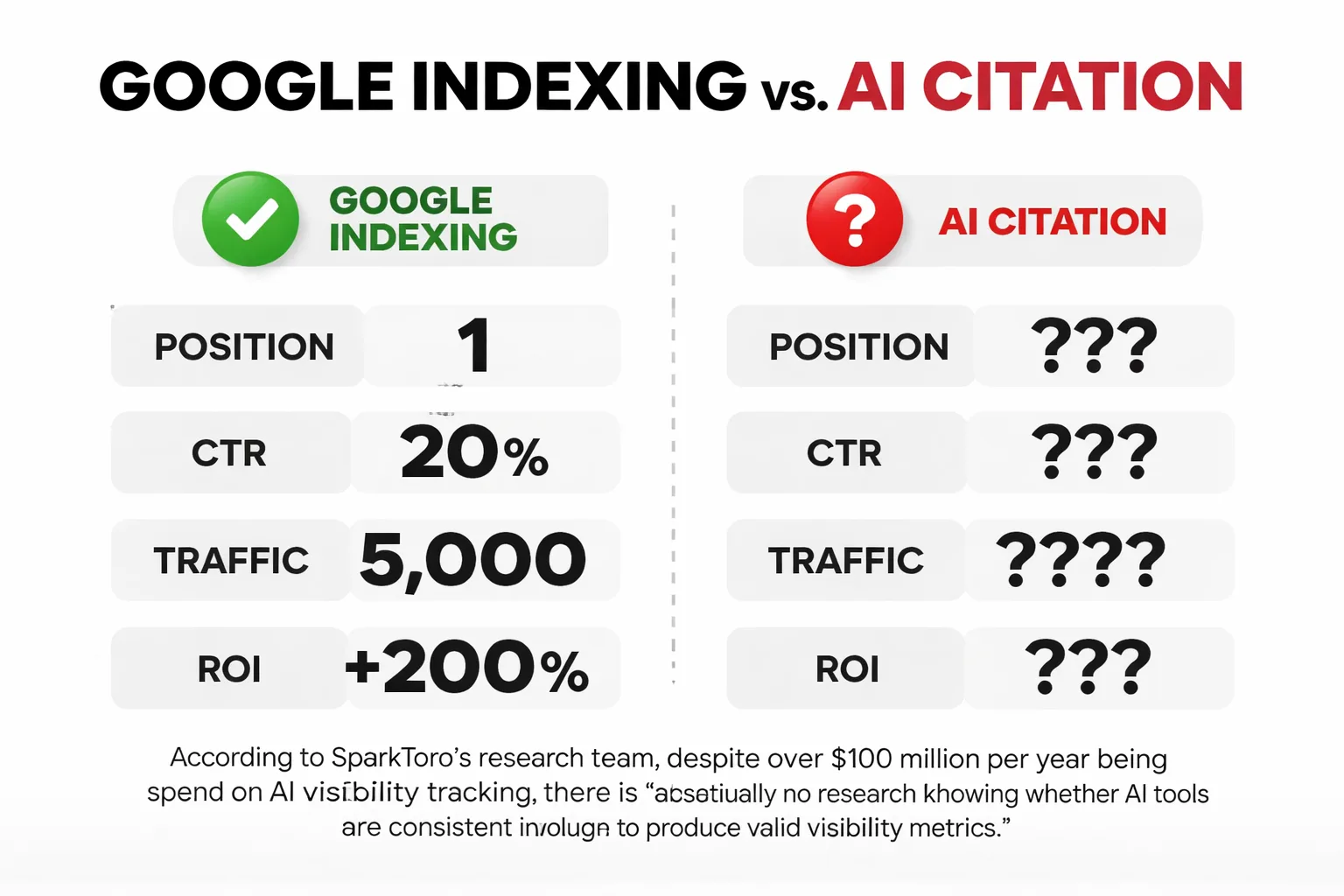
Google indexing does not equal AI citation. A page can be perfectly indexed, ranking in the top 3 for its target keyword, and completely absent from AI-generated answers. I see this pattern constantly. The reason is that AI answer engines do not simply rank pages. They synthesize information from multiple sources, and they prefer sources that are structured for extraction.
According to SparkToro's research team, despite over $100 million per year being spent on AI visibility tracking, there is "absolutely no research showing whether AI tools are consistent enough to produce valid visibility metrics." This means teams are investing in measurement without validated benchmarks. The Carnegie Mellon study on LLM consistency confirmed this inconsistency at the academic level. AI engines are inconsistent in how they recommend brands. You can be cited favorably one day and absent the next, with no changes to your content.
This is why I treat AI visibility as a separate discipline from traditional SEO. You need an AI visibility tool to track where you appear across ChatGPT, Claude, Gemini, Perplexity, Grok, and Google AI Overviews. Without daily monitoring, you are blind to the gap between what you think you rank for and what AI engines actually cite you for.
The Additional Layer. Entity Grounding and Structured Content
To appear in AI-generated answers, you need three things beyond basic submission. First, structured data (Schema.org markup) that explicitly tells crawlers what your content is about. Second, entity presence in knowledge graphs like Wikidata, which AI engines use to verify and ground factual claims. Third, content that is quotable. AI engines prefer content with clear statistics, direct quotations, and structured formats that are easy to extract and cite.
The original GEO research from Princeton and Georgia Tech found that adding citations, quotations, and statistics to content can increase AI visibility by up to 40%. This is not a vague correlation. It is a measured effect from a peer-reviewed paper. If your content does not cite sources, include data points, or use quotation formats, you are making yourself harder for AI to extract and reference.
This is where answer engine optimization diverges from traditional SEO. Traditional SEO optimizes for ranking position. AEO optimizes for extraction and citation. The two are related but distinct. A page can rank #1 on Google and never be cited by an AI engine if its content is not structured for extraction. Conversely, a page ranking #5 can be the primary citation in a ChatGPT answer if it is the most quotable, well-structured source on the topic.
Wikidata and Knowledge Graph Presence
Wikidata is the structured data backbone of Wikipedia. AI engines use it to verify entity facts. If your brand or organization has a Wikidata entry with accurate properties (official website, industry, founding date, key people), AI engines can ground their answers about you in verified data. If you do not have a Wikidata entry, you are relying entirely on your website content to define who you are. That is a weaker signal.
Creating a Wikidata entry requires notability (usually demonstrated by having Wikipedia articles or significant press coverage). If you qualify, it is one of the highest-leverage actions you can take for AI visibility. If you do not qualify, focus on structured data on your own site (Organization schema, sameAs links to your profiles) and getting cited by sources that do have Wikidata entries.
Monitoring AI Citations
You cannot manage what you do not measure. I use Meev's AI visibility tracker to monitor where my brand appears across every major AI search surface. The point is not just to see if I am mentioned. It is to see the context of the mention. Am I cited as the primary recommendation? Am I listed as a secondary option? Am I mentioned negatively?
This is the framing problem I learned the hard way. Early on, I focused on boosting raw mention rates, thinking more mentions meant more leads. That was a misstep. An AI can recommend your brand as a "good starting point" before suggesting a more advanced competitor, effectively funneling users away. It is not about being seen. It is about being seen in the right light, with the right narrative, to genuinely influence a buying decision. Aleyda Solís warned about this when she noted that organic traffic metrics do not show whether a brand is being surfaced, cited, or recommended inside AI-generated answers.
The Perplexity AI visibility checker and ChatGPT AI visibility checker are examples of surface-specific monitoring tools that let you see exactly what each engine says about you. The value is in the per-engine breakdown. Each AI engine has different retrieval weights, different citation preferences, and different content formats it favors. A one-size-fits-all approach does not work.
How Does IndexNow Compare to Traditional Sitemap Submission?
IndexNow and sitemap submission serve different purposes, and you need both. A sitemap is a comprehensive map of your site's structure. It tells search engines what pages exist. IndexNow is a real-time notification system. It tells search engines what changed.
The practical difference is speed. When you submit a sitemap to Google, Google processes it on its own schedule. This can take days. When you ping IndexNow, participating engines (Bing, Yandex, others) receive the notification within minutes. For time-sensitive content, IndexNow is the clear winner. For comprehensive site coverage, sitemaps are still necessary.
The best approach is a hybrid. Submit your sitemap to GSC and Bing Webmaster Tools for comprehensive coverage. Use IndexNow for real-time updates on new and changed content. If your publishing platform supports both (Meev does this automatically on every publish), you do not have to choose. If you are managing this manually, set up IndexNow for your most frequently updated sections and rely on sitemaps for the rest.
When Should You Request Manual Indexing?
Manual indexing requests through GSC's URL Inspection tool are not for every page. They are for priority pages where speed matters. Use manual indexing requests for new product launches, breaking news, time-sensitive announcements, and pages that are not being discovered through normal crawl patterns.
Do not use manual indexing for routine content. Google limits the number of requests you can make per day (roughly 10 per day for most properties). If you submit 10 URLs daily, you are using your quota on pages that would be discovered anyway within a week. Save it for the pages that cannot wait.
I have seen teams waste hours submitting every blog post through GSC. This is a poor use of time. If your internal linking is solid, Google will discover new blog posts within days. Manual indexing is a tool for acceleration, not a substitute for good site architecture.
Why Most Teams Skip Entity Grounding
Here is the honest tradeoff. Entity grounding (Wikidata entries, Organization schema, knowledge graph connections) is the single highest-leverage action for AI visibility. It is also the hardest to execute. Creating a Wikidata entry requires notability, which requires Wikipedia articles or significant press coverage. Implementing comprehensive structured data requires developer time or a plugin that handles it correctly. Most teams skip it because the ROI is unclear and the effort is high.
This is a rational skip if you are a small team with limited resources. But it means you are competing for AI citations with one hand tied behind your back. The teams that invest in entity grounding are the ones that show up in AI answers with verified, grounded facts. The teams that skip it are relying on content quality alone, which is necessary but not sufficient.
The middle ground is implementing Organization schema on your site with sameAs links to all your profiles. This takes 15 minutes with a schema generator. It does not require Wikidata notability. It gives AI engines a clear, structured definition of who you are. Start there. Expand to Wikidata when you have the notability signals.
What This Won't Fix
This tutorial covers the mechanics of submission and crawlability. It does not fix content quality problems. If your pages have thin content, unoriginal analysis, or no unique data, no amount of submission or structured data will get you cited by AI engines. AI engines extract and synthesize. If there is nothing worth extracting, you will not be cited.
This also does not fix branding or positioning problems. If AI engines mention you but frame you as a budget option or a secondary choice, submission and schema will not change that narrative. That requires content strategy work. You need to create content that positions you as the primary, authoritative source on the topics where you want to be cited. The AEO vs SEO distinction matters here. SEO asks "how do I rank?" AEO asks "how do I get cited as the best answer?"
FAQ
Can I submit my site to search engines for free?
Yes. Google Search Console, Bing Webmaster Tools, and IndexNow are all free. There is no paid submission service that provides better results than these free tools. Avoid services that claim to submit your site to "hundreds of search engines" for a fee. These services submit to obscure directories and meta engines that have negligible traffic. The only engines that matter are Google, Bing, and the AI surfaces that build on their indexes.
How long does it take for Google to index a submitted page?
It varies. A manually submitted URL through the URL Inspection tool can be indexed within hours to days. Sitemap-submitted URLs can take days to weeks. Pages that Google discovers through crawling without submission can take weeks to months. The timeline depends on content quality, site authority, and crawl budget. There is no guaranteed timeline. If a page has not been indexed after 4 weeks despite proper submission, check the URL Inspection tool for the specific reason.
Does submitting my site to Bing help with AI search visibility?
Yes. Bing's index powers Copilot and contributes to other AI surfaces. Submitting to Bing Webmaster Tools and using IndexNow ensures your content is in Bing's index, which makes it available to Copilot for answer generation. However, Bing indexing alone does not guarantee AI citation. You still need structured, quotable content for AI engines to extract and reference.
What is the difference between site submission and AI visibility?
Site submission tells search engines your pages exist. AI visibility measures whether and how AI answer engines cite your brand in their generated responses. Submission is a prerequisite for visibility (AI engines cannot cite content they have not discovered), but it is not sufficient. Visibility requires submission plus crawlability plus structured content plus entity grounding plus ongoing monitoring.
Should I use a free submission service to submit my site to hundreds of directories?
No. These services are a waste of time. The directories they submit to have no meaningful traffic and no influence on Google, Bing, or AI answer engines. Focus your time on Google Search Console, Bing Webmaster Tools, IndexNow, and structured data implementation. One hour spent on IndexNow setup is worth more than any free submission service.
In 2026, to submit site to search engine infrastructure effectively means covering three layers. The crawl layer: Google Search Console, Bing Webmaster Tools, and IndexNow. The structure layer: XML sitemaps, robots.txt, canonical tags, and Schema.org markup. The entity layer: Wikidata presence, knowledge graph connections, and content structured for AI extraction. Skip any layer and you leave visibility on the table. Skip the entity layer and you are invisible to AI. The teams that understand this distinction are the ones getting cited by ChatGPT, Perplexity, and Google AI Overviews while their competitors wonder why their perfectly indexed sites generate zero AI traffic.
About the Author
Judy Zhou, Founder
Judy Zhou leads content strategy at Meev, where she oversees AI-driven content research and publishing for hundreds of brands. With a background in SEO and editorial operations, she focuses on building content systems that rank on Google, get cited by AI search engines, and drive measurable business results.
Run a free AI visibility scan to see exactly where your brand is cited and where competitors are stealing your mentions.