
By Judy Zhou, Founder
Key Takeaways
- Traditional Google rankings predict just 45% of AI visibility, leaving more than half of brand citations invisible to standard SEO tools.
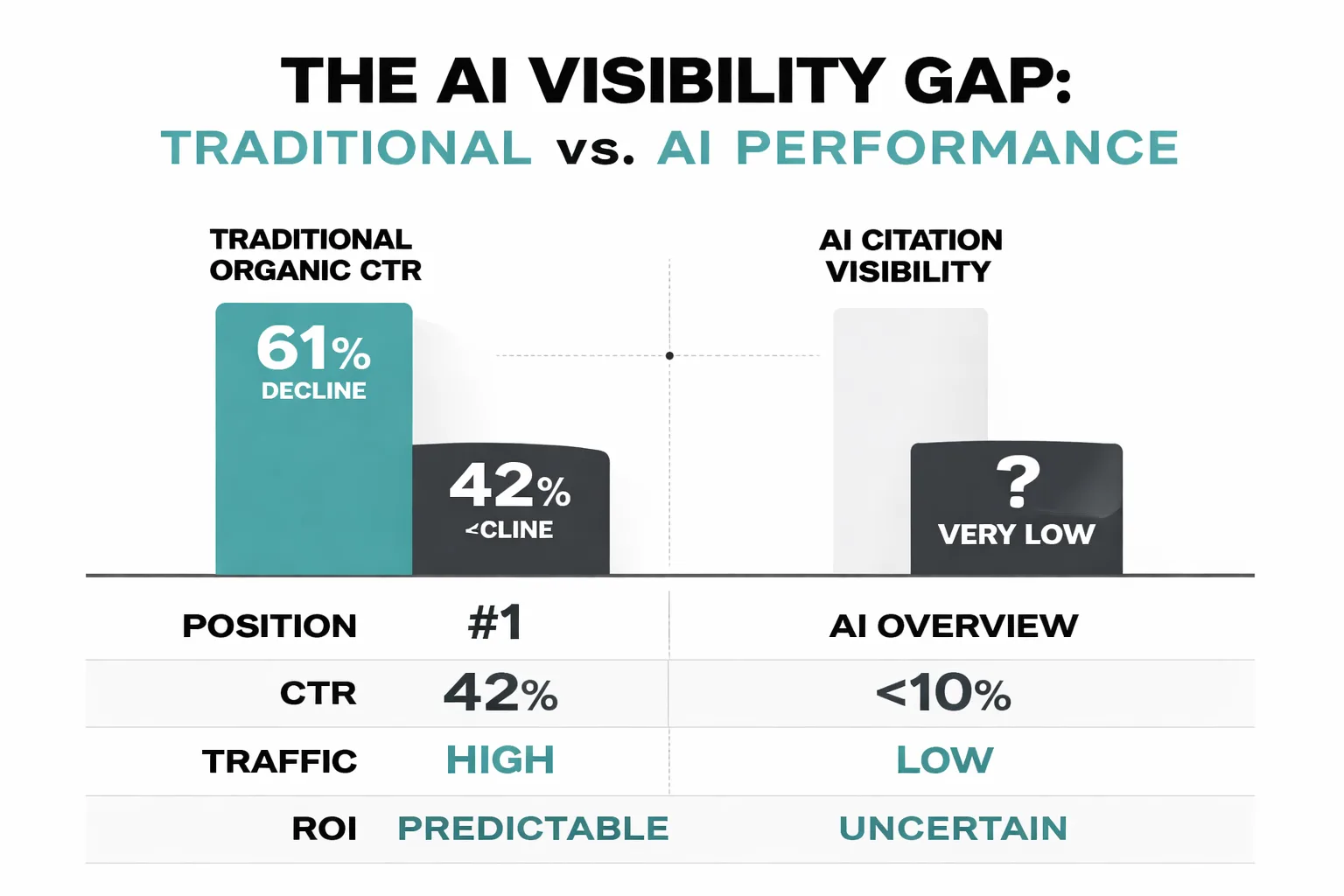
- AI Overviews trigger a 61% organic CTR decline on affected queries, per Seer Interactive's September 2025 analysis.
- Enter your web name directly into an AI citation tracking tool, since engines cite only 3 to 5 sources per response.
- Pew Research found a 47% CTR reduction whenever an AI summary appears in Google results.
Ranking on page one of Google no longer guarantees that AI answer engines will ever mention your website. Traditional SEO metrics. Keyword rankings, domain authority, backlink counts. Tell you almost nothing about your visibility inside ChatGPT, Perplexity, or Google AI Overviews. The real diagnostic starts when you search or enter a web name directly into an AI citation tracking or generative engine optimization tool. Until you do that, you are optimizing blind, measuring a game that has already shifted underneath your strategy without your knowledge.
The gap between traditional indexation and modern AI visibility is massive. Seer Interactive's September 2025 analysis found a 61% organic CTR decline on queries where AI Overviews appear, and Pew Research confirmed a 47% CTR reduction when an AI summary is present. Traditional Google rankings predict just 45% of AI visibility, meaning more than half of what determines whether your brand gets cited by an LLM is invisible to anyone using standard SEO tools.
In my work auditing content operations and building AI search visibility systems, I see the same blind spot every single week. Teams check their Google indexation status, confirm their pages are crawled, and assume they're visible everywhere. They're not. AI engines cite only 3 to 5 sources per response, and if you're not one of them, you don't exist in the answer. This guide walks through exactly how to search or enter a web name to check site visibility across both traditional and AI search surfaces.
What 'Search or Enter Web Name' Actually Means
The phrase "search or enter web name" shows up in three completely different contexts, and conflating them will lead you down the wrong diagnostic path.
In Google Search Console, it's the placeholder text inside the URL Inspection tool. You paste a specific URL there to check whether Google has indexed that exact page, what its coverage status is, and whether any manual actions or crawl errors are blocking it. This is page-level indexation diagnostics.
In your browser's address bar (the Omnibox in Chrome, the address and search bar in Firefox), it's a dual-function field. Type a full URL with a protocol like https://example.com/page and the browser navigates directly to that page. Type a partial string like example marketing blog and the browser sends that string to your default search engine, which interprets it as a query. This is navigational behavior versus informational behavior, and the distinction matters because it mirrors how users find (or fail to find) your brand.
In third-party SEO tools and AI visibility platforms, the phrase refers to entering your domain or brand name to see whether and how it appears across search surfaces. This is where the modern visibility check actually happens. When you search or enter web name into a tool that tracks AI search surfaces, you're asking a fundamentally different question than "is my page indexed?" You're asking "is my brand being cited by ChatGPT, Perplexity, Claude, and Google AI Overviews when users ask questions relevant to my industry?"
The difference between these contexts is the difference between checking whether a library owns your book and checking whether the librarian actually recommends it to visitors. Both matter. But in 2026, the second question is the one driving revenue.
Let me make this concrete with an example I see constantly. A SaaS company launches a new product page. Their SEO team confirms the page is indexed in Google Search Console within 48 hours. They check their rank tracker and see the page ranking for the target keyword. They declare victory. But when a potential customer asks ChatGPT "what's the best tool for [their specific use case]," the AI recommends three competitors and never mentions the SaaS company at all. The team has no idea this is happening because they only checked the library catalog. They never checked whether the librarian recommends their book. That gap between indexation and citation is where pipeline leaks happen silently.
Step 1. Use Google Search Console's URL Inspection Tool
Before checking AI visibility, confirm your page is actually in Google's index. The URL Inspection tool in Google Search Console is the authoritative way to do this.
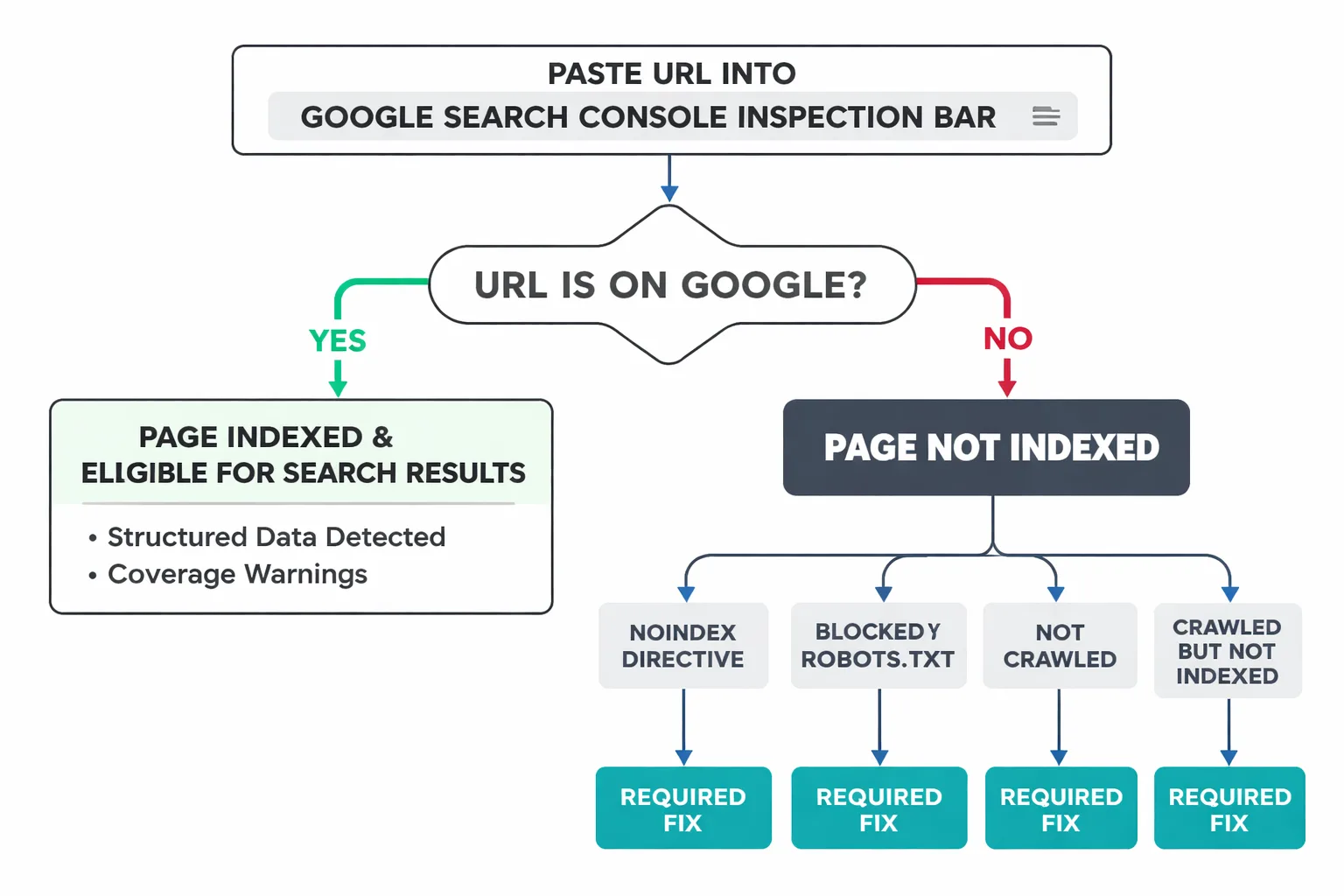
Navigate to Google Search Console, select your property, and paste your URL into the inspection bar at the top. The tool returns one of two primary statuses:
"URL is on Google" means the page is indexed and eligible to appear in search results. But read the details carefully. The tool will tell you whether the page is indexed, whether structured data was detected, and whether there are any coverage warnings. A page can be indexed with warnings that limit its ability to rank.
"URL is not on Google" means the page is not indexed. The tool will show you why: the page has a noindex directive, is blocked by robots.txt, was not crawled, or was crawled but not indexed. Each of these requires a different fix.
Here's what I've learned the hard way about the "Crawled. Currently not indexed" status. I've seen pages sit in that state for over three months despite proper sitemap submission and manual indexing requests. Google does not prioritize your submission queue. It prioritizes content quality, internal linking strength, and mobile-first design. If your page is stuck in this state, the fix is almost never "submit it again." The fix is to strengthen internal links pointing to that page, ensure the content offers genuine value, and verify mobile rendering is clean.
Bing, by contrast, is far more responsive to direct submission through Bing Webmaster Tools. I still submit there for quick initial visibility, but I no longer treat Bing's responsiveness as a signal that Google will follow. They operate on different philosophies.
Let me walk you through the specific interpretation of coverage warnings, because this is where teams get confused. When GSC says "URL is on Google" but shows a warning about structured data, that means Google found schema markup on your page but encountered errors parsing it. Common issues include mismatched schema types (Article schema on a product page), missing required properties (no datePublished on Article schema), or JSON-LD syntax errors. These warnings don't prevent indexing, but they do prevent Google from displaying rich results, and they signal to AI crawlers that your structured data is unreliable. Fix every warning, not just the errors.
Another status I see teams misunderstand is "Discovered. Currently not indexed." This means Google knows the URL exists (probably from a sitemap or internal link) but hasn't crawled it yet. The page is in Google's discovery queue but hasn't earned a crawl. The fix here is to increase the page's prominence through stronger internal linking from high-authority pages on your domain. A contextual link from your homepage or a top-ranking blog post signals to Google that this new page matters.
Step 2. Run a Site: Search in Google
The site: operator is the fastest free diagnostic for understanding how Google sees your domain at scale. Type site:yourdomain.com into Google's search bar and you get a snapshot of every indexed page.
This gives you three things immediately.
First, the total result count tells you approximately how many pages Google has indexed. If you have 500 pages on your site and the site: query returns 40 results, you have a massive indexation gap. Something is preventing Google from crawling and indexing the majority of your content.
Second, the results show you which pages Google considers most important. The first page of site: results is roughly ordered by Google's assessment of page authority and relevance. If your most important product pages or cornerstone content aren't showing up in the first 10-20 results, your internal linking strategy is broken.
Third, you can spot duplicate content issues. Search for site:yourdomain.com and look for near-identical titles or URLs with parameters like ?sessionid= or ?sort=. These fragments create duplicate URLs that dilute your crawl budget and confuse Google about which version to rank.
You can also use site:yourdomain.com/blog to check specific sections. If your blog has 100 posts but site:yourdomain.com/blog returns 15 results, Google isn't indexing your blog content effectively. The culprit is usually a combination of thin content, weak internal linking from the root domain, and slow crawl rates.
One important limitation: the site: operator gives you a traditional indexation picture. It tells you nothing about whether your content is being selected for citation by AI engines. A page can be perfectly indexed in Google and still never appear in a single AI-generated answer. That's the gap most teams miss.
You can also use the site: operator diagnostically in combination with search terms. Try site:yourdomain.com "your brand name" to see how many of your own pages reference your brand by name. Try site:yourdomain.com -inurl:blog to check whether your product or service pages are indexed separately from your blog. These compound queries reveal structural issues that a plain site: search won't surface.
Another technique I use regularly is comparing site: result counts over time. If you check site:yourdomain.com weekly and the result count drops from 320 to 180 without any intentional content removal, something broke. Common causes include a server error that returned 5xx status codes during a crawl window, a robots.txt rule that was accidentally tightened, or a CMS update that introduced noindex tags on category pages. The site: count is a canary in the coal mine. Track it.
Step 3. Cross-Check With an AI Visibility Tool
This is where the diagnostic gets real. Traditional indexation checks tell you whether Google can find your page. They tell you almost nothing about whether AI answer engines will cite your brand.
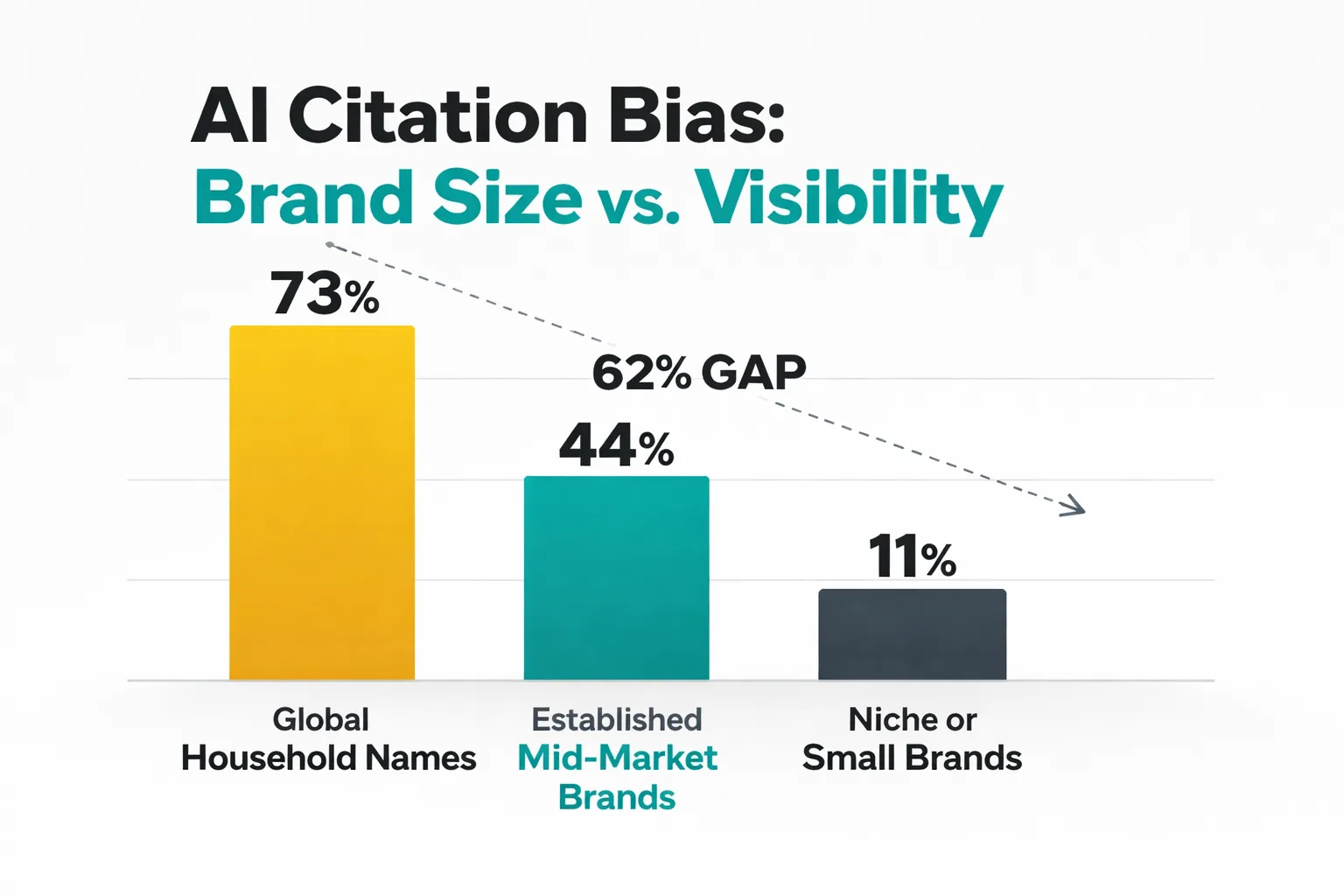
The data backs this up. Research published in arXiv by Chen, Wang, Chen, and Koudas found that AI search engines exhibit a systematic bias toward earned media (third-party authoritative sources) over brand-owned content. A separate study by Kumar and Ranqo measured brand visibility across AI search engines and found that global household names appear in 73% of relevant AI answers, established mid-market brands in 44%, and niche or small brands in only 11%.
That 62 percentage-point gap between global brands and small brands is the entire reason you need a dedicated AI visibility check. If you're a small or mid-market brand and you're only checking Google indexation, you have no idea whether you're in that 11% or whether you're completely invisible to AI answers.
SparkToro's research found that AI tools are "highly inconsistent" when recommending brands or products, and that $100M+ per year is already being spent on AI visibility tracking tools despite no prior research confirming whether these tools produce consistent results. Seth Besmertnik noted publicly that "AI search visibility scores in most of the popular AEO tools today are BS" because the data isn't consistent from tool to tool.
So how do you actually check? You need to run your brand name and relevant topic queries through every major AI search surface and see what comes back. This means checking ChatGPT, Claude, Gemini, Perplexity, Grok, Google AI Overviews, and AI Mode. For each surface, you're looking at three things:
1. Mention presence. Does the AI mention your brand at all when you ask a question relevant to your industry? 2. Mention position. Are you mentioned first, in the middle of a list, or last? Position matters because users weight the first recommendation most heavily. 3. Framing. Is the AI recommending you as the best option, a "good starting point," or a secondary alternative before steering users toward a competitor?
That third dimension is the one most teams skip. I learned this the hard way in my own work. I initially focused on boosting raw mention counts, thinking more mentions equaled more leads. That was a significant misstep. An AI can cite your brand as a "good starting point" before suggesting a more advanced competitor, effectively funneling users away from you. It's not about being seen. It's about being seen in the right light, with the right narrative, to genuinely influence a buying decision.
This is why I recommend using a dedicated AI visibility tracker rather than manually prompting ChatGPT and Perplexity. Manual checks are inconsistent because LLM outputs vary between sessions. A tracking tool runs the same prompts on a schedule and gives you trend data over time.
When you use a tool like the ChatGPT AI visibility checker or the Perplexity AI visibility checker, you get per-LLM drill-down dashboards showing the actual response text and citations behind every mention. That level of granularity is impossible to replicate manually at any scale.
Let me give you a concrete example of how mention position changes business outcomes. Suppose you sell project management software. A user asks ChatGPT "what's the best project management tool for a 20-person startup." The AI responds with a list: "Monday, Asana, ClickUp, and Trello are popular options." Your brand isn't mentioned. You're invisible. Now suppose you are mentioned but you're listed fifth, after four competitors, with the framing "[Your Brand] is a newer option that some teams explore." That framing positions you as an afterthought. The user will click through to the first three options and never reach you. Mention presence without favorable position and framing is a leaky bucket.
This is why tracking mention position matters as much as tracking mention presence. A tool that only tells you "you were mentioned 4 times this week" is giving you a vanity metric. You need to know where in the response you appeared, what the AI said about you, and whether the citation linked to your site or to a third-party review of your product.
Why Does Google Crawl Behavior Differ From AI Citation Behavior?
This is the question I get most often from SEO teams who are new to AI visibility. The confusion is understandable. If Google crawls your page and indexes it, shouldn't that mean it's available to AI engines?
The short answer is no. Google's crawl and index system feeds traditional search results. AI answer engines use a different pipeline. They retrieve information from a combination of their training data, real-time web search results, and retrieval-augmented generation (RAG) that pulls from specific sources at query time.
Google's crawl determines whether your page appears in the blue links. AI citation behavior depends on whether your content is selected as a source during the retrieval step of answer generation. These are fundamentally different selection mechanisms.
According to Tinuiti's Q1 2026 AI Citations Trends Report, Reddit's citation share grew 73% across commercial categories between October 2025 and January 2026. ZipTie.dev's analysis found that Wikipedia comprises approximately 22% of major LLM training data by influence weight, and ChatGPT cites Wikipedia in 7.8% of all citations.
What does this tell you? AI engines preferentially cite established, third-party, authoritative sources. Your brand-owned blog post, no matter how well-optimized for traditional SEO, is competing against Wikipedia, Reddit threads, and major publisher articles for citation slots. And there are only 3 to 5 slots per AI response.
This is why answer engine optimization requires a fundamentally different approach than traditional SEO. You're not trying to rank #1 on a SERP. You're trying to become the source that an LLM retrieves and cites when a user asks a question your brand can answer.
The AEO vs SEO distinction is not academic. It changes your entire content strategy. Traditional SEO rewards comprehensive on-page optimization and backlink building. AEO rewards entity clarity, third-party authority signals, and structured data that helps LLMs understand who you are and what you're an authority on.
Let me break down the retrieval mechanism more precisely. When a user asks ChatGPT a question, the model doesn't search the live web the way Google does. In its default mode, it generates an answer from its training data, which is a snapshot of the web up to a training cutoff date. When web search is enabled (or when using Perplexity, which is built on live retrieval), the model sends the query to a search engine, retrieves the top results, reads their content, and synthesizes an answer citing the sources it found most useful. The citation selection happens in that retrieval-reading-synthesis pipeline. Your page needs to be retrieved (ranked high enough in the search results the model queries), readable (structured in a way the model can parse), and useful (containing information that directly answers the user's question in a citable format).
This is why pages with clear, concise, fact-dense paragraphs tend to get cited more than pages with long narrative introductions. The model is looking for extractable information. If your page buries the answer in a 2,000-word preamble, the model may retrieve your page but extract nothing useful from it. Structure your content for extraction, not just for human readability.
How Does Entity Grounding Change Web Name Visibility?
Entity grounding is the mechanism by which an AI model connects your brand name to a real-world entity in its knowledge graph. If your brand is not grounded as a recognized entity, the AI has no stable reference point for who you are, what you do, and why you're relevant.
Think of it this way. When you type "Nike" into Google, Google doesn't just match the string of letters to web pages. It resolves "Nike" to the entity in its Knowledge Graph, which includes structured information: the company's founding date, headquarters, CEO, industry, and relationships to other entities. This is why you get a knowledge panel on the right side of the SERP.
AI engines do something similar. When a user asks "what's the best running shoe brand," the LLM retrieves from sources it associates with the entity "running shoe brands." If your brand is not grounded as an entity in the LLM's knowledge base, you're invisible to that retrieval process regardless of how well your pages rank in Google.
This is where Wikidata and knowledge graph presence become critical. Wikidata is the structured data backbone that feeds Wikipedia and, by extension, many LLM training corpora. If your brand has a well-maintained Wikidata entry with accurate properties (founded date, industry, official website, key people, products), AI engines have a reliable entity reference to ground your brand name to.
I want to be honest about the limits of entity grounding. The Kumar and Ranqo study found that niche and small brands appear in only 11% of relevant AI answers, compared to 73% for global household names. Entity grounding alone may not overcome that brand authority deficit. A small brand with a perfect Wikidata entry is still competing against brands that have decades of accumulated third-party coverage, review authority, and user behavioral signals.
Entity grounding is necessary but not sufficient. You need it, but you also need the third-party citations, the structured data on your own pages, and the content that AI engines find useful enough to retrieve and cite.
Let me walk through what a practical entity grounding audit looks like. First, search for your brand name on Wikidata. If an entry exists, check the properties. Is your official website URL correct? Is your industry classification accurate? Are your key products or services listed? If no entry exists, you or someone in your organization can create one, but it needs to meet Wikidata's notability standards, which typically require at least two independent, reliable published sources about your brand. A press release doesn't count. A TechCrunch article does.
Second, search for your brand name on Wikipedia. Even if you don't have a Wikipedia page, check whether your brand is mentioned in other Wikipedia articles. If your product is referenced in the "Comparison of project management software" article on Wikipedia, that mention contributes to your entity grounding. If it's not, that's a gap to close through PR and thought leadership.
Third, check your Organization schema markup on your website. Your homepage should include JSON-LD with @type: "Organization", your brand name, logo, founding date, and sameAs links pointing to your Wikidata entry, your Wikipedia page (if it exists), and your official social profiles. These sameAs links are how AI engines connect your web presence to your entity in the knowledge graph. Missing or incorrect sameAs links are one of the most common reasons a brand exists online but isn't grounded as an entity.
What to Do When Your Site Isn't Showing Up
When your site isn't visible in AI answers, you need a triage checklist. Here are the most common culprits, ordered by how often I've seen them be the actual root cause.
1. Thin or unhelpful content. This is the #1 culprit. Google's Helpful Content System is ruthless, and AI engines inherit the same quality signals. If your page is 300 words of generic text with no unique data, no original analysis, and no entity-rich structure, no engine will cite it. The fix is to write content that answers a specific question with specific information no one else provides.
2. Missing or incorrect structured data. AI engines use schema markup to understand what your page is about and what entities it references. If you have no schema, or you have schema that doesn't match your actual content, the AI has to guess. It usually guesses wrong or skips you. Make sure you have Organization, Article, FAQ, and Speakable schema where relevant. You can validate your structured data foundation using the LLMs.txt validator to ensure your content is machine-readable for AI crawlers.
3. No third-party authority signals. Remember, AI engines preferentially cite earned media over brand-owned content. If no one else is talking about your brand, the AI has no third-party signal that you're a legitimate authority. This is where digital PR, thought leadership on authoritative publications, and earning mentions in industry roundups become critical for generative engine optimization.
4. Weak internal linking. I've seen sites with great content that never get cited because their internal linking structure doesn't clearly define entity relationships. If your cornerstone content page about "AI visibility tracking" has zero internal links from related pages, Google and AI engines both struggle to understand its importance. Fix this by building topic clusters with clear hub-and-spoke internal linking.
5. Robots.txt or noindex blocking. This is the most basic culprit but still happens. Check your robots.txt for disallow rules that block AI crawlers. Check for noindex tags on pages you want visible. Some sites accidentally noindex entire sections during staging and forget to remove the tag in production.
6. Missing sitemap or crawl errors. Submit your sitemap through Google Search Console. Check the Coverage report for errors. But as I noted earlier, don't treat sitemap submission as a guarantee of indexing. It's a discovery hint, not a ranking signal.
Let me add a note about a specific robots.txt issue I see with AI crawlers. Some sites have robots.txt rules that block common AI crawler user agents like GPTBot (OpenAI's crawler), ClaudeBot (Anthropic's crawler), or CCBot (used for training data). These blocks were often added during the AI scraping controversy of 2023-2024 when publishers were concerned about their content being used for training without compensation. If your site added these blocks and never removed them, you're actively preventing AI engines from reading your content. Check your robots.txt for Disallow: / rules under these user agents. If you want to be cited by AI engines, you need to allow their crawlers to access your content.
When This Visibility Check Fails
Here's where the standard diagnostic process breaks down.
First, when you're a brand-new site with zero entity presence. If your domain was registered last month, you have no Wikidata entry, no Wikipedia page, no third-party coverage, and no accumulated crawl history. Running through this checklist will confirm you're invisible, but the fix isn't technical. It's temporal. You need to build entity presence over months through content, PR, and structured data. No quick fix exists.
Second, when your brand name is a common word or phrase. If your brand is "Apple" or "Target" or even something like "Mercury," entity disambiguation is a massive problem. AI engines will resolve your brand name to the most prominent entity with that name, which may not be you. The fix is to consistently use your full legal name with disambiguating context ("Mercury Financial," not just "Mercury") across all content and structured data.
Third, when AI tools produce inconsistent results. SparkToro's research confirmed that AI tools are highly inconsistent when recommending brands. You might check ChatGPT on Monday and see your brand cited. You might check again on Wednesday and find it absent. This inconsistency means a single check is not diagnostic. You need repeated checks over time to establish a baseline. One data point is noise. A trend over 30 days is signal.
How Do You Build a Visibility Routine?
A one-time check is a snapshot. Visibility in AI search is dynamic. LLMs update their retrieval sources, AI Overviews change their citation patterns, and new competitors enter your topic space constantly.
Build a weekly routine that covers both traditional and AI surfaces.
Weekly: Run your core brand query through Google Search Console to check for new crawl errors. Run a site: search to spot any indexation drops. Check your LLM visibility tool dashboard for changes in mention rate, position, or framing across AI surfaces.
Monthly: Audit your structured data for accuracy. Review your internal linking structure for new content that isn't properly linked. Check whether competitors who were previously invisible in AI answers have started appearing.
Quarterly: Review your Wikidata entry for accuracy and completeness. Audit your third-party citation footprint. Identify topics where competitors are cited and you're not, and create content to close those gaps.
This is where a platform like Meev changes the economics. Instead of manually running brand queries across every AI surface every week, Meev tracks your mentions across every major AI search surface with daily refresh on SERP-driven surfaces and rolling refresh on LLM-driven surfaces. It shows you mention position, citation framing, and competitor share-of-voice. Then it closes the gap by researching and publishing answer-engine-optimized articles that target the prompts where you're absent. You approve everything before it goes live.
The point isn't to replace your manual checks. It's to make them scalable. When you're tracking visibility across ChatGPT, Claude, Gemini, Perplexity, Grok, Google AI Overviews, and AI Mode, manual weekly checks become a full-time job. A tool that automates the tracking lets you focus on the harder work: fixing the gaps.
Let me describe what a weekly visibility review actually looks like in practice. On Monday morning, I open my dashboard. I check for any new crawl errors in Google Search Console. I scan my site: result count for any week-over-week drops. Then I switch to my AI visibility dashboard. I look at mention rate trends across each AI surface. Did my ChatGPT mentions go up or down? Did I lose a citation I had last week on Perplexity? Are there new prompts where a competitor appeared and I didn't? I spend maybe 20 minutes on this review. The key is consistency. A weekly cadence catches problems early, before a small citation drop becomes a trend that costs you pipeline.
How Does Direct Brand Querying Differ From Informational Search in AI?
There's a critical distinction in AI visibility that most teams overlook. When you type your brand name directly into ChatGPT ("tell me about [Your Brand]") versus when a user asks an informational question where your brand should naturally appear ("what's the best tool for [your use case]"), you're measuring two completely different things.
Direct brand querying tests whether the AI knows your brand exists. It's an entity recognition check. If you type your brand name into ChatGPT and it says "I don't have information about that company," you have a severe entity grounding problem. Your brand isn't in the model's training data or its retrieval index. This is the AI equivalent of not being in the phone book.
Informational search querying tests whether the AI considers your brand a relevant answer to a problem. This is the harder and more valuable test. A user asking "what's the best CRM for a 50-person B2B SaaS company" isn't looking for your brand specifically. They're looking for a solution. If the AI recommends three competitors and not you, the problem isn't entity recognition (the AI may know who you are). The problem is that the AI doesn't consider you authoritative enough on this specific topic to cite you as an answer.
These two failure modes require different fixes. If you fail the direct brand query, you need entity grounding work: Wikidata, Wikipedia, structured data, and third-party coverage that establishes your brand as a real entity. If you fail the informational query but pass the direct brand query, you need topical authority work: content that demonstrates your expertise on the specific problem the user is asking about, cited by sources the AI trusts.
I recommend testing both every week. Direct brand queries are your entity health check. Informational queries are your market position check. Track them separately because they move at different speeds. Entity presence changes slowly (months). Topical citation presence can change quickly (weeks) as new content gets indexed and cited.
What Role Does Structured Data Play in AI Citation Selection?
Structured data is the bridge between human-readable content and machine-readable meaning. AI engines don't just read your words. They parse your schema markup to understand what those words represent.
When an AI engine retrieves your page during the answer generation process, it looks for structured signals that tell it what the page is about, what entities it references, and how to categorize the information. If your page has Article schema with a clear headline, author, datePublished, and about property pointing to a recognized entity, the AI can confidently extract and cite your content. Without that schema, the AI has to infer meaning from raw text, which is less reliable and more likely to result in your page being skipped.
The most impactful schema types for AI citation are:
Organization schema on your homepage. This establishes your brand as an entity with properties like name, URL, logo, founding date, and sameAs links to your Wikidata entry and social profiles. This is the foundation of entity grounding.
Article schema on every blog post. Include headline, author (linked to an Author entity with credentials), datePublished, dateModified, and about (referencing the main entity the article covers). This helps AI engines understand what your content is about and who wrote it.
FAQPage schema on pages that answer common questions. AI engines love FAQ schema because it provides question-answer pairs in a structured format they can extract directly. If your page has FAQ schema and a user asks ChatGPT the same question, your page is more likely to be retrieved and cited.
HowTo schema on tutorial content. This gives AI engines step-by-step instructions in a parseable format. When a user asks "how do I [task your tutorial covers]," the AI can extract your steps and cite your page as the source.
The sameAs property in Organization schema deserves special attention. This property tells AI engines that the entity described on your website is the same entity described on Wikidata, Wikipedia, LinkedIn, Crunchbase, and other authoritative sources. Without sameAs links, the AI has to guess whether your "Acme Corp" is the same "Acme Corp" that appears in its training data. With sameAs links, you're explicitly telling the model: yes, we're the same entity. This is one of the highest-leverage technical fixes you can make for AI citation visibility.
The Visibility Gap You Can't Afford
Here's the reality I want you to leave with. 98.8% of local businesses are completely invisible in AI-generated recommendations despite potentially having good traditional search visibility. 73% of B2B websites experienced significant traffic losses between 2024 and 2025. 73% of marketers lack tools to monitor AI visibility at all.
If you're only checking whether Google crawls and indexes your pages, you're measuring the floor. The ceiling, the thing that actually drives revenue in 2026, is whether AI answer engines cite your brand when potential customers ask questions you should be the answer to.
The process is simple. Search or enter web name into Google Search Console to confirm indexation. Run a site: search to catch indexation gaps. Then cross-check with an AI visibility tool to see whether you're actually being cited. Do it weekly. Build the routine. Close the gap.
Your pages can be perfectly indexed and completely invisible at the same time. The only way to know the difference is to check both surfaces. Start today.
Is your brand cited by ChatGPT, Perplexity, and Google AI Overviews, or just indexed by Google?
Frequently Asked Questions
What does "search or enter web name" mean in Google Search Console?
It's the placeholder text in the URL Inspection tool. You paste a specific URL to check whether Google has indexed that page. The tool returns "URL is on Google" (indexed and eligible to appear) or "URL is not on Google" (not indexed, with reasons like noindex directives, robots.txt blocks, or crawl failures). It's a page-level diagnostic, not a domain-wide visibility check.
Can I check site visibility without Google Search Console?
Yes, but with limitations. The site:yourdomain.com operator in Google gives you a quick snapshot of indexed pages. Third-party tools like Ahrefs and Semrush can show ranking data. But none of these tell you whether AI engines cite your brand. For AI visibility, you need a dedicated tool that queries ChatGPT, Perplexity, Claude, and other LLMs directly.
How often should I check my site's AI visibility?
Weekly at minimum. AI engines update their retrieval sources and citation patterns frequently. A single check is a snapshot, not a trend. You need repeated checks over 30+ days to establish a reliable baseline. SparkToro's research confirmed that AI tools produce inconsistent results between sessions, so one data point is noise.
Why does my site rank on Google but not appear in AI answers?
AI engines cite only 3 to 5 sources per response and preferentially select third-party authoritative sources over brand-owned content. Your page can be perfectly indexed in Google and still never be cited by an LLM. The gap is structural: traditional Google rankings predict only 45% of AI visibility. The other 55% depends on entity grounding, third-party authority signals, and content that AI engines find useful to retrieve.
What's the fastest way to improve AI citation visibility?
Three things, in order of impact. First, ensure your brand has a complete and accurate Wikidata entry so AI engines can ground your entity. Second, earn third-party citations on authoritative publications that AI engines prefer to cite. Third, publish content that directly answers the questions your customers ask AI engines, with structured data and clear entity references throughout.
Should I block AI crawlers in my robots.txt?
If you want to be cited by AI answer engines, no. Many sites added GPTBot, ClaudeBot, and CCBot disallow rules during the AI scraping concerns of 2023-2024. If those blocks are still active, AI engines cannot read your content, and you will not be cited regardless of how good your content is. Review your robots.txt and allow these crawlers if citation visibility is a goal.
About the Author
Judy Zhou, Founder
Judy Zhou leads content strategy at Meev, where she oversees AI-driven content research and publishing for hundreds of brands. With a background in SEO and editorial operations, she focuses on building content systems that rank on Google, get cited by AI search engines, and drive measurable business results.
Run a free AI visibility check across every major AI search surface and see exactly where your brand is cited, where it's absent, and what to fix first.