

By Judy Zhou, Founder
Key Takeaways
- AI Overviews appear in over 47% of searches, based on Semrush's 2025 study of 200,000 queries.
- Similarweb aligns 30% more closely with Google Analytics data than competing tools, according to SparkToro research.
- 84% to 89% of AI-generated answers cite earned media rather than owned content, requiring separate tracking of citation traffic.
- Monitor both click traffic and AI citations with free tools instead of five-figure enterprise contracts.
You don't need a five-figure contract to know where your traffic actually comes from.
Web traffic is splitting in two directions: clicks to your site and citations in AI answers. Semrush's 2025 AI Overviews study analyzed 200,000 queries and found that AI Overviews appear in over 47% of searches. A SparkToro study found Similarweb aligns 30% more closely to Google Analytics data than competing tools. Ahrefs processes 400 million monthly AI prompts across its keyword and AI tracking databases. 84% to 89% of AI-generated answers cite earned media, not owned content. The free tools I cover below will show you both sides: traditional click traffic and the AI citation traffic you are probably blind to right now.
What 'Web Traffic' Actually Means and What the Numbers Tell You
Web traffic is the stream of requests hitting your server. Each visit carries data about where the user came from, what they looked at, and how long they stayed. The core metrics are users (unique visitors), sessions (individual visits), pageviews (total pages loaded), and referral sources (where each visit originated).
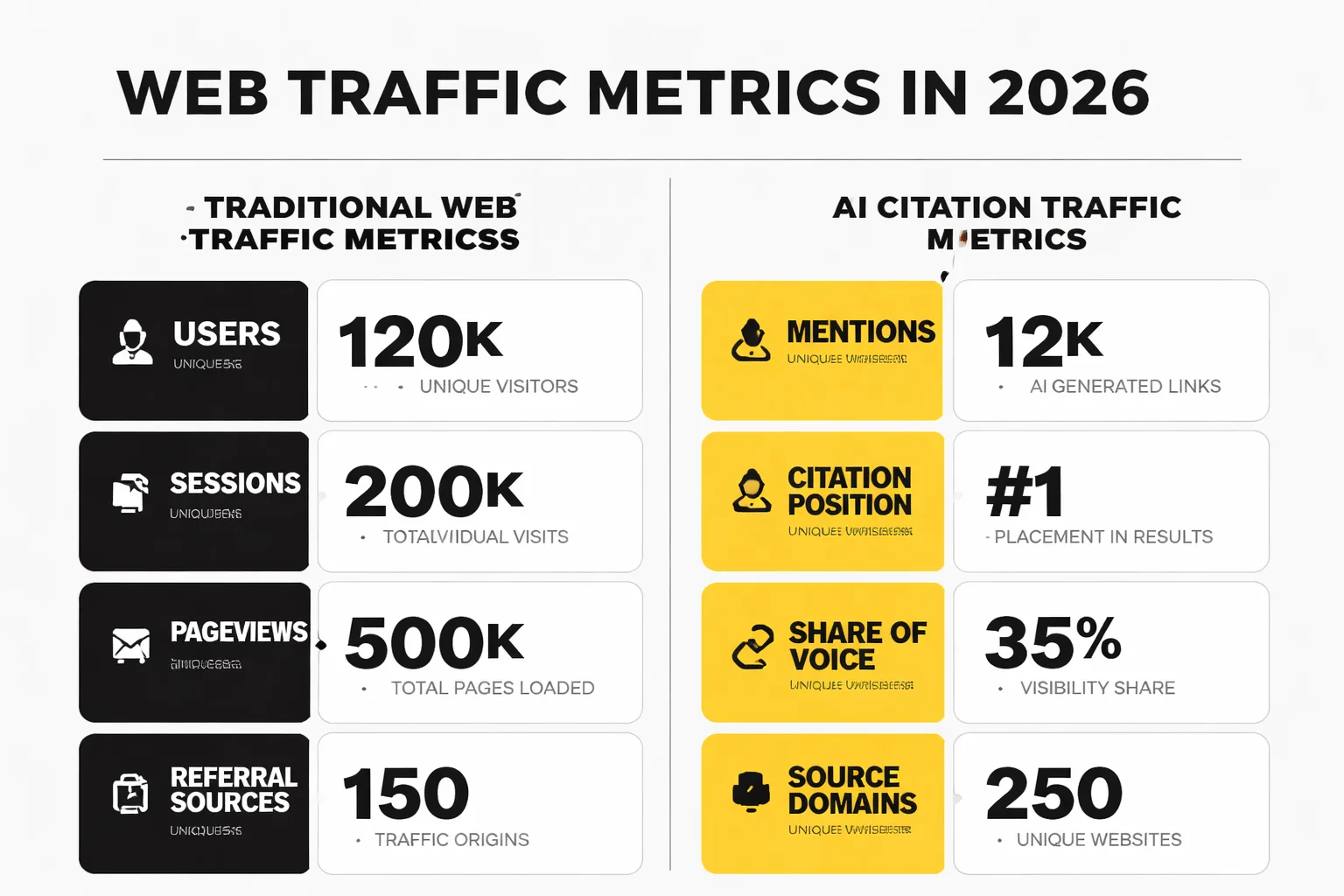
The numbers tell you different things. Sessions reveal volume. Bounce rate signals whether your page matched the visitor's intent. Time on page shows depth of engagement. Traffic sources tell you which channels actually produce results. If 80% of your sessions come from branded search, your content is not earning new audiences. If referral traffic from one domain dominates, you have a concentration risk.
Here is what changed. A Semrush study of 248,000 Reddit posts cited in Google AI Mode, Perplexity, and ChatGPT Search found that AI engines pull from specific content structures and engagement patterns. Traffic is no longer just a click. It is a citation. When ChatGPT recommends your product in an answer, that mention drives downstream search behavior even though no click landed on your site in that moment. Traditional analytics will never capture that interaction.
The metrics you track need to expand. You still need sessions, pageviews, and bounce rate. But you also need to know whether AI engines mention your brand, where in their answers you appear, and which sources they cite as evidence. That is the new definition of web traffic in 2026.
Step 1. Pull Your Own Data From Google Search Console
Google Search Console is free, first-party, and more accurate than any paid tool for your own site. It connects directly to Google's index. No estimation algorithms. No sampling. Just raw performance data from the search engine that drives most of your organic traffic.
To set it up, verify your domain through a DNS TXT record or an HTML file upload. Once verified, GSC gives you access to the Performance report. That report shows clicks, impressions, click-through rate, and average position for every query that triggered your pages in Google Search.
Here is how to read it. Open the Performance report and set your date range to the last 28 days. Sort by clicks to see which queries actually drive traffic. Then switch the sort to impressions. The queries with high impressions but low clicks are your biggest opportunities. People see your result but do not click. That usually means your title tag or meta description is weak.
Export the data. GSC lets you download up to 1,000 rows per query filter. For a full export, use the API or a free connector like the Google Search Console add-on for Google Sheets. I recommend exporting your top 500 queries by clicks and your top 500 by impressions monthly. That gives you a baseline to track whether your content is gaining or losing visibility.
One critical thing GSC shows that paid tools cannot: exact CTR by position. If you rank in position 3 for a query with 10,000 monthly impressions and get 200 clicks, your CTR is 2%. The Ahrefs study of 11.8M results found that position 1 gets roughly 27% of clicks. Knowing your actual CTR tells you whether the problem is ranking position or snippet quality.
GSC also flags indexing issues. Check the Pages section to see if Google has indexed your key pages. If important pages are not indexed, no amount of content optimization will help. Fix indexing first.
For tracking how your Google presence extends into AI surfaces, you can pair GSC with an AI visibility checker to see where you appear in AI Overviews and AI Mode. GSC shows you the traditional search side. The visibility checker shows you the generative side.
Step 2. Estimate Competitor Traffic With Free Tools
You cannot install Google Analytics on a competitor's site. But you can use free tools that estimate traffic based on clickstream data, SERP analysis, and behavioral modeling. The estimates are rough. They are still useful for benchmarking if you understand their limitations.
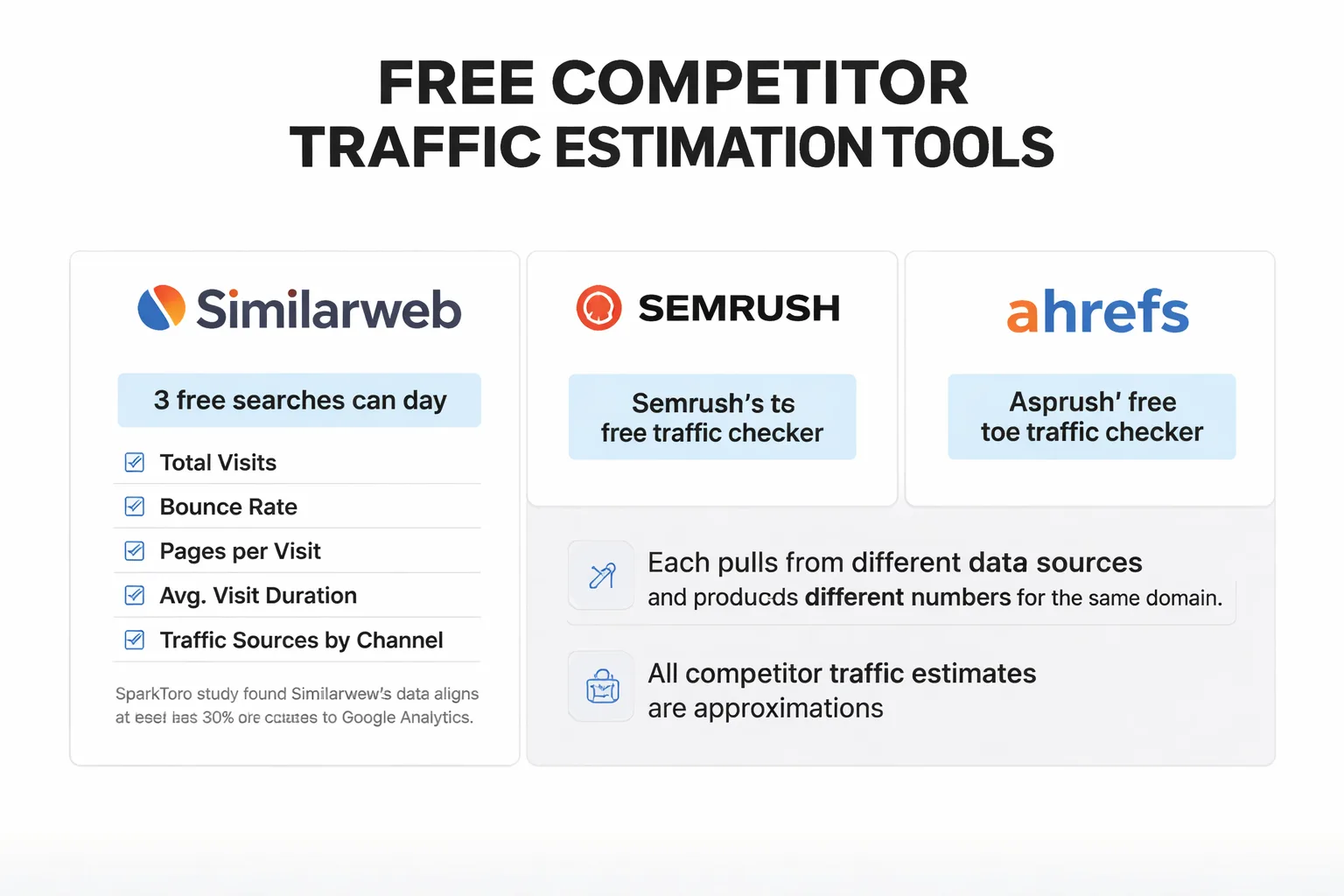
Three free tools worth using: Similarweb's free website traffic checker, Semrush's free traffic checker, and Ahrefs' free traffic checker. Each pulls from different data sources and produces different numbers for the same domain. That variance is not a bug. It is a reminder that all competitor traffic estimates are approximations.
Similarweb gives you three free searches per day. The free report shows total visits, bounce rate, pages per visit, average visit duration, and traffic sources by channel. A SparkToro study cited by Similarweb found Similarweb's data aligns at least 30% more closely to Google Analytics than competing tools. Jonny Bentwood, Global Head of Data and Analytics at Golin, put it plainly: if he wants to be fully confident in accuracy and fidelity, he uses Similarweb.
Semrush's free tier gives you 10 daily lookups. The traffic analytics report estimates monthly visits, traffic sources, and geographic distribution. Semrush also shows you the keywords driving a competitor's organic traffic, which is where its real value lies. You can see which queries a competitor ranks for that you do not.
Ahrefs' free traffic checker provides estimated monthly organic search traffic, the number of keywords a site ranks for, and its top pages. Ahrefs tracks 41.9 billion keywords and indexes 170 trillion pages. The free checker is limited but gives you a quick snapshot of a competitor's organic search footprint.
Here is where the estimates break down. For sites under 50,000 monthly visits, all three tools become unreliable. The clickstream panels they rely on have sparse coverage of small sites. A competitor showing 5,000 monthly visits in Similarweb might actually get 15,000 or 2,000. The directional data is useful (is traffic growing or shrinking?) but the absolute numbers are guesses.
The right way to use these tools is comparative, not absolute. Pull the same metric across all three for your top three competitors. If all three tools show Competitor A getting more traffic than Competitor B, you can trust that direction. If the tools disagree wildly, the site is probably too small for reliable estimation.
For a deeper look at how AI search changes the competitive landscape, our AEO vs SEO guide breaks down what shifts when you optimize for answers instead of links.
How Does AI Citation Traffic Work?
AI citation traffic is the visibility your brand earns when a generative AI engine mentions you in its response to a user prompt. Unlike traditional web traffic, it does not always produce a click. The user reads the answer, forms an impression of your brand, and may or may not visit your site later.
This traffic is real and growing. When Perplexity cites your product as the recommended solution, that mention influences a purchase decision even if your analytics never register the visit. The same applies to ChatGPT, Claude, Gemini, and Google AI Overviews. Each citation is a micro-endorsement that shapes how people perceive your brand.
The problem is measurement. Google Analytics cannot tell you when ChatGPT mentioned your competitor instead of you. GSC shows AI Overviews impressions if you filter for that SERP feature, but it does not track citations in ChatGPT or Claude. You need a different approach.
In my work auditing content operations, I have seen brands with strong traditional traffic and zero AI visibility. Their pages rank well on Google. But when a user asks ChatGPT for recommendations in their category, a competitor gets cited. That is a traffic leak they cannot see in any standard dashboard.
Research on citation failure in LLM-based RAG systems found that models sometimes generate valid, helpful responses but fail to cite complete evidence. Citation failures increase with the relational complexity between the response and the evidence. This means even when your content is good enough to inform an AI answer, the model may omit your citation. You need to track not just whether you appear, but whether you are cited as the source.
Amanda Natividad from The Menu/Substack made a sharp observation: the question is not whether you are showing up in AI answers, but whether you are being described correctly. Citation accuracy matters more than raw mention count. A brand mentioned in the wrong context is worse than no mention at all.
To track this, you can use a ChatGPT AI visibility checker or a Perplexity AI visibility checker to see exactly how each engine describes your brand. These tools run prompts against the major AI engines and show you the response text, your mention position, and the sources cited.
Step 3. Layer In AI Search Traffic You Are Currently Missing
Traditional analytics tools measure clicks. AI search engines generate answers that may never produce a click. This creates a measurement gap that grows wider every month as more users get their information directly from AI responses.
Here is how to close that gap without enterprise tools. Start by identifying the prompts your customers actually type into AI engines. These are not the same as your SEO keywords. A user who searches Google for "project management software" might ask ChatGPT "what is the best project management tool for a 5-person team?" The intent is similar but the phrasing is conversational.
Build a list of 20 to 50 prompts relevant to your category. Include brand-adjacent prompts ("alternatives to [your competitor]") and category prompts ("best [your product category] for [use case]"). Run these prompts manually through ChatGPT, Claude, Gemini, and Perplexity. Record whether your brand appears, where in the response you appear (first mention, in a list, not at all), and which sources the AI cites as evidence.
This manual approach is slow but free. It gives you a baseline. If you want to scale it, an AI visibility tool can automate the prompt tracking across every major AI search surface and show you weekly trends. But the manual method works for getting started.
What you are looking for is the gap. If your competitor is cited in 8 out of 10 prompts and you are cited in 2, that is your AI traffic gap. Closing it requires a different strategy than traditional SEO. You need answer engine optimization, which means structuring your content so AI engines can extract and cite it accurately.
Semrush's Reddit study analyzed 248,000 Reddit posts cited across Google AI Mode, Perplexity, and ChatGPT Search. The study identified specific content types and engagement patterns that increase visibility in AI-generated results. This matters because it shows AI engines have preferences. They favor certain structures, certain source types, and certain engagement signals. Understanding those preferences is how you earn citations.
For a structured approach to this, our answer engine optimization resource walks through how to format content for AI extractability. The key principles: use clear question-and-answer structures, cite primary sources inline, and build entity signals that help AI models understand what your brand is and what it does.
Are AI engines citing your competitors instead of you?
Why Does Entity Grounding Matter for Traffic?
Entity grounding is how AI models understand your brand as a distinct thing with specific attributes. If an AI model does not know what entity your brand is, it cannot recommend you in an answer. It will cite a competitor whose entity is better defined.
Think of it this way. Google's Knowledge Graph has an entry for Nike. When someone asks an AI engine about running shoes, the model can ground its answer in the Nike entity: brand, products, reputation, reviews. If your brand has no entity presence, you are invisible to that reasoning process.
Building entity presence starts with structured data. Add Organization schema to your homepage. Create a Wikidata entry for your company. Ensure your Wikipedia page (if you have one) is accurate and well-sourced. Get listed in relevant directories and industry databases. Each of these signals helps AI models build a richer understanding of who you are.
The LLMs.txt validator is a free tool that checks whether your site is properly signaling its content to AI crawlers. It verifies your llms.txt file, which tells AI engines which parts of your site they should read. This is a simple technical step that most teams overlook.
Entity grounding also depends on external mentions. When high-authority sites describe your brand consistently, AI models reinforce that entity understanding. This is why earned media matters so much for AI visibility. The 84% to 89% figure I mentioned earlier is not a footnote. It is the core mechanic. AI engines trust third-party descriptions more than self-descriptions.
Which Traffic Sources Should You Track?
Every analytics platform breaks traffic down by source. Google Analytics uses source/medium pairs like google/organic, direct/none, or reddit/referral. Understanding these categories is essential because each source tells you something different about your audience and where your visibility gaps live.
Organic search traffic comes from search engine results pages. This is the channel most SEO teams obsess over. It is also the channel most vulnerable to AI disruption. When Google shows an AI Overview that answers a user's question directly, the user may never click through to any website. Your organic traffic for that query drops to zero even though your content informed the AI's answer. Track organic search trends weekly in GSC. If you see impressions holding steady but clicks declining, AI Overviews are likely absorbing your clicks.
Direct traffic comes from users typing your URL or using a bookmark. High direct traffic means strong brand awareness. But here is the nuance: AI citation traffic often behaves like dark direct traffic. A user reads a ChatGPT recommendation, then later types your URL directly. Google Analytics attributes that visit to direct traffic, not to the AI citation that actually drove it. This is why direct traffic spikes often correlate with AI visibility improvements that your analytics cannot connect.
Referral traffic comes from links on other websites. This is the most trackable AI-adjacent source. When Perplexity or ChatGPT includes a clickable citation link, that click shows up in your analytics as referral traffic from the AI engine's domain. Check your referral sources in Google Analytics. If you see traffic from perplexity.ai or chat.openai.com, those are AI citation clicks. The volume is probably low today, but it will grow.
Social traffic comes from platforms like Reddit, X, LinkedIn, and YouTube. Social signals also feed AI engines. The Semrush study of 248,000 Reddit posts found that AI engines cite Reddit content based on specific engagement patterns. If your brand is discussed on Reddit in ways that match those patterns, you are more likely to appear in AI answers. Social presence and AI visibility are connected.
Paid traffic comes from advertising campaigns. This is the one source AI engines do not directly influence. But paid traffic can indirectly boost AI visibility by increasing branded search volume, which strengthens your entity signals. If you run paid campaigns, watch whether AI citation frequency increases in the weeks following a campaign spike.
Email traffic comes from your newsletter and email campaigns. It is a first-party channel you fully control. Email does not directly affect AI visibility, but it does drive engagement signals (time on page, pages per session) that can improve your content's performance in traditional search.
How to Interpret What You Find and Act on It
Once you have pulled your GSC data, checked competitor estimates, and run AI visibility prompts, you need to connect the dots. The data tells a story. Your job is to read it correctly and act.
Here is the decision framework I use.
Scenario A: Traffic is flat, AI citations are zero. Your content ranks on Google but AI engines do not mention you. The problem is entity grounding, not content volume. You need structured data, external mentions, and content formatted for AI extractability. Publishing more blog posts will not fix this. You need to make your existing brand entity legible to AI models.
Scenario B: Traffic is declining, competitors are cited more. Your organic search traffic is dropping and competitors appear in AI answers where you do not. The fix is answer-engine optimized content. Audit the prompts where competitors are cited. Look at the sources AI engines cite for those prompts. Create content that directly answers those prompts with better depth and clearer structure.
Scenario C: Traffic is growing, AI citations are growing. You are in a strong position. Focus on maintaining quality and expanding your prompt coverage. Identify adjacent prompt categories where you are not yet cited and build content for those.
Scenario D: Traffic is growing, AI citations are zero. This is the hidden danger zone. Your Google traffic looks healthy, but AI engines are ignoring you. As more users shift to AI search, your traffic will erode. Start building AI visibility now before the decline shows up in GSC.
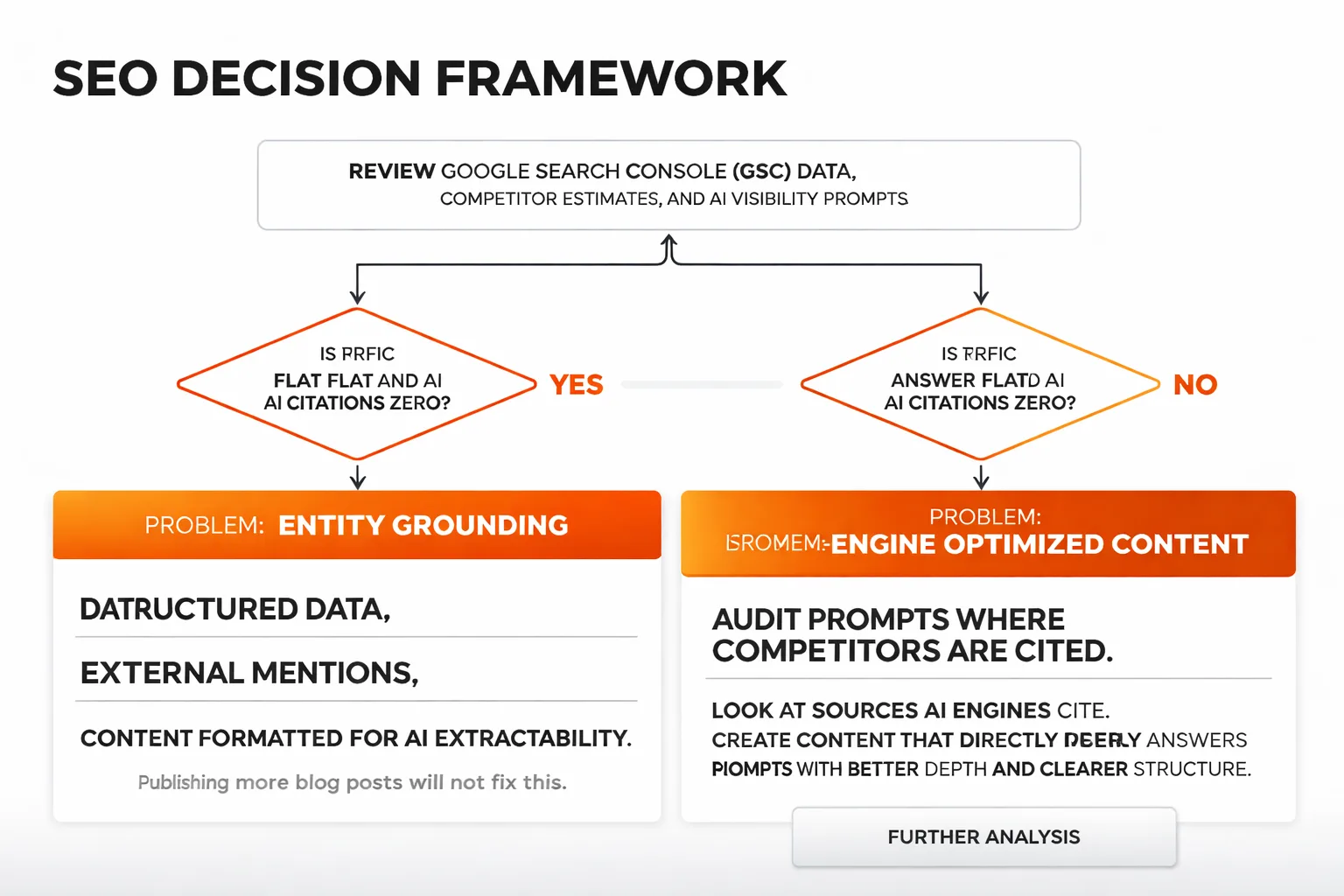
The action plan depends on which scenario matches your situation. But regardless of where you land, the first step is measurement. You cannot fix what you cannot see. The free tools I have covered give you enough signal to diagnose the problem and prioritize next steps.
For tracking AI visibility at scale, an AI visibility tracker can automate the monitoring across engines. But if you are just starting, the manual prompt method works. The important thing is to start measuring both sides of your traffic: clicks and citations.
What This Won't Fix
This tutorial gives you a measurement framework. It does not fix a weak brand. If your product is undifferentiated, no amount of entity schema or AI-optimized content will make AI engines prefer you over a competitor with stronger market presence. AI models reflect the consensus of what the web says about your category. If the web does not say much about you, the AI will not either.
This also does not fix a content quality problem. If your existing pages are thin, outdated, or factually wrong, making them AI-extractable just spreads bad information faster. Fix the content first. Then optimize for extraction.
Finally, this does not produce instant results. Entity grounding and AI citation building take weeks to months. AI models update their training data and retrieval indexes on their own schedules. You are playing a long game. The teams that start now will have a compounding advantage as AI search continues to grow.
Can Free Tools Track Generative Engine Optimization?
Generative engine optimization (GEO) is the practice of optimizing content specifically for AI-generated search results. It is different from traditional SEO because the goal is not to rank in a list of links. The goal is to be cited inside the AI's generated answer. Free tools can track some of this, but they have real limitations.
The manual prompt method I described in Step 3 is the most reliable free GEO tracking approach. You run prompts, record citations, and track changes over time. The limitation is scale. Running 50 prompts across 4 AI engines manually takes about 2 hours per session. If you do this weekly, that is 8 hours per month. For a small team, that is manageable. For a team tracking 200 prompts, it becomes unsustainable.
This is where free tools hit their ceiling. Google Search Console can show you AI Overview impressions and clicks if you filter for the AI Overview SERP feature. That data is free and directly from Google. But it only covers Google's AI surfaces. ChatGPT, Claude, Perplexity, and Gemini do not offer equivalent free dashboards. You are on your own for those.
For a more complete picture, the best GEO tools roundup covers both free and paid options. The key insight I want you to take away: you do not need to start with paid tools. Start with GSC for Google AI data and manual prompts for other engines. When the manual method becomes a bottleneck, that is the signal to invest in automation.
How Do You Check Web Traffic of a Website Without Analytics Access?
This is the most common question I hear from founders who want to benchmark competitors. The answer depends on what you mean by "check." If you want exact numbers, you cannot get them without analytics access. If you want estimates good enough for strategic decisions, the free tools I covered in Step 2 work.
Here is a specific workflow. Start with Similarweb to get the overall traffic volume and source breakdown. Note the split between organic search, direct, referral, and social. Then open Semrush and look at the organic keywords report. Export the top 50 keywords driving traffic to the competitor. Cross-reference those keywords with your own GSC data. The keywords they rank for and you do not are your content gaps.
Next, check Ahrefs' free traffic checker for the estimated number of keywords the competitor ranks for. If Similarweb shows 100,000 monthly visits but Ahrefs shows only 500 ranking keywords, the competitor's traffic is likely driven by direct or referral sources, not organic search. That changes your strategy. You would focus on building referral partnerships rather than creating more content.
For sites under 50,000 monthly visits, take all estimates with a grain of salt. The clickstream data these tools rely on comes from user panels. Small sites have too few users in those panels for reliable extrapolation. If a competitor shows 3,000 monthly visits in Similarweb, the real number could be 1,000 or 8,000. Use the trend direction (is the line going up or down?) rather than the absolute number.
Building a Free AI Visibility Reporting Routine
Measurement only works if you do it consistently. Here is a reporting routine you can run for free, with no enterprise tools, in about 3 hours per week.
Monday: Google Search Console review (30 minutes). Export your Performance report for the previous week. Compare clicks and impressions to the prior week. Note any queries with impression spikes (potential AI Overview triggers) or click drops (potential AI Overview cannibalization). Check the Pages tab for new indexing errors.
Wednesday: Competitor traffic check (30 minutes). Use your three free Similarweb lookups for your top three competitors. Record their estimated monthly visits and traffic source split in a spreadsheet. Use one Semrush lookup to check for new keywords a competitor has started ranking for. This takes one of your 10 daily lookups but gives you early warning of content moves.
Friday: AI citation audit (2 hours). Run your list of 20 to 50 prompts through ChatGPT, Claude, Gemini, and Perplexity. Record brand mentions, citation position, and cited sources. Compare to the previous week. Look for new competitors appearing in answers where you used to be cited. Note any changes in how your brand is described.
This routine gives you weekly data on both traditional traffic and AI citation traffic. Over 4 weeks, you will have enough trend data to identify patterns. If your GSC clicks are flat but AI citations are rising, your content is gaining AI traction even if Google traffic has not caught up. If GSC clicks are rising but AI citations are zero, you have a visibility gap that will hurt you as AI search grows.
For teams that outgrow the manual routine, an AI SEO tool can automate the prompt tracking and citation monitoring. But the manual routine is where every team should start. It builds institutional knowledge about how AI engines describe your category. That knowledge is worth more than any dashboard.
Frequently Asked Questions
Can I check any website's traffic for free?
Yes, with caveats. Similarweb's free checker gives you three daily lookups with visit estimates, traffic sources, and engagement metrics. Semrush's free tier offers 10 daily lookups. Both are estimates based on clickstream data and are more accurate for sites with over 50,000 monthly visits. For your own site, Google Search Console provides exact data at no cost.
How accurate are free website traffic checkers?
Accuracy depends on site size and the tool's data sources. A SparkToro study found Similarweb aligns at least 30% more closely to Google Analytics than competitors. For sites under 50,000 monthly visits, all estimation tools become unreliable. Use them for directional trends (growing vs. shrinking) rather than absolute numbers.
What is the difference between web traffic and AI citation traffic?
Web traffic measures clicks to your site. AI citation traffic measures brand mentions in AI-generated answers. A user who reads a ChatGPT response that recommends your product may never click through to your site, but that citation still influences their perception and downstream behavior. Traditional analytics tools like Google Analytics cannot capture AI citation traffic.
How do I track my brand's visibility in AI search?
Start by manually running 20 to 50 relevant prompts through ChatGPT, Claude, Gemini, and Perplexity. Record whether your brand appears, your position in the response, and which sources the AI cites. For automated tracking across all major AI search surfaces, use an AI visibility checker that runs daily or weekly refreshes.
Is Google Search Console enough for traffic analysis?
GSC is the most accurate free tool for your own Google search performance. It shows exact clicks, impressions, CTR, and position data. However, it does not track traffic from other search engines, social media, direct visits, or AI citation traffic. Pair GSC with Google Analytics for full click traffic coverage and an AI visibility tool for citation tracking.
How often should I check competitor traffic estimates?
Monthly is sufficient for most teams. Pull the same metrics from Similarweb, Semrush, and Ahrefs for your top three competitors once a month. Track the direction of change rather than absolute numbers. If you need more frequent monitoring, consider whether the additional data actually changes your strategy. For most small teams, monthly competitor checks provide enough signal.
What is a free website traffic checker and do I need one?
A free website traffic checker is any tool that estimates or reports website visit data without requiring a paid subscription. Similarweb, Semrush, and Ahrefs all offer free tiers. You need one if you want to benchmark competitors or estimate traffic for sites you do not own. For your own site, Google Search Console and Google Analytics are better free alternatives because they provide exact first-party data rather than estimates.
The future of web traffic is not just clicks. It is citations, mentions, and entity presence across AI engines that increasingly mediate how people discover brands. The free tools I covered here give you a starting point. Use GSC for your own data, free tiers of Similarweb and Semrush for competitor benchmarks, and manual AI prompt testing for citation visibility. That combination will tell you more than any enterprise dashboard. The teams that measure both sides of traffic now will be the ones AI engines cite when it matters.
About the Author
Judy Zhou, Founder
Judy Zhou leads content strategy at Meev, where she oversees AI-driven content research and publishing for hundreds of brands. With a background in SEO and editorial operations, she focuses on building content systems that rank on Google, get cited by AI search engines, and drive measurable business results.
Run your first AI visibility audit today and see exactly where your brand appears (and doesn't) across every major AI search surface.