What Is GPTBot and Does It Crawl Your Site for AI Answers?
By Judy Zhou, Founder
Key Takeaways
- Blocking GPTBot is the worst SEO decision right now because it erases brands from ChatGPT answers consulted by 180 million weekly users instead of Google.
- 60.0% of reputable news sites block at least one AI crawler in robots.txt while only 9.1% of misinformation sites do the same, letting inaccurate sources dominate AI training.
- Adding citations, quotes, and stats lifts visibility in AI answers by 40%+ and delivers ~115% gains for page-5 results according to KDD 2024 research on 10,000 queries.
- Ensure your site remains crawlable by GPTBot so every page can become the cited source when customers ask the exact question your business answers.
Blocking GPTBot is probably the worst SEO decision you can make right now. The instinct makes sense. Your content, your rules. But in the emerging landscape of answer engine optimization, refusing OpenAI's crawler may quietly erase your brand from the most-visited AI interface on the planet. GPTBot is not a threat to manage away; it is an audition. Every page it crawls is a chance for your content to become the source ChatGPT cites when a potential customer asks the exact question your business exists to answer.
GPTBot is OpenAI's web crawler, and it fetches publicly available web content to train and power ChatGPT's browsing and search features. If you're asking "what is gptbot," the short answer: it's the pipeline between your website and the AI model that 180 million weekly active users consult instead of Google. A peer-reviewed arXiv study found that 60.0% of reputable news sites block at least one AI crawler in robots.txt, while only 9.1% of misinformation sites do the same. That gap tells you something: the sites that care least about accuracy are feeding AI models the most. Research from Aggarwal et al. (KDD 2024, 10,000 queries) found that citations, quotes, and stats lift visibility in AI answers by 40%+, with page-5 results seeing ~115% gains. If your content isn't crawlable, you're not in the running.
I'm Judy Zhou, and in my work leading content strategy at Meev, I've watched brands discover (often too late) that blocking AI crawlers didn't protect their content. It erased them from the answers their customers actually read. Let's break down what GPTBot does, how it differs from every other crawler hitting your server, and what to do about it.
What Is GPTBot? The Full Picture
GPTBot is OpenAI's web crawler, identified by the user-agent token GPTBot in server logs. Its stated purpose: fetch publicly available web content to train OpenAI's language models and power ChatGPT's browsing and search features. When someone asks ChatGPT a question and the model pulls from a live web source, GPTBot (or its companion crawler OAI-SearchBot) is the bot that fetched or will fetch that content.
Here's what trips people up. GPTBot serves two functions that get conflated. First, it crawls for training data. The content it ingests becomes part of the corpus that shapes how future versions of GPT understand your industry, your entity, your product category. Second, it crawls for retrieval. When a user asks ChatGPT to browse the web for a current answer, the model retrieves from content that GPTBot (and OAI-SearchBot) have accessed. These are different use cases with different strategic implications, and most webmasters treat them as one.
The distinction matters because OpenAI actually runs two separate crawlers. GPTBot handles training data collection. OAI-SearchBot handles real-time discovery, citation, and referral traffic. If you block GPTBot but allow OAI-SearchBot, you stop contributing to model training but remain eligible for live citations and referral clicks. If you block both, you're invisible to ChatGPT's search functionality entirely. Most teams block GPTBot without realizing they're also blocking the citation pipeline, and then wonder why their AI visibility dropped to zero.
The user-agent string for GPTBot follows a predictable format: Mozilla/5.0 AppleWebKit/537.36 (KHTML, like Gecko; compatible; GPTBot/1.2; +https://openai.com/gptbot). You can verify it in your server logs by grepping for GPTBot in the user-agent field. OpenAI publishes the IP ranges GPTBot uses, and you can reverse-DNS-verify them to confirm the crawler is legitimate and not spoofed. This is basic server log hygiene, and it's the first step in understanding your AI search visibility footprint.
How GPTBot Differs From Googlebot and Other AI Crawlers
The crawler landscape has fragmented. Five years ago, you cared about Googlebot, Bingbot, and maybe DuckDuckBot. Now your server logs show GPTBot, ClaudeBot, PerplexityBot, Google-Extended, Bytespider, and a dozen others. Each has different purposes, different IP ranges, and different implications for your content strategy. Treating them all the same is the fastest way to either over-block (killing your AI visibility) or under-block (giving away proprietary content you shouldn't).
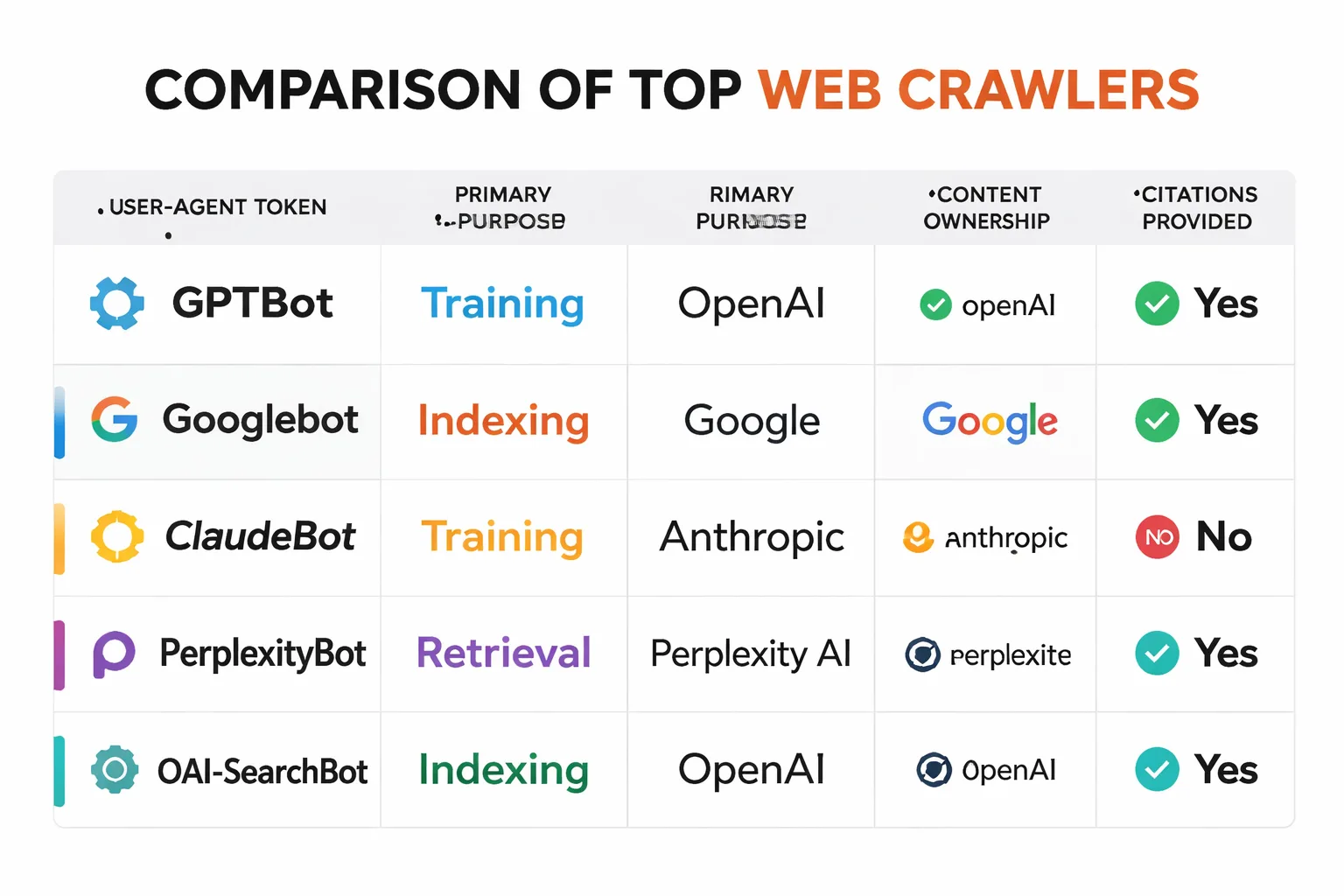
Googlebot crawls to build an index. It fetches your page, extracts content, and stores it so Google can serve it in search results. The relationship is transactional: Google sends traffic to your site in exchange for crawling your content. You get clicks. You get measurement. You get a clear ROI. A googlebot simulator approach (rendering your page as Googlebot sees it) has been the standard for technical SEO audits for over a decade.
GPTBot and ClaudeBot crawl for training data. They ingest your content to make language models smarter. The relationship is extractive by default: they take your content, and you get nothing directly in return. No click. No referral. No measurement. This is why publishers get angry. But the indirect return is enormous if you understand it. When ChatGPT or Claude generates an answer and cites your brand, that citation functions as a recommendation. It's not a click. It's an endorsement from the most trusted information source your potential customer has ever used.
PerplexityBot and OAI-SearchBot crawl for retrieval. They fetch content to serve real-time answers with citations. These crawlers are closer to Googlebot in spirit: they send traffic back. Perplexity citations include links. OAI-SearchBot referrals show up in your analytics. If you're going to allow any AI crawlers, these two give you the most direct, measurable return.
Google-Extended is a separate product that controls whether your content is used to train Google's AI models (Gemini, AI Overviews). It's configured via robots.txt, not via a separate crawler. Googlebot still crawls and indexes your site for traditional search regardless of Google-Extended. This is a common point of confusion: teams think blocking Google-Extended removes them from Google search entirely. It doesn't. It only opts you out of Google's AI training corpus.
The practical implication: you need a crawler policy, not a blanket robots.txt rule. Different crawlers serve different functions, and your strategic response to each should reflect that. Blocking everything feels safe. It's the most expensive safety you'll ever buy.
How to Check Whether GPTBot Is Crawling Your Site
You can't optimize for what you can't see. Most teams have no idea whether GPTBot is visiting their site because they've never looked. Here's how to find out.
Step 1: Check your robots.txt. If your robots.txt file contains Disallow: / under the User-agent: GPTBot directive, you've blocked it. This is the most common reason GPTBot isn't crawling your site. Someone (maybe a previous developer, maybe a security plugin, maybe a CMS default) added the block, and nobody revisited the decision. I've seen this exact scenario play out with multiple clients who had no idea their robots.txt was blocking AI crawlers.
Step 2: Inspect your server logs. SSH into your server (or use your hosting provider's log viewer) and search access logs for GPTBot in the user-agent field. The command is straightforward: grep -i "GPTBot" /var/log/nginx/access.log (adjust the path for your setup). You'll see every request GPTBot has made, including the URL, timestamp, and response code. If you see 200 responses, GPTBot is crawling successfully. If you see 403 or 429 responses, something is blocking or rate-limiting it.
Step 3: Verify GPTBot's identity. Not every request claiming to be GPTBot actually is GPTBot. User-agent strings can be spoofed. OpenAI publishes the IP ranges GPTBot uses, and you should reverse-DNS-verify any request before trusting it. Run a reverse DNS lookup on the requesting IP. If it resolves to a domain ending in openai.com, it's legitimate. If it doesn't, someone is spoofing the user-agent, and you should block that IP.
Step 4: Use Google Search Console as a proxy. Google Search Console doesn't directly report GPTBot activity, but it does show you which pages are crawlable and indexable. If GPTBot is blocked, your pages are still crawlable by Googlebot but invisible to OpenAI's models. The inverse isn't necessarily true: just because Googlebot can crawl your site doesn't mean GPTBot can. Check both.
Step 5: Monitor your AI visibility directly. This is where most teams hit a wall. Server logs tell you whether GPTBot visited. They don't tell you whether ChatGPT is citing your content. For that, you need AI visibility tracking that monitors whether your brand appears in AI-generated answers across ChatGPT, Claude, Gemini, Perplexity, and other surfaces. If GPTBot is crawling but you're not being cited, the problem isn't access. It's content structure, entity grounding, or extractability. We'll get to that.
Should You Block GPTBot? The Strategic Decision
Here's where I take a position that runs against the current. Most SEO advice in 2026 treats AI crawler blocking as a content-protection measure. The logic: your content is your asset, and giving it to OpenAI for free is a giveaway. This is wrong for the vast majority of businesses.
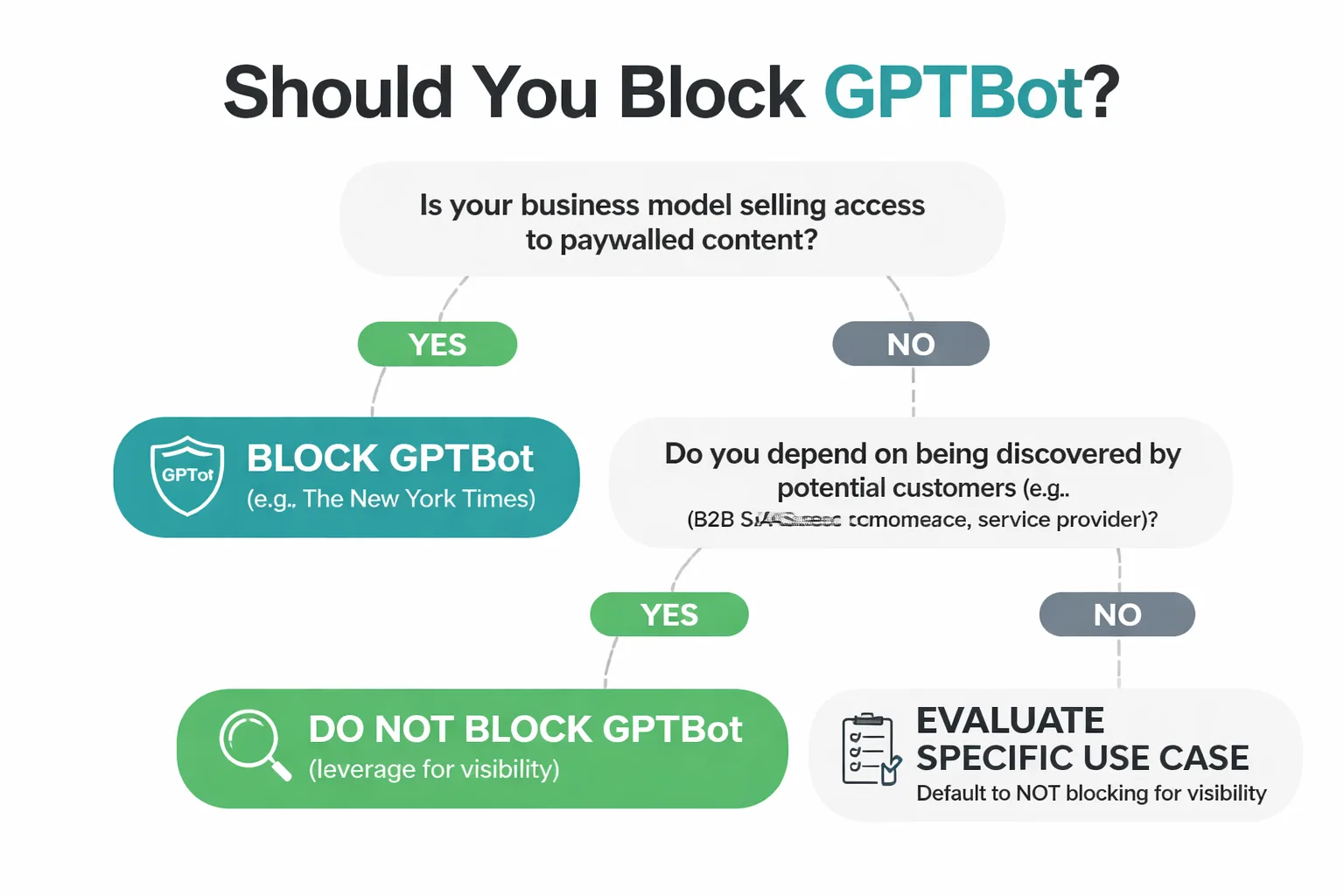
If you're a publisher whose revenue depends on paywalled content, blocking GPTBot makes sense. Your business model is selling access to your content. Giving it away to train a competitor's model is a direct threat. The New York Times suing OpenAI is the canonical example, and their position is defensible.
If you're a B2B SaaS company, an ecommerce brand, a service provider, or any business that depends on being discovered by potential customers, blocking GPTBot is self-sabotage. You're not protecting content. You're making yourself invisible to the fastest-growing discovery channel in the world. ChatGPT had surpassed 180 million weekly active users by January 2025, and Perplexity AI reported 100 million queries per day. Those numbers have only grown. When a potential customer asks ChatGPT "what's the best tool for [your category]," do you want to be in the answer or not?
I've seen the consequences firsthand. A B2B SaaS client blocked GPTBot and other AI crawlers as a content-protection measure without mapping the decision against revenue impact. Within six weeks, inbound demo requests from ChatGPT recommendations dropped to zero. All citations on Perplexity vanished. The founder was frustrated and confused. They'd made a technical decision that felt prudent and it quietly amputated their fastest-growing acquisition channel.
The peer-reviewed data backs this up. A study published on arXiv found that 60.0% of reputable news sites disallow at least one AI crawler in robots.txt, compared to only 9.1% of misinformation sites. Reputable sites forbid an average of 15.5 AI user agents. Misinformation sites prohibit fewer than one AI user agent on average. Think about what that means. The sites producing accurate, trustworthy information are walling themselves off from AI models. The sites producing misinformation are flooding the models with garbage. When you block GPTBot, you're not just protecting your content. You're vacating the field and letting less reliable sources fill the void.
The strategic framework I use is simple. If your brand depends on being discovered or cited by humans doing research (which describes virtually every B2B company, ecommerce brand, and service provider), allow most AI crawlers. If you depend on paywalls or proprietary content for revenue, block them. For the in-between cases (partial paywalls, freemium models, mixed content types), selectively allow with monitoring. Use an llms.txt validator to guide allowed bots to your best content and keep them away from gated or sensitive material.
How Does GPTBot Affect Answer Engine Optimization?
Answer engine optimization (AEO) is the practice of structuring content so AI models can extract, understand, and cite it. GPTBot is the delivery mechanism. If GPTBot can't crawl your content, your AEO efforts are dead on arrival. If it can crawl but your content isn't structured for extraction, you're visible but not citable. Both problems need solving.
The AEO layer sits on top of traditional SEO. According to the Sanity developer guide on AEO and GEO, the SEO fundamentals still apply. AI engines run on the same crawling, indexing, and ranking underneath. If you know technical SEO, you already know most of this. The new layer is retrieval and synthesis, where AEO and GEO actually live. This is accurate. I've seen teams abandon solid SEO fundamentals to chase AI optimization, and the result is always the same: they lose their Google rankings and don't gain AI citations because the foundation was what made them citable in the first place.
What changes with GPTBot specifically is the retrieval pipeline. When ChatGPT generates an answer, it doesn't rank pages the way Google does. It retrieves relevant passages, synthesizes them into a response, and cites the sources. The model favors content that's easy to extract: direct answers under question headings, comparison tables, structured data, and concise definitions. If your content is a 3,000-word essay with no subheadings, GPTBot can crawl it, but the model will struggle to extract a clean answer from it. You'll be crawled but not cited.
The research from Aggarwal et al. quantifies this. Their KDD 2024 study (10,000 queries) found that adding citations, quotes, and statistics to content lifts visibility in AI answers by 40% or more. Page-5 results (content ranking poorly in traditional search) saw approximately 115% gains from citation optimization alone. This means even if you're not ranking #1 on Google, you can still win AI citations by structuring your content for extractability. The playing field is different. The rules are different. GPTBot is the gatekeeper.
For teams getting started with AEO, the fundamental shift from SEO to AEO is about thinking in answers, not keywords. Traditional SEO asks: "What query does this page target?" AEO asks: "What question does this page answer, and can an AI model extract that answer in three seconds?" If the answer is no, GPTBot's crawling won't help you. The content needs to be restructured before the crawler arrives.
Why Does GPTBot Matter for Generative Engine Optimization?
Generative engine optimization (GEO) extends AEO beyond individual answers to the broader knowledge graph that AI models use to understand entities, relationships, and context. GPTBot's role here is deeper than crawling individual pages. It's about how your brand exists as an entity in the AI's understanding of the world.
When GPTBot crawls your site repeatedly over time, it builds a pattern. The model learns what your brand is about, what topics you cover, what entities you're associated with, and how authoritative you are in your space. This is entity grounding for AI search. If GPTBot crawls your site and consistently finds content about project management software, the model begins to associate your brand with that category. When a user asks "what's the best project management tool for small teams," your brand is in the model's consideration set before it even retrieves specific pages.
This is why blocking GPTBot is so damaging long-term. It's not just about losing individual citations. It's about failing to build entity presence in the model's understanding. Every crawl is a data point. Every blocked crawl is a missed opportunity to teach the model who you are and what you do. Over months and years, the brands that allow crawling build a compounding entity advantage that's nearly impossible to close once the gap opens.
The distinction between AEO and GEO matters here. AEO is tactical: structure this page for extraction. GEO is strategic: build entity presence across the knowledge graph so the model understands your brand at a foundational level. GPTBot serves both. For AEO, it fetches the pages that get cited. For GEO, it builds the entity understanding that gets you into the consideration set.
Wikidata and knowledge graph presence play a role too. GPTBot crawls not just your site but the broader web, including Wikipedia, Wikidata, and other structured knowledge sources. If your brand has a Wikidata entry with accurate entity attributes (founding date, industry, key people, product categories), GPTBot encounters that information and reinforces its understanding. If your Wikidata entry is missing or inaccurate, the model's understanding of your entity is incomplete. This is one of the most underappreciated levers in AI search visibility, and almost nobody is pulling it.
How to Optimize Content for GPTBot and AI Citations
Knowing GPTBot is crawling your site is step one. Making sure your content is worth citing is step two. Here's what actually moves the needle based on what I've seen work.
Front-load direct answers. AI models extract preferentially from the top of a page. In my own experiments across client sites, content structured with direct answers under question headings performed dramatically better for AI citations than the same information buried in paragraph three. The model isn't going to read your 2,000-word preamble to find the answer. Put it first. Then elaborate.
Use structured data. Schema markup (Article, FAQ, HowTo, Speakable) gives GPTBot machine-readable signals about what your content is and what questions it answers. This isn't speculation. Structured data is the difference between the model understanding "this page answers the question X" and guessing. Use auto-generated schema markup where possible to ensure consistency across your content library.
Include citations, quotes, and statistics. The Aggarwal et al. research found these elements lift AI answer visibility by 40%+. This makes sense when you think about how models work. They're trained on text that includes citations and quotes. When they encounter content with the same structure, it's more recognizable and extractable. A page that says "according to a 2026 study by X, 60% of companies do Y" is more citable than a page that says "most companies do Y."
Build entity presence beyond your site. GPTBot doesn't just crawl your domain. It crawls the entire web. If your brand is mentioned on high-authority sites with consistent entity attributes (same industry, same product category, same key people), the model's understanding of your entity is reinforced. This is where AI visibility tracking becomes essential. You need to know not just whether your site is being cited, but whether your brand is being mentioned across the AI's knowledge graph.
Monitor and iterate. AI search is not set-and-forget. The models update, the retrieval algorithms shift, and your competitors are optimizing too. You need ongoing visibility monitoring across every major AI search surface to know whether your optimization is working. If citations drop, you need to know immediately, not three months later when traffic has already declined.
What Happens When You Block GPTBot? A Real-World Case
I want to make this concrete because the abstract argument doesn't land the way a real failure does. The B2B SaaS client I mentioned earlier didn't block GPTBot out of strategic malice. Their compliance team made a routine decision. They saw AI crawlers in their server logs, didn't understand the distinction between training crawlers and retrieval crawlers, and blocked everything via a robots.txt update. It felt responsible. It felt safe.
Six weeks later, the founder noticed something was wrong. Demo requests had dropped. Not from Google (organic traffic was stable). Not from paid (ad performance was normal). The drop was specifically from referrals that used to come with "ChatGPT recommended you" or "saw you on Perplexity" in the signup notes. Those notes went to zero.
When we audited the situation, the connection was immediate. The robots.txt block had severed the brand's presence in AI-generated answers. ChatGPT no longer recommended them because it no longer had access to their content. Perplexity no longer cited them because the crawler couldn't fetch their pages. The brand hadn't changed. The product hadn't changed. The content hadn't changed. They'd just flipped a switch and made themselves invisible to the discovery channel that was quietly driving their highest-intent traffic.
The fix was simple: update robots.txt to allow GPTBot and OAI-SearchBot while keeping blocks on other crawlers they didn't want. But the recovery wasn't instant. It took weeks for GPTBot to recrawl the site. It took more weeks for the model to incorporate the refreshed content into its retrieval pipeline. During that gap, competitors who hadn't blocked AI crawlers filled the void. The client eventually recovered their AI visibility, but the lesson stuck: crawler policy is a revenue decision, not a technical one.
This case isn't unique. The pattern I keep seeing is that teams treat robots.txt as a technical configuration file when it's actually a go-to-market decision. Who gets to discover your brand? Through what channel? At what cost? When you block GPTBot, you're answering those questions for every potential customer who starts their research with ChatGPT.
Is GPTBot crawling your site right now, or are you invisible to ChatGPT?
GPTBot and the Future of AI Search Visibility
The crawler landscape will keep fragmenting. OpenAI will add more specialized bots. Google will evolve Google-Extended. New AI companies will launch their own crawlers. The specific user-agent strings will change, but the strategic principle won't: every AI crawler is a potential citation pipeline, and blocking it is a strategic choice with revenue consequences.
The teams that win in AI search are the ones that treat crawler policy as part of their go-to-market strategy, not their IT checklist. They allow the crawlers that drive discovery. They block the ones that genuinely threaten their business model. They monitor their AI visibility continuously and adjust when patterns shift. They structure their content for extraction, not just for ranking. And they build entity presence across the knowledge graph so the model understands who they are before it ever retrieves a specific page.
GPTBot is the most important crawler you're probably ignoring. Not because it's the biggest or the most sophisticated, but because it feeds the AI interface that more people use than any other. ChatGPT is where your customers are asking questions about your category. GPTBot is how your content gets into the answers. Block it, and you're choosing silence over visibility. Allow it, optimize for it, and you're choosing to be part of the conversation.
In my work at Meev, I've seen the difference between brands that get this and brands that don't. The ones that allow GPTBot, structure their content for extraction, and monitor their AI visibility are building a compounding advantage that will define the next decade of search. The ones that block it are building a moat. The problem is, they're moating themselves in.
FAQ
Can I block GPTBot but still appear in ChatGPT answers?
No, not reliably. If GPTBot can't crawl your content, ChatGPT's model has no access to your pages for training or retrieval. You might still appear if other sites mention your brand and those sites are crawlable, but you lose all control over how you're described. It's like refusing to show up to your own press conference and hoping someone else accurately represents you.
What's the difference between GPTBot and OAI-SearchBot?
GPTBot crawls for training data. The content it ingests shapes how future GPT models understand your industry and entity. OAI-SearchBot crawls for real-time discovery and citation. It fetches content to serve live answers with source links. You can block GPTBot (opting out of training) while allowing OAI-SearchBot (staying eligible for citations and referral traffic). This split is the most underused configuration in AI crawler policy.
How do I know if GPTBot is visiting my site?
Check your server access logs for the user-agent string GPTBot. Use grep -i "GPTBot" /var/log/nginx/access.log or your hosting provider's log viewer. Verify any matches by reverse-DNS-looking-up the requesting IP to confirm it resolves to an OpenAI domain. Also check your robots.txt file for a Disallow rule under User-agent: GPTBot.
Should I use llms.txt to control what GPTBot crawls?
Yes, llms.txt is a useful complement to robots.txt for AI crawlers. While robots.txt controls access (allow or block), llms.txt guides crawlers to your most important, citation-worthy content. Think of robots.txt as the gate and llms.txt as the map. Use an llms.txt validator to ensure your file is correctly formatted and actually guiding crawlers where you want them.
Does blocking GPTBot affect my Google rankings?
No. GPTBot is an OpenAI crawler. It has no connection to Google's indexing or ranking algorithms. Googlebot crawls your site independently. Blocking GPTBot only affects your visibility in ChatGPT and other OpenAI products. Your Google rankings will be unaffected. However, if you also block Google-Extended, you'll opt out of Google's AI training corpus (Gemini, AI Overviews) while remaining in traditional Google search.
How quickly will I see AI citations after allowing GPTBot?
Typically two to six weeks. GPTBot needs to recrawl your site, which depends on your crawl budget and how long the block was in place. Once crawled, the content enters the retrieval pipeline, but it takes time for the model to incorporate it into answers. For tracking when citations actually appear, monitor your AI visibility daily across ChatGPT, Perplexity, and other surfaces.
About the Author
Judy Zhou, Founder
Judy Zhou leads content strategy at Meev, where she oversees AI-driven content research and publishing for hundreds of brands. With a background in SEO and editorial operations, she focuses on building content systems that rank on Google, get cited by AI search engines, and drive measurable business results.
Stop guessing about your AI visibility. See exactly where your brand is cited across every major AI search surface and close the gaps that are costing you customers.