

By Judy Zhou, Founder
Key Takeaways
- A keyword combiner merges root terms with modifier lists to surface every long-tail variant at scale, turning scattered keyword lists into content clusters that cover an entire topic.
- The overlap between top Google results and AI-cited sources has dropped to under 20%, so ranking #1 no longer guarantees citations from ChatGPT or Perplexity.
- 72% of consumers plan to use AI for shopping more frequently, and AI search is now the top predictor of purchase intent for CRM buyers.
- 97% of an enterprise's knowledge graph remains invisible to AI systems, but strategically filtering keyword combinations by intent and AI citation gaps closes that gap.
Your keyword list isn't a content strategy until it's a content cluster.
Most teams stop at keyword research. They export a list of terms, sort by volume, and start writing. A keyword combiner changes that by merging root terms with modifier lists to surface every long-tail variant at scale, giving you the raw material to build content clusters that cover an entire topic surface area instead of isolated posts. The problem is that raw combinations are useless without a filtering and mapping layer. You need to trim noise, group by intent, and validate against AI citation gaps before a single article gets written.
The overlap between top Google results and AI-cited sources has dropped to under 20% by some estimates. That means ranking #1 on Google no longer guarantees ChatGPT or Perplexity will cite you. According to HubSpot's Consumer Trends Report, 72% of consumers plan to use AI for shopping more frequently, and AI search was the number one predictor of purchase intent for CRM software buyers (HubSpot). If your content clusters aren't built with answer engine optimization in mind, you're invisible in the channels where purchase decisions are now happening.
Research from an arXiv study on per-entity bias mapping found that 97% of an enterprise's knowledge graph is invisible to AI systems (arXiv). That's not a typo. Almost everything you've published might as well not exist as far as LLMs are concerned. A keyword combiner, used strategically, is one of the tools that can help close that gap by ensuring your content covers the full entity surface area AI engines look for.
I'm Judy Zhou, and in my work leading content strategy at Meev, I've seen teams go from scattered keyword lists to structured content clusters that win both Google rankings and AI citations. The process below is what actually works.
What Is a Keyword Combiner. And What Does 'Merge' Mean Here?
A keyword combiner is a tool that takes two or more lists of keyword fragments and produces every possible permutation of those fragments. If you feed it List A (root terms: "CRM," "project management," "invoicing") and List B (modifiers: "software," "tools," "platform," "for small business"), it outputs every combination: "CRM software," "CRM tools," "CRM platform," "CRM for small business," "project management software," and so on. The merge operation is a Cartesian product. Every item in List A pairs with every item in List B.
That's the mechanical answer. The strategic answer is that a keyword combiner surfaces long-tail variants you'd never think to search for manually. Long-tail keywords typically have lower search volume but dramatically higher conversion rates because they capture specific intent. When you're building content clusters, those specific intents are what separate a pillar page from a spoke article.
One way to group keywords is by intent category: informational ("what is CRM software"), navigational ("Salesforce login"), commercial ("best CRM for startups"), and transactional ("buy CRM software"). A keyword combiner generates the raw combinations. Your job is to filter and group them by intent so each cluster spoke addresses a distinct question.
The mistake most teams make is treating the combiner's output as a final keyword list. It's not. It's raw material. Think of it like crude oil. You don't put crude oil in your car. You refine it first. The same principle applies here.
Let's get more specific about what a useful combination looks like versus a useless one. Take the root term "invoicing" and the modifier "software for freelancers." The combination "invoicing software for freelancers" is a real query with clear commercial intent. Someone searching for that term is likely ready to evaluate options. Now take the same root term and the modifiers "automated" and "open source." The combination "automated open source invoicing software" is technically valid but represents a much narrower audience. It might still be worth a spoke article, but it's lower priority.
The combiner doesn't know the difference. It produces both combinations with equal enthusiasm. That's why the filtering step matters so much, and why I spend more time on filtering than on combination generation. The combiner does in seconds what would take hours manually. The filtering is where the strategy lives.
How to seed your combiner with root terms?
Your root terms should come from your entity definition. What is your brand an authority on? If you sell project management software, your root terms aren't just "project management." They're the sub-entities that make up your topic surface: "task tracking," "team collaboration," "Gantt charts," "resource allocation," "time tracking," and "project reporting."
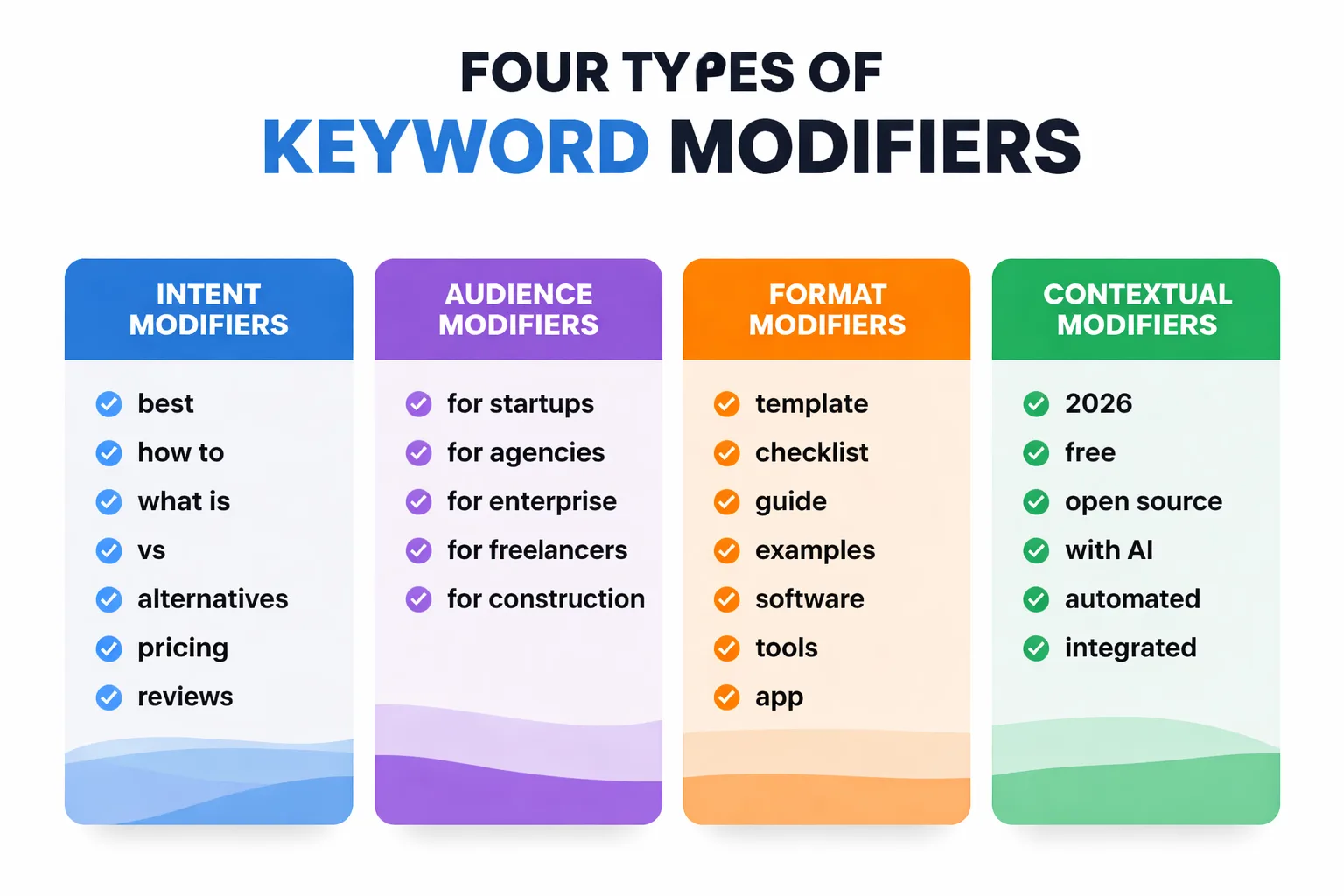
Modifiers fall into four categories that I've found useful:
1. Intent modifiers: "best," "how to," "what is," "vs," "alternatives," "pricing," "reviews" 2. Audience modifiers: "for startups," "for agencies," "for enterprise," "for freelancers," "for construction" 3. Format modifiers: "template," "checklist," "guide," "examples," "software," "tools," "app" 4. Contextual modifiers: "2026," "free," "open source," "with AI," "automated," "integrated"
The goal is to produce combinations that map to real search queries. "Best project management software for construction teams" is a real query someone types into Google or asks ChatGPT. "Project management template for freelancers" is another one. These are the long-tail variants that become individual spoke articles in your content cluster.
Here's where entity grounding comes in. Each root term should correspond to a real entity in your knowledge graph. If you're working on entity grounding for AI search, your root terms need to match the entities that Wikidata and other knowledge bases recognize. This is what connects your content to the structured data layer that LLMs use for citation and attribution.
I've seen teams skip this step and just dump every keyword they can think of into the combiner. The result is thousands of combinations, most of which are noise. "Free open source project management Gantt chart template for construction teams 2026" is technically a valid combination. Nobody is searching for it. Start with 5-10 root terms and 8-12 modifiers per category. That gives you 40-120 combinations per modifier category, which is enough to work with.
Let me walk you through a concrete example. Say you're building a content cluster around "generative engine optimization." Your root terms might be: "GEO," "generative engine optimization," "AI search optimization," "LLM citations," and "AI visibility." Your intent modifiers might be: "what is," "how to do," "tools," "services," "agency," "vs SEO," and "best practices." Your audience modifiers might be: "for ecommerce," "for SaaS," "for enterprise," and "for small business."
Running these through a keyword combiner produces combinations like "generative engine optimization tools for ecommerce," "AI search optimization for SaaS," "LLM citations vs SEO," and "GEO best practices for enterprise." Each of these is a potential spoke article. Each targets a specific audience with a specific intent. And together, they form a cluster that signals comprehensive topical authority to both Google and AI engines.
The root term selection is where most of the strategic thinking happens. If you choose root terms that are too broad ("marketing"), your combinations will be generic and uncompetitive. If you choose root terms that are too narrow ("Gantt chart color coding"), your combinations will have no search volume. The sweet spot is terms that are specific enough to have clear intent but broad enough to generate meaningful combinations. I usually start with the entities that appear in my top-performing Google Search Console queries and expand from there.
Step 2: Filter Combined Keywords by Search Intent and Difficulty
Your combiner just gave you 300+ keyword combinations. Most of them are useless. Now you filter.
First pass: remove duplicates and near-duplicates. If your combiner produced both "best CRM software" and "CRM software best," keep one. If it produced "CRM tools for small business" and "small business CRM tools," keep the one with higher search volume. Tools like Google Keyword Planner or DataForSEO can confirm volume.
Second pass: cluster by intent. Group all informational queries together. Group all commercial queries together. Group all transactional queries together. This is where you start to see the shape of your content cluster emerge. Informational queries become explainer articles and how-to guides. Commercial queries become comparison pages and listicles. Transactional queries become product pages and pricing pages.
Third pass: flag winnable long-tails. I look for keyword difficulty under 30 and search volume above 100. These are the terms where a small team can actually rank. High-difficulty, high-volume terms go on a separate list for future pillar pages once the cluster has built enough authority.
The filtering step is where most teams give up. 300 combinations is overwhelming. But here's the thing: you don't need to act on all of them. You need to find the 20-30 that form a coherent content cluster. The rest are future opportunities or noise to discard.
Let's break down the filtering with real numbers. Say your combiner produced 340 combinations across four modifier categories. After removing duplicates and near-duplicates, you might have 280 unique combinations. After clustering by intent, you might find 90 informational, 110 commercial, 50 transactional, and 30 navigational. After filtering by difficulty and volume, you might be left with 45 winnable long-tails: 20 informational, 15 commercial, 7 transactional, and 3 navigational. Those 45 keywords are your content cluster.
The commercial keywords are where I'd start publishing. They capture comparison intent, which means the reader is evaluating options. That's where you can position your product, demonstrate expertise, and earn both Google traffic and AI citations. Informational keywords are important for topical authority but convert at lower rates. Transactional keywords are high-value but limited in number. Navigational keywords are usually brand-specific and don't need dedicated articles.
In my experience, the best filter is a simple question: would a real person type this into Google or say it to ChatGPT? If the answer is no, cut it. "Automated integrated project management software with AI for enterprise teams" is a valid combination but not a natural query. "AI project management software for enterprise teams" is. Trust your ear.
One more filtering dimension that's becoming critical in 2026: AI answer supply. For each keyword combination, search it in Perplexity and Google AI Overviews. Does an AI answer already exist? Does it cite a competitor? If an AI answer exists and cites a competitor, that's a high-priority keyword. You're not just competing for a Google ranking. You're competing for a citation slot in an AI-generated answer. Keywords where AI answers exist but don't cite any source are opportunities to become the primary cited source. This is where ai search engine optimization tools that track AI visibility give you an edge over teams still using only traditional SEO platforms.
Step 3: Map Combined Keywords to Content Cluster Spokes
This is where the keyword combiner output becomes a content strategy. Each intent group from Step 2 becomes a cluster spoke. The pillar page covers the broad root term. The spokes cover the specific long-tail variants.
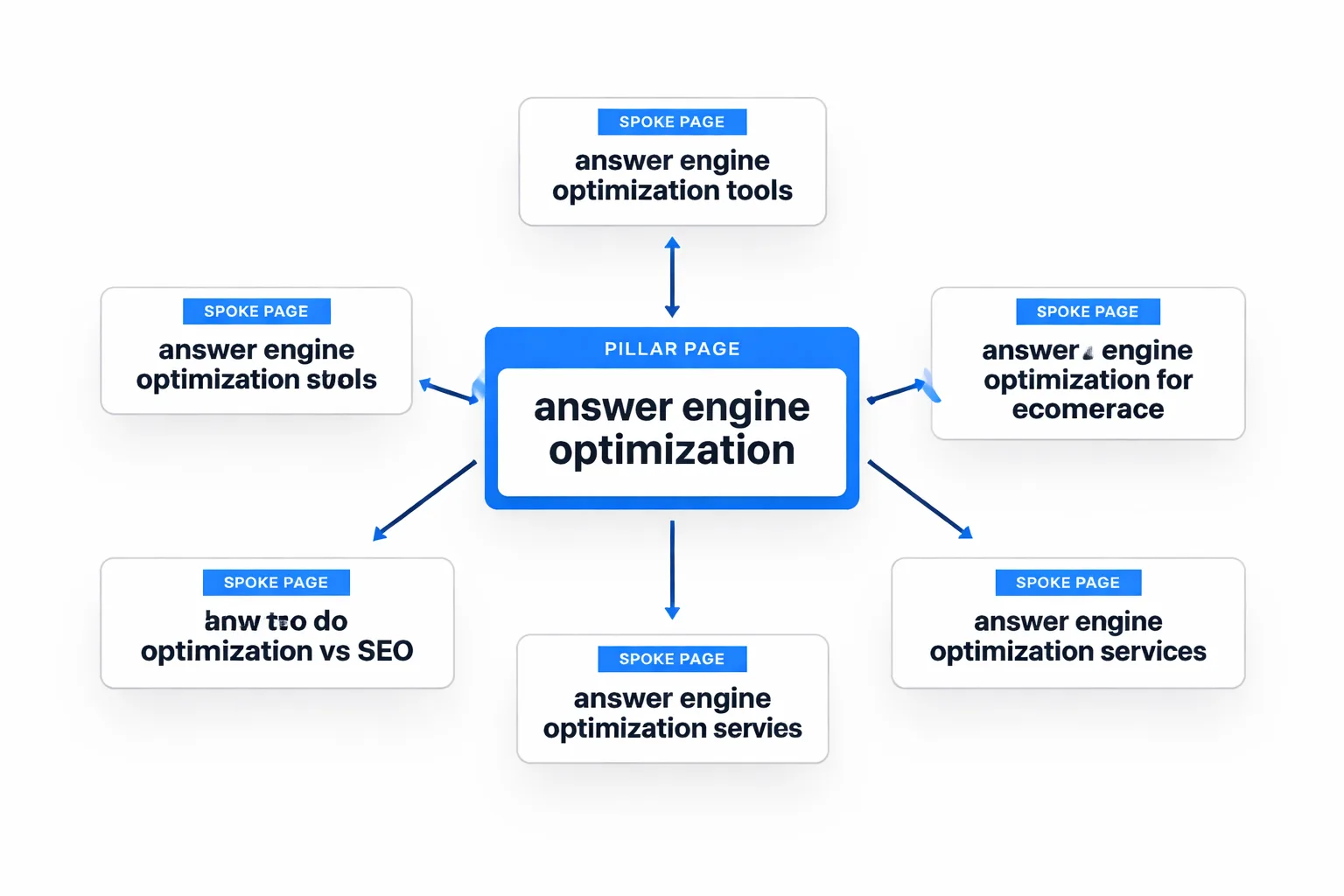
Let's say your root term is "answer engine optimization." Your pillar page targets that exact phrase. Your spokes target the long-tail combinations your combiner produced: "answer engine optimization tools," "answer engine optimization for ecommerce," "how to do answer engine optimization," "answer engine optimization vs SEO," and "answer engine optimization services."
Each spoke links back to the pillar. The pillar links out to each spoke. Internal linking establishes the topical authority signal that both Google and AI engines use to understand entity relationships. This is where answer engine optimization and traditional SEO converge. The cluster structure signals to Google that you cover the topic comprehensively. It signals to LLMs that your site is an authority on the entity.
Here's the critical rule: each spoke must cover a distinct intent. If two spokes target the same intent, they cannibalize each other in Google rankings and confuse AI engines about which page to cite. I've seen this happen when teams create both "best CRM software" and "top CRM tools" as separate articles. They're the same intent. Pick one.
The cluster mapping should also consider the buyer journey. Top-of-funnel spokes answer informational questions ("what is answer engine optimization"). Mid-funnel spokes compare options ("AEO vs SEO"). Bottom-of-funnel spokes capture transactional intent ("answer engine optimization services"). A well-mapped cluster guides the reader from awareness to decision, and it gives AI engines multiple entry points to cite your brand.
Let me give you a detailed mapping example. Say you're building a cluster for an ai search optimization SaaS company. Your pillar page targets "AI search optimization" with a 3,000-word comprehensive guide. Your spokes might look like this:
- Spoke 1 (informational): "What is AI search optimization?" targeting beginners searching for a definition. This spoke explains the concept, links to the pillar, and establishes your brand as the source of the definition. - Spoke 2 (commercial): "Best AI search optimization tools in 2026" targeting buyers comparing options. This spoke is a listicle that includes your product alongside competitors, with honest comparisons. - Spoke 3 (commercial): "AI search optimization vs traditional SEO" targeting buyers deciding between approaches. This spoke links to both the pillar and Spoke 1. - Spoke 4 (transactional): "AI search optimization services" targeting buyers ready to hire. This spoke is a service page with case studies and pricing. - Spoke 5 (informational): "How to measure AI search visibility" targeting practitioners who need to track results. This spoke links to your tool's features page. - Spoke 6 (format): "AI search optimization checklist" targeting practitioners who want a quick reference. This spoke is a downloadable resource that captures email addresses.
Each spoke has a distinct purpose, targets a distinct intent, and links to the pillar and at least one other spoke. The cluster covers the full topic surface area. When an AI engine gets asked about AI search optimization, it has multiple pages from your site to draw from, increasing the likelihood of citation.
The internal linking structure matters more than most teams realize. I recommend a hub-and-spoke model where the pillar links to every spoke, each spoke links back to the pillar, and adjacent spokes link to each other. For example, Spoke 2 (best tools) should link to Spoke 4 (services) because a reader comparing tools might also be evaluating services. Spoke 1 (what is) should link to Spoke 3 (vs traditional SEO) because a reader learning the concept might want to understand how it differs from what they already know. These cross-links create a dense semantic web that both Google's crawler and AI retrieval systems use to understand entity relationships.
How Does AI Citation Differ From Google Ranking?
This is the question that reframes the entire keyword combiner exercise. Google ranks pages. AI engines cite sources. The difference matters because the optimization strategies diverge.
Google uses backlinks, content quality, and on-page signals to rank individual pages for individual queries. You can rank #1 for a keyword with a single well-optimized page. AI engines like ChatGPT, Perplexity, and Claude synthesize information from multiple sources to generate answers. They don't rank pages. They extract and attribute claims. Research from arXiv on generative engine optimization found that AI search systematically favors earned media (third-party, authoritative sources) over brand-owned content, contrasting with Google's more balanced mix (arXiv).
This means your content cluster needs external validation to get cited by AI engines. Internal linking alone won't do it. You need third-party sources mentioning your brand, linking to your pillar pages, and establishing your entity in the broader knowledge graph. A keyword combiner helps you identify which topics need external coverage because those are the topics where AI engines are citing competitors instead of you.
The AEO vs SEO distinction is not academic. It changes how you prioritize content. If you're only tracking Google rankings, you're measuring half the picture. You need to track AI citations separately because the overlap between Google top results and AI-cited sources has collapsed. A page can rank #1 on Google and never appear in a ChatGPT answer. I've seen it happen repeatedly.
Let me explain the mechanics of why this happens. When you search Google, the algorithm retrieves and ranks pages based on relevance and authority signals. The user clicks a link and reads the page themselves. When you ask ChatGPT or Perplexity a question, the LLM retrieves information from multiple sources, synthesizes an answer, and presents it with citations. The user may never click through to any source. The citation itself is the visibility.
This creates a fundamentally different optimization problem. For Google, you optimize individual pages for individual keywords. For AI engines, you optimize your entire entity presence across the web. A keyword combiner helps with the first problem by identifying which pages to create. It helps with the second problem by identifying which topics need entity-level coverage. The difference is that entity-level coverage requires external sources, not just your own content.
I saw this play out with a client in the project management space. They had a strong content cluster targeting "project management software" and related long-tails. They ranked in the top 3 on Google for most of their target keywords. But when I checked their AI visibility, they were absent from ChatGPT and Perplexity answers for the same topics. The reason? No third-party sources were citing their brand. Competitors with weaker Google rankings but stronger external citation profiles were showing up in AI answers instead.
Step 4: Validate Clusters Against AI Citation Gaps
This is the step most teams skip entirely. You've built your content cluster. You've mapped keywords to spokes. Now you need to check whether AI engines are actually citing your content for those topics.
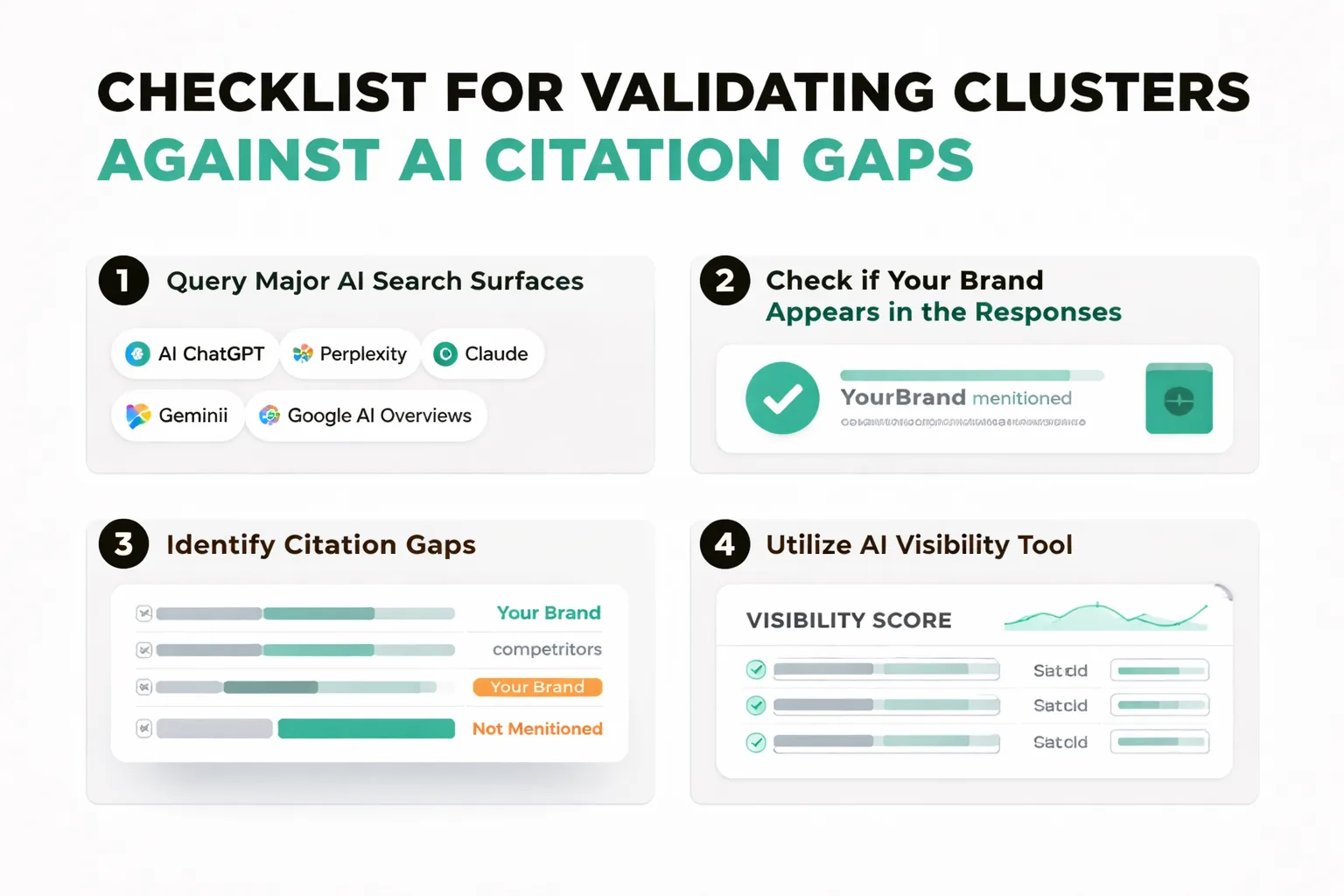
The validation process is straightforward but requires the right tools. You need to query major AI search surfaces (ChatGPT, Perplexity, Claude, Gemini, Google AI Overviews) with prompts related to your cluster topics and check whether your brand appears in the responses. If competitors are cited and you're not, that's a citation gap.
This is where an AI visibility tool becomes essential. Manual checking across every AI surface is time-consuming and inconsistent. You need automated tracking that shows you exactly where your brand is cited, where it's absent, and which sources AI engines are using instead.
The arXiv per-entity bias mapping study identified three failure modes that cause citation gaps. First, invisibility: weak structured data means your entity isn't recognized. Second, the Brand Hallucination Paradox: LLMs falsely attribute citations to familiar brands instead of the actual source. Third, the Parametric-Retrieval Lag Asymmetry: RAG systems update within days, but parametric memory (where citation tracking occurs) updates every 12-24 months (arXiv). Your content might be live and crawlable, but if the LLM's parametric memory hasn't updated, you won't be cited.
This lag is why 97% of an enterprise's knowledge graph is invisible to AI systems (arXiv). The content exists. The structured data exists. But the AI system hasn't updated its internal model to recognize it. Your keyword combiner output needs to account for this by prioritizing topics where you can build external citations quickly, rather than relying solely on publishing content and waiting for AI engines to discover it.
When you find a citation gap, the fix isn't always more content. Sometimes it's entity disambiguation: making sure your brand is correctly identified in Wikidata and other knowledge bases. Sometimes it's outreach: getting cited by the third-party sources that AI engines already trust. The Perplexity AI visibility checker can show you which sources Perplexity cites for your topics, and the ChatGPT AI visibility checker does the same for ChatGPT.
Let's walk through a concrete validation workflow. After publishing your content cluster, wait two weeks for indexing. Then query each AI surface with five prompt variations related to your pillar topic. For example, if your cluster targets "generative engine optimization," your prompts might be: "What is generative engine optimization?" "How do I optimize my content for AI search?" "What are the best GEO tools?" "How does GEO differ from SEO?" and "Can you recommend generative engine optimization services?"
For each prompt, record: (1) whether your brand is mentioned, (2) where in the answer it appears (first, in a list, last), (3) which sources are cited, and (4) which competitors are mentioned. This gives you a citation gap map. If you're absent from 4 out of 5 prompts, you have a significant visibility problem. If you're present but listed last, you have a positioning problem. If competitors are cited and you're not, you have an authority problem.
The fix depends on the problem type. Visibility problems require entity grounding and structured data improvements. Positioning problems require content quality improvements and more authoritative external citations. Authority problems require outreach to the sources AI engines already trust. This is where Meev's Citation Path feature becomes valuable: it identifies which publishers AI engines cite for your topics, resolves verified contacts, and drafts personalized outreach pitches so you can earn the third-party citations that move the needle.
Are your content clusters showing up in AI answers, or just Google results?
Why Does Entity Grounding Matter for Keyword Combinations?
Because without it, your keyword combiner produces strings of text that have no meaning to AI systems. A keyword like "CRM software for startups" is a string. An entity like "CRM software" with a defined relationship to "startups" as a target audience is structured data. AI engines work with structured data, not strings.
Entity grounding means connecting your keyword combinations to recognized entities in knowledge graphs like Wikidata. When your content cluster covers "project management software," "task tracking," and "Gantt charts," those terms need to map to actual entities with defined properties. Otherwise, the LLM has no way to connect your content to the topic it's answering a question about.
The Moz topic cluster model (Moz) recommends organizing content by topic and building internal link structures to establish topical authority. That's necessary but insufficient for AI visibility. Internal links signal to Google that your pages are related. They don't signal to ChatGPT that your brand is an authority on the topic. For that, you need external entity references: Wikidata entries, Wikipedia mentions, third-party citations, and structured data markup on your own pages.
This is where the keyword combiner becomes more than a keyword tool. It becomes an entity coverage audit. If your combiner produces 200 combinations and only 50 map to entities you've actually grounded in structured data, you've found your gap. The other 150 combinations represent topics where your content will struggle to get cited by AI engines, no matter how well-written it is.
Let me explain how entity grounding works in practice. Say your brand is "Acme CRM." You need a Wikidata entry for Acme CRM that defines it as a software product, specifies its category (customer relationship management software), lists its key features, and links to your official website. You need schema markup on your pages that uses the same entity identifiers. You need third-party sources (industry blogs, review sites, news articles) that reference Acme CRM in the context of CRM software.
When an LLM encounters a query like "best CRM for startups," it doesn't just search for pages containing those keywords. It looks for entities in its knowledge graph that match the concept "CRM software" and have a relationship to "startups" as a target audience. If Acme CRM isn't in the knowledge graph, or if the relationship to startups isn't established, the LLM won't cite you. It will cite a competitor who is in the knowledge graph, even if your content is objectively better.
This is why I recommend auditing your Wikidata presence before you start combining keywords. If your brand doesn't have a Wikidata entry, creating one should be your first priority. If it does have an entry but the entry is incomplete, improving it should be your second priority. Only then should you invest in content cluster creation. Without entity grounding, your keyword combiner output is a list of strings that AI engines can't connect to your brand.
How Do You Prioritize Combinations for Agentic SEO?
Agentic SEO changes the prioritization game. When AI agents (not humans) are the ones searching for and evaluating content, the query patterns shift. Agents don't type "best CRM software." They send structured queries with specific parameters: "Find CRM software with API access, under $50/month, with G2 rating above 4.0." Your keyword combiner needs to account for this by including parameter-based modifiers.
For agentic SEO, I add a fifth modifier category to the combiner: capability modifiers. These are specific features and attributes that AI agents filter on: "with API," "with integrations," "with automation," "with AI," "with free tier," "with SSO," "with SOC 2." When combined with root terms, these modifiers produce queries that match how agents actually search.
The prioritization framework for agentic SEO is different from traditional SEO. Instead of prioritizing by search volume, I prioritize by agent query frequency. This is harder to measure because agent queries don't show up in traditional keyword research tools. But you can infer it by looking at the types of questions AI engines answer about your topic. If Perplexity frequently answers questions about "CRM software with API access," that's a signal that agents are querying for it.
This is where ai and search engine optimization intersect in a way that traditional SEO tools completely miss. Traditional tools tell you what humans search for. AI visibility tools tell you what AI engines answer. The gap between the two is where agentic SEO opportunities live.
For ecommerce specifically, agentic commerce is accelerating this shift. According to HubSpot's State of AEO 2026 Report, AI search was the number one predictor of purchase intent for CRM software buyers (HubSpot). That means AI agents are not just answering questions. They're influencing purchase decisions. Your keyword combiner needs to produce combinations that capture commercial intent in an agentic context: "buy," "pricing," "compare," "alternatives," combined with capability modifiers.
What This Won't Fix
A keyword combiner won't fix a weak brand entity. If your company isn't recognized in Wikidata, doesn't have Wikipedia coverage, and lacks third-party citations, no amount of keyword combination will make AI engines cite you. The combiner surfaces the topics you should cover. It doesn't create the external validation that makes AI engines trust your coverage.
It also won't fix content quality. I've seen teams generate 300 keyword combinations, publish 300 thin articles, and wonder why neither Google nor AI engines care. The cluster structure matters. The entity grounding matters. But if the individual articles are shallow, generic, or factually wrong, no structural framework will save them. This is why we built Meev's 16-dimension quality firewall: it blocks weak drafts before they reach your CMS, so your cluster doesn't get polluted with content that drags down the entire topic's authority.
Finally, a keyword combiner won't solve the parametric memory lag. You can publish the perfect content cluster today, and it might take 12-24 months for LLM parametric memory to update and start citing you. RAG systems will pick up new content faster (within days), but the citation tracking layer that determines attribution lags behind. This is a structural limitation of current AI systems, not a content strategy failure. The workaround is to focus on RAG-discoverable content (fresh, well-structured, externally cited) while waiting for parametric memory to catch up.
Building Clusters That Win Both Channels
The teams winning right now are the ones who treat the keyword combiner as a starting point, not an endpoint. They use it to generate comprehensive topic coverage. They filter ruthlessly by intent and difficulty. They map combinations to cluster spokes with distinct purposes. And they validate every cluster against AI citation data before publishing.
The old playbook was simple: find keywords, write content, rank on Google. The new playbook adds a layer: find keywords, build clusters, ground entities, validate AI citations, and close gaps with targeted outreach. It's more work. But the teams doing it are showing up in ChatGPT answers while their competitors are still arguing about meta descriptions.
If you're starting from scratch, pick one root term, build one cluster, and validate it before scaling. Use a keyword combiner to generate your combinations. Map them to spokes. Check your AI visibility before and after publishing. Iterate based on what the data tells you, not what the old SEO playbook says.
The keyword combiner is not a magic bullet. It's a force multiplier. It takes your existing keyword knowledge and expands it systematically. But the strategy, the filtering, the cluster mapping, and the AI citation validation are what turn raw combinations into a content engine that wins in both Google and AI search. That's the difference between a keyword list and a content strategy.
FAQ
What does merge mean in a keyword combiner?
Merge means taking every item from one list and pairing it with every item from another list, producing all possible combinations. It's a Cartesian product. If List A has 5 root terms and List B has 10 modifiers, the merge produces 50 combined keywords.
What is one way to group keywords from a combiner?
Group by search intent: informational, navigational, commercial, and transactional. This grouping maps directly to content types: explainers, comparison pages, listicles, and product pages. Each intent group becomes a spoke in your content cluster.
How many root terms and modifiers should I start with?
Start with 5-10 root terms and 8-12 modifiers per category (intent, audience, format, contextual). That produces 40-120 combinations per modifier category, which is enough to identify a viable content cluster without drowning in noise.
Can a keyword combiner help with AI search visibility?
Yes, but only if you use the output to build entity-grounded content clusters. Raw keyword combinations don't improve AI visibility. Structured clusters that cover an entity's full topic surface area, with proper internal linking and external citations, are what get you cited by AI engines.
How do I validate my content cluster against AI citations?
Query major AI search surfaces with prompts related to your cluster topics and check whether your brand appears in responses. Use an AI visibility tracker to automate this across ChatGPT, Perplexity, Claude, Gemini, and Google AI Overviews. If competitors are cited and you're not, you've found a citation gap to close.
What's the difference between a keyword list and a content cluster?
A keyword list is a flat collection of terms. A content cluster is a structured set of pages organized around a central topic (pillar) with supporting articles (spokes) that cover specific long-tail variants. The cluster structure signals topical authority to Google and entity coverage to AI engines.
How does a keyword combiner support ecommerce GEO and agentic commerce?
For ecommerce, add capability modifiers ("with API," "with free shipping," "with SOC 2") to your combiner alongside commercial intent modifiers ("buy," "pricing," "compare"). This produces combinations that match how AI agents query products on behalf of users. Prioritize combinations where AI engines already generate shopping-related answers but don't cite your brand.
About the Author
Judy Zhou, Founder
Judy Zhou leads content strategy at Meev, where she oversees AI-driven content research and publishing for hundreds of brands. With a background in SEO and editorial operations, she focuses on building content systems that rank on Google, get cited by AI search engines, and drive measurable business results.
Stop guessing which keywords will get you cited. Track your AI visibility across every major AI search surface and close the gaps your competitors are exploiting.