

TLDR: - Topical authority and user intent alignment outperform raw content volume — sites with focused topic clusters consistently outrank prolific publishers who ignore intent mapping. - The 'hub and spoke' architecture works only when each spoke targets a distinct intent stage; two pages sharing the same intent will cannibalize each other indefinitely, regardless of keyword differences. - E-E-A-T signals that actually move rankings are topical depth and internal link structure — not author badges or review disclaimers. - Use the Topical Authority Scorecard (coverage breadth + intent coverage + internal link depth + engagement metrics) to diagnose gaps before publishing a single new post.
Key Takeaways
- Topical authority and user intent alignment outperform raw content volume — sites with focused topic clusters consistently outrank prolific publishers who ignore intent mapping.
- The hub-and-spoke architecture works only when each spoke targets a distinct intent stage; two pages sharing the same intent will cannibalize each other indefinitely, regardless of keyword differences.
- E-E-A-T signals that actually move rankings are topical depth and internal link structure — not author badges or review disclaimers.
- Use the Topical Authority Scorecard (coverage breadth + intent coverage + internal link depth + engagement metrics) to diagnose gaps before publishing a single new post.
Six months ago, I ran a content audit on a B2B SaaS site that had published 214 blog posts in 18 months. Organic traffic: flat. Featured snippets: zero. The editorial team was exhausted and confused — they'd done everything the old playbook said. More content, more keywords, more publishing cadence. What they hadn't done was ask a simpler question: does any of this content actually own a topic?
That's the tension at the center of modern content strategy. 88% of SEOs believe topical authority is important, yet most content teams still measure success by output volume. The two goals aren't just different — they're often in direct conflict. Publishing more is easy. Building a content ecosystem that Google recognizes as the definitive resource on a subject? That's the actual job.
Why Does Google Reward Topical Authority and User Intent Over Output Volume?
Google's ranking systems have shifted decisively toward rewarding sites that cover topics deeply, not just pages that target isolated keywords. The days when isolated blog posts and keyword-stuffed pages could secure top rankings are gone — and the mechanism behind this shift deserves a closer look.
Search algorithms now evaluate topic coverage holistically. When a crawler visits your site, it's not just assessing a single page — it's mapping your site's entire treatment of a subject. If you have 40 posts loosely tagged "content marketing" but none of them connect through internal links, none address the full spectrum of user intent stages, and several answer the same question with slightly different phrasing, Google's systems register that as noise, not expertise. The result is a ranking plateau that no amount of additional publishing will break.
The sites that rank consistently are the ones that treat a topic like a subject matter expert would — covering it from first principles to advanced application, with each piece of content serving a distinct purpose in the reader's journey.
I've seen this play out across a dozen content audits in the past year. Sites with 60 tightly clustered, intent-mapped posts routinely outrank competitors with 300+ unstructured articles. The volume paradox is real: past a certain point, more content without strategic architecture actively dilutes your topical signal. Google interprets a sprawling, unstructured content library as a generalist site — and generalists don't win against specialists in competitive SERPs.
The SGE (Search Generative Experience) shift makes this even more pronounced. AI-generated search overviews pull from sources that demonstrate clear, deep knowledge of a topic. Generic content — even well-written generic content — rarely gets cited. What gets cited is the site that has answered the question, the follow-up question, and the edge case question, all within a coherent content architecture that signals genuine depth.
How Do You Map Topical Authority and User Intent Across a Topic Cluster?
Mapping topical authority and user intent across a cluster starts with one uncomfortable exercise: auditing what you already have before you publish anything new.
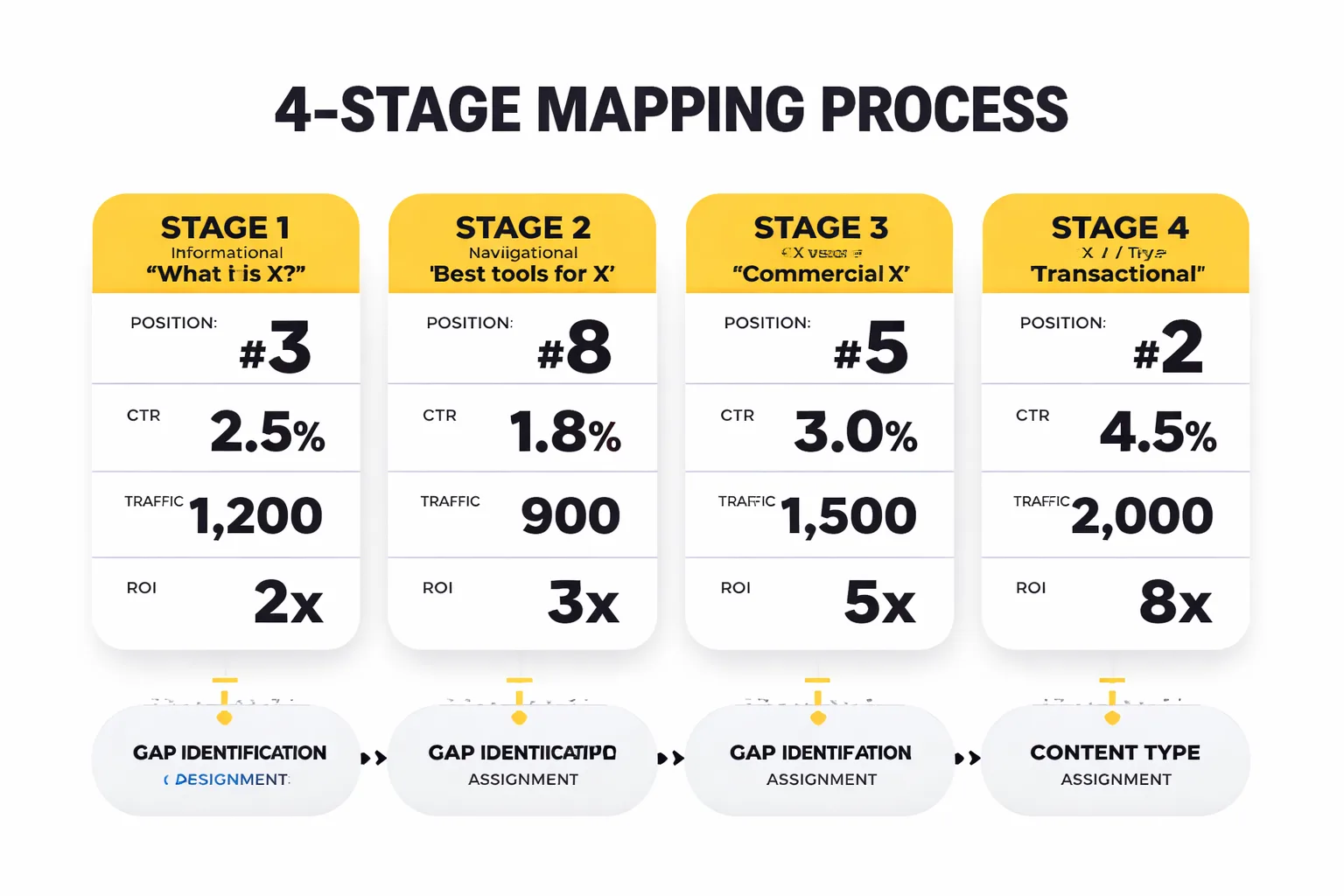
Here's the process I use with content teams, broken into four steps:
Step 1: Pull every URL in your cluster into a spreadsheet. Export from Google Search Console — filter by your topic's primary keyword family. You want every page that's receiving impressions for related queries, not just the ones you intended to rank.
Step 2: Classify each page by intent stage. Informational ("what is topical authority"), navigational ("best tools for building topic clusters"), commercial investigation ("topical authority strategy vs. content volume"), or transactional ("hire a content strategist"). Most content teams discover they have 80% informational content and almost nothing at the commercial investigation stage — which is exactly where buyers make decisions.
Step 3: Map intent gaps. Where does your cluster go silent? If you have five "what is" posts and zero "how to implement" posts, you're abandoning readers at the exact moment they're ready to go deeper. That's a gap Google notices too — because users who can't find the next logical answer on your site bounce to a competitor who has it.
Step 4: Check for intent overlap. This is the step most teams skip, and it's the one that costs them the most. I spent three months troubleshooting a cluster for a B2B SaaS client where the pillar page and one supporting post kept trading positions in Search Console — neither would hold a stable rank for longer than two weeks. We'd optimized internal linking, checked crawl depth, the works. The fix wasn't technical. The problem was that the cluster post had drifted into answering the same navigational intent as the pillar during a content refresh. Once I rewrote the supporting post to address a downstream, more specific use-case question — shifting its intent from "what is X" to "how to implement X in scenario Y" — the oscillation stopped within about 30 days and the pillar held its position. Two pages sharing an intent will fight each other indefinitely. Different keywords targeting identical intent will cannibalize. Same keyword targeting different intents almost never does.
For high-potential keyword discovery within your cluster gaps, I recommend running your topic through Google Search Console's Query report filtered by impressions (not clicks) — the queries you're getting impressions for but not ranking on are your most actionable gap signals.
What Is the Topical Authority Scorecard?
Measuring topical authority requires moving beyond rankings as the sole metric. Rankings are an output. The scorecard I use measures the inputs that produce sustainable ranking outcomes — and it has four dimensions.
| Dimension | What to Measure | Strong Signal | Weak Signal |
| Coverage Breadth | % of intent stages covered per topic | All 4 stages covered | Only informational content |
| Internal Link Depth | Avg. internal links per cluster post | 4+ links to/from pillar | Orphaned or pillar-only links |
| E-E-A-T Depth | Topical specificity + author credentials visible | Named expert, specific data | Generic byline, no sourcing |
| Engagement Quality | Time on page, scroll depth, return visits | >3 min avg, >60% scroll | <90 sec, high bounce |
On the E-E-A-T dimension specifically: I've watched teams spend real budget slapping "medically reviewed by Dr. So-and-So" badges on AI-assisted articles and treating it as an E-E-A-T win. The signal that actually moved the needle in my testing was topical depth and internal linking structure — not the badge. There is no algorithmic E-E-A-T score in Google's systems. The Quality Rater Guidelines are a training document for human reviewers who calibrate ranking models — they don't directly touch your rankings. Credentials build conversion trust, but conflating that with ranking impact is a category error I see constantly.
What does move rankings: internal link architecture that signals which page is the authoritative hub, and content that answers follow-up questions without sending users back to Google.
For calculating SEO ROI on topical authority investments specifically, I track a composite metric: cluster-level organic sessions (not page-level), featured snippet ownership within the cluster, and the percentage of cluster queries where your site appears in positions 1-3. These three numbers together tell you whether your topical investment is compounding or stalling.
If you want a deeper implementation framework for this kind of architecture, the Complete Guide to Building Topical Authority With AI Content covers the structural setup in more detail than I can fit here.
Is your content cluster actually mapped to user intent — or just keyword variations of the same question?
When to Publish More vs. When to Consolidate
This is the decision content teams get wrong most often — and the mistake is almost always defaulting to "publish more" when the data is actually screaming "consolidate."
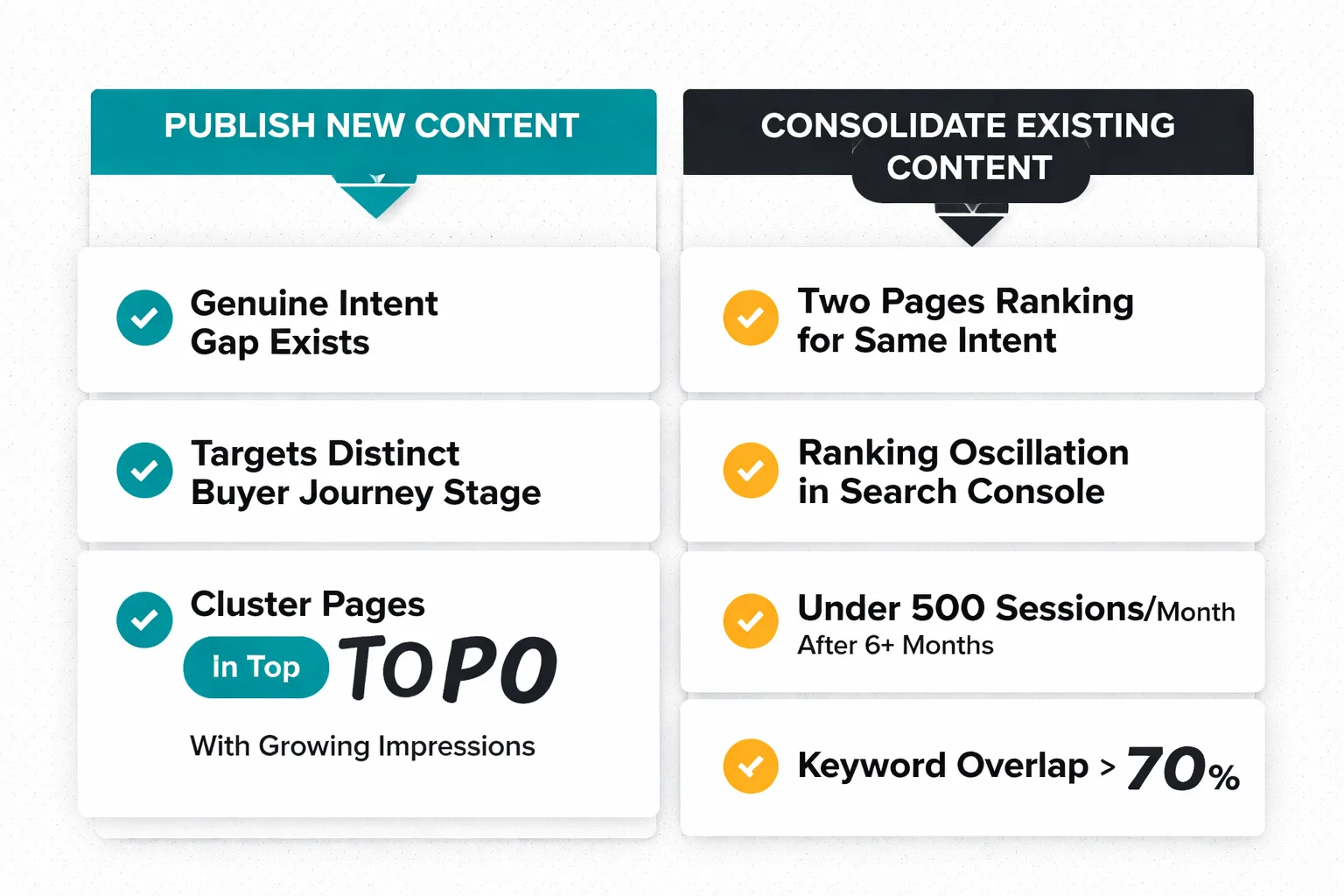
Here's the decision framework I use:
Publish new content when: - You've identified a genuine intent gap — a user question your cluster doesn't answer at all - The new topic targets a distinct stage in the buyer journey (not just a keyword variation of existing content) - Your existing cluster pages are performing above baseline (ranking in top 20, growing impressions) - You have internal linking opportunities ready — the new post can connect to at least 3 existing pages
Consolidate when: - Two or more pages are competing for the same primary intent in Search Console (ranking oscillation is the tell) - Any cluster page has been live 6+ months with under 500 organic sessions/month and isn't a deliberate long-tail play - Your topic coverage is deep on one intent stage and completely absent on another — merging thin informational posts frees up crawl budget and link equity for the gaps that matter - A content refresh would require rewriting more than 60% of an existing post — at that point, a redirect and rebuild is cleaner
I made the consolidation mistake twice early in my career — seeing two pages from the same cluster competing for a broad, short-tail term, I consolidated and redirected, only to watch rankings drop for both pages within six weeks. What I've learned since: Google competing your pillar against a cluster post on a generic keyword isn't automatically the problem. The real damage looks different. It's ranking oscillation — where Google can't decide which page satisfies the user's primary intent and keeps swapping positions. That's the signal worth acting on. Audit clusters for intent overlap, not keyword overlap.
The volume question — "how much content is enough?" — doesn't have a universal answer, but it has a directional one: you need enough content to cover every meaningful intent stage within your topic, and not one post more than that until those posts are performing. Strategic volume means publishing to fill genuine gaps, not to fill a calendar.
Three Sites That Got This Right (And One That Didn't)
Real outcomes are more useful than frameworks, so here are four cases I've tracked closely — three that executed topical authority strategy well, and one that's a cautionary example of what over-publishing without intent alignment actually produces.
Case 1: The B2B SaaS Turnaround
A project management software company came to me with 180 published posts and declining organic traffic — down 23% year-over-year. After auditing the cluster, I found 47 posts targeting variations of the same informational intent ("what is project management") and almost nothing at the commercial investigation stage. We consolidated 31 of those posts into 8 detailed guides, built a proper hub-and-spoke architecture with the pillar page linking to each guide and each guide linking back, and published 6 new posts targeting commercial-stage queries ("[software A] vs [software B]", "best project management tools for remote teams"). Within 90 days, organic sessions were up 34% — from 18K to 24K monthly — and they captured 4 featured snippets in the commercial investigation category where they'd previously had zero presence.
Case 2: The Health Content Publisher
A health-adjacent content site had strong domain authority but weak topical coverage on sleep health specifically. Rather than publishing broadly, they ran a 4-month sprint: 22 posts covering every intent stage around sleep health, from "what causes insomnia" through "best sleep trackers" to "cognitive behavioral therapy for insomnia cost." Each post linked to a central pillar. Google Search Console structured data markup was applied to all 22 posts. Result: the pillar page moved from position 14 to position 3 for its primary term within 5 months, and 9 of the 22 supporting posts ranked in the top 10 for their target queries. The cluster approach — not the individual posts — drove the outcome.
Case 3: The E-commerce Content Play
A mid-size e-commerce brand in the outdoor gear space built a content cluster around "backpacking for beginners" using the hub-and-spoke model across 14 posts. What made this work wasn't the volume — it was the intent mapping. Each post served a distinct stage: gear checklists (informational), brand comparisons (commercial), and buying guides (transactional). The pillar page aggregated all of it with strong internal linking. Organic revenue attributable to that cluster: up 41% in 6 months, tracked via Google Analytics 4 assisted conversions. That's the ROI metric that actually gets content budgets renewed.
The Cautionary Case: The Over-Publisher
This one I watched from the outside — a content marketing agency that built a blog by publishing 5 posts per week on every tangentially related keyword in their niche. At 400+ posts, their topical signal was completely diluted. They ranked for almost nothing competitively because Google couldn't identify what they were actually an authority on. When I analyzed their Search Console data (they shared it in a public case study), the pattern was stark: hundreds of keywords with impressions in positions 11-20, almost none breaking into the top 10. Their internal linking was nonexistent — posts were published in isolation, never connecting to a pillar. They eventually hired an SEO firm that spent 6 months consolidating 280 posts into 40 and rebuilding the architecture from scratch. The lesson is blunt: interconnected content ecosystems outperform sprawling unstructured libraries every time, and the cost of unwinding a volume-first strategy is always higher than building the architecture right from the start.
What We'd Do Differently
If I were starting a content program from zero today, I'd do three things differently than the conventional playbook suggests.
First, I'd audit intent before I published a single post. The intent map is the architecture — everything else is construction. Second, I'd set a hard rule: no new posts until every existing cluster post has at least 4 internal links and a clear, distinct intent assignment. Orphaned content is wasted crawl budget. Third, I'd measure cluster-level performance, not page-level. Individual post rankings are a distraction. What matters is whether your topic cluster, as a system, is capturing more of the SERP over time.
Topical authority and user intent aren't separate strategies — they're the same strategy. You build authority by systematically covering the full spectrum of what a user needs to know about a topic, in the right sequence, with the right internal architecture connecting it all. Volume is a byproduct of doing that work thoroughly — not a substitute for it.
The 214-post site I mentioned at the start? We consolidated it to 89 posts over four months, rebuilt the internal linking structure around 6 topic pillars, and filled the commercial-stage intent gaps with 12 new posts. Organic traffic was up 47% within 6 months. The team published less and ranked more by prioritizing topical authority and user intent. That's the actual trade-off — and it's one I'd make every time.
FAQ
What is topical authority and why does it outperform content volume?
Topical authority refers to a site's comprehensive expertise on a topic, built through focused topic clusters that align with user intent, rather than just publishing high volumes of content. Sites with strong topical authority consistently outrank prolific publishers because Google rewards depth and ecosystem structure over raw output. Measuring success by post count conflicts with building a definitive resource on a subject.How does the 'hub and spoke' architecture improve rankings?
The hub and spoke model works by having a central 'hub' page cover a broad topic, linked to 'spoke' pages that target distinct stages of user intent, creating a cohesive ecosystem. If two spokes target the same intent, they cannibalize each other, hurting rankings regardless of keyword differences. Proper implementation ensures full coverage without overlap.Which E-E-A-T signals actually impact rankings?
Topical depth and strong internal link structures are the E-E-A-T signals that move rankings, demonstrating expertise and authority across a topic. Author badges or review disclaimers have minimal effect compared to these. Focus on building depth through intent-aligned content and linking.How can I diagnose topical authority gaps before publishing more content?
Use the Topical Authority Scorecard, which evaluates coverage breadth, intent coverage, internal link depth, and engagement metrics. This audit reveals weaknesses in your ecosystem, like cannibalization or shallow coverage, preventing wasted effort on new posts. Apply it to existing content to prioritize fixes over volume.Stop publishing into the void. Build topic clusters that Google recognizes as authoritative — and start ranking for the queries that actually drive revenue.