
By Judy Zhou, Head of Content Strategy
Key Takeaways
- Only 14% of marketers track AI citation visibility, leaving 86% blind to whether their content appears in LLM responses like ChatGPT.
- 94% of B2B buyers use AI search engines during vendor research, per Forrester, making citation tracking essential for discovery.
- Structured citation strategies can increase LLM citation rates from 5–15% to 40–50% within six months, according to Discovered Labs analysis.
- Prioritize LLM citation tracking tools now to capture AI-routed buying intent before the competitive window closes in 2026.
Sarah had just published what her team agreed was their strongest piece of the quarter — a deeply researched, expert-reviewed guide on B2B software procurement. A week later, a colleague typed the exact target question into ChatGPT. The AI gave a thorough, confident answer. It cited three sources. Sarah's article wasn't one of them. A competitor with a thinner, older post was. That moment — increasingly common in marketing teams right now — is exactly why LLM citation tracking tools have gone from a nice-to-have to a genuine strategic priority.
LLM citation tracking is the practice of monitoring when and where AI engines like ChatGPT, Perplexity, Gemini, and Google AI Overviews reference your brand or content in their responses. Only 14% of marketers currently track AI citation visibility, according to industry benchmarks — which means the other 86% are flying blind while AI search becomes a primary first-touch discovery channel. According to Forrester, 94% of B2B buyers now use AI search engines during vendor research. The tools in this roundup exist to close that gap. Discovered Labs analysis found that structured citation strategies can lift citation rates from 5–15% to 40–50% within six months. The window to get ahead is open. It won't stay that way.
Why LLM Citation Tracking Is a 2026 Priority
The competitive case is straightforward: AI engines are routing buying intent at scale, and most brands have no idea whether they're showing up. But the mechanics underneath are less obvious than they look, and that's where most teams get stuck.
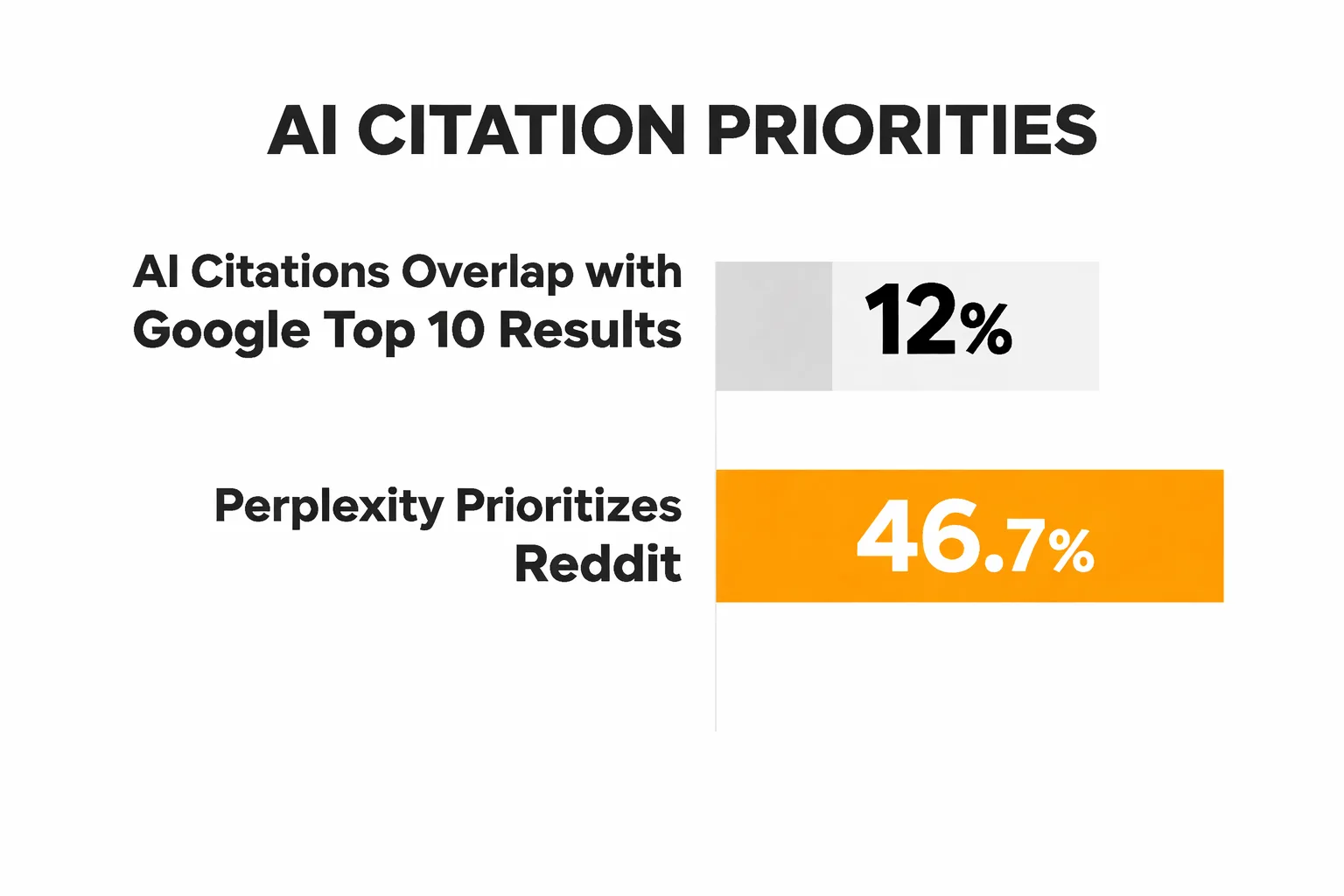
Here's something I keep seeing in my work overseeing content strategy across hundreds of brands: teams conflate brand mentions with citations, and they treat both as equivalent to traditional backlinks. None of those assumptions hold. Discovered Labs found that only 12% of AI citations overlap with Google's top 10 results — meaning your traditional SEO performance is a poor predictor of your AI visibility. You can rank on page one for a keyword and be completely absent from the AI response that answers the same question.
The platform divergence makes this harder. Perplexity prioritizes Reddit (46.7% of top citations), while ChatGPT favors Wikipedia (47.9% of top citations), per Discovered Labs. That's not a minor nuance — it means the content distribution strategy that earns you ChatGPT citations is structurally different from the one that earns you Perplexity citations. Without a tool tracking each platform separately, you're optimizing blind.
There's also the reliability problem. SparkToro tested 600 volunteers across 2,961 prompts and found the odds of getting the same brand list twice from ChatGPT are less than 1 in 100 — and the same list in the same order: 1 in 1,000. Manual spot-checks are theater. You need systematic tracking across multiple prompts and platforms to see signal through the noise.
The E-E-A-T filter makes the stakes even higher. A Semrush content optimization study found E-E-A-T signals show a +30.64% correlation with AI citations, and a ZipTie analysis of 2,400 citations found 96% came from sources with strong E-E-A-T signals — leaving only 4% for everything else. That's not a ranking nudge. That's a near-binary gate. If your content doesn't clear it, no amount of keyword optimization compensates.
How We Ranked These LLM Citation Tracking Tools
I evaluated these tools against five criteria that matter to working content teams, not just analysts with time for elaborate setups.
Citation coverage was the first filter: which AI engines does the tool actually track? ChatGPT, Perplexity, Gemini, Claude, and Google AI Overviews are the minimum viable set in 2026. Tools that cover only one or two platforms give you a partial picture that can actively mislead.
Mention vs. citation differentiation is the criterion most tools get wrong. A mention is when an AI response references your brand. A citation is when it links to your content. These are different signals with different strategic implications — and conflating them is how teams waste months on campaigns that earn mentions but never drive traffic.
Data freshness and tracking cadence matter because AI citation patterns shift. A tool that runs weekly snapshots will miss the volatility that SparkToro's research documents. Daily or near-daily cadence is the practical floor for actionable data.
Reporting depth covers whether the tool tells you why you're being cited (or not) — source attribution, sentiment framing, competitive share of voice — not just whether a mention appeared.
Pricing transparency is a proxy for trust. Tools that hide tiers behind sales calls make budget planning harder than it needs to be for content teams operating on fixed monthly budgets.
Comparison Table
| Tool | AI Engines Covered | Tracking Cadence | Mention vs. Citation | Integrations | Starting Price |
| Meev | ChatGPT, Claude, Gemini, Perplexity, Grok | Daily / 2×-week hybrid | Yes — differentiated | API, Knowledge Base | $59/mo |
| OtterlyAI | ChatGPT, Perplexity, Google AIOs, Gemini, Copilot | Not publicly specified | Yes — URL-level | Limited | $29/mo |
| Peec AI | ChatGPT, Perplexity, Google AIOs + add-ons | Daily | Yes — 'used' vs. 'cited' | Looker Studio, MCP/API | €89/mo |
| Profound | Up to 10 engines (tier-dependent) | Not publicly specified | Yes — granular attribution | SSO, Enterprise | $99/mo |
| Semrush AI Toolkit | ChatGPT, Google AIOs, Gemini, Claude, Grok, Perplexity, DeepSeek | Not publicly specified | Partial | Semrush ecosystem | $99/mo add-on |
| LLMrefs | 10+ models incl. GPT-5, Gemini, Claude, Grok | Weekly per keyword | Yes | API | Free tier available |
| Writesonic GEO | ChatGPT, Gemini, Claude, Perplexity | Not publicly specified | Partial | SEO suite integrated | $199/mo |
| Ahrefs Brand Radar | Major AI engines | Not publicly specified | Partial | Ahrefs ecosystem | $129/mo (bundled) |
| AIclicks | 8+ LLMs incl. ChatGPT, Perplexity, Gemini, Claude | Not publicly specified | Yes — with outreach data | Contact discovery | $95/mo |
| Mangools AI Search Watcher | ChatGPT + major AI engines | Not publicly specified | Basic | Mangools suite | Entry-level (see site) |
| Scrunch AI | ChatGPT, Perplexity, Google AIOs | Not publicly specified | Yes | Limited | $79–$199/mo est. |
1. Meev — Best for Teams That Want Tracking and Publishing in One Platform
Best for: Teams that want AI citation tracking plus a content engine they can trust to publish — not just a dashboard that surfaces problems.
Meev is the only platform in this roundup that closes the loop between citation tracking and content execution. Most tools tell you where you're missing. Meev tells you, then writes and publishes the content designed to fix it — with a 12-dimension Quality Matrix and Google Penalty Risk Matrix gating every article before it ships. That publish gate matters: it's the mechanism that keeps scaled content output from triggering SpamBrain's Scaled Content Abuse flag, which I've watched hit sites that were producing volume without differentiation.
The citation tracking covers ChatGPT, Claude, Gemini, Perplexity, and Grok with a hybrid daily and twice-weekly cadence — one of the more aggressive refresh schedules in the category. The Knowledge Base enforcement layer is genuinely differentiated: articles are grounded in your approved claims, not AI hallucination, which means the content that gets published is attributable to your brand's actual positions. For teams worried about AI-generated content that doesn't represent their expertise, this is the structural fix.
Key features: - Citation tracking across ChatGPT, Claude, Gemini, Perplexity, and Grok with hybrid daily / 2×-week cadence - 12-dimension Quality Matrix plus Google Penalty Risk Matrix — 70/100 publish gate on both - Knowledge Base enforcement — articles grounded in your approved claims, not AI hallucination - Closed-loop Citation Path (roadmap) — each article mapped to the citation-rate delta it drove - Autopilot topic pool with gap detection from competitor citation patterns
Pricing: 7-day free trial (no credit card, no auto-charge). After the trial, services pause unless you subscribe — your account stays open and your data stays readable. Lite $59/mo, Starter $79/mo, Pro $249/mo, Agency $599/mo. 20% annual discount. Cancel anytime; hard-cap quotas with no overage fees.
If your content team is already stretched and you need a system that tracks citations and acts on the gaps, Meev is the only platform here that does both. The comparison with Profound is worth reading if you're evaluating enterprise-tier options — the pricing gap is significant and the feature overlap is smaller than it looks.
2. OtterlyAI — Best for Mid-Market Citation Gap Analysis
Best for: Content marketers and SEO teams at mid-market brands who need actionable citation gap analysis and GEO optimization recommendations without enterprise-level complexity.
OtterlyAI has built a reputation as one of the more accessible entry points into AI search monitoring, covering six platforms with URL-level attribution that separates it from tools that only surface brand-level mentions. The GEO crawlability audits with predictive citation scoring give content teams a forward-looking signal — not just where you're cited today, but where you're likely to be cited if you fix specific content issues.
Key features: - Citation tracking across 6 AI platforms with URL-level attribution - Brand position and sentiment tracking (positive, neutral, negative) - GEO crawlability and content audits with predictive citation scoring - Automated GEO recommendations and country-level market monitoring
Pricing: Lite plan from $29/month (10 prompts); Standard ~$189/month (100 prompts); Pro ~$989/month (1,000 prompts)
At $29/month entry, OtterlyAI is the most accessible tool in this roundup for teams testing the waters. The prompt volume at the Lite tier is genuinely limited — 10 prompts won't give you statistically reliable data across multiple platforms — but it's a reasonable way to validate whether AI citation tracking belongs in your stack before committing to a higher tier.
3. Peec AI — Best for Analytics-Driven Marketing Teams
!Screenshot of Peec AI's landing page
Best for: Mid-market marketing teams and agencies seeking enterprise-grade analytics at a rational price point with a streamlined, intuitive dashboard.
Peec AI's most distinctive feature is its distinction between 'used' sources (content that informed the AI's answer) and 'cited' sources (URLs explicitly mentioned in the response). That granularity matters strategically: a source can influence an AI response without getting credit for it, and knowing which of your content falls into each category tells you whether you have an influence problem or a credit problem. Those require different fixes.
Key features: - Tracks both 'used' (content informed the answer) and 'cited' (URL explicitly mentioned) source types - Daily prompt execution cadence with visible countdown to next run - Google Looker Studio connector and MCP/API integrations for custom BI workflows - Unlimited team seats on all plans with CSV export and client-ready reports
Pricing: Starter €89/month (25 prompts, ~2,250 answers/month); Pro €199/month (100 prompts, ~9,000 answers/month); Enterprise €499+/month (300+ prompts); add-ons available for Gemini, Claude, DeepSeek, Grok, and others
The base plan covers ChatGPT, Perplexity, and Google AI Overviews — additional engines are paid add-ons, which can push the effective monthly cost higher than the headline price suggests. For teams that need Claude or Gemini tracking specifically, factor that in before comparing to all-inclusive tiers from other tools.
4. Profound — Best for Enterprise Citation Intelligence
!Screenshot of Profound's landing page
Best for: Enterprise brands and large agencies with dedicated analysts who need maximum AI platform breadth, security compliance, and deep citation intelligence at scale.
Profound processes over 100 million AI search prompts per month, which gives its citation attribution data a statistical weight that smaller-volume tools can't match. The Conversation Explorer tool surfaces AI search volume data that was previously invisible — not just citation rates, but the underlying query patterns driving those citations. For enterprise teams building topical authority for AI search, that query-level intelligence is genuinely useful.
Key features: - Conversation Explorer tool revealing previously invisible AI search volume data - Granular citation source attribution linking AI mentions to specific content assets - Competitive benchmarking and share-of-voice analysis across topics, regions, and platforms - Enterprise-grade 'god-view' dashboard for agencies managing multiple client brands
Pricing: Starter $99/month (ChatGPT-only, 50 prompts); Growth $399/month (3 engines, 200+ prompts); Enterprise custom pricing (up to 10 engines, multi-company tracking, SSO/SOC2)
The Starter tier being ChatGPT-only is a real limitation given how platform-divergent citation patterns are. If Perplexity is a priority channel for your audience — and given its 46.7% Reddit citation share, it often is for B2C brands — you're looking at the Growth tier minimum. The interface complexity is also worth flagging for smaller teams: Profound is built for analysts, not content managers who need a quick weekly read.
5. Semrush AI Toolkit — Best for Existing Semrush Users
!Screenshot of Semrush AI Toolkit's landing page
Best for: SEO teams and agencies already using Semrush who want to add AI citation tracking without introducing a new vendor or data pipeline.
The Semrush AI Toolkit's primary advantage is integration, not innovation. If your team already lives in Semrush for keyword research, backlink analysis, and rank tracking, adding AI citation monitoring to the same dashboard eliminates the context-switching tax. The Semrush AI Overviews study tracking 144,000+ LLM citations is also worth reading alongside your dashboard data — the research context helps interpret what you're seeing.
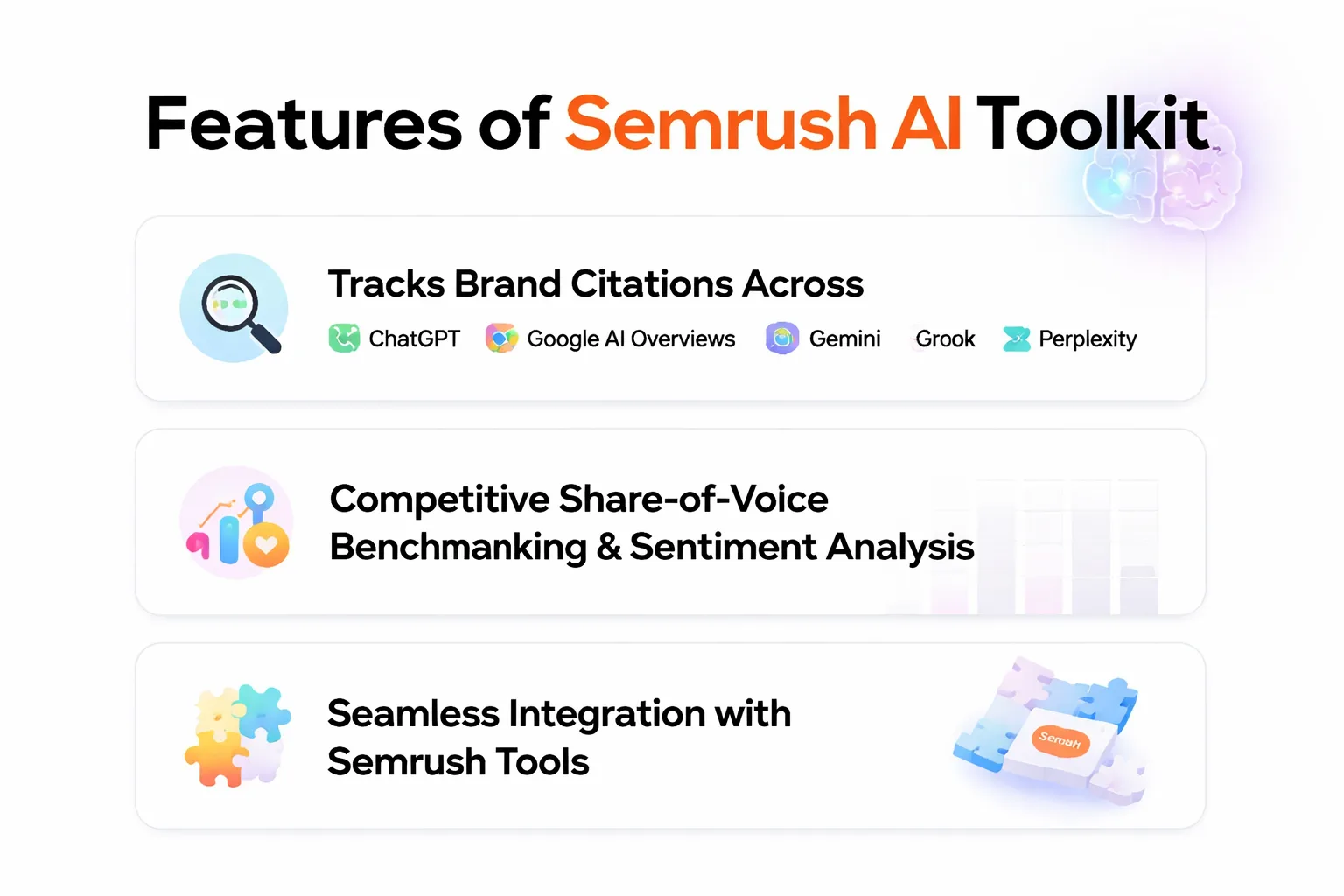
Key features: - Tracks brand citations across ChatGPT, Google AI Overviews, Gemini, Claude, Grok, Perplexity, and DeepSeek - Competitive share-of-voice benchmarking and sentiment analysis - Seamless integration with existing Semrush SEO projects and reporting pipelines - LLM Brand Visibility module that slots into existing client reports without a new vendor or login
Pricing: AI Visibility Toolkit add-on starts at $99/month per domain; Semrush One (full SEO + AI visibility) starts at $199/month; Enterprise AIO at custom pricing for multi-brand and agency scale
The add-on cost structure means you're paying for AI tracking on top of an existing Semrush subscription. For teams already at the Pro or Guru tier, the combined monthly cost climbs fast. If AI citation tracking is your primary use case rather than a supplement to existing SEO workflows, a purpose-built tool will likely deliver better value.
6. LLMrefs — Best for SEOs Transitioning from Keyword Tracking
!Screenshot of LLMrefs's landing page
Best for: SEOs and content marketers transitioning from traditional keyword rank tracking to GEO who want to import existing keyword lists and immediately see LLM visibility gaps.
LLMrefs takes a keyword-first approach rather than a prompt-first approach, which makes it immediately familiar to anyone coming from traditional SEO tooling. You import your existing keyword list; it fans out into AI-native prompts automatically and shows you where you appear (or don't) across 10+ models. The geo-targeting across 20+ countries also makes it one of the more practical options for brands with international content operations.
Key features: - Keyword-based tracking (not prompt-based) with automatic fan-out prompt generation from real user conversations - Coverage across 10+ AI models including GPT-5, Gemini, Perplexity, Claude, Grok, Copilot, Meta AI, and DeepSeek - Geo-targeting across 20+ countries and 10+ languages - Statistically significant brand ranking outcomes ensured for every tracked keyword
Pricing: Free account available; paid plans scale by keyword volume — positioned as the most affordable AEO/GEO tool in the market; full tier pricing confirmed on site
The weekly update cadence per keyword is the main trade-off. For fast-moving categories where citation patterns shift daily, that lag can mean you're optimizing against stale data. The keyword-centric methodology also doesn't surface the prompt-level nuance that dedicated prompt-tracking tools provide — but for teams that want a familiar interface and a free entry point, it's a strong starting option.
Wondering which AI engines are actually citing your brand right now — and which competitors they're recommending instead?
7. Writesonic GEO — Best for Combined GEO and SEO Teams
Best for: Content marketing teams that want a combined GEO + SEO platform covering both AI citation tracking and content optimization without managing separate tools.
Writesonic GEO's differentiator is the integration of AI citation tracking with content optimization in a single platform. The AI crawler analytics showing when bots visit and index your site is a feature I haven't seen executed this clearly elsewhere — it closes a visibility gap that most teams don't even know they have. Understanding when Perplexity or ChatGPT's crawlers are actually touching your content is genuinely useful for timing content updates and getting content cited in Perplexity.
Key features: - Multi-LLM citation tracking with cached AI answer capture to show how brands are framed - Competitor AI monitoring with share-of-voice and historical data - AI crawler analytics showing when bots visit and index your site - Integrated SEO and GEO content optimization tools in a single platform
Pricing: Professional from $199/month (AI Mode tracking, prompt insights, citation analysis); Advanced from $399/month (deeper analytics, competitor benchmarking, expanded GEO); Enterprise at custom pricing
At $199/month minimum, Writesonic GEO is priced for teams that are committed to GEO as a strategic channel, not testing it. The combined platform value is real, but only if you're actually using both the tracking and the optimization sides. Teams that already have a content production system they trust may find they're paying for functionality they won't use.
8. Ahrefs Brand Radar — Best for Link-to-Citation Analysis
Best for: SEO professionals and content strategists already in the Ahrefs ecosystem who want to connect traditional link authority signals to AI citation performance in one workflow.
Ahrefs Brand Radar's unique angle is the gap analysis between sources AI models trust and sources currently linking to your brand. The pattern I've seen in my own work confirms this matters: domain authority correlates with AI citation, but the correlation is weaker than most SEO teams assume. Ahrefs Brand Radar makes that gap visible — showing you which high-authority domains are being cited in your category that aren't yet linking to you, which is a legitimate publisher outreach list.
Key features: - Brand citation tracking across major AI engines integrated with Ahrefs' existing domain authority and backlink data - Source mix analysis showing which domains AI models cite most for your category - Competitive share-of-voice benchmarking across AI and traditional search in one platform - Identifies the gap between sources AI trusts and sources currently linking to your brand
Pricing: Bundled within Ahrefs plans; Lite starts at $129/month, Standard at $249/month; Brand Radar access confirmed at higher tiers — contact Ahrefs for standalone add-on pricing
Full Brand Radar access is gated behind higher-tier plans, which makes it expensive if AI tracking is your sole reason for upgrading. For teams already at Ahrefs Standard or above, it's a meaningful addition. For everyone else, the cost-to-value math is harder to justify against purpose-built tools.
9. AIclicks — Best for PR-Driven Citation Outreach
Best for: Content and PR teams who want to connect LLM citation data directly to publisher outreach workflows and close the gap between brand mentions and linked citations.
AIclicks is the only tool in this roundup that explicitly connects citation tracking to outreach infrastructure. You see which domains the AI is citing in your category, and you get the contact information to pitch those publishers directly. That's a direct response to the mention-citation gap problem: brands that get mentioned in AI responses without getting credited, because their name doesn't co-occur with the claim in the original source content.
Key features: - Citation extraction with contact info for cited source domains enabling direct PR outreach - Historical citation data going back up to approximately 3 years - Tracks brand visibility across 8+ LLMs including ChatGPT, Perplexity, Gemini, and Claude - AI Visibility Score with competitive share-of-voice benchmarking
Pricing: Starts at $95/month for 25-prompt blocks; volume discounts available; full tier breakdown confirmed on site
The outreach-integrated workflow is genuinely differentiated. The trade-off is that AIclicks has a smaller public footprint than established players, which means fewer independent reviews and less community knowledge about edge cases. For teams whose primary bottleneck is publisher outreach rather than citation analysis depth, it's worth evaluating seriously.
10. Mangools AI Search Watcher — Best for Solo Operators
Best for: Solo content marketers, freelancers, and small teams already using Mangools SEO tools who need an affordable, no-frills entry point into AI citation tracking.
Mangools built its reputation on making SEO tooling accessible to solo operators and small teams, and AI Search Watcher follows that same design philosophy. The integration with Mangools' existing SERPWatcher and KWFinder means you're not learning a new interface — you're adding AI visibility data to a workflow you already know. For teams where citation tracking is one part of a broader SEO practice rather than a dedicated function, that simplicity has real value.
Key features: - Brand mention tracking across ChatGPT and major AI search engines - Designed for reliable citation data without enterprise-level complexity or setup - Integrates with Mangools' existing SEO suite (SERPWatcher, KWFinder) for combined SEO + AI visibility - Simple onboarding optimized for solo marketers and small teams
Pricing: Free trial available; paid plans start at accessible entry-level pricing — full tier pricing confirmed on the Mangools site
The competitive benchmarking depth is lighter than enterprise tools, and model coverage breadth may be limiting for teams tracking multiple brands. But for a solo content marketer who wants to know whether their brand is showing up in ChatGPT responses without spending $200/month to find out, Mangools AI Search Watcher is a rational starting point.
11. Scrunch AI — Best for Growth-Stage Content Teams
Best for: Growth-stage content marketing teams that want a focused, mid-market AI citation tracker with clear source-level insights to inform both content creation and PR outreach strategy.
Scrunch AI positions itself in the mid-market tier alongside Peec AI and OtterlyAI, with a focus on making source-level citation data actionable for content teams. The top-cited source domain analysis is the feature that stands out: knowing which specific domains AI engines are pulling from in your category tells you where to focus your publisher pitching efforts, which is a more efficient use of outreach budget than spraying pitches at high-DA sites generically.
Key features: - Multi-LLM brand mention and citation tracking across ChatGPT, Perplexity, and Google AI Overviews - Top-cited source domain analysis to identify content and outreach opportunities - Competitor citation benchmarking and share-of-voice reporting - Content optimization guidance based on citation pattern analysis
Pricing: Pricing tiers confirmed on site; positioned as a mid-market option competitive with Peec AI and OtterlyAI in the $79–$199/month range
Scrunch AI has a smaller market footprint than the category leaders, with fewer published independent reviews. That's a meaningful consideration for teams that rely on community knowledge and third-party case studies when evaluating new tools. The fundamentals are solid, but do your own testing before committing.
Making the Right Choice for Your Stack
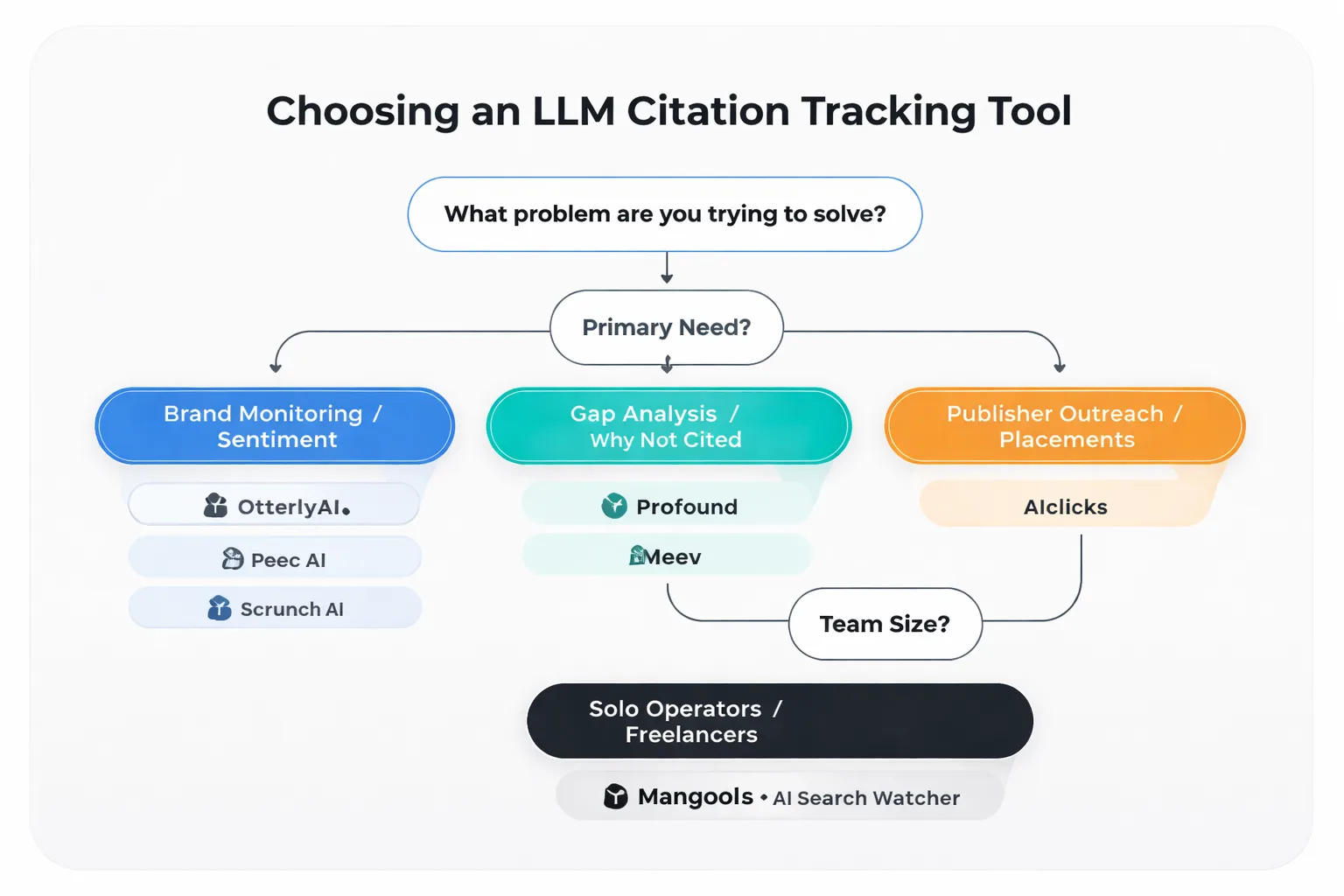
The tool decision depends less on feature lists and more on what problem you're actually trying to solve. I've watched teams buy the wrong tier of the right tool because they optimized for the dashboard demo rather than their actual workflow.
Three use cases dominate how content teams approach LLM citation tracking:
Brand monitoring vs. gap analysis vs. outreach. If you primarily need to know whether your brand is being cited (and with what sentiment), OtterlyAI, Peec AI, and Scrunch AI all deliver that at accessible price points. If you need to understand why you're not being cited and identify which content gaps to close, Profound and Meev offer the analytical depth to answer that question. If your bottleneck is publisher outreach — turning citation data into actual placements — AIclicks is the only tool here that integrates contact discovery directly.
Solo operators vs. agency teams vs. enterprise ops. Solo operators and freelancers should start with Mangools AI Search Watcher or LLMrefs — both offer free or low-cost entry points without forcing a commitment before you've validated the workflow. Agency teams managing multiple client brands need multi-brand dashboards and client-ready reporting: Profound's god-view dashboard and Peec AI's unlimited seats both address this. Enterprise content ops with compliance requirements and SSO needs should evaluate Profound's Enterprise tier or Semrush's enterprise offering, where security infrastructure is already built in.
The contrarian take most teams miss: the biggest mistake I see isn't choosing the wrong tool. It's choosing a tool and then tracking the wrong thing. A citation in a high-authority outlet means nothing if the AI response names your competitor while citing your source. I've started calling this the citation-without-credit problem — and it's more common than most content teams realize. The fix isn't more tracking. It's rewriting your publisher pitch briefs so journalists anchor claims to your brand name explicitly, not just link back. No tool in this roundup solves that for you. It's an editorial problem, not a software problem. For teams building out their Claude visibility or Perplexity citation strategy, that distinction is worth internalizing before you spend a dollar on any tool.
For teams evaluating Google AI Overviews as a specific channel, the Ahrefs finding that 38% of AI Overview citations pull from top-10 domains is worth keeping in mind: domain authority still matters here more than in Perplexity or ChatGPT. That changes which tool features you prioritize.
Frequently Asked Questions
How often do AI citation rankings change?
More often than most teams expect, and less predictably than traditional search rankings. SparkToro's research across 2,961 prompts found the odds of getting the same brand list twice from ChatGPT are less than 1 in 100. That volatility means single-snapshot monitoring is unreliable — you need aggregate tracking across multiple prompt runs and platforms to distinguish real citation shifts from statistical noise. Tools with daily cadence (Meev, Peec AI) give you more signal than weekly snapshots for fast-moving categories.
Can these tools track unlinked brand mentions?
Some can, some can't, and the distinction matters. Peec AI explicitly differentiates between 'used' sources (content that informed the AI's answer without being credited) and 'cited' sources (URLs explicitly mentioned). OtterlyAI tracks mentions with sentiment classification. Most tools in this roundup surface some form of brand mention data, but the granularity varies significantly. If unlinked mention tracking is a priority — particularly for understanding where you're influencing AI responses without getting credit — verify the specific capability before purchasing.
What's the difference between AI citation tracking and traditional rank tracking?
Traditional rank tracking tells you where a URL appears in a list of ten blue links for a given keyword. AI citation tracking tells you whether an AI engine referenced your brand or content when generating a response to a query — which may not include a link at all, and may appear in a response that has no traditional SERP equivalent. The correlation between the two is weaker than most SEO teams assume: only 12% of AI citations overlap with Google's top 10 results, per Discovered Labs. You can rank well and be invisible in AI responses, or vice versa. They require separate tracking infrastructure.
How do I benchmark my citation share?
Start by identifying 5–10 competitor brands in your category and running the same set of prompts across platforms for all of them. Your citation share is the percentage of responses where your brand appears relative to total responses across all tracked competitors. Most tools in this roundup (Profound, Peec AI, OtterlyAI, Semrush AI Toolkit) include share-of-voice dashboards that automate this calculation. The more important benchmark is directional trend over 30–90 days, not a point-in-time number — given how volatile AI citation patterns are, a single week's data tells you very little.
Do I need a separate tool for each AI platform?
No — and that was true even 18 months ago when the category was less mature. Every tool in this roundup covers at least three major AI engines. The more important question is whether the platforms you care about most are included in the base tier or locked behind add-ons. Peec AI's base plan, for example, covers ChatGPT, Perplexity, and Google AI Overviews — but Claude and Gemini require paid add-ons. Meev's base plans cover all five major engines. Map your priority platforms against each tool's tier structure before comparing headline prices.
How does E-E-A-T affect AI citation eligibility?
Significantly. Semrush's content optimization research found E-E-A-T signals show a +30.64% correlation with AI citations, and a ZipTie analysis found 96% of AI Overview citations come from sources with strong E-E-A-T signals. That makes E-E-A-T less of a ranking factor and more of a binary gate: content that doesn't demonstrate authorship, expertise, and sourcing credibility is largely excluded from AI citation pools regardless of keyword optimization. Tracking tools can show you the gap; closing it requires editorial investment in author credentials, primary research, and source attribution.
About the Author
Judy Zhou, Head of Content Strategy
Judy Zhou leads content strategy at Meev, where she oversees AI-driven content research and publishing for hundreds of brands. With a background in SEO and editorial operations, she focuses on building content systems that rank on Google, get cited by AI search engines, and drive measurable business results.
Start tracking your AI citation share across ChatGPT, Claude, Gemini, Perplexity, and Grok — no credit card required for the 7-day trial.