

By Judy Zhou, Founder
Key Takeaways
- Fewer than one in ten auto-blog platforms block weak drafts before CMS, causing traffic to plateau then drop after Google's Helpful Content update.
- One agency published 4,400 posts over 18 months yet recorded zero citations in AI Overviews once quality scoring was skipped.
- Select only platforms that enforce mandatory E-E-A-T quality gates rather than shipping every model output to WordPress.
- Google's guidance accepts AI content when its primary purpose is not manipulation and it demonstrably meets E-E-A-T standards.
Marcus had the spreadsheet open on one monitor and the CMS dashboard on the other. His agency had published 4,400 posts over eighteen months using an automated blogging stack they'd stitched together themselves. Briefs in, articles out, WordPress scheduled. Traffic had climbed, then plateaued, then dropped the week Google's Helpful Content update rolled through his clients' verticals. When he pulled the AI Overviews citation report, his content appeared exactly zero times. That afternoon, he started over. Different platform, different philosophy. One built for 2026's ranking environment, not 2022's.
Automated blogging in 2026 is not a volume problem. Every platform on this list can produce articles at scale. The real problem is quality-gated content publishing: fewer than one in ten auto-blog platforms block weak drafts before they reach your CMS. Most autoblogger tools ship whatever the model outputs, and Google's systems are now sophisticated enough to notice the difference. Google's own guidance is clear: AI-generated content is acceptable as long as the primary purpose isn't search engine manipulation and it meets E-E-A-T standards. The tool doesn't disqualify you. The quality does. Platforms that treat quality scoring as optional are the ones whose clients end up in Marcus's position. This list ranks platforms on whether they actually help you rank. Not just whether they can write.
Why Automated Blogging Is Harder to Get Right Than It Looks
The pitch for automatic blog platforms is straightforward: feed in topics, get publishable articles back, scale your content operation without scaling your headcount. That pitch is accurate as far as it goes. The part nobody puts in the demo is what happens when Google's Helpful Content System evaluates 80 articles that all read like they were written by the same model, on the same day, for the same keyword cluster.
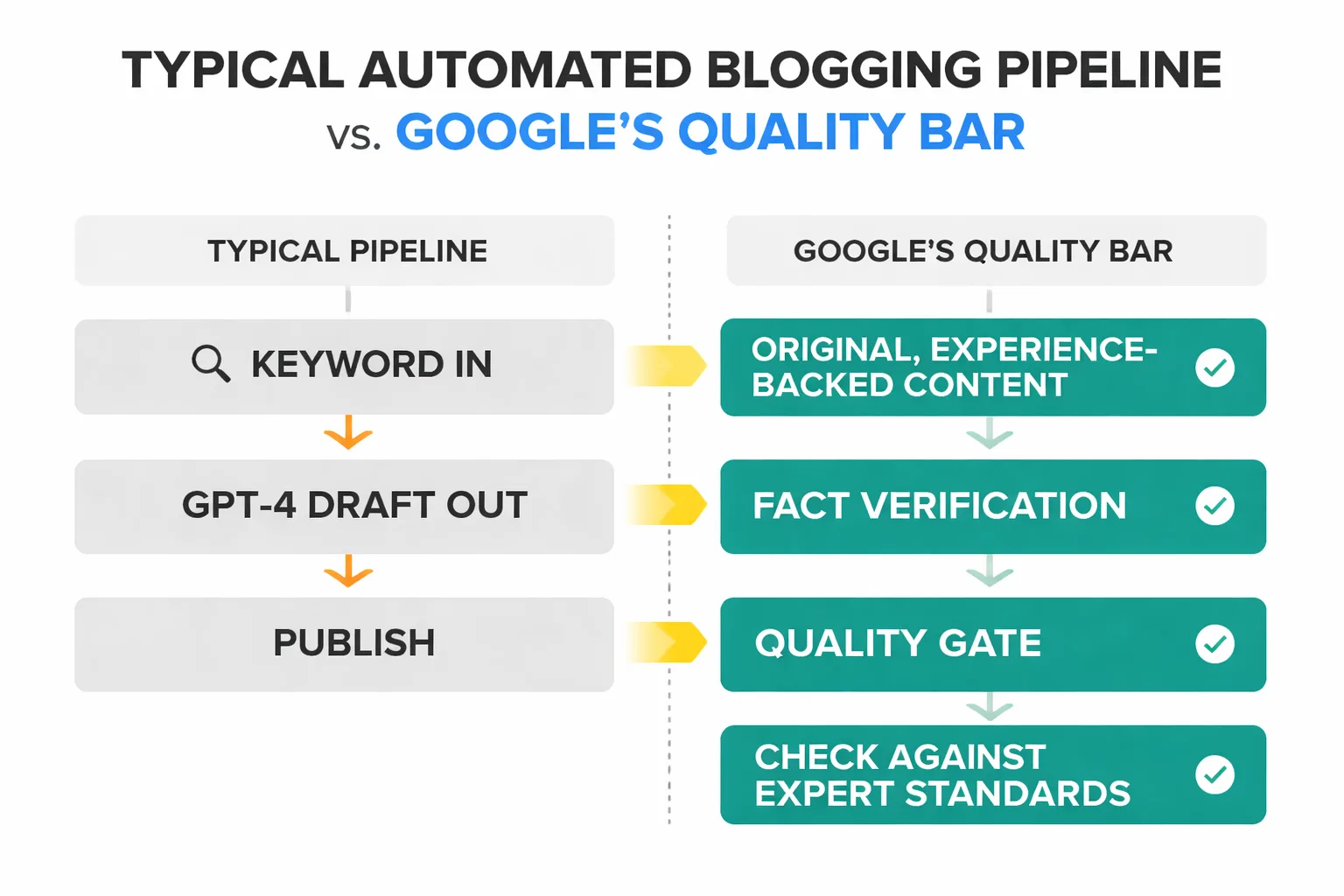
Google's Ranking Systems Guide makes the quality bar explicit. The system rewards original, experience-backed content that demonstrates genuine expertise. It doesn't care whether a human or an AI wrote the piece. It cares whether the piece says something a real expert would say. That's a harder standard than most automated blogging stacks are built to meet. The typical autoblogging pipeline is: keyword in, GPT-4 draft out, publish. No fact verification. No quality gate. No check against whether this article cannibalizes three others on the same domain. The result isn't just thin content. It's thin content at scale, which is precisely what Google's scaled content abuse guidance was written to catch.
There's a second problem that gets less attention: AI search visibility. Getting ranked on Google is one thing. Getting cited by ChatGPT, Perplexity, or Google AI Overviews is another problem entirely, and most auto-blog platforms don't even try to address it. I've seen teams publish hundreds of posts and never appear in a single AI-generated answer. Not because the content was bad, but because it wasn't structured for extraction, wasn't grounded in verifiable claims, and wasn't tracked against AI citation patterns. If you're building a content operation in 2026 and not thinking about LLM citation tracking alongside traditional SEO, you're optimizing for half the search surface.
The platforms that actually work share three traits: they gate quality before publish, they're built for E-E-A-T signals rather than keyword density, and they give you some visibility into whether the content is earning AI citations. Not just Google rankings.
How We Ranked These Platforms
I run content strategy at Meev, where we oversee AI-driven publishing for hundreds of brands. That means I've seen firsthand which platform features actually move rankings and which ones are dashboard theater. The ranking criteria here are ones I'd apply to any platform evaluation:
Content quality controls. Does the platform score articles before publishing them? Does it block weak drafts automatically, or does it leave that to the user? A platform with a 70/100 publish gate is meaningfully different from one that ships everything.
E-E-A-T signal support. Can you attach author entity profiles? Does the platform enforce a knowledge base so articles reflect your actual expertise rather than generic AI output? Does it add outbound citations to authoritative sources?
SERP and AI visibility output. Does the platform track whether published content ranks? Does it monitor AI citations across ChatGPT, Perplexity, Google AI Overviews, and other surfaces? The AEO vs SEO distinction matters here. Ranking and being cited by AI are related but not the same thing.
CMS integrations. WordPress is table stakes. Ghost, Shopify, Wix, and custom webhooks separate platforms built for real content operations from those built for demos.
Pricing transparency. Hidden overage fees and opaque usage limits are red flags. The best platforms publish hard quotas with no surprise charges.
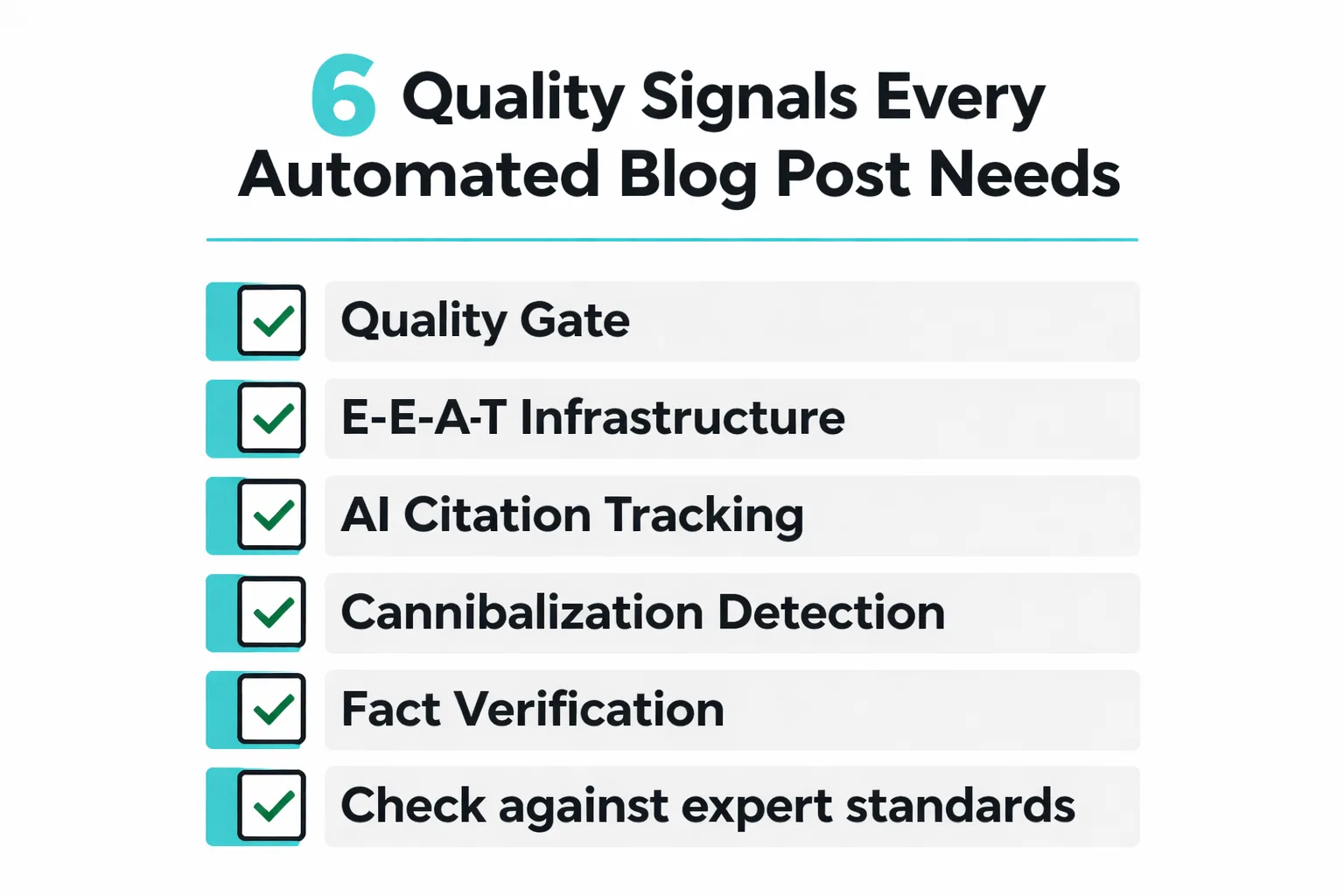
Scaled content abuse risk. Does the platform have cannibalization detection? Duplicate content checks? A penalty risk matrix? These aren't nice-to-haves in 2026. They're baseline requirements for any team publishing at volume.
Comparison Table
| Platform | Quality Gate | CMS Integrations | AI Visibility Tracking | Pricing (starting) | Best For |
| Meev | 16-dim quality firewall, 70/100 publish gate | WordPress, Ghost, Shopify, Wix, webhook | ChatGPT, Claude, Gemini, Perplexity, Grok, DeepSeek, AI Overviews, AI Mode | $49/mo (Lite) | Teams needing citation tracking + gated publishing |
| Writesonic | Basic tone/readability check | WordPress, Webflow | None | $16/mo | Budget solo creators |
| Jasper | Style guide enforcement | WordPress, Webflow | None | $49/mo | Brand-consistent copy teams |
| Copy.ai | Workflow-level review steps | WordPress | None | $49/mo | Sales + marketing copy at scale |
| Koala.sh | Minimal (publish-on-generate) | WordPress | None | $9/mo | High-volume, low-oversight blogs |
| Byword | None | WordPress, Ghost | None | $99/mo | Fast article generation, manual QA |
| Content at Scale | AI detection + humanization layer | WordPress | None | $250/mo | Teams worried about AI detection |
Pricing as of June 2026. Features subject to change. Verify on each platform's pricing page.
Is your automated blogging stack actually gating quality before it publishes — or shipping everything the model outputs?
1. Meev — Best for Teams That Need Citation Tracking + Gated Publishing
Meev is the only automated blogging platform on this list that combines a hard quality gate with AI search citation tracking in a single workflow. Every article goes through a 16-dimension quality firewall before it reaches your CMS. 11 article-quality signals plus a 5-dimension Google Penalty Risk Matrix. Articles that score below 70/100 don't publish. That's not a setting you can override in a hurry. It's a structural constraint that forces quality before volume.
The citation tracking side covers ChatGPT, Claude, Gemini, Perplexity, Grok, DeepSeek, Google AI Overviews, and AI Mode. Daily refresh on SERP-driven surfaces, rolling refresh on LLM-driven surfaces. You can see where in each AI answer your brand appears. First mention, buried in a list, or not at all. And drill into the actual response text behind every mention. That's a level of AI search visibility no other platform on this list offers.
The Knowledge Base feature is what separates Meev's content quality from generic AI output. You upload approved claims, brand positioning, and source documents. Every article the platform generates is grounded in those materials, not in whatever the model decides to hallucinate. Combined with Author Entity profiles for E-E-A-T signals and archetype-aware writing (Listicle, How-To, Explainer, Problem-Solver each have distinct quality criteria), the output reads like a real expert wrote it. Because the system was constrained to write like one.
Pricing: 7-day free trial. Lite $49/mo, Starter $99/mo, Pro $269/mo, Agency $599/mo. 20% annual discount. Hard-cap quotas with no overage fees. Services pause (not delete) after trial if you don't subscribe.
Key features: - Citation tracking across ChatGPT, Claude, Gemini, Perplexity, Grok, DeepSeek, Google AI Overviews, and AI Mode. 16-dimension quality firewall with 70/100 publish gate. Knowledge Base enforcement. Articles grounded in your approved claims. Archetype-aware writing (Listicle, How-To, Explainer, Problem-Solver, Vertical) - Multi-platform publishing: WordPress, Ghost, Shopify, Wix, custom webhook. GSC + IndexNow dual indexing on every publish. Cannibalization detection at planning and writing stages. Citation Path outreach workflow (Pro+)
2. Writesonic — Best for Budget Solo Creators
Writesonic is the entry point for solo founders who want AI content at scale without a large monthly commitment. The platform generates long-form articles with basic SEO optimization. Title tags, meta descriptions, keyword placement. And publishes directly to WordPress. Quality controls are limited to tone and readability checks, which means you're responsible for catching thin content before it ships.
For someone publishing 5-10 posts a month and reviewing each one manually, Writesonic does the job. For anyone running at higher volume without a review layer, the risk of scaled content abuse grows fast. There's no quality gate, no cannibalization detection, and no AI visibility tracking. You'll need separate tools for all of that.
Pricing starts around $16/month for individual plans. Good for: solo bloggers, early-stage founders testing content as a channel.
3. Jasper — Best for Brand-Consistent Copy Teams
Jasper's strength is brand voice enforcement. You define your tone, style guidelines, and terminology, and the platform applies them consistently across every piece. For marketing teams where off-brand copy is a real operational problem, that consistency has genuine value.
The SEO features are functional but not deep. Jasper integrates with Surfer SEO for on-page optimization guidance, which adds a layer of keyword coverage analysis. What it doesn't offer is any form of AI citation tracking or quality gating beyond style compliance. The platform will publish whatever meets your brand voice guidelines, regardless of whether the underlying content is thin or duplicative.
Pricing starts at $49/month. Best for: in-house marketing teams at mid-size companies where brand consistency is the primary concern.
4. Copy.ai — Best for Sales and Marketing Copy at Scale
Copy.ai is built around workflow automation. You define multi-step sequences, and the platform executes them across content types. For teams that need landing pages, email sequences, and blog posts to share brand context and messaging, the workflow approach has real appeal.
The blogging output is competent but generic. Copy.ai doesn't have a publish gate, and the content quality reflects that. Articles are coherent and on-topic, but they don't demonstrate the kind of first-person expertise or original analysis that Google's E-E-A-T standards reward. For teams using it as a drafting accelerator with heavy human editing, it works. For fully automated publishing, the quality ceiling is low.
Pricing starts at $49/month. Best for: growth teams that need marketing copy across multiple formats, not pure SEO blogging.
5. Koala.sh — Best for High-Volume, Low-Oversight Publishing
Koala is the fastest path from keyword to published post on this list. You input a keyword, the platform generates an article, and it publishes to WordPress with minimal friction. For affiliate sites and programmatic SEO plays where volume matters more than depth, Koala's speed and price point are hard to beat.
The tradeoff is everything else. There's no quality gate, no E-E-A-T infrastructure, no AI citation tracking, and no cannibalization detection. If you're publishing 200 articles a month on a thin affiliate site and you know exactly what you're doing, Koala can work. If you're trying to build topical authority for AI search or avoid Google's scaled content abuse filters, this platform will get you in trouble faster than almost any other option.
Pricing starts around $9/month. Best for: experienced affiliate publishers who review content manually and understand the risk profile.
6. Byword — Best for Fast Generation with Manual QA
Byword sits in an interesting middle position: it generates high-quality long-form articles faster than most platforms, but it ships everything without a quality gate and leaves QA entirely to the user. The output quality is noticeably better than Koala. More structured, better sourced, more coherent. But the platform assumes you'll review before publishing.
For a small team with an editor who reviews every post, Byword is a strong drafting tool. For fully automated publishing, the lack of any quality enforcement is a liability. Byword also publishes to WordPress and Ghost, which covers most use cases. No AI visibility tracking.
Pricing starts at $99/month. Best for: small teams with an editorial review step built into their workflow.
7. Content at Scale — Best for Teams Worried About AI Detection
Content at Scale's differentiator is its AI detection and humanization layer. The platform generates long-form content and then runs it through its own detection system, flagging and rewriting sections that score as AI-generated. For clients who've been told their content is being flagged by AI detectors, this addresses a specific anxiety.
The honest take: AI detection tools have significant false-positive rates, and optimizing content to pass a detector is not the same as optimizing it to rank. Content at Scale produces readable, humanized output, but it doesn't have a quality gate in the sense that Meev does. There's no knowledge base enforcement, no E-E-A-T infrastructure, and no AI citation tracking. The platform solves a narrow problem well. Whether that problem is the right one to solve is a separate question.
Pricing starts at $250/month. Best for: content agencies whose clients have AI detection concerns and need plausible-deniability output.
Making the Right Choice for Your Content Operation
The right automated blogging platform depends almost entirely on what you're trying to accomplish and what you're willing to own yourself.
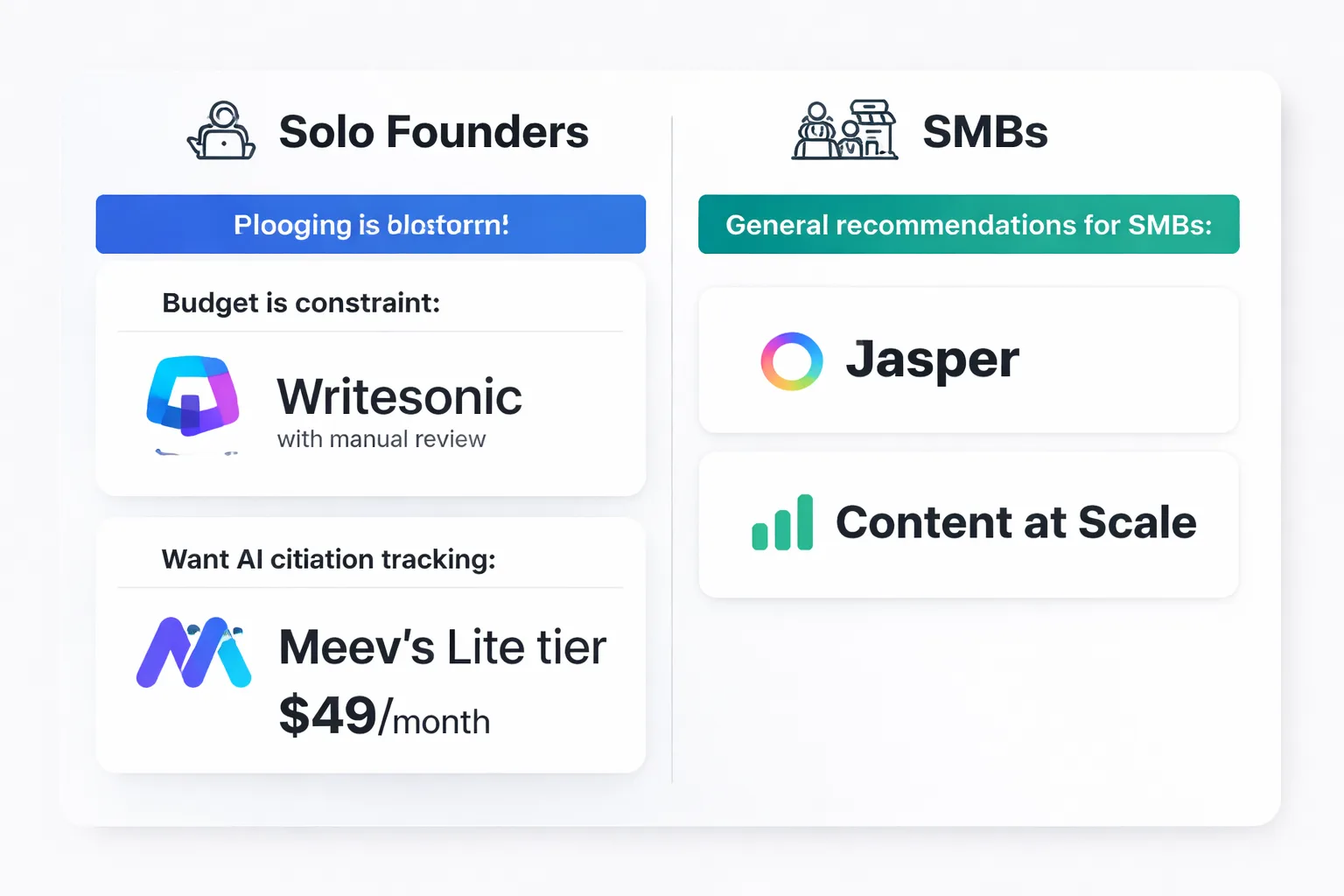
Solo founders are usually trying to establish topical authority fast without a large budget. The temptation is to pick the cheapest option and publish at volume. That works until it doesn't. And in 2026, Google's systems catch thin content faster than they did two years ago. My recommendation for solo founders: start with a platform that has at least a basic quality gate, even if it means publishing fewer articles. Ten well-structured, fact-verified posts will outperform 100 thin ones, both on Google and in Perplexity source selection. If budget is genuinely the constraint, Writesonic with a manual review step is a reasonable starting point. If you want AI citation tracking alongside publishing, Meev's Lite tier at $49/month is built for exactly this use case.
SMBs with a dedicated content person or small team need a platform that enforces quality without requiring constant manual intervention. The scaled content abuse risk is real at this level. Teams publishing 20-40 posts a month without cannibalization detection will eventually create a keyword overlap problem that tanks rankings across the board. Meev's Starter tier covers this with automated cannibalization detection, Knowledge Base grounding, and quality-gated publishing. For teams that also want to understand why their content is or isn't appearing in AI answers, the AI visibility tracking is the feature that makes the platform genuinely different from the alternatives.
Agencies managing multiple client domains have a different problem: consistency and accountability across accounts. White-label reporting, multi-domain dashboards, and role-based team access matter more at this scale than they do for solo founders. Meev's Agency tier covers 15 domains with 10 seats, white-label client reports, and portfolio-level analytics. The alternative is stitching together separate tools for content generation, quality scoring, AI visibility tracking, and reporting. Which is exactly the stack Marcus was running before his traffic dropped.
One thing I'd flag regardless of team size: if you're not tracking AI citations alongside traditional rankings, you're missing a growing share of the search surface. The AEO vs GEO distinction is real and getting more important. Platforms that only report on Google rankings are giving you half the picture. Understanding what AEO is and how it differs from traditional SEO is now a baseline requirement for any serious content operation.
The contrarian take I want to leave you with: most teams are asking the wrong question when they evaluate these platforms. They ask "which platform generates the best articles?" The right question is "which platform prevents me from publishing bad ones?" Quality gates, knowledge base enforcement, and penalty risk scoring are not premium features. They're the baseline for sustainable automated blogging in 2026. Every platform on this list can write. Only one blocks the output that shouldn't ship.
If you're auditing your current auto-blog setup, a free AI SEO audit is a useful starting point. It surfaces the on-page signals that matter for both Google rankings and AI citation eligibility.
FAQ
Does automated blogging hurt SEO?
Not inherently. Google's guidance is explicit that AI-generated content is acceptable when it meets E-E-A-T standards and isn't produced primarily to manipulate rankings. The problem isn't automation. It's publishing thin, generic, or duplicative content at scale. Platforms with quality gates and knowledge base enforcement produce content that meets Google's standards. Platforms that ship every draft without review are the ones that create SEO problems.
How do I avoid Google's scaled content abuse penalties?
Three things matter most: cannibalization detection (so you're not publishing five articles targeting the same keyword), quality scoring before publish (so thin drafts don't go live), and genuine information gain (each article says something the top-10 results don't already say). Platforms that automate all three give you structural protection. Platforms that leave these checks to the user require discipline that most publishing operations don't maintain at volume.
Can automated blogging platforms track AI citations?
Most can't. Citation tracking across ChatGPT, Perplexity, Claude, Gemini, and Google AI Overviews is a separate capability from content generation, and the majority of auto-blog platforms don't offer it. Meev is the exception on this list. It tracks citations across every major AI search surface and connects that data to the content it publishes, so you can see which articles are earning AI visibility and which aren't.
What's the difference between ranking on Google and getting cited by AI?
They're related but not the same. Google rankings depend on domain authority, backlinks, on-page optimization, and content quality signals. AI citations depend on whether your content is structured for extraction, whether it appears on sources AI engines already trust, and whether it contains specific, attributable claims. A piece can rank on page one of Google and never appear in a Perplexity answer. Optimizing for both requires understanding the distinction. The AEO vs SEO framework is a useful starting point.
How many articles do I need to publish to see results from automated blogging?
There's no universal number, but topical authority for AI search typically requires covering a topic cluster with enough depth that AI engines treat your domain as a reliable source. That usually means 15-30 well-structured articles on a specific topic area, not 200 thin posts spread across unrelated keywords. Platforms with topic planning and gap detection help you allocate volume where it compounds rather than dilutes.
About the Author
Judy Zhou, Founder
Judy Zhou leads content strategy at Meev, where she oversees AI-driven content research and publishing for hundreds of brands. With a background in SEO and editorial operations, she focuses on building content systems that rank on Google, get cited by AI search engines, and drive measurable business results.
See how Meev's 16-dimension quality firewall and AI citation tracking compare to your current setup — free for 7 days.