
By Judy Zhou, Founder
Key Takeaways
- ChatGPT now reaches 910 million weekly active users, making citation tracking essential for any brand's visibility strategy.
- 57% of LLM citations go to reviews and social proof while only 5.4% come from educational blog posts, based on analysis of 23,000+ citations across ChatGPT, Perplexity, Gemini, and AI Overviews.
- YouTube (21.4%), Reddit (18.14%), and Google (7.97%) are the top-cited domains in AI search engines, so prioritize content formats that match these sources.
- The highest-performing GEO tools close the loop by tracking citations, spotting gaps, and delivering specific fixes instead of long feature lists.
In March 2023, the week after Microsoft embedded GPT-4 into Bing, a small cohort of SEOs noticed something alarming: their highest-traffic informational pages were being summarized and answered directly inside the chat interface, with citations going to competitors they had outranked for years. That moment was the unofficial starting gun for Generative Engine Optimization as a formal discipline. Three years later, an entire ecosystem of specialized platforms has emerged to help brands win those citations. And the differences between the best and worst tools are enormous.
The ai tools with best generative engine optimization features in 2026 are not the ones with the longest feature lists. They're the ones that close the loop: track where you're cited, identify where you're not, and give you a concrete path to fix the gap. According to Sacra's OpenAI research, ChatGPT now has 910 million weekly active users. Google AI Overviews reach 2 billion monthly users across 200+ countries. Omniscient Digital's analysis of 23,000+ citations across ChatGPT, Perplexity, Gemini, and AI Overviews found that 57% of LLM citations go to reviews and social proof. While only 5.4% go to educational blog posts. YouTube (21.4%), Reddit (18.14%), and Google (7.97%) are the top-cited domains across AI search engines, according to LLM Pulse's citation dataset.
Those four numbers should reframe how you evaluate every tool in this list.
Why GEO Features Are Now Non-Negotiable in AI Tooling
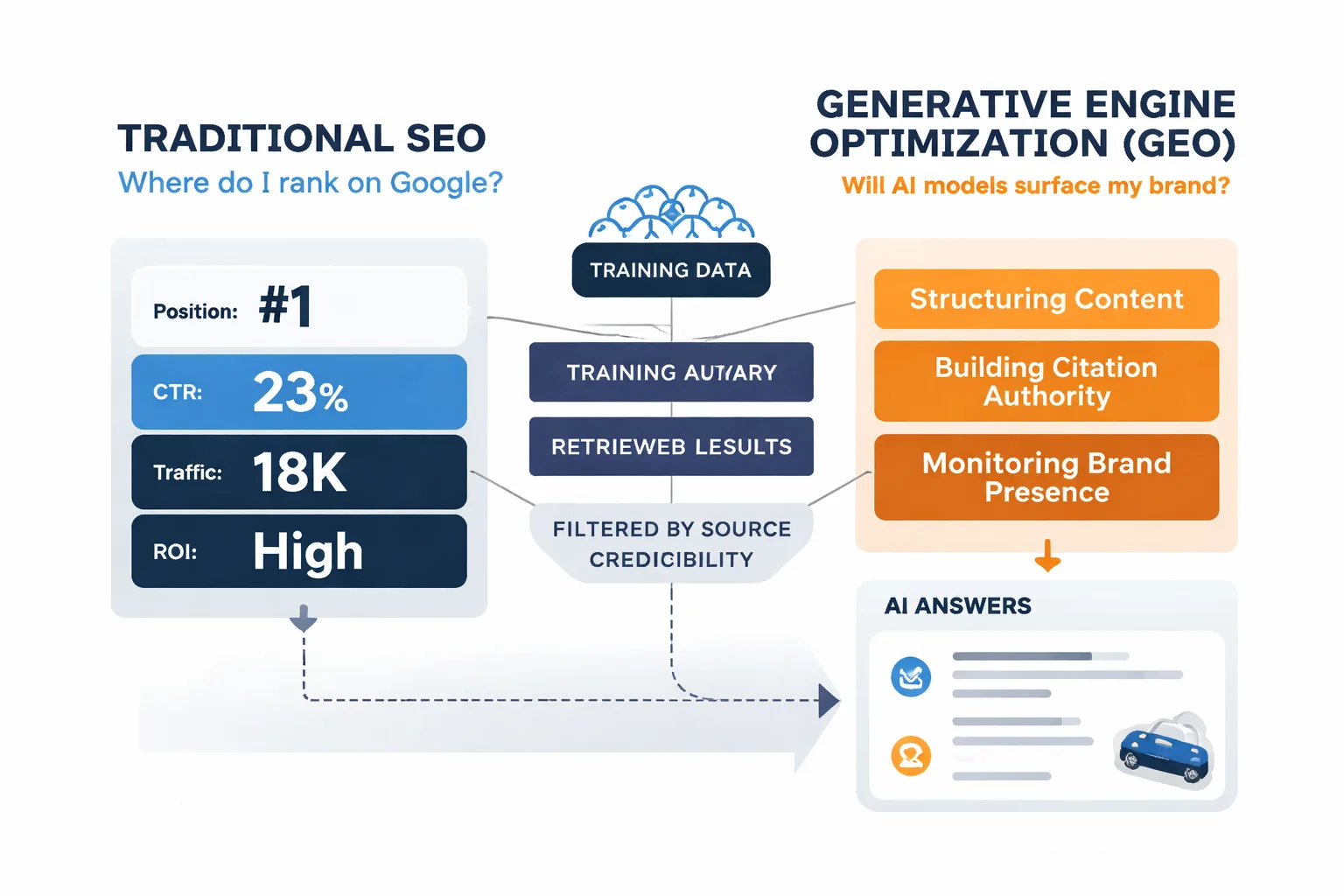
Traditional SEO tools were built to answer one question: where do I rank on Google? That question still matters. But it's now the wrong starting point for content teams that want to show up in the answers users actually read.
When someone asks ChatGPT to recommend a project management tool, or asks Perplexity to explain the best CRM for small teams, the model doesn't consult a keyword ranking. It pulls from its training data, its retrieval layer, and. In the case of tools like Perplexity. Live web results filtered by source credibility. Your position on page one of Google is largely irrelevant to that process. What matters is whether the model has encountered your brand in enough credible, structured contexts to cite you confidently.
This is what generative engine optimization actually addresses. GEO is the practice of structuring content, building citation authority, and monitoring brand presence specifically so that AI models surface your brand in their responses. It's adjacent to SEO but not the same thing. If you want to understand how the two disciplines relate before going deeper on tooling, AEO vs SEO is a useful framework to have in your head first.
In practice, GEO features in a tool look like: prompt-based visibility testing ("does this model cite us when asked about X?"), citation share tracking across multiple AI engines, mention position analysis (are you first in the list or buried at the end?), and content gap identification (which prompts cite competitors but not you?). Most legacy SEO platforms have bolted on one or two of these. A smaller set of newer platforms was built around them from day one.
The gap matters. I keep seeing teams run a citation check in one tool, do their content gap analysis in a second, and manage outreach in a third spreadsheet. That fragmentation is expensive and slow. The tools worth paying for in 2026 are the ones that collapse that stack.
How We Evaluated These Tools
I scored tools across five dimensions. Not all of them are weighted equally. GEO-specific features carry the most weight because that's the capability gap most teams are trying to fill.
GEO-specific features (40%): Does the tool do prompt-based AI visibility testing? Does it track citation share across multiple AI engines, not just Google AI Overviews? Does it show mention position within an answer, not just whether a mention exists? Does it surface citation gaps where competitors appear and you don't?
AI visibility analytics depth (25%): Can you drill into per-engine performance? Can you see the actual response text and citations behind a mention? Is there trend data over time, or just a snapshot?
Agency scalability (15%): Multi-domain management, team seats, white-label reporting, client-level dashboards. This matters less for solo founders and more for agencies running 10+ clients.
Content workflow integration (10%): Does the tool connect citation tracking to content creation and publishing? Or does it stop at the data layer and leave you to figure out the fix?
Pricing transparency (10%): Can you find the pricing without booking a demo? Are the plan limits clearly stated? Hidden pricing is a tax on your time.
I deliberately did not score on brand recognition or market share. Some of the most cited platforms in this space have the weakest GEO features. The rankings reflect what the tools actually do, not how well-funded their marketing team is.
The Full Comparison Table
| Tool | AI Engines Tracked | Citation Tracking | Content Generation | Publisher Outreach | Best For | Starting Price |
| Meev | ChatGPT, Claude, Gemini, Perplexity, Grok, Google AIO, AI Mode, DeepSeek | Yes. Position + share of voice | Yes. 16-dim quality firewall, auto-publish | Yes. Verified contacts + KB-grounded pitches | SMB, Agency | $49/mo |
| Semrush AI Toolkit | Google AIO, limited LLM tracking | Partial. AIO-focused | Via integrations | No | Agency (SEO-first) | $139/mo |
| Ahrefs | Google AIO, some LLM tracking | Partial | No | No | SMB, Agency (SEO-first) | $129/mo |
| BrightEdge | Google AIO, ChatGPT (enterprise) | Yes. Enterprise depth | No | No | Enterprise | Custom |
| Conductor | Google AIO | Partial | No | No | Enterprise | Custom |
| Surfer SEO | Google AIO | No | Yes. Content scoring | No | SMB | $89/mo |
| Search Atlas | ChatGPT, Perplexity, Google AIO, Gemini | Yes | Yes | No | SMB, Agency | $99/mo |
| Otterly.ai | ChatGPT, Perplexity, Gemini, Bing | Yes. Prompt-based | No | No | Solo Founder, SMB | $29/mo |
| Rankscale | ChatGPT, Perplexity, Gemini | Yes | No | No | SMB | $49/mo |
| AirOps | Perplexity, ChatGPT | Partial | Yes. Workflow automation | No | Agency | $99/mo |
| Goodie | ChatGPT, Perplexity, Gemini | Yes | No | No | Solo Founder | $39/mo |
| Profound | ChatGPT, Perplexity, Gemini, Google AIO | Yes. Brand + competitor | No | No | Enterprise, Agency | Custom |
| Writesonic GEO | Google AIO | Partial | Yes | No | SMB | $79/mo |
| AlsoAsked | Google PAA (AIO-adjacent) | No | No | No | Solo Founder | $15/mo |
A few things stand out immediately. Most tools that entered the market as SEO platforms have bolted on Google AI Overviews tracking and called it GEO coverage. That's not wrong. AIO is a major surface. But it misses Perplexity source selection, ChatGPT citation patterns, and the LLM-native surfaces where a growing share of zero-click answers are generated. If you want to understand what full-surface tracking looks like, the AI visibility tool overview at Meev breaks down how multi-engine tracking actually works versus single-surface approximations.
Want to see where your brand actually shows up across ChatGPT, Perplexity, and Google AI Overviews right now?
The Tools That Actually Lead on GEO
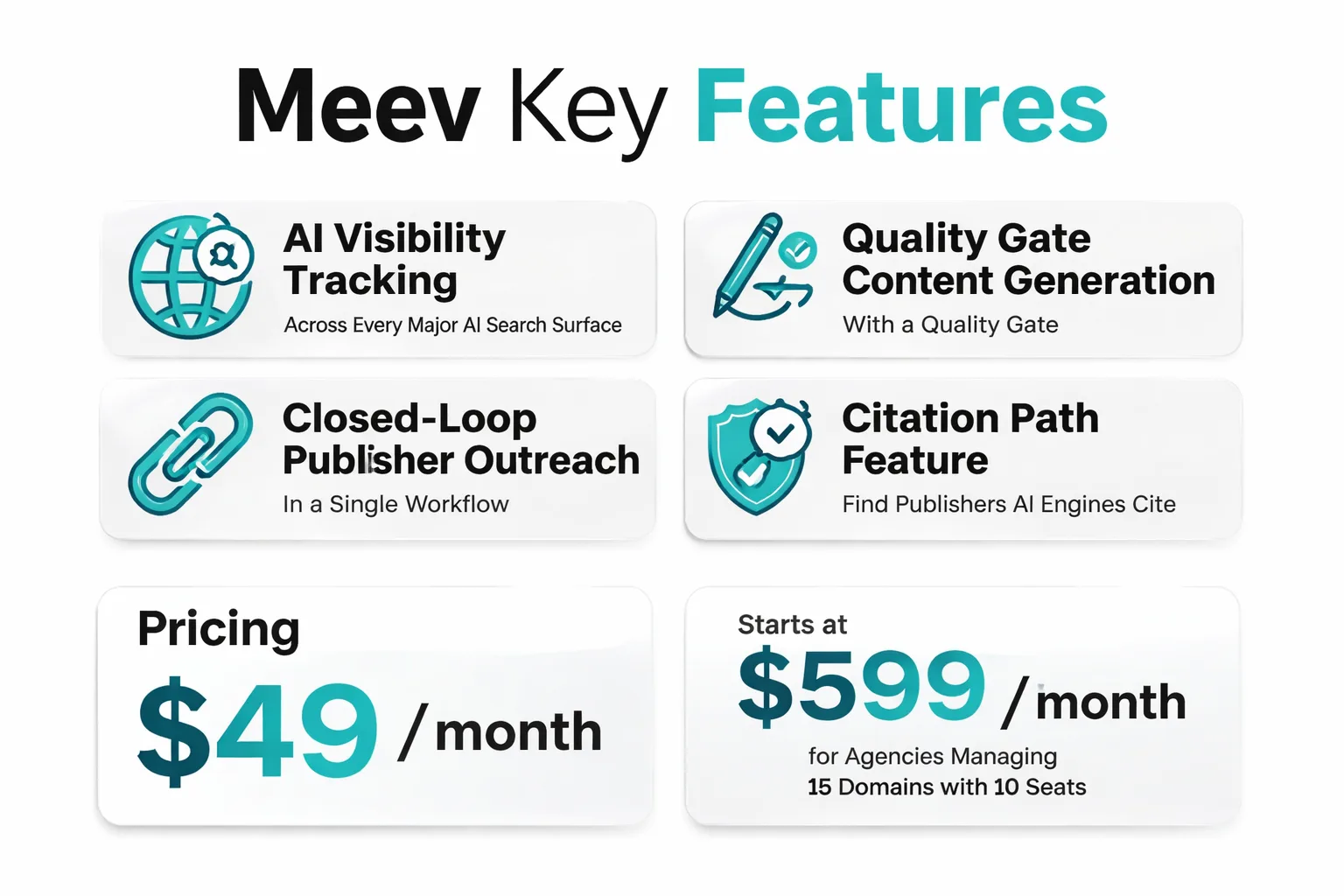
Meev is the only platform in this list that combines AI visibility tracking across every major AI search surface, content generation with a quality gate, and closed-loop publisher outreach in a single workflow. The citation path feature. Finding which publishers AI engines actually cite for your topics, resolving verified contacts, and drafting personalized pitches grounded in your knowledge base. Is something no competitor has shipped in a comparable form. The 16-dimension quality firewall blocks articles below 70/100 from auto-publishing, which matters if you're running quality-gated content publishing at scale and need to avoid the scaled content abuse flags that Google's helpful content system penalizes. Pricing starts at $49/month and scales to $599/month for agencies managing 15 domains with 10 seats.
Profound is the strongest pure-play AI visibility platform for enterprise teams. It tracks brand and competitor mentions across ChatGPT, Perplexity, Gemini, and Google AIO with the kind of depth that justifies its custom pricing. Per-prompt drill-downs, share-of-voice over time, and competitive benchmarking. The gap is that it stops at data. There's no content generation, no outreach workflow, no path from "we're not cited here" to "here's what to do about it."
Otterly.ai punches above its weight for solo founders and small teams. At $29/month, you get prompt-based visibility testing across four major AI engines and clean reporting that doesn't require a data analyst to interpret. It won't scale to an agency with 15 clients, and it has no content workflow. But for a solo founder who needs to know whether their brand is showing up in AI answers for their core topics, it's the most accessible entry point I've seen.
Search Atlas has made real progress on multi-engine tracking and has a content generation layer that's more developed than most. It's a credible SMB and agency option, particularly for teams that want a single platform for both traditional SEO and AI visibility without the price jump to enterprise tools.
Semrush and Ahrefs are still the best tools for traditional SEO. Their GEO features are improving. Semrush's AI Overviews tracking is genuinely useful. But both remain Google-first platforms with AI features grafted on. If your primary need is GEO, neither is the right anchor tool. If you're already paying for one of them for keyword research and backlink analysis, don't cancel it. Just don't mistake it for a GEO solution.
How GEO Tools Help With Content and Citation Building
Here's the failure pattern I keep running into: teams publish high-authority content that should theoretically get cited, and it just doesn't show up. The research is starting to explain why. LLMs drop content silently when connecting it to a query requires multi-hop reasoning. If your article is about "enterprise data security" but the user asked about "compliance risk for SaaS vendors," the model has to make two or three inferential jumps to link them. It often doesn't.
I've seen this happen with genuinely strong content. Good domain authority, well-structured, cited elsewhere. That gets zero LLM pickup because the relevance isn't immediate and explicit. The fix isn't writing more content. It's making the connection between your content and the specific query painfully obvious, usually by tightening the scope of each page to one very narrow question.
Good GEO tools help with this in two ways. First, they show you exactly which prompts are generating citations for competitors but not for you. Which tells you where the scope mismatch is. Second, the better ones (Meev's archetype-aware content engine, for example) generate content structured around specific query patterns rather than broad topics, which reduces the inferential distance between what the model retrieves and what the user asked.
The citation building side is where most tools still fall short. The data from Omniscient Digital's citation analysis is clarifying here: 57% of LLM citations go to reviews and social proof, while educational blog posts capture only 5.4%. That's not an argument against publishing blog content. It's an argument for treating your G2 profile, Capterra listing, and third-party review presence as citation infrastructure. Not afterthoughts. The brands winning LLM citations right now aren't the ones with the best pillar content. They're the ones with aggressive, continuously updated review programs on platforms that AI engines already trust.
The Perplexity source selection question is worth addressing directly. Perplexity uses a live retrieval layer that weights recency, domain authority, and structured content. Getting cited there requires a different approach than getting cited in ChatGPT's training-derived responses. If you want to check your current Perplexity citation status before choosing a tool, the Perplexity AI visibility checker gives you a fast baseline. For a deeper look at how AEO and GEO differ as disciplines, AEO vs GEO is worth reading alongside this.
Making the Right Choice for Your GEO Stack
The right tool depends almost entirely on your operational model. Here's how I'd think about it by persona.
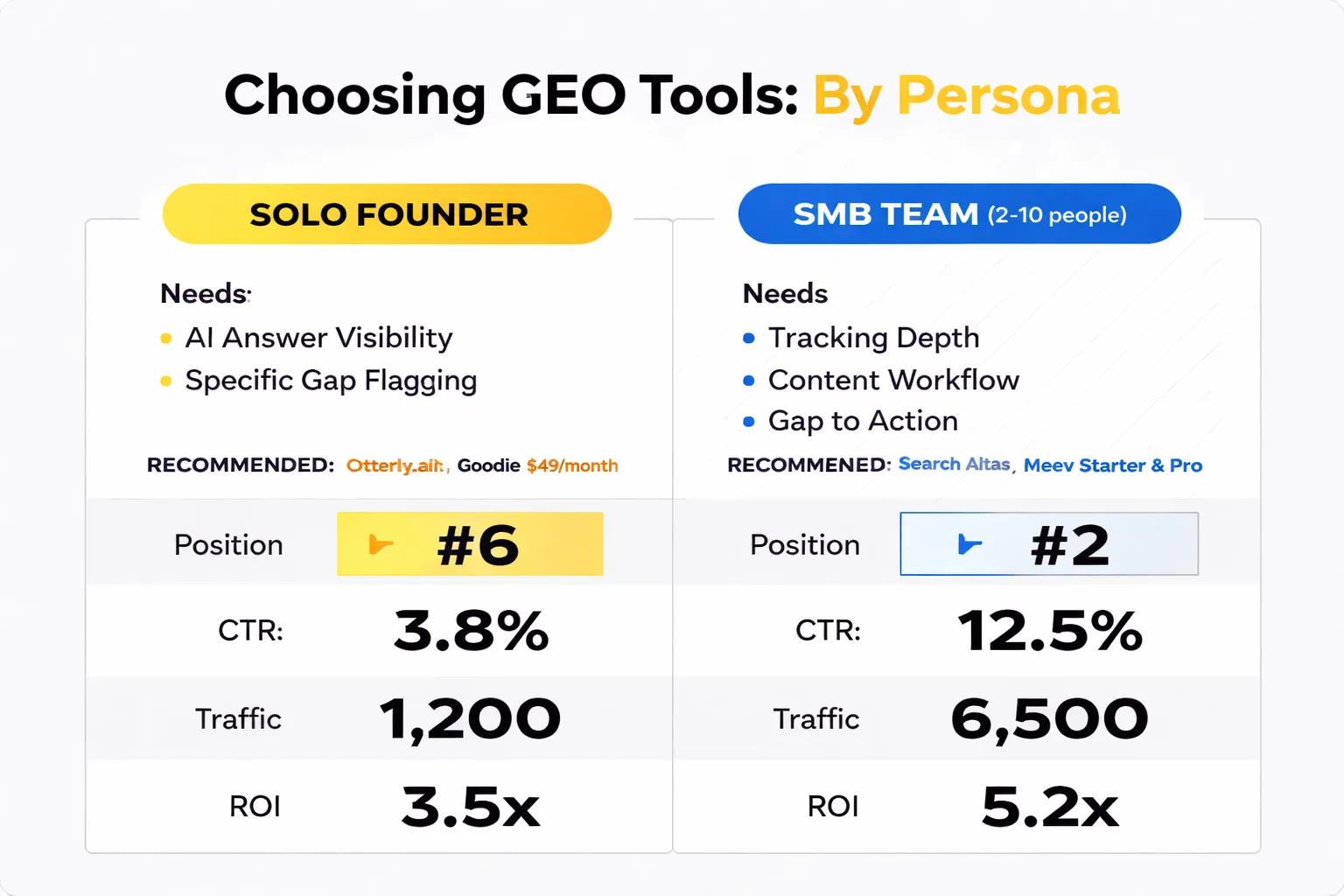
Solo founder: Your constraint is time, not budget. You need a tool that tells you clearly whether you're showing up in AI answers for your core topics, and flags the specific gaps without requiring you to build a reporting workflow. Otterly.ai at $29/month or Goodie at $39/month cover the visibility tracking layer cleanly. If you also need content generation and want to avoid stitching together three separate tools, Meev's Lite plan at $49/month handles tracking and publishing in one place. Don't pay for enterprise citation outreach features you won't use.
SMB (2-10 person marketing team): You need tracking depth, some content workflow, and ideally a path from gap identification to action. Search Atlas and Meev's Starter or Pro tiers are the strongest options here. The question to ask is whether your team will actually use the citation outreach features if they exist. If not, you're paying for capability you'll ignore. Meev's Pro tier at $269/month covers 5 domains, 3 seats, and full citation path functionality, which fits most SMB content teams.
Agency (managing 5+ clients): Multi-domain management and white-label reporting are non-negotiable. Profound is the best pure-play visibility platform at enterprise scale, but it doesn't generate content or manage outreach. Meev's Agency tier at $599/month handles 15 domains, 10 seats, white-label reports, and the full citation-to-outreach loop. For agencies that are also running SEO for clients, keeping Semrush or Ahrefs for keyword and backlink work and layering Meev on top for GEO is a cleaner stack than trying to force one tool to do everything.
One principle I've landed on after working across this stack: don't try to consolidate your entire SEO and GEO workflow into a single tool if that tool wasn't built for both from the ground up. The tools that do traditional SEO well and the tools that do GEO well have different core architectures. Forcing one to cover the other's job usually means you get mediocre performance on both. The better move is a deliberate two-tool stack with clear ownership: one tool for keyword research, backlinks, and on-page SEO; one tool for AI visibility tracking, citation gap analysis, and outreach.
If you want to understand the full scope of what AEO and answer engine optimization require before finalizing your stack, what is AEO gives you the foundational framework. And if you're doing a cost comparison across your current tooling before adding a GEO layer, the SEO cost calculator is a useful sanity check on budget allocation.
One more thing worth stating plainly on attribution. I've tried building citation-to-conversion models for clients and hit a wall every time: AI-generated responses don't pass UTM parameters, and Perplexity and ChatGPT don't show up cleanly in GA4 referral reports. The 15.9% conversion rate figure that circulates in GEO playbooks comes from a single self-reported content experiment with no control group. What I track instead is branded search lift in the 30 days following a measurable citation share increase. It's imperfect and indirect, but it's closer to a real business signal than citation count alone. Any tool vendor telling you citation share directly equals revenue is ahead of the evidence. Good GEO tools give you the data to make that call yourself. They don't make it for you.
FAQ
What's the difference between a GEO tool and an SEO tool?
An SEO tool is built to optimize your visibility in traditional search engine results pages. Keyword rankings, backlinks, on-page signals, crawlability. A GEO tool is built to optimize your visibility in AI-generated answers. The core difference is measurement: SEO tools track rank positions in Google's index, while GEO tools track whether AI models cite your brand when answering relevant prompts. The two disciplines overlap (strong SEO signals help with GEO), but the tracking mechanisms, content strategies, and outreach targets are different enough that they warrant separate tooling in most stacks.
Can one platform handle both AI visibility tracking and content publishing?
A few platforms are getting close. Meev currently offers the most complete version of this: AI visibility tracking across every major AI search surface, content generation with a 16-dimension quality firewall, and publisher outreach in a single workflow. Search Atlas also combines tracking and content generation, though its outreach layer is less developed. Most other tools specialize in one or the other. If you're evaluating whether a combined platform fits your workflow, the key question is whether the content generation is architected around citation-earning structures (narrow scope, credibility signals, structured answers) or generic blog output.
How often should you run GEO audits?
For active citation monitoring, weekly is the right cadence for the surfaces that refresh frequently (Google AI Overviews, Perplexity). LLM-native surfaces like ChatGPT update on training cycles that are less predictable, so monthly trend reviews make more sense there. For deeper audits. Reviewing your full citation gap map, re-evaluating which publishers to target, updating your knowledge base. Quarterly is usually sufficient unless you're in a fast-moving competitive category. The tools that matter most here are the ones with automated weekly digests so you're not manually pulling reports.
How do GEO tools handle Google AI Overviews specifically?
Google AI Overviews optimization is a distinct sub-discipline within GEO because AIO uses Google's own index and retrieval signals rather than a third-party LLM's training data. Tools like Semrush and Ahrefs have invested more in AIO tracking than in LLM-native citation tracking, which makes them stronger for this specific surface. Platforms built for multi-engine GEO (Meev, Profound, Search Atlas) track AIO alongside LLM surfaces, which gives you a more complete picture. The content signals that earn AIO citations. Structured answers, clear entity signals, E-E-A-T indicators. Overlap significantly with what earns LLM citations, so optimizing for one tends to help the other.
Is E-E-A-T still relevant for AI citation strategy?
Yes, and arguably more so than for traditional SEO. AI models that use retrieval-augmented generation (RAG) — including Perplexity and Google's AIO. Weight source credibility heavily when selecting citations. Author entity profiles, named experts, verifiable credentials, and first-person experience signals all contribute to the credibility score that determines whether your content gets pulled into an AI response. The difference from traditional SEO is that E-E-A-T for AI search needs to be legible to a model, not just to a human reviewer. That means explicit author bylines with linked credentials, structured data markup, and content that names its sources rather than making anonymous claims.
About the Author
Judy Zhou, Founder
Judy Zhou leads content strategy at Meev, where she oversees AI-driven content research and publishing for hundreds of brands. With a background in SEO and editorial operations, she focuses on building content systems that rank on Google, get cited by AI search engines, and drive measurable business results.
Track your AI citation share, find the gaps your competitors are filling, and start closing them — all in one platform.