
By Judy Zhou, Founder
Key Takeaways
- Auto blogging tools that ship whatever the model produces are a liability — sites publishing 50+ unreviewed AI posts per month are losing AI citation presence, not gaining it.
- Only one platform in this roundup (Meev) combines a hard quality gate (16-dimension firewall blocking drafts below 70/100) with native AI search visibility tracking across ChatGPT, Claude, Gemini, Perplexity, and more.
- For budget-constrained solo operators in low-competition niches, BlogSEO AI (~$12/mo) and RightBlogger ($17.99/mo) are defensible choices — but neither catches factual errors before publishing.
- Google's scaled content abuse guidelines target the workflow, not the technology: quality gates, author entity signals, and genuine information gain are what separate safe AI content at scale from a manual review flag.
Marcus had published 400 posts in 90 days. His auto blogging setup was humming. Briefs in, articles out, WordPress scheduled to midnight. Then his agency client pulled the contract. Not because traffic was down. Traffic was up. They'd spotted their brand mentioned in one of the posts, clicked through, and found a paragraph that was factually wrong in a way only an industry insider would catch. Four hundred posts. One paragraph. Gone. That's the story most auto blogging tool roundups skip, and it's exactly where this one starts.
Auto blogging has a quality problem that no one in the tool space wants to name directly. The platforms selling you on "publish 30 articles a month" have a financial incentive to optimize for volume, not accuracy. As someone who oversees AI-driven content research and publishing for hundreds of brands at Meev, I've watched this play out in slow motion: sites that publish 50+ AI-generated posts a month aren't gaining citation presence in AI search engines like Perplexity or ChatGPT. They're losing it. The content exists. The authority doesn't.
This roundup is built around a different question. Not "which tool publishes the most," but which auto blogging platforms have real quality controls that prevent factual errors, thin content, and Google's scaled content abuse penalties. The tools below were evaluated on output depth, hallucination safeguards, E-E-A-T signals, and whether they integrate with AI search visibility workflows. A few of them pass. Most don't.
The pattern I keep seeing: LLMs aren't pulling from brand-owned blogs the way we assumed. As of mid-2026, 40% of LLM citations point to Reddit and 26% to Wikipedia. That's not a fluke. Publishing volume without quality gates doesn't close that gap. It widens it.
Why Most Auto Blogging Tools Fail the Quality Bar
The auto blogging category has a structural problem: the tools that win on G2 reviews are the ones that make publishing feel frictionless. Frictionless publishing and quality publishing are not the same thing.
Most platforms in this space generate content by feeding a keyword into a general-purpose LLM, wrapping the output in some SEO scaffolding, and pushing it to your CMS. That workflow has no mechanism for catching factual errors, no author entity signals, no check against your existing content for cannibalization, and no gate that asks whether the article actually adds something new to the web. The result is what Google's quality raters call "scaled content abuse" — content produced primarily to rank, not to inform.
Google's May 2024 AI Overviews rollout demonstrated what happens when source authority weighting breaks down. AI Overviews produced outputs that Moz documented as "bizarre misinformation" and "public health risks" because the system failed to weight authoritative sources correctly during synthesis. That failure wasn't just a Google problem. It was a signal about what happens when content pipelines prioritize output speed over information gain. If the AI engine pulling from your content can't distinguish your article from a thin rewrite of a Wikipedia page, you're not winning citations. You're adding noise.
A genuinely useful auto blogging platform needs at least four things a slop factory doesn't have: a quality gate that blocks weak drafts before they publish, fact-verification or source-tracing at the claim level, author entity signals for E-E-A-T, and cannibalization detection so you're not competing with yourself. Only one tool in this roundup has all four built into a single workflow.
How We Ranked These Auto Blogging Tools
I evaluated each platform against five criteria. These aren't arbitrary. They map directly to the failure modes I've seen across client sites.
Output quality scoring. Does the platform score its own output before publishing? A tool that ships whatever the model produces is a liability. I looked for numeric quality thresholds, not vague "AI-powered optimization" claims.
Hallucination safeguards. Does the platform source-trace claims, cite authoritative sources inline, or flag unverifiable assertions? This is the criterion most tools fail silently. They generate confident-sounding text with no mechanism for checking whether it's true.
AI visibility integration. Can the tool connect content output to AI search visibility tracking? Publishing without knowing whether your content is being cited by ChatGPT, Perplexity, or Google AI Overviews is flying blind. Understanding what AI search visibility tools actually measure matters here more than most auto blogging guides acknowledge.
CMS compatibility. Multi-CMS publishing matters for agencies and multi-site operators. I checked WordPress, Shopify, Webflow, Wix, and Ghost support.
Quality-gated publishing workflows. This is the hardest criterion to fake. Does the platform let you set a minimum quality threshold that blocks articles below a score from auto-publishing? Or does it just generate and ship?
Comparison Table
The table below maps each tool against the criteria above. Pricing is as of June 2026.
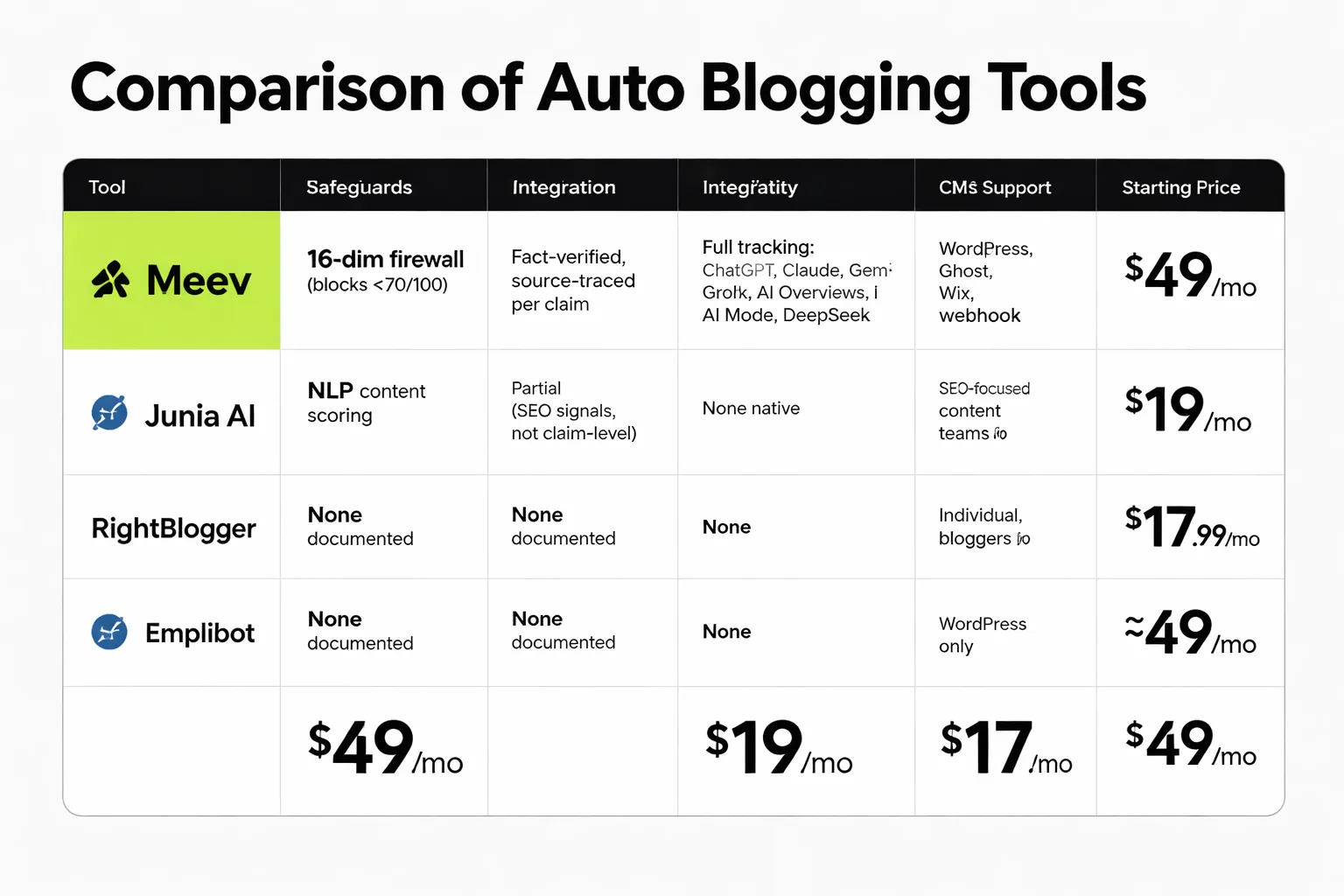
| Tool | Quality Gate | Hallucination Safeguards | AI Visibility Integration | CMS Support | Best For | Starting Price |
| Meev | 16-dim firewall (blocks <70/100) | Fact-verified, source-traced per claim | Full tracking: ChatGPT, Claude, Gemini, Perplexity, Grok, AI Overviews, AI Mode, DeepSeek | WordPress, Ghost, Shopify, Wix, webhook | Agencies + AI visibility-focused teams | $49/mo |
| Junia AI | NLP content scoring | Partial (SEO signals, not claim-level) | None native | WordPress, Webflow | SEO-focused content teams | ~$19/mo |
| RightBlogger | None documented | None documented | None | WordPress, Webflow | Individual bloggers | $17.99/mo |
| Emplibot | None documented | None documented | None | WordPress only | Hands-off niche publishers | ~$49/mo |
| auto-post.io | Not specified | Not specified | None | WordPress, Webflow, Wix, Payload | Multi-site agencies | Not listed |
| BlogSEO AI | Basic SEO checks | None documented | GSC integration only | WordPress, Shopify, Webflow, Wix | Budget-conscious SMBs | ~$12/mo |
1. Meev — Best for agencies and teams who need quality-gated auto blogging with AI citation tracking
Best for: Agencies, SMBs, and AI-visibility-focused content teams who can't afford factual errors and want their published content to appear in AI-generated answers.
Meev is the only platform in this roundup that treats auto blogging and AI search visibility as a single workflow rather than two separate problems. Every article goes through a 16-dimension Portfolio Quality Metric before it reaches your CMS. Articles scoring below 70/100 are blocked from auto-publishing. That's not a soft recommendation to review the draft. It's a hard gate.
Key features: - 16-dimension quality firewall: 11 article-quality signals plus a 5-dimension Google Penalty Risk Matrix. Fact-verified content with every claim source-traced before publish, plus outbound citations to authoritative sources. AI visibility tracking across ChatGPT, Claude, Gemini, Perplexity, Grok, Google AI Overviews, AI Mode, and DeepSeek. Archetype-aware writing (Listicle, How-To, Explainer, Problem-Solver) with retrieval weights tuned per format. Multi-platform publishing to WordPress, Ghost, Shopify, Wix, and custom webhooks. Author entity profiles for E-E-A-T signals, cannibalization detection at both planning and writing stages
Pricing: Lite $49/mo (10 articles); Starter $99/mo (30 articles); Pro $269/mo (80 articles, 5 domains, AI visibility tracking); Agency $599/mo (150 articles, 15 domains, white-label reports). Annual billing saves 20%.
What separates Meev from every other tool on this list is the closed loop between content output and AI citation monitoring. You can publish an article, track whether it gets cited in Perplexity or ChatGPT answers, and use the Citation Path feature to find the publishers AI engines already trust for your topic. That's not a workflow any other auto blogging platform offers. The tradeoff is price. At $269/mo for the Pro tier, it's not a budget tool. But for an agency managing five or more client domains where one factual error can cost a contract, the quality firewall pays for itself the first time it catches something.
2. Junia AI — Best for SEO-focused content teams and agency operators who prioritize search-optimized output quality over raw publishing speed.
Best for: SEO-focused content teams and agency operators who prioritize search-optimized output quality over raw publishing speed.
Junia AI positions itself as an SEO-first writing platform with genuine topical authority tooling. Its topical cluster generation from a single seed keyword is one of the more practical implementations of this concept I've seen at its price point. The NLP-based content scoring gives writers a signal about optimization depth before publishing, which is more than most tools offer.
Key features: - Topical authority cluster generation from a single seed keyword. Deep SEO optimization with NLP-based content scoring. Direct WordPress and Webflow publishing integrations. Brand voice training for consistent tone across all articles
Pricing: Starter from ~$19/month; Professional from ~$49/month; Business from ~$99/month. Annual billing discounts available.
Junia AI's content scoring is SEO-oriented, not fact-accuracy-oriented. It'll tell you whether your article covers the right semantic territory for a keyword. It won't tell you whether a specific claim is verifiable. For teams running a human review step before every publish, that's fine. For teams trying to automate the full pipeline without a fact-check layer, the gap matters. The topical cluster feature also requires upfront keyword strategy work to deliver full value, which means it suits teams with an existing SEO framework better than those starting from scratch.
3. RightBlogger — Best for individual bloggers and content creators who want an affordable all-in-one toolkit with scheduled auto-publishing
Best for: Individual bloggers and content creators who want an affordable, user-friendly all-in-one toolkit with reliable scheduled auto-publishing to WordPress.
RightBlogger packages 90+ content tools into a single dashboard at a price point that's hard to argue with for solo operators. The native autoblogging scheduler for WordPress and Webflow is functional and the unlimited word generation on the Pro plan removes the friction of credit caps that plague cheaper tools.
Key features: - 90+ specialized blogging tools in one dashboard. Native autoblogging scheduler for WordPress and Webflow. Unlimited word generation on Pro plan with no credit caps. SEO-optimized article outlines, intros, and full drafts
Pricing: Pro Plan at $17.99/month (billed annually) with unlimited words and full access to the autoblogging feature. Monthly billing available at a higher rate.
RightBlogger's own platform documentation advises fact-checking output before publishing. That's honest. It also means this is not a fully hands-off auto blogging setup for anyone publishing in a niche where accuracy matters. For a personal blog covering general lifestyle topics, the risk profile is manageable. For a site in finance, health, legal, or any industry where a wrong claim damages trust, the absence of a quality gate is a real constraint. The 90+ tools are useful for individual creators who want variety. For agency-scale workflows managing multiple clients, the platform isn't designed for that use case.
Wondering if your current auto blogging setup is hurting your AI search citations?
4. Emplibot — Best for WordPress site owners who want the most hands-off automated blogging experience possible
Best for: WordPress site owners and niche publishers who want the most hands-off automated blogging experience possible and are willing to curate niche selection carefully.
Emplibot is the most genuinely automated option in this roundup. It researches, writes, and publishes complete articles to WordPress on a recurring schedule with no manual steps required. Automatic internal linking, image sourcing, niche-aware topic research, and social media auto-sharing on publish are all included.
Key features: - Fully autonomous end-to-end publishing with no manual steps required. Automatic internal linking and image sourcing. Niche-aware topic research and content calendar generation. Social media auto-sharing upon publish
Pricing: Starter from ~$49/month; Business from ~$129/month; Agency plan available. All plans include fully automated WordPress publishing.
The hands-off nature is both the appeal and the risk. Emplibot requires careful niche selection because generic or broad topics produce noticeably lower-quality output. The platform also has less editorial control than tools that keep humans in the loop before publishing, which means the quality of what goes live is heavily dependent on how well you've defined your niche parameters upfront. For a tightly defined niche blog where the operator is comfortable with the output variance, Emplibot delivers on its promise. For anything requiring factual precision or brand safety, the lack of a quality gate is a genuine gap.
5. auto-post.io — Best for agencies and multi-site operators who need one platform across several CMS environments
Best for: Agencies and multi-site operators who need a single platform to automate content publishing across several different CMS environments at once.
auto-post.io's core differentiator is its native publishing integrations across WordPress, Webflow, Wix, and Payload CMS simultaneously. For agencies managing clients on different CMS platforms, the campaign-based scheduling across multiple websites from a single dashboard addresses a real operational pain point.
Key features: - Native publishing integrations for WordPress, Webflow, Wix, and Payload CMS. Campaign-based content scheduling across multiple websites simultaneously. Advanced AI model integrations for high-quality content generation. Saves 20+ hours per week via fully automated publish workflows
Pricing: Starter plan available; paid tiers scale by post volume and number of connected sites. Pricing details available on the auto-post.io pricing page.
auto-post.io is a newer platform, which means independent validation of output quality at scale is limited. The pricing transparency on the public site is also thin. Full tier details require sign-up. For agencies evaluating tools, that friction in the buying process is worth noting. The multi-CMS capability is genuinely useful and not well-served by most competitors. Whether the content quality holds up across high-volume campaigns is something I'd want to verify with a trial before committing a client workflow to it.
6. BlogSEO AI — Best for budget-conscious bloggers and small business operators who need affordable multi-CMS auto-publishing
Best for: Budget-conscious bloggers, Shopify store owners, and small business operators who need affordable multi-CMS auto-publishing without sacrificing core SEO features.
BlogSEO AI hits a price point that makes it accessible for small business operators and individual Shopify store owners who need content at scale without a large budget. The Google Search Console integration for data-driven topic selection is a practical feature that helps prioritize what to write based on actual search data rather than guesswork.
Key features: - One-click publishing to WordPress, Shopify, Webflow, and Wix. Automated keyword research and topic generation. Multilingual article generation in 20+ languages. Google Search Console integration for data-driven topic selection
Pricing: Basic from ~$12/month (billed annually); Standard from ~$29/month; Advanced from ~$59/month. Free trial available.
The multilingual support is a real differentiator at this price point. For small businesses targeting non-English markets, 20+ language support with a $12/month entry tier is hard to beat. The constraints are real though: lower-tier plans cap monthly article generation, which limits true high-volume workflows. And in competitive niches, the long-form content depth often needs supplemental editing before it can hold its own against well-optimized human-written content. For informational content in lower-competition niches, BlogSEO AI delivers solid value. For topical authority building in competitive spaces, the output quality ceiling becomes a constraint faster than the pricing does.
Making the Right Choice for Your Stack
The decision isn't really about which tool has the best feature list. It's about where your risk tolerance sits and what failure looks like for your business.
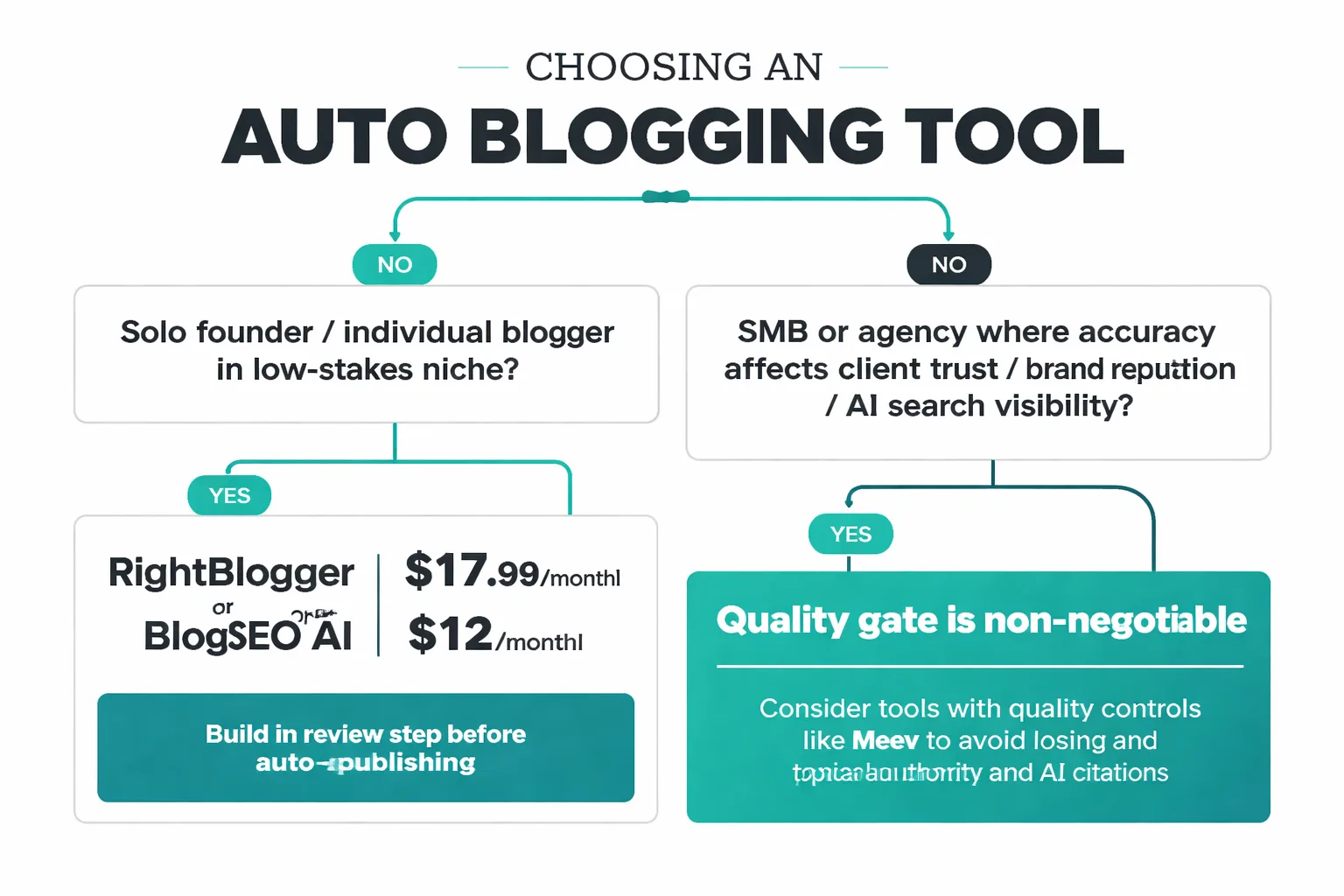
If you're a solo founder or individual blogger publishing in a low-stakes niche where a factual error costs you nothing more than a quick edit, RightBlogger at $17.99/month or BlogSEO AI at $12/month are defensible choices. You get volume, CMS integration, and enough SEO scaffolding to compete in informational queries. Just build in a review step before auto-publishing. Neither platform will catch errors for you.
If you're an SMB or agency where content accuracy affects client trust, brand reputation, or AI search visibility, the quality gate question is non-negotiable. The pattern I keep seeing is that sites optimizing for volume without quality controls aren't just failing to gain AI citations. They're actively losing topical authority as their signal-to-noise ratio drops. One well-sourced, fact-verified article that gets cited in a Perplexity answer is worth more than twenty thin posts that don't. Understanding Answer Engine Optimization and how it differs from traditional SEO is the frame that makes this choice obvious.
If AI search citation is a business goal (and in 2026, it should be), then the tool you choose for auto blogging needs to connect to your AI visibility monitoring. Publishing without tracking whether your content appears in ChatGPT, Claude, Gemini, or Perplexity answers is the equivalent of running ads without conversion tracking. The AEO vs SEO distinction matters here: you're not just optimizing for Google rankings anymore. You're optimizing for whether an AI engine trusts your domain enough to cite it.
The Adobe and IBM Consulting research on automotive AI search put it bluntly: "the first impression of your brand might no longer come from your website or a showroom; it might come from what an algorithm says about you." That's true across every industry, not just automotive. If your auto blogging pipeline is producing content that an AI engine wouldn't cite, you're building a library no one's recommending.
On budget: Don't optimize for the cheapest tool that technically publishes. Optimize for the cheapest tool that doesn't create problems you'll spend more money fixing later. A $12/month tool that produces one factually wrong article that damages a client relationship has a real cost. A $269/month tool with a quality firewall that catches that error before it publishes has a different cost structure entirely.
For teams serious about Generative Engine Optimization and building topical authority that AI engines actually cite, the short list is Meev for the full quality-plus-visibility workflow, Junia AI for SEO-first teams with a human review step, and BlogSEO AI for budget-constrained operators in lower-competition niches. Everything else in this roundup is a volume tool. Volume tools have their place. Just know what you're buying.
FAQ
Can auto blogging hurt your AI citations?
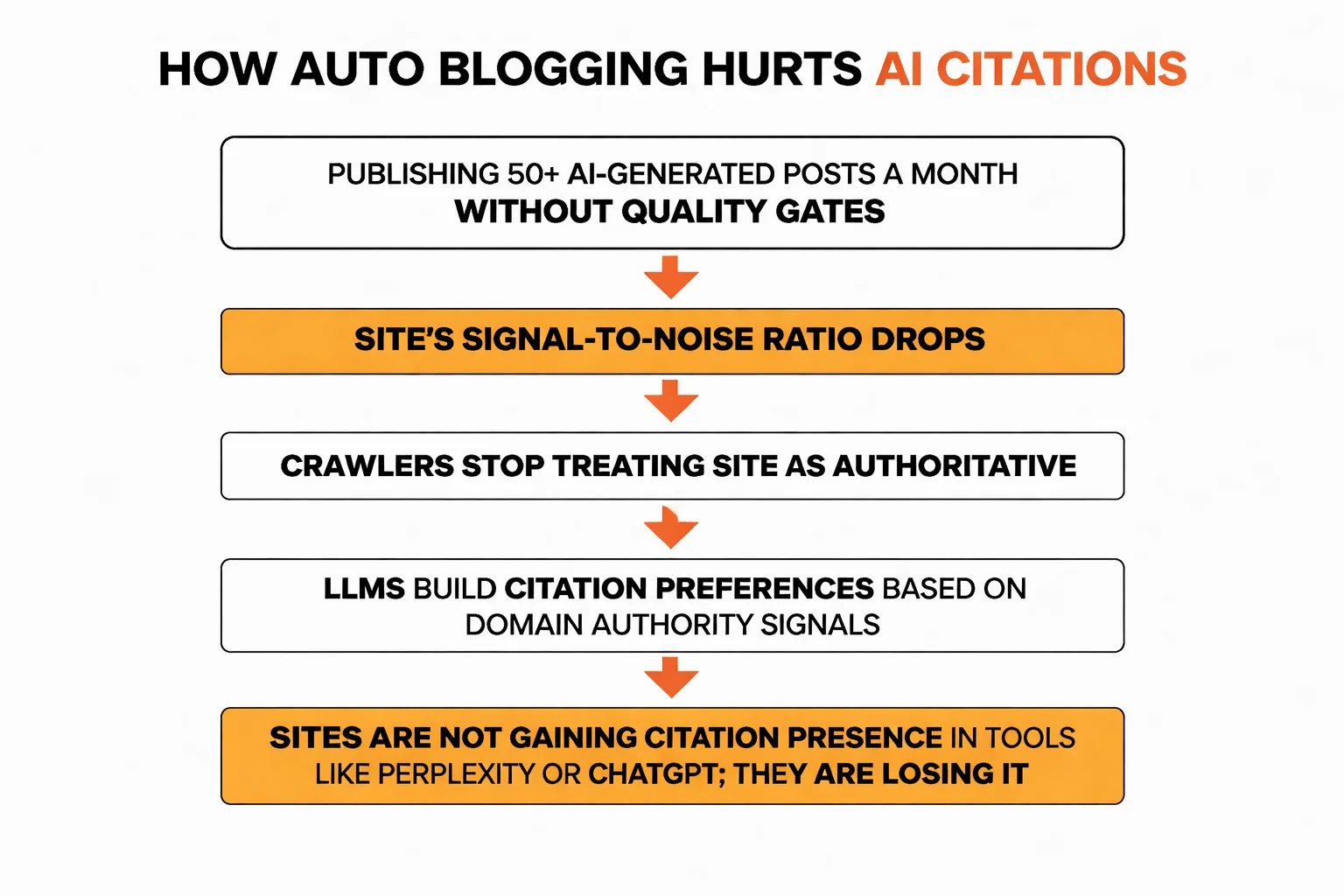
Yes, and the mechanism is more direct than most people realize. LLMs build citation preferences based on domain authority signals, not just content volume. When a site's signal-to-noise ratio drops because it's publishing thin, unverified content at scale, crawlers stop treating it as authoritative. The sites I've seen publishing 50+ AI-generated posts a month without quality gates aren't gaining citation presence in tools like Perplexity or ChatGPT. They're losing it. Volume without quality gates is a negative compounding loop for AI visibility. You can check your current Perplexity citation presence with the free Perplexity Brand Visibility Checker before you commit to any auto blogging workflow.
What's the difference between auto blogging and AI content at scale?
Auto blogging is a workflow: keyword in, article out, CMS published, no human in the loop. AI content at scale is a strategy: using AI to increase content output while maintaining editorial standards, quality gates, and human review checkpoints. The distinction matters because Google's scaled content abuse guidelines target the workflow, not the technology. A site publishing 100 AI-assisted articles a month with genuine quality controls, author entity signals, and fact verification is not the same as a site auto-publishing 100 keyword-stuffed drafts. One builds topical authority. The other triggers manual review flags. The LLMs.txt Validator is one signal check worth running alongside any content scaling strategy.
How do you avoid Google's scaled content abuse penalties?
Three things matter most. First, implement a quality gate that blocks articles below a minimum score from auto-publishing. A draft that scores 60/100 on output quality is not ready for your CMS. Second, ensure every article has genuine information gain: something a reader can't get from the top three existing results. This means original data, expert perspective, or synthesis that doesn't exist elsewhere. Third, maintain author entity signals. Articles published without a named author, linked credentials, or demonstrable expertise are exactly what Google's quality raters flag as scaled content abuse. The AEO vs GEO framework is a useful lens here because it reframes the question from "how do I avoid penalties" to "how do I build content AI engines want to cite."
Does publishing frequency matter for AI search visibility?
Less than most auto blogging tools want you to believe. The data I've seen suggests LLMs weight domain authority and source credibility over recency and volume. Reddit captures 40% of LLM citations and Wikipedia captures 26% not because they publish frequently, but because they're treated as community-validated, authoritative sources. For a brand-owned blog, one well-sourced article that demonstrates genuine expertise will generate more AI citations than ten thin posts. Frequency matters for crawl coverage. Quality matters for citation selection.
Should I use auto blogging if I'm just starting a new site?
Not without a quality gate. New sites have no domain authority buffer. Every article you publish in the first six months is disproportionately influential in how crawlers categorize your site. Publishing thin AI-generated content during that window is the fastest way to get categorized as a low-quality site before you've had a chance to establish topical authority. If you're going to use an auto blogging tool from day one, use one with a quality firewall and publish fewer, better articles. Ten strong articles beat fifty weak ones every time for a new domain trying to establish AI search visibility.
About the Author
Judy Zhou, Founder
Judy Zhou leads content strategy at Meev, where she oversees AI-driven content research and publishing for hundreds of brands. With a background in SEO and editorial operations, she focuses on building content systems that rank on Google, get cited by AI search engines, and drive measurable business results.
See how Meev's quality firewall blocks AI slop before it reaches your CMS — and tracks whether your content gets cited by ChatGPT, Perplexity, and Google AI Overviews.