
By Judy Zhou, Head of Content Strategy
Key Takeaways
- Google Gemini cites zero sources in 92% of its answers across 14,000 real queries, proving most brands have zero visibility into AI citations.
- AI crawlers consume content at a 38,000:1 ratio versus referred traffic, so being indexed no longer equals being cited.
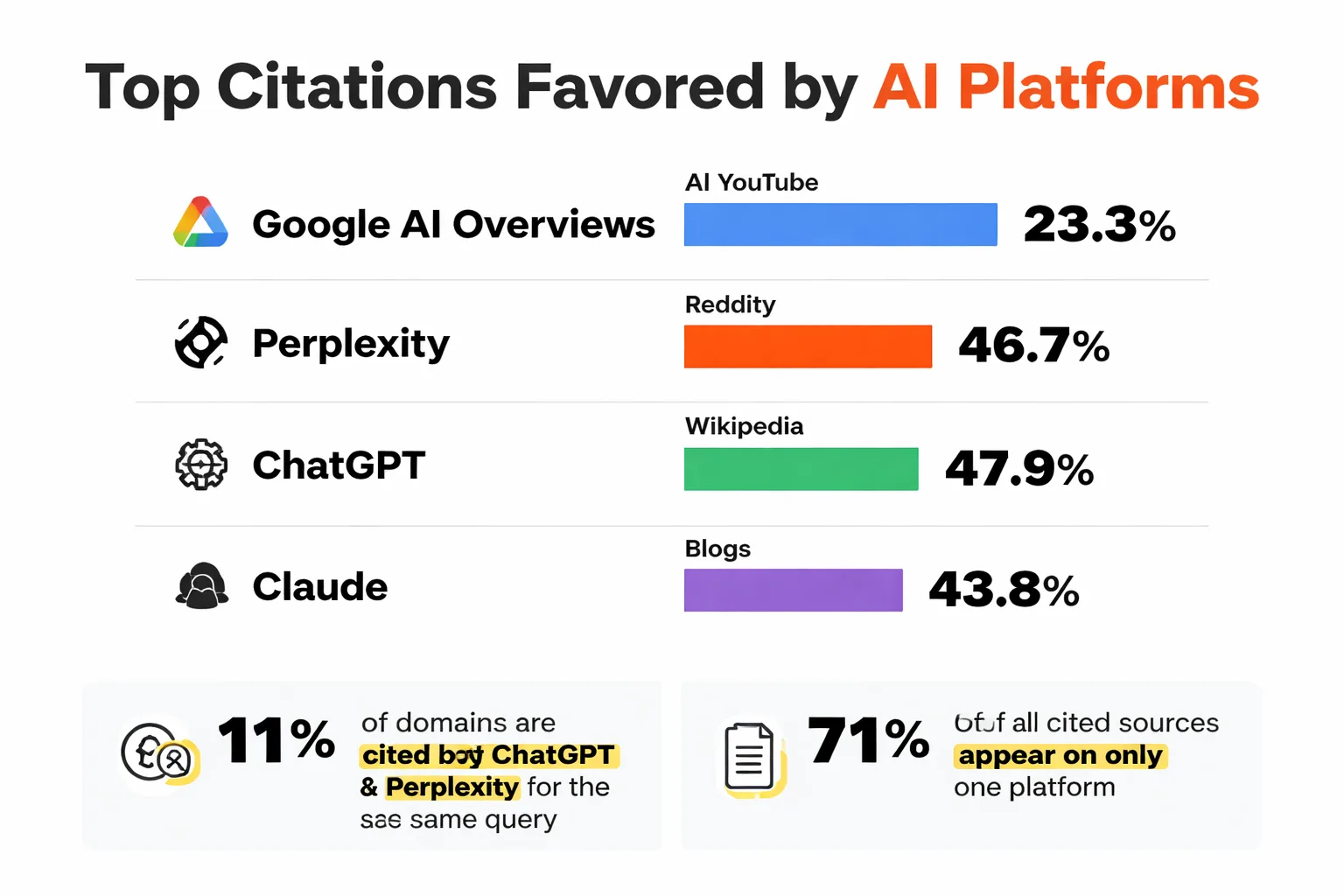
- Only 11% of domains are cited by both ChatGPT and Perplexity on the same query, with 71% of sources appearing on just one platform.
- Between 50% and 90% of LLM-generated citations fail to support the attached claims, requiring tools that track accuracy, not just mentions.
Your brand is either cited by AI models or it doesn't exist.
That's not hyperbole. It's the operating reality for any brand competing for attention in 2026. The best rated software for ai visibility has become one of the fastest-growing tool categories in marketing. And for good reason. A June 2025 study of 14,000 real-world queries found that Google Gemini cites zero sources in 92% of its answers, while Perplexity reads roughly 10 pages per query but credits only 3-4 sources. According to a Nature Communications 2025 study by Wu et al., between 50% and 90% of LLM-generated citations don't fully support the claims they're attached to. Cloudflare's 2025 crawler analysis found AI bots consume content at a 38,000:1 ratio versus traffic referred back to sources. The implication: being crawled and being cited are completely different outcomes, and most brands have no visibility into either.
This guide covers the 10 best ai visibility software platforms in 2026. What each one actually does, who it's built for, and how to pick the right one for your situation.
The AI Visibility Gap Nobody Talks About
Before we get into the tools, it's worth being honest about what you're actually measuring. As someone who leads content strategy for hundreds of brands at Meev, I've watched teams pour budget into GEO playbooks. FAQ schemas, definition-first formatting, H2s phrased as questions. Only to discover the citation signal they were chasing wasn't where they thought it was.
The research I keep coming back to: only 11% of domains are cited by both ChatGPT and Perplexity for the same query, and 71% of all cited sources appear on only one platform. Google AI Overviews favor YouTube at 23.3% of top citations. Perplexity favors Reddit at 46.7%. ChatGPT favors Wikipedia at 47.9%. Claude, interestingly, favors blogs at 43.8% of citations. These aren't interchangeable channels. What earns a citation on Perplexity will not automatically earn one on ChatGPT.
The practical consequence: a single-platform tracker gives you a dangerously incomplete picture. And a tracker without a content engine attached gives you a list of problems with no path to fixing them.
Why E-E-A-T Functions as a Binary Gate
Here's the finding that reframed how I think about content quality for AI search. A Semrush analysis found E-E-A-T signals show a +30.6% positive correlation to AI citations, and a separate Wellows analysis of 2,400 AI Overview citations found 96% came from sources with strong E-E-A-T signals. Clarity and summarization showed an even stronger +32.8% correlation.
What this tells me isn't that E-E-A-T gives you a gradual lift. It functions more like a gate. You're either in the 96% or you're not. That's why quality-gated publishing. Blocking weak drafts before they reach your CMS. Matters more than raw publishing volume. Scaled content abuse avoidance isn't just about avoiding Google penalties; it's about not polluting your own citation signal with content that LLMs will correctly learn to ignore.
The SISTRIX Visibility Index tracks this at the domain level. Sites that took hits in the January 2026 Google algorithm update, as documented by Lily Ray, shared a common pattern: high-volume publishing without the E-E-A-T architecture to support it.
How Does AI Visibility Software Actually Work?
At its core, ai visibility software does one of three things (and the best platforms do all three): it monitors where your brand appears in AI-generated answers, it analyzes why competitors appear when you don't, and it helps you close those gaps through content or outreach.
The monitoring layer works by submitting prompts to AI engines. Either via API or UI-based simulation. And parsing the responses for brand mentions, citations, sentiment, and position. The sophistication varies enormously. Entry-level tools run a handful of keyword-derived prompts and report back yes/no mention data. Enterprise platforms like Profound capture real user-facing data from a dataset of 400M+ anonymized conversations, which is a fundamentally different signal than synthetic prompt testing.
The content layer is where most tools stop short. They surface gaps. Prompts where competitors are cited and you aren't. But leave you to figure out what to publish. A smaller number of platforms (Meev being the clearest example) close the loop: gap detection feeds a content queue, articles are generated against a quality standard, and the published piece is tracked back to the citation-rate change it drove.
The outreach layer is the least developed category. Finding the publishers AI engines actually cite for your topics, verifying contact details, and pitching personalized placements is largely a manual workflow at most organizations. Uptick Marketing documented 9,000+ AI citations in 90 days through targeted brand mention outreach and publisher pitching, with 52 different pages on their site cited by Microsoft Copilot and ChatGPT. That's a real outcome. But I'd note what the case study doesn't document: whether any of that outreach volume triggered quality signal degradation or LLM accuracy issues. My working assumption is that any citation-building campaign operating at scale carries unquantified downside risk, and I build 30-day review checkpoints into campaigns specifically to catch signal drift before it compounds.
Want to see where your brand actually shows up across ChatGPT, Perplexity, and Google AI Overviews right now?
When Should You Invest in a Dedicated Tool?
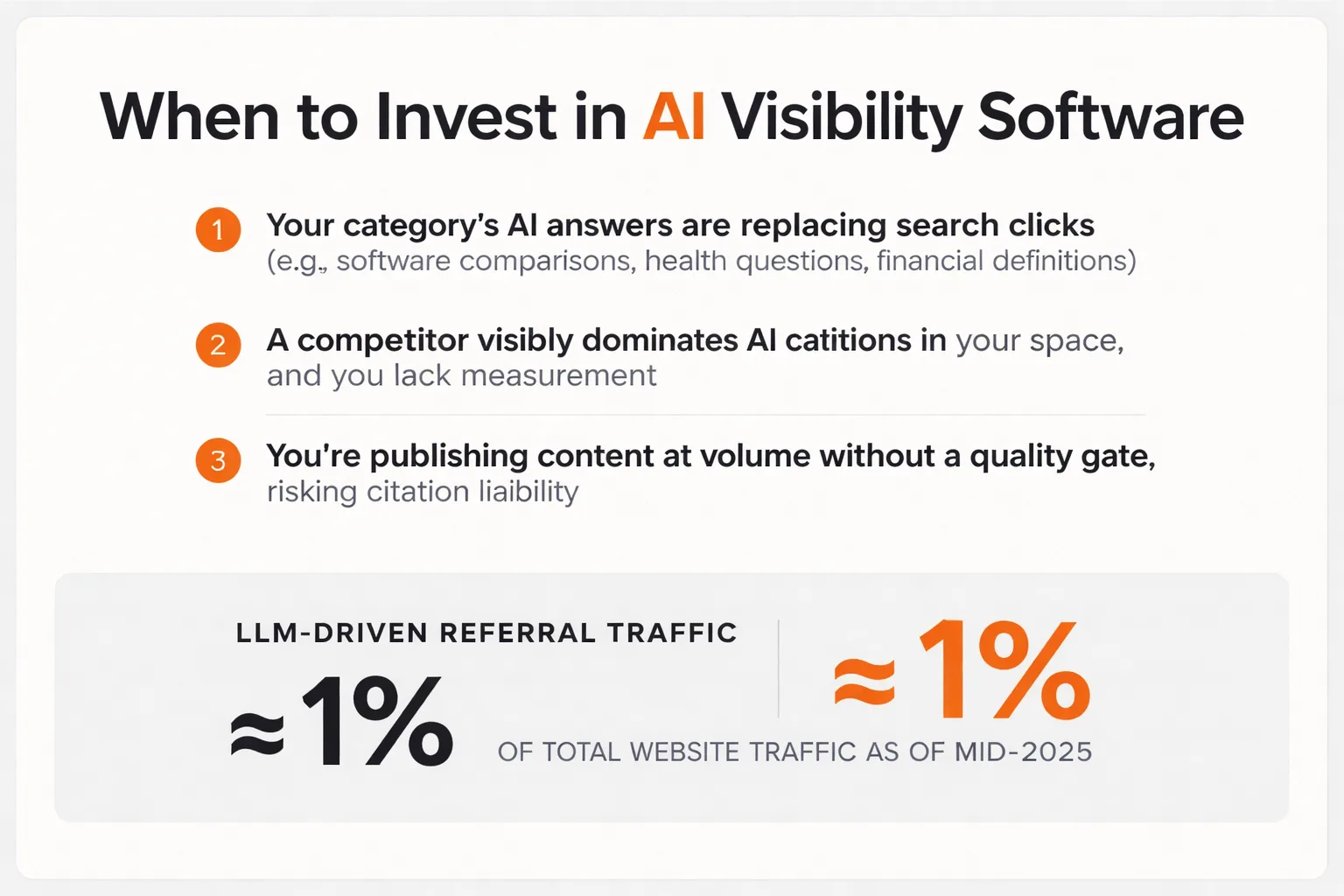
Not every team needs a purpose-built ai search visibility tool on day one. LLM-driven referral traffic is still sitting around 1% of total website traffic as of mid-2025, per Statista. Measurable isn't the same as meaningful. And I'd push back hard on any team deprioritizing conversion-focused content to chase Perplexity mentions before the ROI case is established.
That said, there are three scenarios where investing now makes clear sense. First: if your category is one where AI answers are already replacing search clicks at scale (software comparisons, health questions, financial definitions). Second: if a competitor is visibly dominating AI citations in your space and you have no measurement infrastructure to understand why. Third: if you're publishing content at volume and have no quality gate. In which case you're almost certainly building a citation liability, not an asset.
For solo founders, the calculus is different. The tools starting at $29-$49/month make it cheap to validate AI visibility as a channel before committing. For agencies managing multiple brands, the per-domain economics of mid-tier platforms become the deciding factor fast.
Comparison Table
| Tool | Starting Price | AI Engines Covered | Content Generation | Citation Outreach | Best For |
| Meev | $49/mo (7-day trial) | 8 (ChatGPT, Claude, Gemini, Perplexity, Grok, AI Overviews, AI Mode, DeepSeek) | Yes. Quality-gated, multi-CMS | Yes (Pro+) | Teams wanting tracking + publishing in one platform |
| Profound | $499/mo | 10+ engines | No | Partial (FAQ automation) | Enterprise brands, regulated industries |
| OtterlyAI | $29/mo | ChatGPT, Claude, Gemini, Perplexity, AI Overviews | No | No | Solo marketers, early-stage startups |
| AthenaHQ | $295/mo | Multiple (proprietary ACE) | Recommendations only | No | Growth-stage brands wanting full GEO workflow |
| Peec AI | ~€85/mo | ChatGPT, Perplexity, AI Overviews | No | No | Agencies focused on citation attribution |
| Scrunch AI | $250/mo | ChatGPT, Perplexity, Claude, Meta AI, Gemini, AI Mode, AI Overviews | No | No | Enterprise technical SEO teams |
| Semrush AI Toolkit | $99/mo (standalone) | Multiple LLMs (via AIO) | Yes (ContentShake) | No | Teams already in the Semrush ecosystem |
| Ahrefs Brand Radar | $129/mo (Lite) | ChatGPT, Gemini, Copilot, AI Overviews | No | No | SEO teams already using Ahrefs |
| AIclicks | Contact for pricing | ChatGPT, Perplexity, Gemini, AI Overviews | No | No | In-house enterprise teams |
| SE Ranking | $65/mo | AI Overview, AI Mode, ChatGPT, Gemini, Perplexity | No | No | Agencies wanting broadest feature-to-price ratio |
1. Meev — Best for teams that want tracking and publishing in one platform
Best for: Teams that want AI citation tracking plus a content engine they can trust to publish. Not just a dashboard that surfaces problems. Differentiated by the 12-dimension Quality Matrix and Helpful Content Risk score that gate every article before it ships.
Meev is an autonomous AI search visibility platform that tracks citations across every major AI search surface (ChatGPT, Claude, Gemini, Perplexity, Grok, DeepSeek, Google AI Overviews, AI Mode), writes quality-gated content that earns them, and proves which placements drove the lift. It's the only platform in this list that closes the loop between gap detection, content generation, and citation outcome tracking in a single workflow.
Key features: - Citation tracking across ChatGPT, Claude, Gemini, Perplexity, and Grok on a rolling cadence; Google AI Overviews and AI Mode refresh daily. 12-dimension Quality Matrix plus Helpful Content Risk score. 70/100 publish gate on both. Knowledge Base enforcement. Articles grounded in your approved claims, not AI hallucination. Closed-loop Citation Path (roadmap) — each article mapped to the citation-rate delta it drove. Autopilot topic pool with gap detection from competitor citation patterns
Pricing: 7-day free trial. After the trial, services pause unless you subscribe. Your account stays open and your data stays readable. Lite $49/mo, Starter $99/mo, Pro $269/mo, Agency $599/mo. 20% annual discount. Cancel anytime; hard-cap quotas with no overage fees.
What separates Meev from every other tool in this roundup is the quality firewall. Most auto-blog engines ship whatever the model produces. Meev blocks articles scoring below 70/100 on both the Quality Matrix and Helpful Content Risk score before they reach your CMS. For teams worried about scaled content abuse. A legitimate concern given how aggressively Google's Helpful Content System penalizes thin AI output. This is the architectural difference that matters. The Citation Path feature (Pro+) also handles the outreach layer: find the publishers AI engines cite for your topics, verify contacts, and draft personalized pitches grounded in your Knowledge Base, all in one workflow. If you're comparing Meev to a dedicated enterprise platform, the Meev vs Profound comparison breaks down where each wins.
2. Profound — Best for enterprise brands and regulated industries
Best for: Enterprise brands, large in-house teams, regulated industries (healthcare, pharma, finance), and well-funded agencies that need deep AI search intelligence and agentic workflow automation.
Profound is an enterprise-grade AI visibility platform that captures real user-facing data across 10+ AI engines including ChatGPT, Claude, Perplexity, Google AI Overviews, Gemini, Copilot, DeepSeek, Grok, Meta AI, and Google AI Mode. The differentiator here is the Conversation Explorer. A 400M+ anonymized conversation dataset that surfaces how real users are actually interacting with AI answers about your brand, not just synthetic prompt simulations.
Key features: - Real user-facing AI answer capture across 10+ engines with 400M+ anonymized conversation dataset via Conversation Explorer. AI Crawler Analytics (Agent Analytics) tracking how AI bots interact with your website at the server-log level. Marketing Agents that automate FAQ generation, content optimization, and earned-media discovery. Automated Slack alerts when brand sentiment drops below -0.2 or inaccuracy exceeds 5%, plus GA4/BigQuery native connector
Pricing: Lite plan starts at $499/month; Agency Growth plan starts at $1,499/month (includes 10 pitch workspaces, client workspaces, and 5 team seats); Enterprise custom pricing available.
Profound is the right call for enterprise teams where the cost of a bad AI citation. A wrong drug interaction, a misattributed financial claim. Justifies the platform investment. The automated sentiment alerting and GA4/BigQuery connector make it genuinely operational for large teams. The honest limitation: $499/month entry price puts it out of reach for most SMBs, and the platform complexity requires dedicated bandwidth to operationalize. For teams evaluating Profound against a more accessible alternative, it's worth reading through the feature-by-feature breakdown before committing.
3. OtterlyAI — Best for solo marketers validating the channel
Best for: Solo marketers, early-stage startups, and SMBs that want to validate AI visibility as a channel without committing to enterprise-level pricing.
OtterlyAI is a beginner-friendly AI brand mention and citation tracking tool that monitors visibility across major LLMs and AI search engines with fast time-to-value and no complex configuration. Gartner recognized it as a Cool Vendor for AI in Marketing 2025, which signals it's on the radar of enterprise evaluators even if its sweet spot is the SMB market.
Key features: - AI search monitoring across ChatGPT, Claude, Gemini, Perplexity, and Google AI Overviews. Prompt-based monitoring that translates keywords into conversational AI-focused queries. Brand visibility and sentiment analysis showing appearance frequency, positioning, and tone. Competitive visibility analysis highlighting share of voice and visibility gaps vs. rivals
Pricing: Lite plan starts at $29/month; higher tiers available up to ~$39/month entry on some plans; Gartner-recognized Cool Vendor for AI in Marketing 2025.
At $29/month, OtterlyAI is the lowest-friction entry point in this category. If you're a solo founder who wants to answer the question "is my brand showing up in AI answers at all?" before investing in a full platform, this is the right starting point. The honest trade-off: it doesn't have the deep analytics, content optimization workflows, or enterprise governance features you'll need once you've validated the channel and want to act on the data.
4. AthenaHQ — Best for growth-stage brands wanting end-to-end GEO
Best for: Growth-stage brands and agencies that want a comprehensive, actionable GEO platform to manage the entire AI visibility lifecycle from monitoring through content execution.
AthenaHQ is a strategy-focused generative engine optimization platform backed by former Google Search and DeepMind experts that combines AI search visibility monitoring, content optimization, and technical automation into a full end-to-end workflow. The team's background is a genuine differentiator in a category where most tools are built by SEO practitioners rather than people who worked on the underlying search infrastructure.
Key features: - Athena Citation Engine (ACE) — proprietary technology for optimizing and tracking LLM citations. Dynamic blindspot detection and competitor impersonation for aggressive share-of-voice strategy. Actionable content recommendations improving machine readability and LLM relevance. Integrated workflow covering monitoring, analytics, content optimization, and execution in one platform
Pricing: Plans start from $295/month; connects with CMS, analytics platforms, and collaboration tools; enterprise pricing available on request.
AthenaHQ sits in an interesting position: more strategic depth than OtterlyAI or Peec AI, less enterprise overhead than Profound. The ACE engine's approach to LLM citation optimization is technically sophisticated, and the blindspot detection feature is genuinely useful for competitive GEO strategy. The caveat is that the platform evolves rapidly. Teams need to stay current with frequent feature changes, which requires more ongoing attention than a set-and-forget monitoring tool.
5. Peec AI — Best for agencies focused on citation attribution
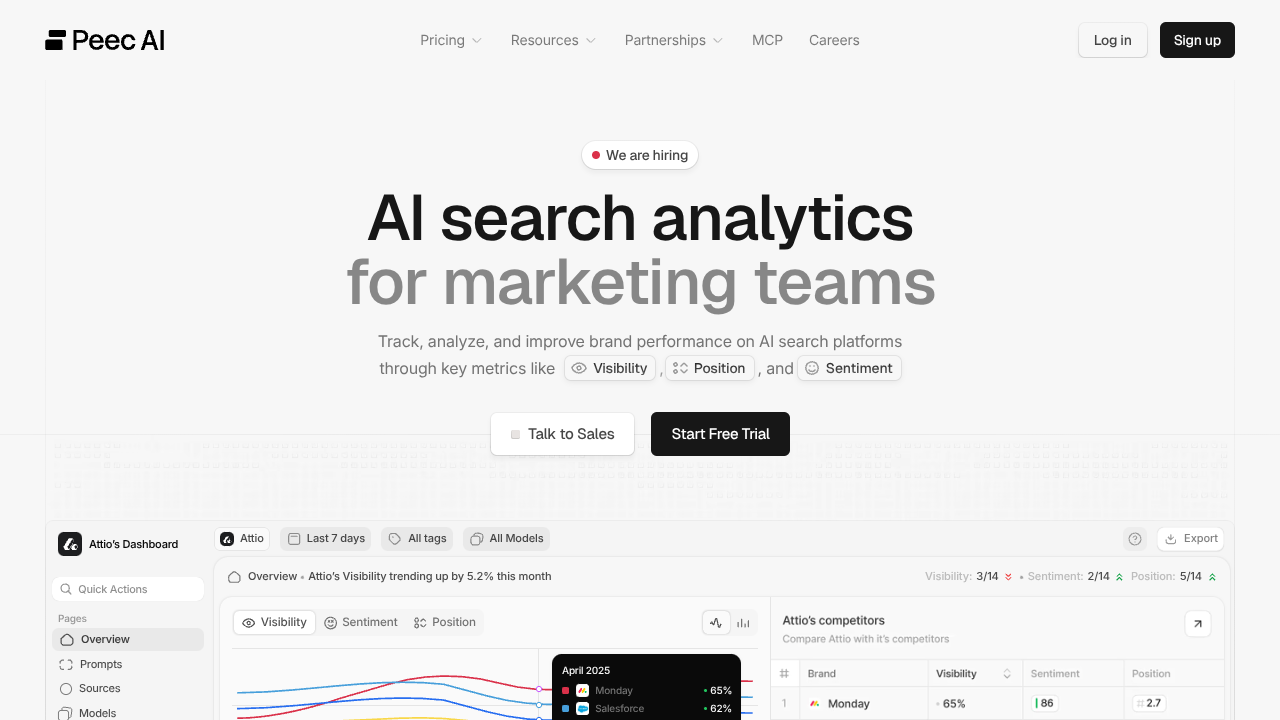
Best for: Agencies and in-house SEO teams that need accurate prompt-level citation attribution and want to double down on high-performing content channels driving AI mentions.
Peec AI is an AI visibility tracker that automatically generates realistic conversational prompts from your keywords and tracks source-level citations across ChatGPT, Perplexity, and Google AI Overviews. The source citation tracking is the standout feature: it identifies whether your visibility is coming from your blog, G2 reviews, Reddit threads, or other channels. Which is the kind of attribution data that actually informs where to invest next.
Key features: - Auto-generated 'Suggested' prompts that convert keywords into realistic conversational queries matching actual user behavior. Source citation tracking identifying whether visibility comes from your blog, G2 reviews, Reddit threads, or other channels. Multi-model coverage across ChatGPT, Perplexity, and Google AI Overviews in one subscription. Competitor benchmarking showing share of voice and citation gaps across the same prompt sets
Pricing: Starts at approximately €85/month (~$93/month); higher tiers available for additional engines, prompts, and team seats.
For agencies running citation attribution analysis, Peec AI's source-level tracking is genuinely differentiated. Knowing that your brand is being cited via a Reddit thread rather than your own site is actionable intelligence. It tells you whether to invest in owned content or third-party presence building. The coverage limitation (three primary engines at entry tier, no Claude or Grok) is a real constraint for teams tracking the full AI model comparison across all major surfaces. See the Meev vs Peec AI comparison for a detailed breakdown of where each platform wins.
6. Scrunch AI — Best for technical SEO teams treating AI visibility as an infrastructure problem
Best for: Enterprise brands and technical SEO teams that treat AI visibility as a crawlability and infrastructure problem, not just a content or monitoring challenge.
Scrunch AI is a technical GEO and AI visibility platform featuring an Agent Experience Platform (AXP) that serves a CDN-level, machine-readable version of your site to AI crawlers while preserving normal human UX. This is a fundamentally different approach to AI visibility. Instead of optimizing content after the fact, it optimizes how AI bots experience your site at the infrastructure level.
Key features: - Agent Experience Platform (AXP) delivering compressed, machine-readable pages to AI crawlers at the CDN level without disrupting human UX. Multi-LLM monitoring across ChatGPT, Perplexity, Claude, Meta AI, Gemini, Google AI Mode, and AI Overviews. Real-time AI bot traffic feed showing how AI crawlers interact with your site and content. Citation analysis and competitor benchmarking segmented by persona, topic, and geography
Pricing: Starts at $250/month; Pro tier reaches $1,000/month; enterprise packages with custom pricing available.
The AXP concept is compelling for teams that have already optimized content and want to address the crawlability layer. The Cloudflare data showing a 38,000:1 crawl-to-refer ratio makes the case that how AI bots experience your site matters independently of content quality. The practical barrier: CDN-level setup requires engineering involvement, which makes Scrunch AI inaccessible for non-technical marketing teams operating without developer support.
7. Semrush AI Toolkit — Best for teams already in the Semrush ecosystem
Best for: SEO and SEM organizations already invested in the Semrush ecosystem that want to add AI search analysis to existing workflows without adopting a separate specialist platform.
Semrush's AI Visibility Toolkit (Semrush AIO) extends the industry-leading SEO suite with brand share-of-answer benchmarking and LLM citation tracking. For teams already paying for Semrush's keyword research, backlink analysis, and content tools, adding the AI visibility layer at $99/month per domain is a reasonable consolidation play.
Key features: - AI Visibility Toolkit (AIO) benchmarking brand share-of-answer and competitor comparisons across LLMs. ContentShake AI for generating and optimizing SEO content aligned with keyword intent and AI readability. Semrush Copilot AI assistant surfacing keyword opportunities, competitor rankings, and technical visibility issues. Unified dashboard connecting keyword data, backlink intelligence, content optimization, technical audits, and AI visibility
Pricing: Standalone AI Visibility Toolkit (GEO analytics) at $99/month per domain; standard SEO plans from $139.95/month; full Semrush One bundle starts at $199/month combining SEO Toolkit and AI Visibility Toolkit.
The honest assessment here: Semrush AIO is an extension of a traditional SEO suite, not a purpose-built GEO platform. The depth of AI-specific insights lags behind dedicated tools like Profound or AthenaHQ. But if you're already paying for Semrush and want to add an AI visibility layer without managing a second platform login, the integration value is real. Full cross-LLM benchmarking requires higher-tier plans, which can push total cost above $450/month.
8. Ahrefs Brand Radar — Best for SEO teams already using Ahrefs
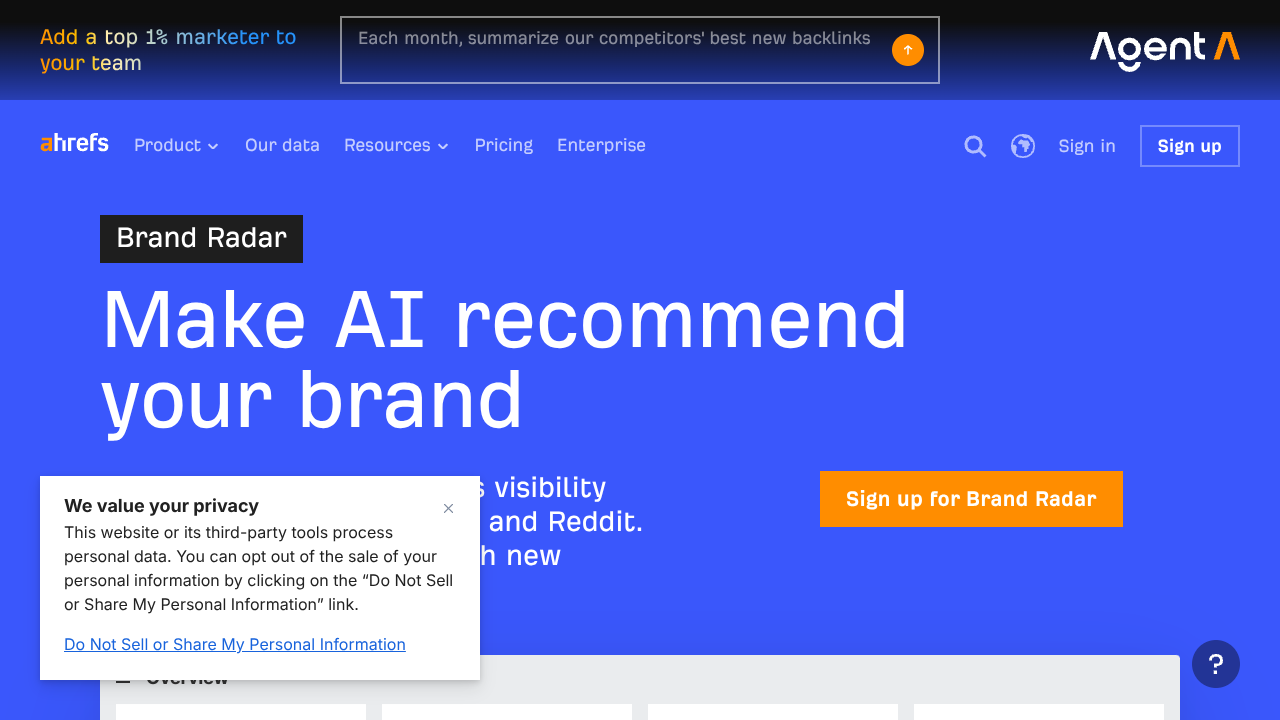
Best for: Marketers and SEO teams already using Ahrefs who want AI visibility data layered into their existing research and reporting workflows without switching platforms.
Ahrefs Brand Radar tracks how your brand is mentioned and cited across ChatGPT, Gemini, Copilot, and Google AI Overviews, integrated alongside the keyword research, backlinks, and content analysis tools Ahrefs users already rely on. The share-of-voice measurement and competitor citation comparison are the most useful features for teams doing regular GEO reporting.
Key features: - AI brand mention and citation tracking across ChatGPT, Gemini, Copilot, and Google AI Overviews. Share of voice measurement and competitor citation comparison integrated into existing Ahrefs reports. Massive dataset enabling quick AI visibility data exploration and share-of-voice benchmarking at scale. GEO and AI visibility features blended with keyword research, backlink analysis, and content audit workflows
Pricing: Included within Ahrefs plans; Ahrefs Starter from $29/month, Lite from $129/month, Standard from $249/month, Advanced from $449/month; Brand Radar and AI citation features available on mid-to-upper tiers.
Same logic as Semrush: if you're already paying for Ahrefs, Brand Radar is a low-friction way to add AI visibility tracking to your existing workflow. The coverage gap (no Perplexity, no Claude at most tiers) is a real limitation given that Perplexity's Reddit-heavy citation pattern makes it a distinct signal worth tracking separately. Full Brand Radar capabilities require mid-to-upper tier plans, which may not be cost-justified for small teams.
9. AIclicks — Best for in-house enterprise teams wanting a dedicated command center
Best for: In-house marketing teams and enterprise organizations that need a dedicated LLM visibility command center with clear weekly workflows, rather than a bolt-on feature within a broader SEO suite.
AIclicks is a practical AI visibility command center built specifically for prompt-level LLM monitoring, citation intelligence, sentiment analysis, and competitor benchmarking across ChatGPT, Perplexity, Gemini, and Google AI Overviews. The weekly workflow orientation is a design choice that separates it from platforms built primarily around dashboards.
Key features: - Prompt-level monitoring with custom prompt sets mirroring real customer intent, tracked over time as AI models evolve. Citation intelligence showing which sources influence AI answers and where brand positioning is reinforced or diluted. Coverage across ChatGPT, Perplexity, Gemini, and Google AI Overviews with consistent cross-market reporting. Competitor benchmarking and share-of-voice tracking enabling weekly GEO workflow execution for in-house and enterprise teams
Pricing: Pricing details available on site at aiclicks.io; positioned as a mid-market tool for in-house and enterprise teams; free trial available.
AIclicks is designed to be paired with Google Search Console for technical health and baseline Google Search trends. It's not a replacement for traditional SEO infrastructure, and the team is explicit about that positioning. The prompt set setup and ongoing workflow management require dedicated team time. For in-house teams that want a structured weekly GEO practice rather than a passive monitoring dashboard, that investment is justified.
10. SE Ranking — Best for agencies wanting the broadest feature-to-price ratio
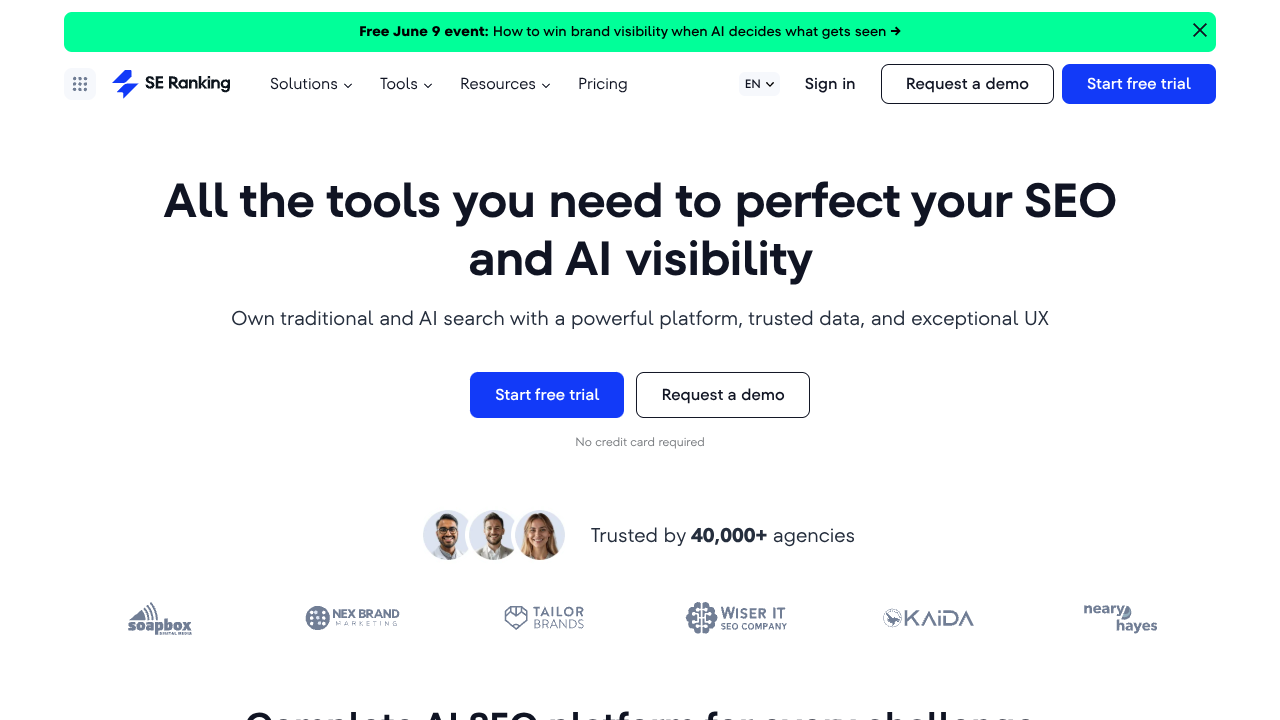
Best for: Agencies and in-house SEO teams that want the broadest feature-to-price ratio in the category, combining traditional SEO and AI visibility monitoring without paying enterprise-tier prices.
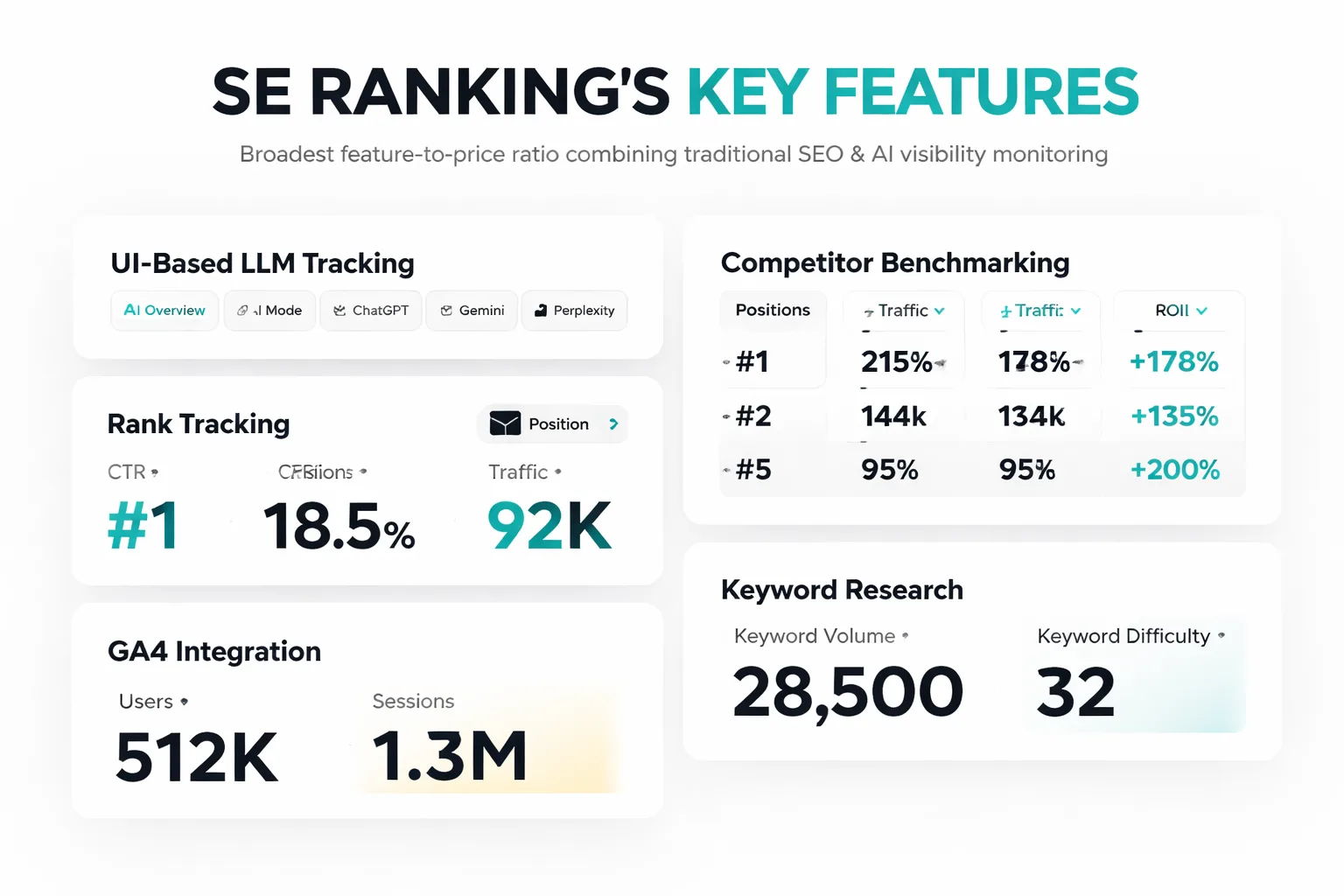
SE Ranking is a comprehensive SEO and LLM visibility platform combining UI-based citation and mention tracking across AI Overview, AI Mode, ChatGPT, Gemini, and Perplexity with traditional rank tracking, keyword research, and GA4 integration. The MCP server integration. Allowing AI visibility data to be piped directly into AI assistants. Is a genuinely forward-looking feature.
Key features: - UI-based LLM tracking across AI Overview, AI Mode, ChatGPT, Gemini, and Perplexity for accurate real-user-facing data. Competitor benchmarking with MCP server integration allowing AI visibility data to be piped directly into AI assistants. Rank tracking, keyword research, site audits, and competitive research alongside AI visibility in one unified platform. GA4 integration bringing traffic data into AI visibility reporting for a complete cross-channel performance view
Pricing: Essential plan from $65/month; Pro from $119/month; Business from $259/month; AI visibility tracker included across plans with MCP server integration; SE Visible companion product extends LLM monitoring further.
For agencies that need to manage AI visibility alongside traditional SEO without paying Profound-level prices, SE Ranking is the strongest value play in this list. The GA4 integration is particularly useful for teams trying to connect AI citation gains to actual traffic outcomes. Which, given that LLM referral traffic is still around 1% of total site traffic for most brands, is a connection worth measuring carefully. The SE Visible companion product extends LLM monitoring further but adds to total cost.
Making the Right Choice
The tool you pick should match where you are in the AI visibility journey, not where you aspire to be.
If you're a solo founder or early-stage SMB, start with OtterlyAI at $29/month or Meev's 7-day trial to validate whether your brand is showing up at all. The data will tell you whether to invest further.
If you're an agency managing multiple brands, SE Ranking's $65/month entry point gives you the broadest feature-to-price ratio in the category. For agencies that need citation attribution at the source level, Peec AI's prompt-level tracking is worth the premium. The Meev vs Peec AI comparison is a useful reference if you're deciding between the two.
If you're a growth-stage brand that needs to close the loop between monitoring and content, Meev or AthenaHQ are the strongest options. Meev's quality-gated publishing is the right architecture if scaled content abuse avoidance is a concern. Which it should be for any team publishing at volume. For Gemini visibility tracking specifically, the daily refresh cadence matters more than most teams realize, given how frequently AI Overview sources rotate.
If you're enterprise with a regulated brand, Profound is the only platform in this list with the real-user conversation data and automated sentiment alerting to justify the investment. The $499/month entry price is steep, but the depth of intelligence is genuinely differentiated.
One contrarian take before you finalize anything: the mention-citation gap is real and getting wider. A June 2025 analysis of 14,000 queries found citations capture only about a third of how AI actually uses content. Tracking citation counts as a primary KPI is optimizing for a metric that doesn't fully represent the underlying signal. The teams winning at generative engine optimization in 2026 are the ones measuring citation-to-traffic conversion, not citation volume. Pick a platform that helps you connect those dots, not just count the mentions.
For DeepSeek visibility tracking and Grok visibility, both are increasingly relevant as those models gain share. And most platforms in this list either don't cover them or gate them behind enterprise tiers. Worth factoring into your evaluation if either model is material to your audience.
Frequently Asked Questions
What is AI visibility software and how is it different from traditional SEO tools?
AI visibility software tracks whether and how your brand appears in AI-generated answers from platforms like ChatGPT, Perplexity, Google AI Overviews, and Claude. Traditional SEO tools track keyword rankings in Google's blue-link results. The difference matters because a June 2025 study of 14,000 queries found Google Gemini cites zero sources in 92% of its answers. Meaning the ranking signals that drive traditional SEO performance don't translate directly to AI citation outcomes.
How do I know if my brand is being cited by AI models?
You need a dedicated ai visibility software platform that submits prompts to AI engines and parses responses for brand mentions, citations, and sentiment. Google Search Console doesn't capture this data. Most platforms in this list offer a free trial or entry-level tier that will tell you within days whether your brand is appearing in AI-generated answers for your target topics.
Does E-E-A-T still matter for AI citations in 2026?
Yes, and possibly more than for traditional search. A Semrush analysis found E-E-A-T signals show a +30.6% positive correlation to AI citations, and a Wellows analysis of 2,400 AI Overview citations found 96% came from sources with strong E-E-A-T signals. The pattern I keep seeing is that E-E-A-T functions more like a binary gate than a gradual lift. You're either in the citation pool or you're not.
Can small businesses afford AI visibility tools?
Yes. OtterlyAI starts at $29/month. Meev's Lite tier is $49/month with a 7-day free trial. SE Ranking's Essential plan is $65/month and includes both traditional SEO and AI visibility tracking. The question isn't whether you can afford a tool. It's whether your business is at the stage where AI citation tracking will drive decisions. For most solo founders, the answer is: start with a free trial, validate the channel, then decide.
What's the difference between monitoring citations and building them?
Monitoring tells you where you appear today. Building citations requires either publishing content that earns mentions organically, or actively pitching the publishers AI engines already cite for your topics. Most platforms in this list do monitoring only. Meev's Citation Path feature (Pro+) handles the outreach layer: it finds the publishers AI engines cite for your topics, verifies contacts, and drafts personalized pitches. Uptick Marketing documented 9,000+ AI citations in 90 days through this kind of targeted publisher pitching. Though any campaign at that scale should include quality checkpoints to catch signal drift.
How often do AI visibility platforms refresh their data?
It varies significantly by platform and engine type. Google AI Overviews and AI Mode change frequently and benefit from daily refresh. LLM-driven surfaces like ChatGPT and Claude change more slowly and are typically tracked on rolling weekly cadences. Meev refreshes Google AI Overviews and AI Mode daily; other surfaces run on rolling cadences. Profound's real-user conversation dataset updates continuously. Entry-level tools like OtterlyAI refresh less frequently. Check refresh cadence before committing. Stale data leads to wrong optimization decisions.
About the Author
Judy Zhou, Head of Content Strategy
Judy Zhou leads content strategy at Meev, where she oversees AI-driven content research and publishing for hundreds of brands. With a background in SEO and editorial operations, she focuses on building content systems that rank on Google, get cited by AI search engines, and drive measurable business results.
Start your 7-day free trial and get your first AI citation report in minutes — no engineering setup required.