

By Judy Zhou, Head of Content Strategy
Key Takeaways
- The browser prompt 'Search Google or type a URL' represents two distinct user intents — informational discovery and direct navigational access — each requiring a different SEO strategy to capture.
- Direct navigation (typing a URL) signals brand recall and trust; it bypasses organic search entirely and is increasingly the traffic type most insulated from AI Overview disruption.
- According to SparkToro and Datos research, less than 40% of Google searches result in a click to an external website — making direct navigation habits a critical buffer against zero-click search growth.
- The most durable branded search strategy in 2026 is converting first-time organic visitors into habitual direct navigators, because keyword rankings are rented but URL-typing habits are owned.
What the Phrase Actually Means — and Who's Searching It
The phrase "search google or type a url" shows up in the browser's omnibox as a placeholder prompt — yet it pulls 60,500 monthly searches at near-zero keyword difficulty. That's not a coincidence. It's a signal.
The people typing this exact phrase into Google aren't confused about how browsers work. They're either new internet users trying to understand the UI, students or professionals researching UX and browser behavior, or — and this is the group that matters most to SEO strategists — content and marketing practitioners trying to understand what that prompt means for how users navigate the web. The query sits at an interesting crossroads: it's simultaneously a beginner question and a conceptual entry point into one of the most important distinctions in search marketing.
Here's the quick answer for anyone who needs it: when Chrome's omnibox displays "Search Google or type a URL," it's offering two fundamentally different paths. Typing a search query sends you to a Google results page — you're exploring, discovering, comparing. Typing a URL takes you directly to a website — you already know where you want to go. One path is about finding. The other is about arriving. That distinction, seemingly trivial at the browser level, has enormous downstream implications for how brands get found, how traffic gets classified, and how content strategies should be built.
Key takeaways: - The omnibox prompt represents two distinct user intents — informational discovery versus direct navigational access — and each has different SEO implications. - Direct navigation signals brand recall and trust; organic search signals content relevance and topical authority. - Direct traffic and organic traffic are measured differently in GA4, and conflating them leads to misread attribution models. - Brands that build for both paths — strong content for search discovery and strong brand recall for direct navigation — compound their traffic resilience over time.
Navigational vs. Informational Intent — Why the Distinction Matters for SEO
Google classifies queries into intent buckets, and the two that matter most here are navigational (the user wants a specific website) and informational (the user wants an answer or wants to explore a topic). The omnibox prompt is essentially a physical manifestation of this split — two input modes, two intent types, baked into the browser UI itself.
When someone types a brand name or URL directly, Google treats it as a navigational query. The SERP for navigational queries typically surfaces a Knowledge Panel, sitelinks, and the brand's homepage — Google is confident about the destination and tries to get the user there fast. When someone types a question or topic phrase, Google surfaces organic results, featured snippets, People Also Ask boxes, and increasingly, AI Overviews. The content game is completely different depending on which path the user takes.
For content teams, this distinction shapes strategy in a concrete way. Informational queries are where blog posts, pillar pages, and topical clusters compete. Navigational queries are where brand equity lives — and where you either win by default (because users already know you) or lose to a competitor who's built stronger recall. The mistake I see content teams make repeatedly is treating all traffic as equivalent. A site that doubles its organic traffic through informational content but sees flat or declining direct traffic is building reach without building loyalty. Both metrics need to move.
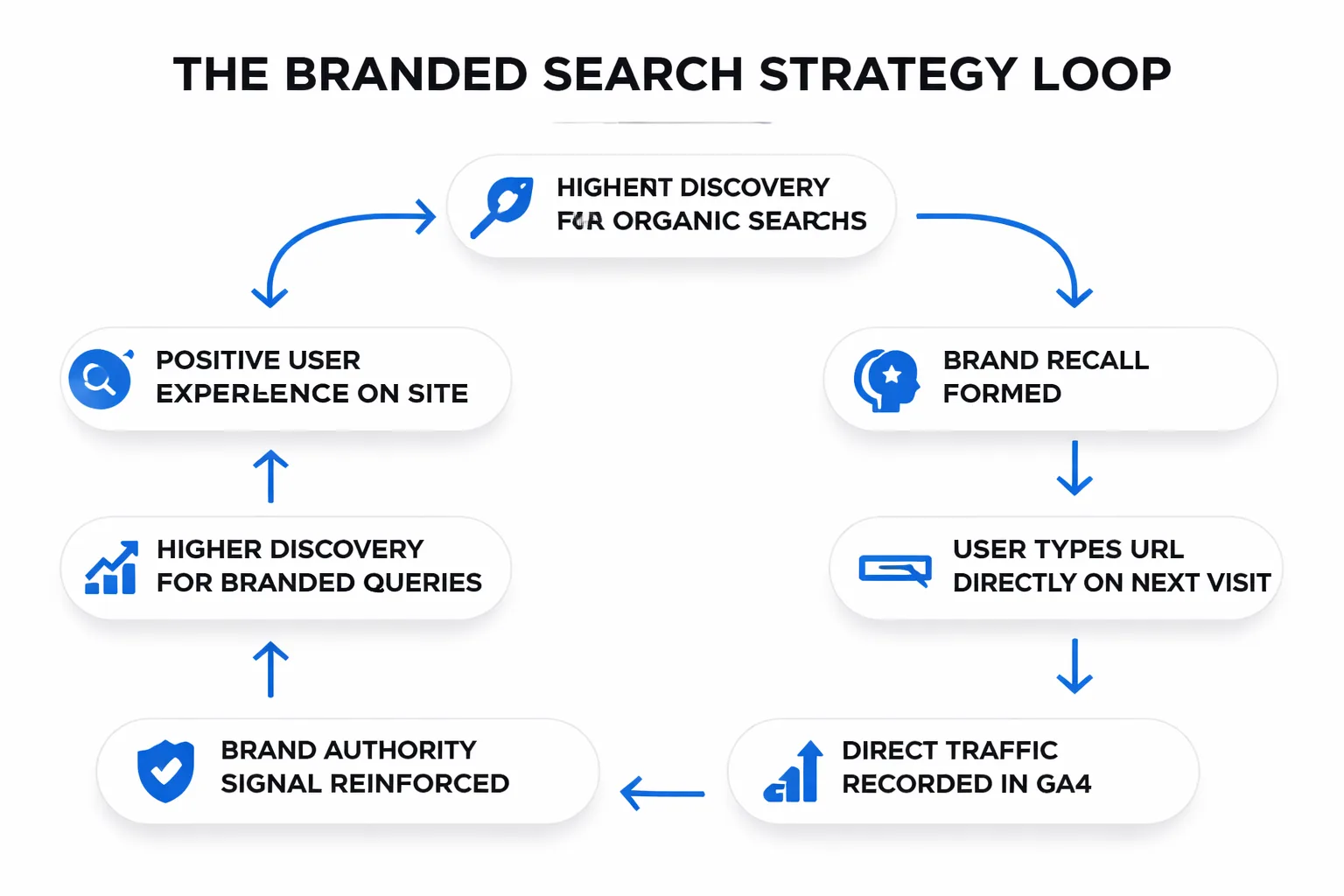
The SEO implication that rarely gets discussed: navigational intent is where E-E-A-T becomes self-reinforcing. When users navigate directly to your site repeatedly, Google interprets that behavioral signal as a trust indicator. It's not just about backlinks or structured data — it's about whether real humans are choosing you as a destination, not just a search result.
Are you tracking whether your content is building direct navigation habits — or just renting SERP positions?
How This Behavior Shapes Your Branded Search Strategy
Direct navigation — users typing your URL or brand name into the omnibox — is the highest-quality traffic signal a site can receive. It means someone already knows you exist, already trusts you enough to come back, and didn't need a search result to remind them. That's brand equity made measurable.
The practical implication for branded search strategy in 2026 is this: every piece of content you publish is either building brand recall or it isn't. A blog post that ranks for a keyword, earns a click, delivers genuine value, and leaves the reader with a clear sense of who wrote this is planting a seed for future direct navigation. A post that ranks, gets clicked, and feels generic — no author voice, no distinct perspective, no memorable insight — is just renting a SERP position.
I've seen this dynamic play out in content audits where branded search volume was flat for 18 months despite consistent organic growth. The content was technically solid — well-optimized, properly structured, hitting keyword targets. But it had no voice, no consistent authorship, no reason for a reader to remember where they read it. The fix wasn't more content. It was making existing content more attributable: stronger author bylines, consistent perspective, and a content style that felt like it came from a specific team with a specific point of view. Branded query volume started moving within a quarter.
Reducing reliance on organic click-through is a real strategic goal — and direct navigation is how you get there. If a Google algorithm update, an AI Overview expansion, or a SERP layout change cuts your organic CTR by 30%, brands with strong direct navigation habits in their audience are insulated. Brands that exist only as search results are fully exposed.
This is also where the connection to keyword research strategy becomes relevant — because as AI Overviews absorb more informational queries, the brands that have built direct navigation habits are the ones that survive zero-click search expansion intact.
The Omnibox Effect — How Chrome's URL Bar Changed Search Habits
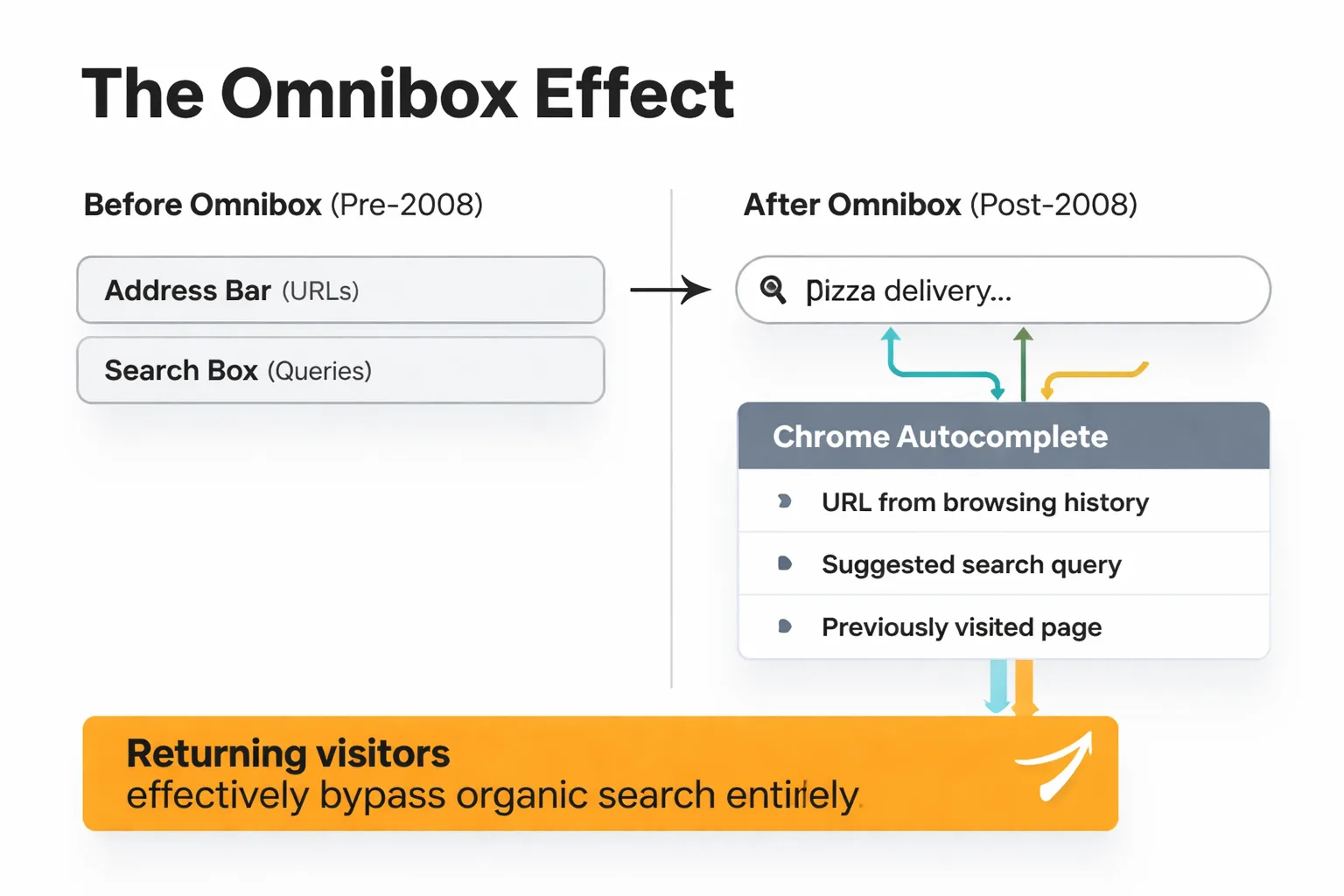
Before the omnibox, browsers had two separate fields: an address bar for URLs and a search box for queries. Chrome collapsed them into one in 2008, and the behavioral consequences took years to fully surface.
The omnibox made search the default behavior for most users. Instead of thinking "do I know this URL or do I need to search for it," users just type whatever they're thinking and let the browser decide. Chrome's autocomplete does the rest — surfacing either a URL from browsing history, a suggested search query, or a previously visited page. That autocomplete layer is where personalization enters the picture, and it's where the "search google or type a url" prompt becomes strategically interesting.
For users with a site in their browsing history, Chrome will surface that URL as an autocomplete suggestion before they finish typing. This means returning visitors effectively bypass organic search entirely — they never see your competitors, never see an AI Overview, never see a featured snippet for someone else. The omnibox autocomplete is a loyalty moat, and most brands don't think about it in those terms.
The zero-click trend accelerates this dynamic. According to SparkToro and Datos research published in 2024, less than 40% of Google searches result in a click to an external website. As AI Overviews absorb more informational queries, the share of searches that end without a site visit will grow. The brands that have built omnibox autocomplete presence — through repeat visits, strong brand recall, and consistent user return behavior — are the ones that sidestep this trend. Content discoverability through search matters, but it's increasingly a top-of-funnel acquisition mechanism, not a retention one.
The content implication: stop treating every page as if it exists only to rank. Some pages should be designed explicitly to bring people back — resource hubs, tools, dashboards, reference content that users bookmark and return to. Those return visits are what build the omnibox autocomplete presence that makes direct navigation habitual.
Action Steps — Optimizing for Both Paths
Optimizing for direct navigation SEO and organic search simultaneously isn't a contradiction — it's a compounding strategy. Here's how to execute it.
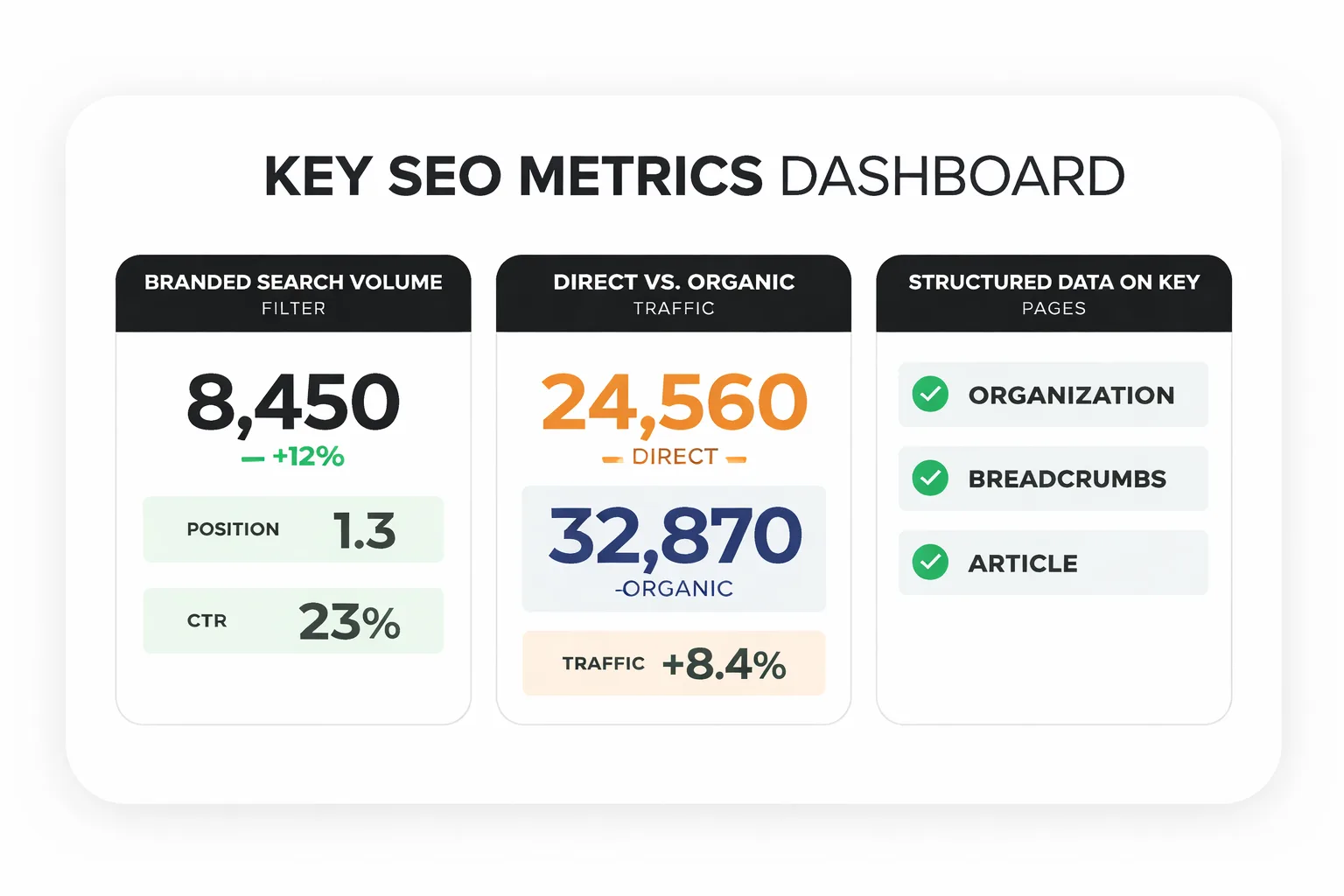
1. Audit your branded search volume monthly. In Google Search Console, filter by queries that include your brand name. Track this number month-over-month. Flat or declining branded query volume while organic traffic grows is a warning sign — you're building reach without building recognition. Set a baseline now.
2. Set up direct vs. organic traffic splits in GA4. In GA4, navigate to Reports → Acquisition → Traffic Acquisition. Filter by "Session default channel group" and compare Direct versus Organic Search over rolling 90-day windows. A healthy content brand typically sees direct traffic grow proportionally with organic — lagging direct traffic means your content isn't converting readers into returning visitors.
3. Implement structured data on every key page. Organization schema, BreadcrumbList, and Article schema help Google understand your site's entity structure and surface sitelinks for branded navigational queries. Sitelinks are a SERP signal that you're a trusted destination — they appear when Google is confident about navigational intent. Google's structured data documentation is the canonical reference for implementation.
4. Optimize your homepage for navigational queries. Your homepage is the landing page for direct navigation. It should load fast (Core Web Vitals matter here — Google's PageSpeed Insights gives you the benchmark), clearly communicate what you do within the first viewport, and have a strong enough brand impression that a first-time visitor would remember the name. Most homepages are optimized for conversion, not recall. Those aren't the same thing.
5. Build content that earns return visits. This means resource pages, original research, tools, and reference content — the kind of content users bookmark. A blog post that ranks once and gets forgotten doesn't build omnibox presence. A resource that users return to monthly does. Identify your highest-returning pages in GA4 (look at returning user rate by page) and invest in expanding those.
6. Monitor branded keyword cannibalization. If a competitor is bidding on your brand name in Google Ads, they're intercepting navigational intent before it reaches you. Check this by searching your brand name in an incognito window and noting whether paid ads appear above your organic result. If they do, a defensive branded keyword campaign is worth the spend — the cost-per-click on your own brand terms is typically low, and the cost of losing that navigational traffic is high.
7. Align content voice with brand recall. This is the one brands consistently underinvest in. If your content has no identifiable voice — no consistent perspective, no named authors, no distinct editorial angle — readers can't form the brand association that drives future direct navigation. As I lead content strategy across multiple publishing operations, the pattern I keep seeing is that branded search volume correlates strongly with content that has a point of view. Generic content ranks. Distinctive content gets remembered.
The two paths — "search google" and "type a URL" — aren't competing strategies. They're sequential stages of the same user relationship. You earn the first visit through search. You earn the URL-typing habit through what happens after that first visit. Build for both, measure both, and stop treating direct traffic as a vanity metric that takes care of itself.
What This Means for AI Search and the Future of Direct Navigation
The rise of conversational AI search — ChatGPT, Perplexity, Google's AI Overviews — is accelerating the split between informational and navigational intent in ways that make the omnibox distinction even more strategically important.
AI search engines are increasingly absorbing informational queries. When a user asks ChatGPT "how does programmatic SEO work," they may never visit a website at all. The informational path — the "search google" side of the omnibox prompt — is under direct pressure from AI answer engines. The navigational path, by contrast, is harder to disrupt. A user who types your URL directly is expressing a preference that no AI Overview can intercept.
This is the contrarian take I'll commit to: the most durable SEO strategy in 2026 isn't ranking for more keywords — it's converting enough first-time organic visitors into habitual direct navigators that your traffic becomes partially AI-proof. Keyword rankings are rented. Direct navigation habits are owned.
The brands that understand what "search google or type a url" actually represents — not just a browser prompt, but a fork in the user relationship — are the ones building content systems that compound over time rather than chasing algorithm cycles.
FAQ
What does "Search Google or type a URL" mean in a browser's omnibox?
This phrase is a placeholder prompt in browsers like Chrome, offering two paths: typing a search query sends you to Google results for exploration and discovery, while typing a URL takes you directly to a specific website. The distinction highlights user intent—finding versus arriving—and has key implications for SEO and traffic analysis. It's not just UI guidance but a signal of navigational behavior.Why do people search for "search Google or type a URL" on Google?
Searchers include new internet users learning browser basics, UX researchers studying prompts, and SEO marketers analyzing user intent. With 60,500 monthly searches at near-zero difficulty, it reveals interest in how this UI affects web navigation. For marketers, it's a conceptual entry into distinguishing discovery from direct access.What's the difference between search discovery and direct navigation intents?
Search discovery involves typing queries to explore Google results, signaling informational needs and reliance on content relevance. Direct navigation means entering a URL, indicating brand recall, trust, and prior knowledge of the destination. These intents lead to different traffic types—organic for discovery, direct for navigation—with unique SEO strategies.How does this omnibox prompt impact SEO and analytics?
It underscores building for dual intents: strong content for organic discovery and brand strength for direct traffic. In GA4, direct and organic traffic are measured separately, so conflating them distorts attribution. Brands succeeding in both paths optimize for topical authority in search and recall in navigation.About the Author
Judy Zhou, Head of Content Strategy
Judy Zhou leads content strategy at Meev, where she oversees AI-driven content research and publishing for hundreds of brands. With a background in SEO and editorial operations, she focuses on building content systems that rank on Google, get cited by AI search engines, and drive measurable business results.
Build content that earns return visits, strengthens branded search, and compounds over time — see how Meev automates the strategy behind both paths.