

What Is Marketing Content? A No-Fluff Breakdown for 2026
By Judy Zhou, Head of Content Strategy at Meev
Key Takeaways
- Marketing content is any asset — text, video, interactive, or AI-generated — intentionally created to move an audience toward a business outcome; content marketing is the strategic system that deploys those assets.
- A study of 487 competitive Google search results found roughly 83% of top-ranking pages are not using AI-generated content — human authorship remains the dominant ranking signal in 2026.
- Long-form articles, short-form video, and interactive tools are the three content formats with the strongest documented ROI, but only when mapped to a specific funnel stage and given 6–18 months to compound.
- Before producing new assets, audit what you already have — tag every URL by format and funnel stage, pull Google Search Console performance data, and assign each piece one of four actions: Update, Consolidate, Create, or Retire.
Most definitions of marketing content are useless. They're either so broad they include your company's 404 page, or so narrow they miss the chatbot conversation that just closed a $12,000 deal. As someone who oversees AI-driven content research and publishing for hundreds of brands, I've watched this definitional fog cause real damage — teams producing content without knowing what they're actually making, or why.
So here's a working definition I'll defend: marketing content is any asset — text, video, audio, interactive, or AI-generated — intentionally created or deployed to move a target audience toward a business outcome. That's it. The format doesn't matter. The channel doesn't matter. Intent and outcome do.
What follows is the breakdown I wish existed when I started building content systems at scale.
Marketing Content vs. Content Marketing — The Actual Difference
These two terms get used interchangeably. They shouldn't be.
Marketing content is a noun — it's the asset. A blog post, a product demo video, a personalized email sequence, a comparison landing page. It exists as a thing you can point to, measure, and audit.
Content marketing is a strategy — it's the system that decides which assets to create, for whom, through which channels, and toward what measurable goal. The Content Marketing Institute defines content marketing as "a strategic marketing approach focused on creating and distributing valuable, relevant, and consistent content to attract and retain a clearly defined audience." Notice the word strategic. A single blog post is marketing content. Publishing 50 blog posts organized around topical clusters, mapped to buyer intent, and distributed through owned channels to build search authority — that's content marketing.
Here's the analogy that makes it stick: marketing content is the brick. Content marketing is the architecture. You can have a pile of bricks without a building. Most companies do.
The confusion matters because it produces the wrong decisions. Teams that think "we need more content" are thinking about bricks. Teams that think "we need a content strategy" are thinking about load-bearing walls. I've audited brand content libraries with 800+ published assets that drove almost no organic traffic — not because the individual pieces were bad, but because there was no system connecting them. Topical authority requires intentional architecture: content clusters, internal linking, consistent authorship signals, and a distribution plan. Bricks scattered across a field don't become a house.
The practical test: if you can't explain how a specific piece of content connects to a business outcome — a lead, a conversion, a retained customer — it might be marketing content in form, but it's not functioning as part of content marketing in practice.
The Six Categories of Marketing Content
Every piece of marketing content belongs to one of six functional categories. Getting this taxonomy right is the first step to building a content system that actually works.
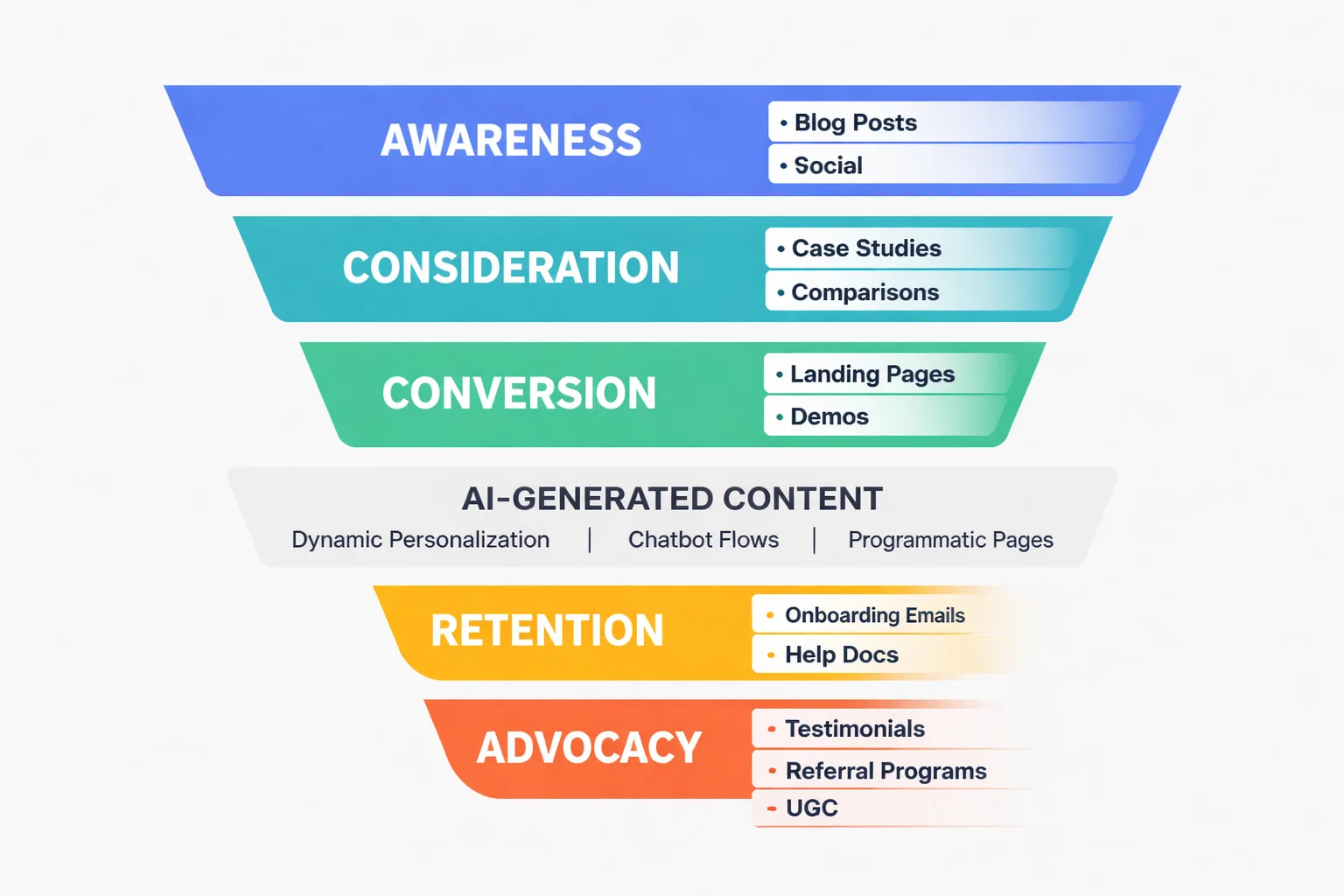
1. Awareness content — top-of-funnel assets designed to reach people who don't know you exist yet. Think SEO blog posts targeting informational queries, short-form social video, YouTube explainers, podcast appearances. The job is visibility and first impression.
2. Consideration content — mid-funnel assets for people actively evaluating solutions. Case studies, comparison pages ("us vs. competitor"), webinars, detailed guides, product demo videos. The job is building trust and demonstrating fit.
3. Conversion content — bottom-of-funnel assets that ask for the action. Landing pages, pricing pages, free trial flows, sales decks, proposal templates. The job is removing friction and closing.
4. Retention content — post-purchase assets that keep customers engaged and reduce churn. Onboarding email sequences, product tutorials, help documentation, in-app tooltips, newsletters. Most teams underinvest here catastrophically — it costs five times more to acquire a new customer than to retain an existing one, and yet retention content budgets are typically a fraction of acquisition budgets.
5. Advocacy content — assets that turn customers into promoters. Testimonial pages, referral program landing pages, user-generated content campaigns, community forums, review generation flows. This is the category that compounds — one strong advocate creates warm leads you never had to pay for.
6. AI-generated content as an emerging category — and this is where 2026 is genuinely different from 2022. Personalized chatbot conversation flows, dynamic landing pages that rewrite themselves based on traffic source, programmatic content pages generated from structured data — these are now marketing content. They require different measurement frameworks (more on this below), but they belong in your content inventory just as much as a hand-crafted blog post.
The mistake I see constantly: teams build awareness content obsessively and treat everything else as an afterthought. Your funnel leaks from the bottom, not the top.
How AI Has Redefined What Counts as Marketing Content
Two years ago, "marketing content" meant something a human wrote, designed, or recorded. That definition is now incomplete.
AI-generated assets — chatbot response flows, personalized email sequences triggered by behavioral signals, dynamic landing pages that adapt headline copy based on the ad source, programmatic location pages built from a structured data template — all of these now function as marketing content. They attract, inform, and convert. They're just not created the way we used to create things.
This changes measurement in three specific ways. First, you can't evaluate AI-generated content by the piece — you evaluate it by the system. A single programmatic page might perform poorly; 10,000 of them targeting long-tail local queries might drive meaningful organic traffic. The unit of analysis shifts from asset to asset-class. Second, AI-generated content requires explicit quality gates that human-authored content often gets implicitly. When a writer drafts a case study, editorial judgment is baked in. When an AI generates 500 product description variants, you need systematic checks — factual accuracy, brand voice consistency, E-E-A-T signals — that don't happen automatically. I've built explicit "assumption audit" checkpoints into our AI-assisted workflows specifically because research shows users shown AI-generated artifacts are measurably less likely to question the model's reasoning or flag missing context. That's an editorial risk I'm not willing to absorb at publishing scale.
Third — and this is the one that should make you uncomfortable — a study of 487 competitive Google search results found that roughly 83% of top-ranking pages are not using AI-generated content. I've also watched a real failure play out: a page targeting a competitive SEO keyword was flagged as 100% AI-generated, dropped from Google's index after a core update, and only recovered after replacement with human-authored content. AI as a drafting and optimization layer is defensible. AI as the final published signal is a gamble with your organic traffic.
For content marketers thinking about AI search — specifically Answer Engine Optimization (AEO), the practice of structuring content to appear in AI-generated answer surfaces like Google's AI Overviews and ChatGPT responses — the calculation is different again. AEO rewards clear, structured, factually grounded content that AI systems can confidently cite. That's actually harder to fake with low-quality AI generation than traditional SEO was.
Wondering which content formats are actually worth your production budget in 2026?
Which Content Types Drive the Most ROI in 2026
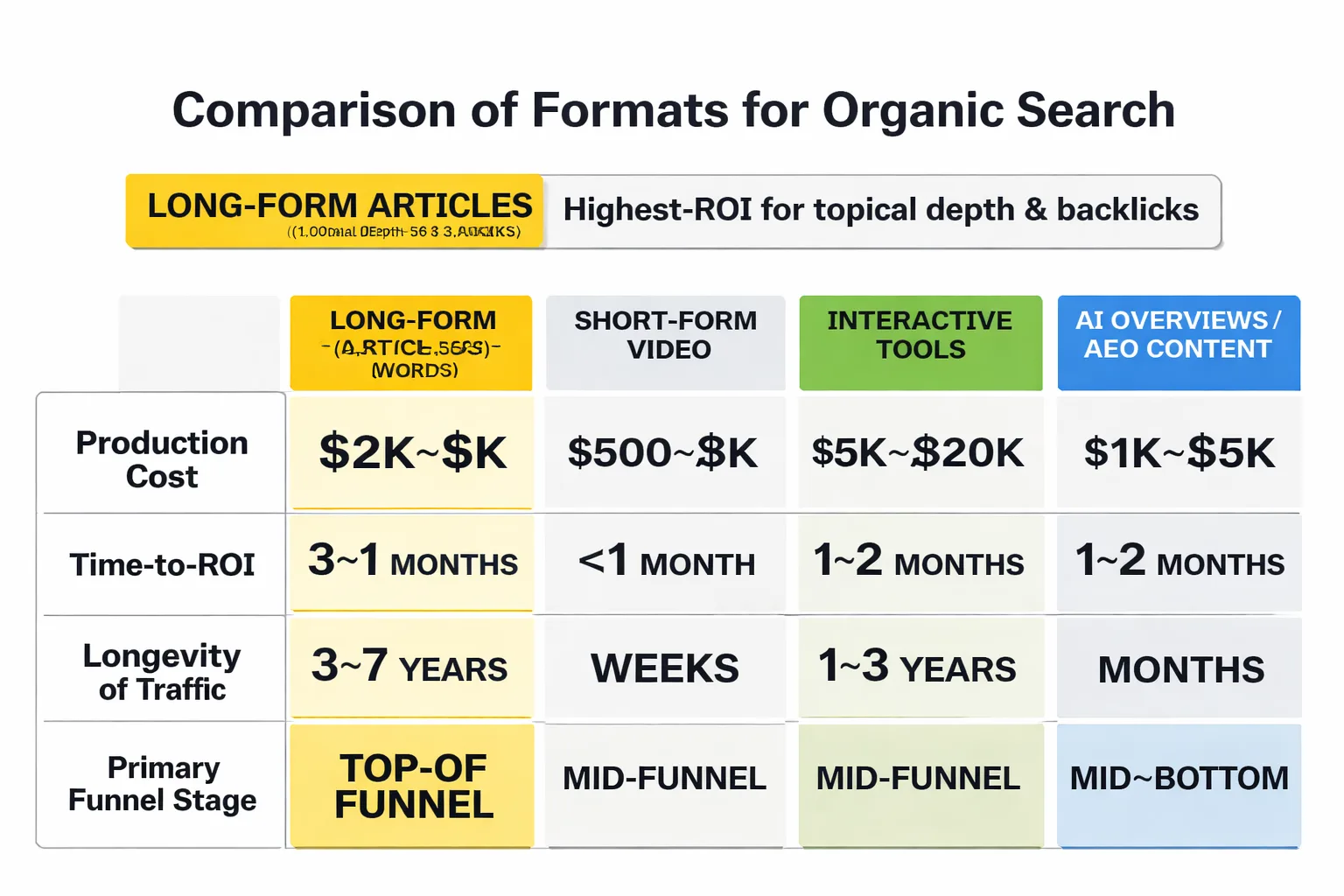
Not all content formats are created equal, and in 2026, the performance gap between formats has widened.
Long-form articles (1,500–3,500 words) remain the highest-ROI format for organic search when they're built around genuine topical depth — not just word count. The mechanism is straightforward: long-form content earns more backlinks, covers more semantic territory, and signals topical authority to Google's quality systems. The caveat is that "long-form" has been so thoroughly gamed by AI-padded content that Google's helpful content systems are now actively discounting thin long-form. Length without depth is just noise. For calculating SEO ROI, long-form articles are the baseline — every other format should be measured against their compounding organic traffic value.
Short-form video (under 90 seconds) is the dominant format for paid social and organic discovery on TikTok, Instagram Reels, and YouTube Shorts. The production cost has dropped dramatically with AI video tools, but the creative bar has risen equally fast. What converts in short video isn't production quality — it's specificity. A 60-second video solving one precise problem outperforms a polished brand video every time.
Interactive tools — calculators, assessments, configurators, quizzes — are chronically underused and consistently outperform static content on time-on-page, backlink acquisition, and lead capture. A mortgage calculator earns links passively. A "what type of content strategy do you need" assessment captures email addresses and segments leads simultaneously. The production investment is higher, but the compounding return is real.
AI Overviews and AEO-optimized content is the emerging format category that most teams aren't treating seriously yet. Google's AI Overviews now appear for a substantial portion of informational queries, and being cited in an AI Overview drives brand visibility even when it doesn't drive a click. Structuring content for AEO — clear question-answer formatting, structured data markup via Google Search Console, factual precision, strong E-E-A-T signals — is now a distinct content production discipline, not just a technical SEO afterthought.
Where to allocate resources? My honest take: 50% to long-form SEO content with genuine topical depth, 25% to short-form video for distribution and discovery, 15% to interactive tools for lead capture and link acquisition, 10% to AEO-optimized FAQ and structured content for AI search surfaces. Adjust based on your funnel stage priorities, but don't go below 10% on any format you're currently ignoring entirely.
One thing I've seen teams get wrong on ROI: they measure content performance at 30 days and make budget decisions based on that. Long-form SEO content typically hits its traffic peak at 6–18 months. Cutting budget on a piece that hasn't had time to compound is like pulling a plant before it's flowered.
Building a Marketing Content Inventory
Before you create a single new asset, you need to know what you already have. Most content teams I've worked with are sitting on hundreds of underperforming or completely untagged assets that could be repurposed, updated, or consolidated faster than producing something new.
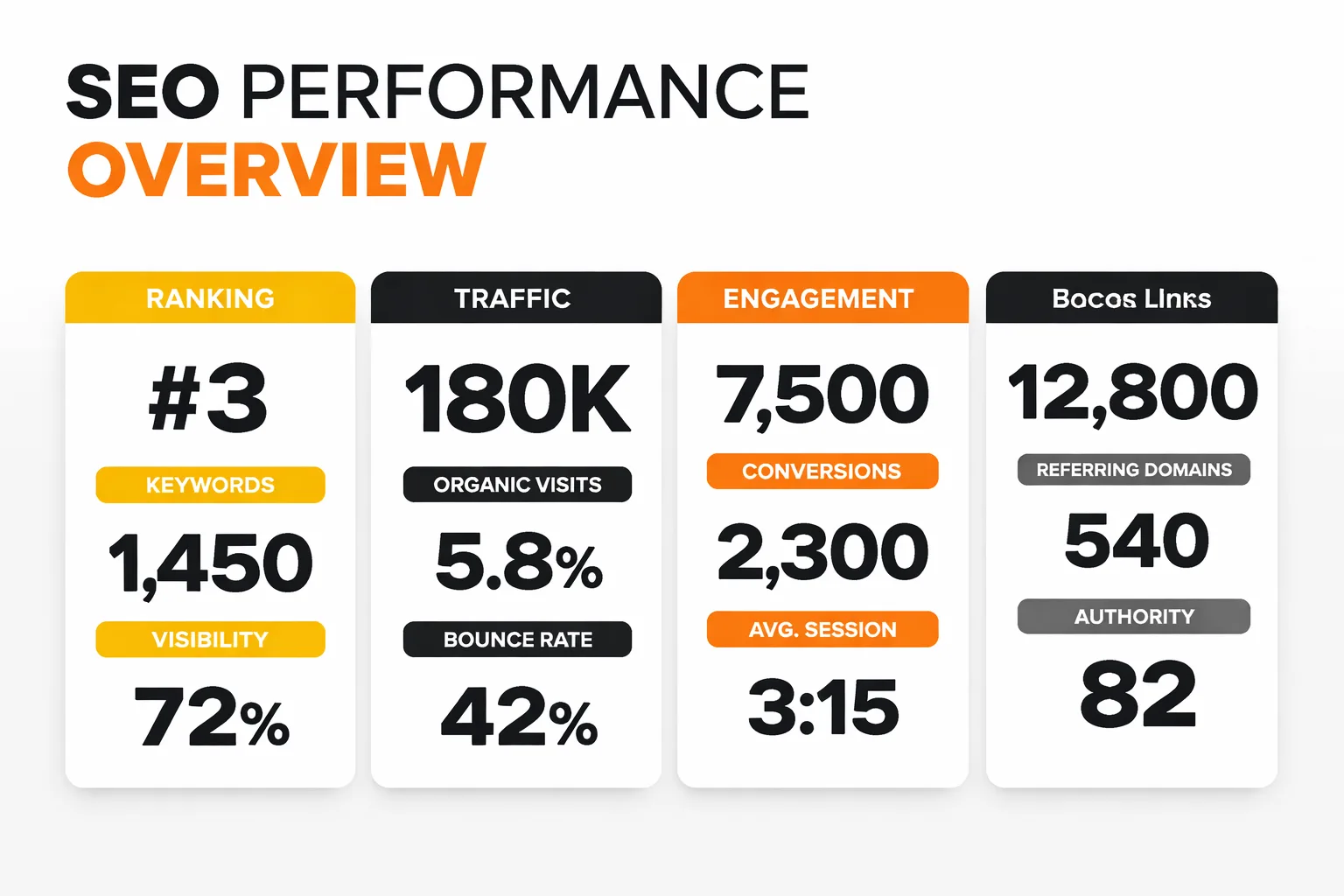
Here's the process I use, broken into five steps.
Step 1 — Crawl everything. Use a site crawler (Screaming Frog, Sitebulb, or equivalent) to export every indexed URL. Include blog posts, landing pages, resource pages, case studies, and any other content-type URLs. Don't filter anything out yet — you want the full picture.
Step 2 — Tag by format and funnel stage. This is manual work, and it's worth doing properly. For each URL, assign: (a) content format — article, video, interactive, PDF, landing page; (b) funnel stage — awareness, consideration, conversion, retention, advocacy; (c) primary keyword target if applicable; (d) date published and last updated. A simple spreadsheet works fine. Columns: URL | Title | Format | Funnel Stage | Primary Keyword | Published Date | Last Updated.
Step 3 — Pull performance data. Connect your spreadsheet to Google Search Console data (impressions, clicks, average position) and Google Analytics (sessions, conversions, time on page). If you have backlink data from Ahrefs or a similar tool, add referring domain count. Now you have a performance layer on top of your inventory.
Step 4 — Identify gaps. Sort your inventory by funnel stage. Where do you have 40 awareness pieces and 3 conversion pieces? Where are entire topic clusters missing consideration-stage content? Where are you targeting keywords with no content at all? The gaps tell you where to create. The underperformers tell you where to update or consolidate.
Step 5 — Prioritize actions. Every asset gets one of four labels: Update (good topic, outdated or thin — refresh and republish), Consolidate (multiple thin pieces on the same topic — merge into one authoritative piece), Create (gap with clear demand — build new), or Retire (no traffic, no backlinks, no strategic value — remove or redirect). In my experience, a typical content audit produces roughly 30% Update, 20% Consolidate, 30% Create, and 20% Retire. Your numbers will vary, but if you're not retiring anything, you're not being honest with yourself.
A note on E-E-A-T during your audit: Google's quality rater guidelines weight Experience, Expertise, Authoritativeness, and Trustworthiness as signals for how content is evaluated. When you're updating existing pieces, add explicit authorship — named author, credentials, date of last review. This is especially important for any content touching health, finance, legal, or technical domains. Anonymous content is increasingly a liability, not just a missed opportunity.
For teams considering whether to build this inventory process into an automated workflow, the comparison between Meev and Surfer SEO is worth reading — it covers the difference between tools built for manual SEO research versus platforms designed for automated, scalable content publishing with built-in performance tracking.
One final thing I want to name directly: the content inventory is not a one-time project. It's a quarterly discipline. Content decays — rankings drop, information goes stale, competitors publish better versions of your best pieces. The teams I've seen maintain consistent organic growth treat their content inventory the same way a financial team treats a balance sheet: something you review on a schedule, not something you build once and forget.
Marketing content, defined properly, is the engine of every digital business. But an engine with no maintenance schedule eventually stops running.
FAQ
What's the difference between marketing content and a marketing campaign?
A marketing campaign is a time-bound initiative with a specific goal — a product launch, a seasonal promotion, a lead generation push. Marketing content is the asset layer that campaigns are built from. A campaign might run for six weeks; the content assets created for it (landing pages, blog posts, video ads) may continue generating value long after the campaign ends.Does AI-generated content hurt your Google rankings?
It depends on quality and disclosure, not on AI involvement per se. Research on 487 competitive Google search results found 83% of top-ranking pages are not AI-generated, and documented cases show fully AI-generated pages being deindexed after core updates. Google's stated position is that AI content isn't inherently penalized — but content that is unhelpful, thin, or manipulative is, regardless of how it was produced.How many content formats should a small team focus on?
Two, maybe three. Trying to maintain a blog, YouTube channel, podcast, newsletter, and active social presence simultaneously with a team of fewer than five people produces mediocre output across all channels. Pick the formats where your audience actually spends time and where you can produce genuinely good work. Depth in two formats beats shallow presence in six.What is Answer Engine Optimization (AEO) and why does it matter for marketing content?
AEO is the practice of structuring content to appear in AI-generated answer surfaces — Google's AI Overviews, ChatGPT responses, Perplexity citations. Unlike traditional SEO, which optimizes for clicks to your page, AEO optimizes for being cited as a source within an AI-generated answer. It requires clear question-answer formatting, factual precision, structured data markup, and strong E-E-A-T signals. As AI search surfaces handle more informational queries, AEO becomes a distinct content discipline worth investing in.How do you measure content ROI beyond traffic?
Traffic is a vanity metric if it doesn't connect to revenue. The metrics that matter: organic-attributed leads (contacts who first touched your site via organic content), assisted conversions (content pieces that appeared in the conversion path but weren't the last touch), and customer acquisition cost by channel. For retention content, measure churn rate and product adoption rates among customers who engage with your help documentation versus those who don't. The difference is usually striking.How often should you update existing marketing content?
High-traffic pages targeting competitive keywords should be reviewed every 6 months. Lower-traffic evergreen content can be reviewed annually. Any content making specific claims about pricing, statistics, regulations, or product features should be reviewed whenever those facts change — not on a calendar schedule. A single outdated statistic on a high-authority page can undermine trust faster than you'd expect.What's the minimum viable content inventory for a new brand?
Focus on three assets before anything else: one strong awareness piece targeting your highest-volume informational keyword, one conversion page that clearly explains your offer and handles objections, and one retention asset (an onboarding email sequence or help document) for customers who just signed up. Everything else builds from there. Trying to fill every funnel stage simultaneously before you have product-market fit is a resource drain, not a strategy.See how Meev's automated publishing system maps content to funnel stages and tracks ROI — without the manual spreadsheet work.