

Stop presenting organic traffic graphs to your CFO and hoping they don't ask about revenue. Most SEO ROI reports are built on vanity metrics that don't move the needle, but calculating actual return doesn't require a degree in data science. Here is how to build a transparent, defensible ROI model that proves your content's value.
Who this is for: Content marketers, SEO leads, and anyone who has ever presented an organic traffic graph to a CFO and felt vaguely dishonest. By the end of this guide, you'll have a repeatable framework for calculating SEO ROI that holds up to scrutiny — and a dashboard you can actually defend in a budget meeting.
Key Takeaways
- Vanity metrics like impressions and keyword rankings are not SEO ROI — organic-attributed pipeline, tracked through GA4 and your CRM, is the only number that matters in a budget meeting.
- The honest ROI formula is: (organic-attributed revenue − total content investment) ÷ total content investment × 100 — and total investment must include in-house labor, tools, and AI overhead.
- AI-assisted content can cut cost-per-piece by 40–60%, but fully automated content with no human editorial review loses 30–50% of peak traffic within 12 months, erasing those savings.
- Zero-click searches and AI Overviews are structurally compressing click volume — apply a 15–25% reduction to expected clicks on informational keywords or your ROI model will systematically overstate returns.
TLDR
- Vanity metrics like impressions and raw traffic are not SEO ROI — organic-attributed pipeline is.
- The honest ROI formula is: (organic-attributed revenue − total content investment) ÷ total content investment × 100.
- AI-assisted content can cut cost-per-piece by 40–60%, but only if quality controls prevent the traffic losses that erase those savings (source).
- Zero-click searches and AI Overviews are compressing organic click volume — your ROI model must account for this or it will overstate returns.
Why Are Most SEO ROI Reports Meaningless?
Most SEO ROI reports are built to survive a Slack message, not a board meeting. They lead with impressions, celebrate ranking for keywords that never convert, and quietly omit the full cost of producing the content that drove those rankings. I've sat in enough quarterly reviews to know the pattern: the deck looks great, leadership nods, and six months later someone asks why organic revenue is flat despite "record traffic."
The three most common ways SEO teams inflate their numbers are so normalized they barely register as dishonest anymore. First, attributing 100% of organic revenue to SEO — ignoring that a paid retargeting ad, a sales email, or a referral from a partner may have closed the deal. Last-click attribution in GA4 will happily give SEO full credit for a conversion that touched six other channels. Second, omitting content production costs entirely. I see this constantly: an ROI calculation that counts tool spend and agency fees but treats in-house writing hours as free. They're not free. A senior content strategist's time has a fully-loaded cost, and if you're not including it, your ROI number is fiction. Third — and this one is getting worse — using impressions or keyword rankings as proxies for business impact. Ranking #1 for a 10,000-search-per-month keyword sounds impressive until you account for the fact that Google's AI Overviews are now absorbing a meaningful share of those clicks before users ever reach your page. Impressions are not revenue. Rankings are not revenue. Pipeline is revenue.
The honest version of SEO reporting is harder to build and less flattering in the short term. It's also the only version that builds durable trust with leadership — which is the only thing that protects your budget when rankings dip.
What Inputs Do You Need for Calculating SEO ROI?
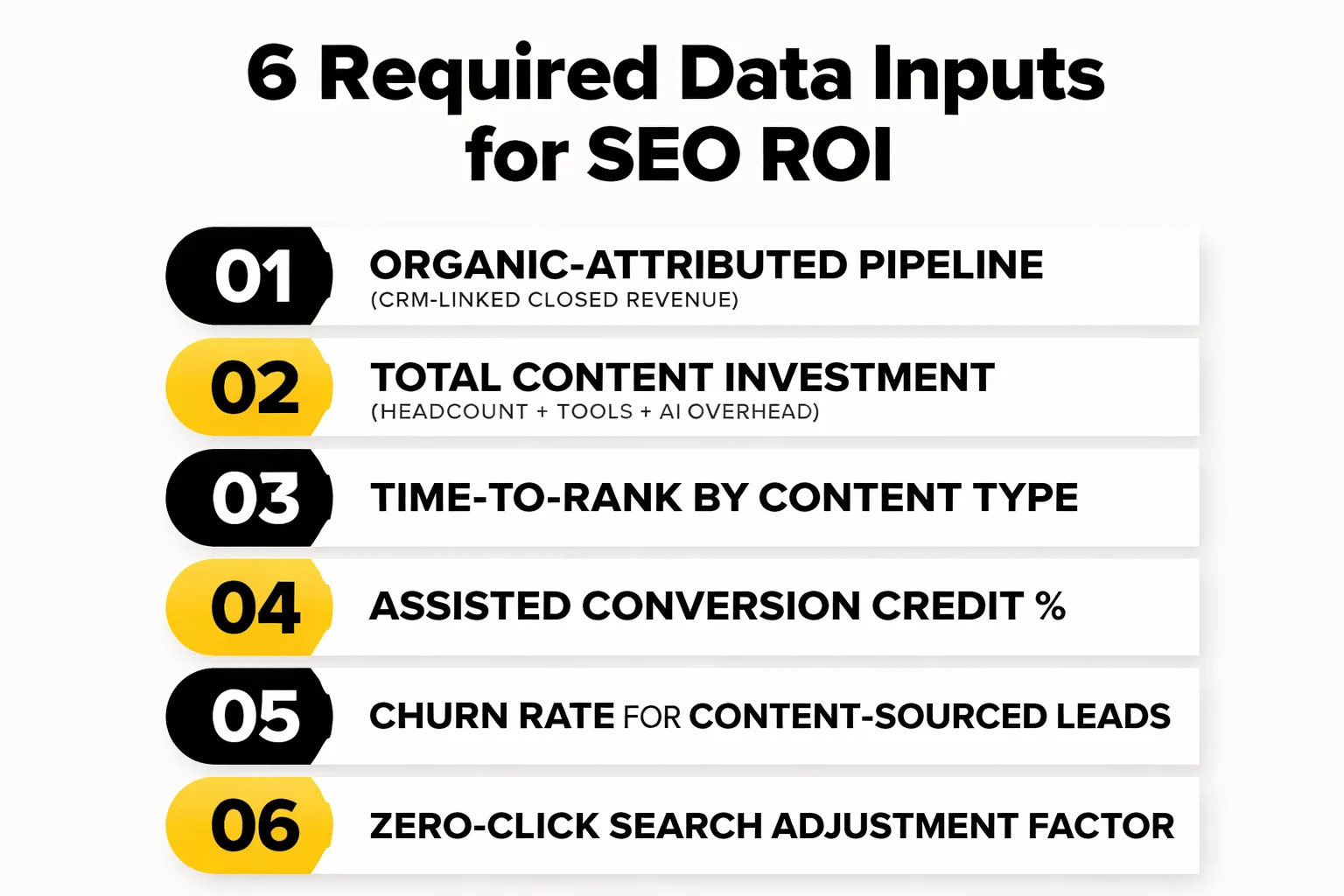
Calculating SEO ROI honestly requires pulling data from at least three systems most content teams treat as separate. Here's the exact list:
1. Organic-attributed pipeline (not just traffic) In GA4, set up a custom channel group that isolates organic search. Then connect it to your CRM — HubSpot, Salesforce, whatever you're using — to track how many leads that entered via organic search eventually became closed revenue. This is your numerator.
2. Total content investment This has to include everything: writer fees or in-house salary allocation, editor time, SEO tool subscriptions (Ahrefs, Semrush, GSC integrations), AI tool costs, design and publishing overhead, and the time a strategist spends on briefs and QA. If you're using an AI writing tool, include that monthly cost and divide it across the pieces it contributed to. Omitting any of these makes your ROI look better than it is.
3. Time-to-rank This matters because SEO is a delayed investment. A piece published in January may not generate meaningful traffic until April. Your ROI calculation should use a rolling 90-day or 180-day window, not a calendar month, or you'll systematically undervalue content that's still building momentum and overvalue recent content that hasn't proven itself yet.
4. Assisted conversion credit Not every organic visit that converts was the deciding touchpoint. Pull the "Path exploration" report in GA4 to see how often organic search appears in multi-touch conversion paths without being the last click. A reasonable approach: give organic full credit when it's the first AND last touch, and 50% credit when it appears in the middle of a longer path. This is still imprecise, but it's more defensible than last-click-only.
5. Churn rate for content-sourced leads If your business has subscription or repeat-purchase revenue, content-sourced customers often have different retention profiles than paid-ad customers. Track this separately. In some categories, organic leads churn 20–30% less — that's a meaningful ROI multiplier that almost nobody includes.
6. Zero-click and AI Overview adjustment This is the input most teams skip entirely, and it's becoming the most important one. If your target keywords are being answered directly in AI Overviews or featured snippets, your click-through rate will be structurally lower than historical benchmarks suggest. Build in a conservative 15–25% reduction to your expected click volume for informational keywords, and adjust your traffic-to-pipeline conversion assumptions accordingly.
What Is the Simple Formula for Calculating SEO ROI?
SEO ROI is calculated as: (organic-attributed revenue − total content investment) ÷ total content investment × 100.
That's the formula. Here's what it looks like with real numbers.
Say your content team published 20 articles over a quarter. Total investment: $18,000 (writer fees, editor time, tools, AI subscriptions, strategy hours). Over the following 180 days, GA4 and your CRM show that organic search contributed to $72,000 in closed revenue — using the assisted-conversion methodology above, you apply full credit to $48,000 and 50% credit to $48,000 of assisted pipeline, landing at roughly $72,000 in organic-attributed revenue.
The math: ($72,000 − $18,000) ÷ $18,000 × 100 = 300% SEO ROI.
That's a real, defensible number. Not "we got 400,000 impressions." Not "we rank for 200 keywords." Three hundred percent return on a documented investment, with the methodology visible and auditable.
One adjustment worth making explicit: if your content also generates brand awareness or topical authority that you can't directly attribute to pipeline — think comparison guides, category explainers, or thought leadership — don't try to force a revenue number onto it. Instead, track it separately as a "topical authority" investment with its own metrics (share of voice, branded search growth, AI citation frequency). Mixing attributable and non-attributable content in the same ROI calculation muddies both numbers. As a Head of Content Strategy, I've found that keeping these two buckets separate actually makes the attributable ROI look better — because you're not diluting it with content that was never meant to convert directly.
A note on the SEO tool stack you're using: the accuracy of your ROI calculation is only as good as your tracking setup. If your GA4 conversion events aren't firing correctly, or your CRM isn't capturing the organic source on inbound leads, you're not calculating ROI — you're estimating it with extra steps.
Tired of building ROI reports that don't survive a CFO's first question?
How AI Content Changes the ROI Math
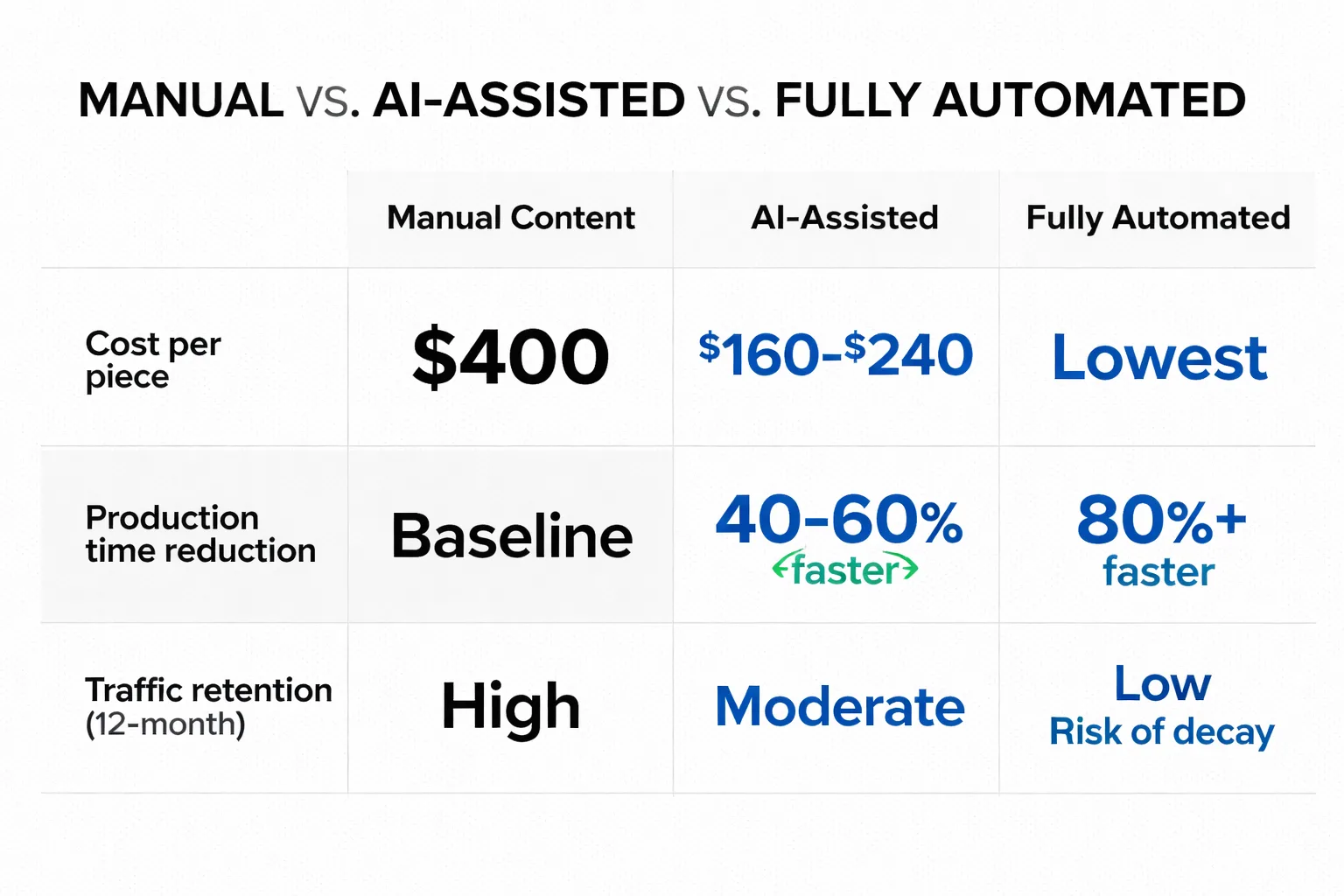
AI-assisted content production has genuinely changed the cost side of the ROI equation — but not always in the direction teams assume.
The cost-per-piece reduction is real. A well-structured AI-assisted workflow — brief, AI draft, human edit, SEO QA — can cut production time by 40–60% compared to fully manual. If a manually written article costs $400 in combined labor and tools, an AI-assisted equivalent might land at $160–$240. At scale, that compression is significant. For a team publishing 50 articles a month, the savings can run into tens of thousands of dollars annually.
But here's what the math doesn't show on its own: quality-related traffic losses can erase those savings faster than the cost reduction accumulates. I've watched content teams celebrate a 50% reduction in cost-per-piece while their organic traffic quietly declined because the AI output was thin, repetitive, or factually imprecise — the exact signals Google's quality raters flag. The cost side improved; the revenue side collapsed. Net ROI: negative.
The benchmark I use when evaluating AI content programs is 12-month traffic retention. Fully manual content, when well-researched, tends to hold or grow traffic over 12 months. Human-edited AI content, when the editing is substantive (not just a light proofread), performs comparably. Fully automated AI content with no meaningful human review shows a steeper decay curve — often losing 30–50% of peak traffic within a year as Google's systems catch up. That decay has a direct ROI impact that doesn't show up in your Q1 numbers but absolutely shows up in Q4.
One more cost that almost nobody accounts for: the overhead of managing AI tools. Prompt engineering, workflow QA, fact-checking passes, hallucination review — these are real labor costs. If you're building an honest ROI model, include them. A useful reference point here is the case study of a small business that achieved a 5X SEO ROI — notably, that result came from focused, quality-driven content rather than volume-based automation. Scale matters less than signal quality.
The honest AI content ROI position: AI assistance improves ROI when it's used to accelerate research, structure, and first drafts — with humans maintaining editorial control over accuracy and depth. It degrades ROI when it's used to replace editorial judgment entirely.
How Do You Build a Monthly ROI Dashboard in Under an Hour?
You don't need a BI tool or a data engineering team. Here's the exact setup I use with content teams that need to report SEO ROI to non-technical stakeholders.
Step 1: Pull organic conversion data from GA4 Go to Reports → Acquisition → Traffic acquisition. Filter by "Organic Search" as the session default channel group. Then navigate to Conversions and set your primary conversion event (form submission, demo request, purchase — whatever maps to revenue). Export this monthly.
Step 2: Connect to your CRM revenue data In HubSpot or Salesforce, filter closed-won deals by "original source = organic search" for the same period. This gives you the revenue figure. Cross-reference with GA4 to catch any attribution gaps. The number won't be perfect — attribution never is — but it will be directionally accurate and auditable.
Step 3: Build your cost tracker in a spreadsheet Create a simple table with these columns: Month | Articles Published | Writer Cost | Editor Cost | Tool Cost (prorated) | AI Tool Cost (prorated) | Strategy Hours × Hourly Rate | Total Investment. Sum the Total Investment column monthly.
Step 4: Calculate ROI in one cell In a new column: =(Organic Revenue − Total Investment) ÷ Total Investment × 100. Format as a percentage. That's your monthly SEO ROI. Run it as a trailing 6-month average to smooth out the time-to-rank delay.
Step 5: Add a zero-click adjustment row For any month where you're tracking keywords heavily affected by AI Overviews or featured snippets, apply a 15–20% reduction to your expected traffic-to-conversion rate. Flag this row visually so stakeholders understand it's a conservative adjustment, not a data error.
Presenting to non-technical stakeholders: Lead with the ROI percentage and the revenue number. Put the methodology on a second tab — available if asked, not front-and-center. The single chart that works best in executive presentations is a bar chart showing monthly organic-attributed revenue stacked against monthly content investment, with the ROI line overlaid. It makes the compounding nature of SEO visible in a way that a traffic graph never does.
One thing I've learned the hard way: never present SEO ROI without also presenting the confidence interval. Something like "our attribution model captures approximately 70–80% of organic-influenced revenue" signals analytical honesty and preempts the inevitable "but how do you know?" question from a CFO who's seen too many inflated marketing decks.
Calculating SEO ROI honestly isn't just an analytics exercise — it's a trust-building practice. The teams that report conservatively and accurately in year one are the ones that get budget increases in year two, because leadership has learned their numbers mean something.
FAQ
What is a good SEO ROI benchmark?
There's no universal benchmark, but a commonly cited range for mature SEO programs is 200–500% ROI over a 12-month period. Early-stage programs (under 12 months) often show negative ROI due to the time-to-rank delay — this is normal and should be communicated upfront.How do I calculate SEO ROI if I don't track revenue in GA4?
Start by assigning a value to your primary conversion event. If a demo request closes at a 20% rate and your average deal is $5,000, each demo is worth $1,000. Multiply that by your organic-sourced demo volume. It's an estimate, but it's a grounded one you can defend.Should I include brand content in my SEO ROI calculation?
No — keep it separate. Topical authority content (comparison guides, educational explainers) serves a different function than conversion-focused content. Mixing them dilutes your attributable ROI number and makes it harder to make the case for either type of investment.How does AI content affect SEO ROI?
AI-assisted content reduces cost-per-piece by 40–60% in well-run workflows, which improves ROI on the cost side. But fully automated content with no human editorial review tends to lose 30–50% of peak traffic within 12 months, which destroys the revenue side. Net ROI depends entirely on the quality of your human editing layer.How do I account for zero-click searches in my ROI model?
Apply a 15–25% reduction to expected click volume for informational keywords that are likely to trigger AI Overviews or featured snippets. Track your actual CTR in Google Search Console monthly and adjust the factor as your data accumulates.What's the biggest mistake teams make when calculating content ROI?
Omitting in-house labor costs. If your content strategist, editor, and SEO lead each spend 20 hours a month on content — and you're not including their fully-loaded hourly cost — your ROI number is overstated by a significant margin. Every hour has a cost; the honest model includes all of them.How often should I report SEO ROI?
Monthly tracking with quarterly reviews is the right cadence. Monthly data catches anomalies early. Quarterly reviews give enough time-to-rank runway to show meaningful trends. Avoid weekly ROI reporting — the signal-to-noise ratio is too low to be useful.How do I handle SEO ROI for non-transactional content?
For content that builds topical authority or brand awareness without a direct conversion path, track share of voice, branded search volume growth, and AI citation frequency (how often your content is referenced in AI-generated answers). Report these separately from revenue-attributed ROI, with their own investment line.Meev helps content teams track what actually moves the needle — from cost-per-piece to organic-attributed pipeline — so your next budget meeting has real numbers behind it.