

By Judy Zhou, Head of Content Strategy
Key Takeaways
- Most AI content platforms stop at publish — only Meev natively tracks citations across 8 AI surfaces including ChatGPT, Perplexity, Gemini, and DeepSeek.
- Google's Helpful Content System penalizes 'little or no value to users,' not automation itself — a quality gate that blocks weak drafts before CMS publish is the only reliable defense at scale.
- Reddit accounted for 24% of all Perplexity citations in January 2026 (Tinuiti), growing 73% across commercial categories since October 2025 — publishing volume alone does not drive AI citation rates.
- The right evaluation metric for AI content platforms in 2026 is cost-per-cited-article, not cost-per-article — a platform publishing 100 uncited articles has infinite ROI on the metric that matters.
Maya had published over 200 articles in six months using one of the most popular AI content platforms on the market. Her auto-blog engine was humming, her CMS was full, and her editorial calendar was planned through Q3. Then she ran a simple test: she asked Perplexity, ChatGPT, and Google's AI Overview to answer the ten core questions her content was designed to address. A competitor cited in seven of them. An industry newsletter cited in four. Maya's site. With its 200 carefully scheduled posts. Cited in exactly zero. That moment rewrote how she thought about AI-powered content creation entirely.
Most ai powered content creation platforms sold in 2026 are optimized for output volume, not citation potential. Google's Helpful Content System now treats 'SEO-first' content as a documented negative ranking factor, per Google's own search guidance. The Tinuiti Q1 2026 AI Citations Trends Report found that Reddit's citation share in Perplexity grew 73% across commercial categories from October 2025 to January 2026, with Reddit accounting for 24% of all Perplexity citations in January 2026 — more than most brand content combined. Ahrefs' research across 75,000+ brands found that topical authority and domain trust, not publishing volume, predict AI citation rates across ChatGPT, Google AIO, Perplexity, and Gemini. The platforms that actually move the needle in 2026 are the ones that connect content generation to AI search visibility outcomes. Not just word counts.
What Separates a Real AI Content Platform from a Glorified Text Spinner
The phrase "ai content creation platform" covers an enormous range. At one end: a text spinner that wraps GPT-4 in a UI and charges $49/month. At the other: a system that generates fact-verified articles, gates them through quality scoring, publishes them across multiple CMSs, and then tracks whether any of that content actually gets cited by ChatGPT, Perplexity, or Google's AI Overviews. Those are not the same product. Buyers conflate them constantly, and the cost of that confusion is real: 200 articles, zero citations, and a content calendar that looks productive but isn't.
In 2026, I'd argue a real ai powered content creation platform needs to clear four bars before it earns that label.
First, quality gating. Publishing whatever the model produces is not a strategy. It's a liability. Google's Helpful Content System doesn't penalize automation; it penalizes content that provides little or no value to users. The distinction matters enormously. A platform with a quality firewall that blocks weak drafts before they reach your CMS is structurally different from one that ships everything and lets you sort it out. Cyrus Shepard's analysis of Google's Helpful Content System notes that 'SEO-first content' is a documented negative factor. But Google never clearly defines it, which means practitioners have to infer penalties through performance audits after the damage is done. A quality gate upstream of publishing is the only reliable defense.
Second, E-E-A-T signals. Author entity profiles, outbound citations to authoritative sources, and fact-verified claims are not nice-to-haves. They're the structural difference between content that builds trust over time and content that erodes it. Platforms that let you publish anonymously, without source attribution, are setting you up for a slow-motion credibility collapse.
Third, CMS integration depth. Copy-paste workflows are a tax on every article you publish. Real platforms push directly to WordPress, Ghost, Shopify, Wix, or custom webhooks. With schema markup, internal linking, and sitemap pings handled automatically.
Fourth, and this is the one most platforms skip entirely: AI search visibility tracking. If you can't see whether your content is being cited by ChatGPT, Perplexity, or Google AI Overviews, you're flying blind on the metric that will define content ROI for the next several years. Generative Engine Optimization (GEO) is no longer a future concern. It's the present competitive surface.
How We Evaluated These Platforms
The evaluation criteria I used here reflect how I think about content infrastructure in my work leading content strategy at Meev, where we oversee AI-driven publishing across hundreds of brands. Volume capacity is the last thing I look at. Here's what I actually weighed.
Content quality scoring. Does the platform gate output against measurable quality criteria, or does it ship whatever the model generates? Platforms without a quality threshold are auto-blog engines in the pejorative sense.
AI citation potential. Does the platform produce content structured for extraction by AI engines. With Q&A formatting, schema markup, outbound citations, and answer-dense openers? And does it track whether that content is actually getting cited?
Auto-publishing workflows. End-to-end means keyword discovery through CMS publish, not "we generate the draft and you handle the rest." I looked for IndexNow integration, GSC sitemap submission, and calendar-based scheduling.
Scaled content abuse avoidance. This is the filter most buyers skip. Publishing 500 thin articles is worse than publishing 50 good ones. Platforms that enable high-volume publishing without quality gates are actively dangerous to use at scale.
E-E-A-T signals. Author profiles, source citations, knowledge base retrieval, and fact verification. These aren't decorative. They're the structural inputs that determine whether Google treats your content as trustworthy.
Pricing transparency. If I can't find the price without booking a demo, that's a signal about the product's relationship with its customers.
Comparison Table
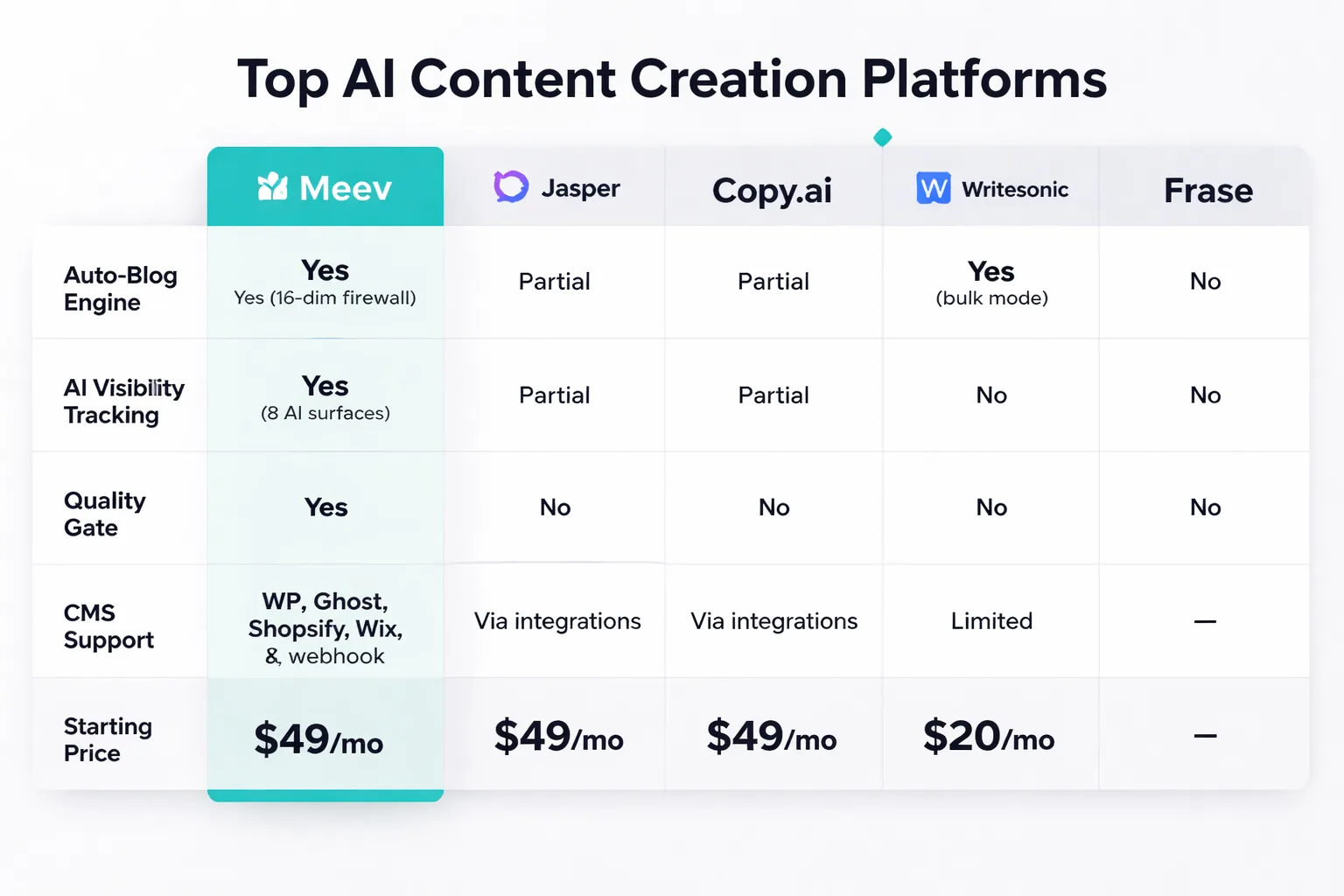
The table below covers the dimensions that matter for shortlisting. "AI Visibility Tracking" means the platform monitors whether your content is cited by LLMs. Not just whether it ranks on Google.
| Platform | Auto-Blog Engine | AI Visibility Tracking | Quality Gate | CMS Support | Starting Price |
| Meev | Yes (16-dim firewall) | Yes (8 AI surfaces) | Yes | WP, Ghost, Shopify, Wix, webhook | $49/mo |
| Jasper | Partial | No | No | Via integrations | $49/mo |
| Copy.ai | Partial (GTM workflows) | No | No | Via integrations | $49/mo |
| Writesonic | Yes (bulk mode) | No | No | Limited | $20/mo |
| Frase | No | No | No | No native publish | $15/mo |
| Surfer SEO | Partial (1-click gen) | No | No | No native publish | $19/mo |
| RightBlogger | Yes | No | No | WP, Webflow, Ghost, Wix, Shopify, Duda | $29.99/mo |
| Anyword | No | No | No | Via integrations | $49/mo |
| Rytr | No | No | No | Browser ext only | $9/mo |
| ContentBot | Partial | No | No | WordPress | $19/mo |
1. Meev — Best for AI visibility + quality-gated auto-publishing
Best for: Content teams, agencies, and solo founders who need a single platform covering quality-gated auto-publishing, AI search visibility tracking across 8 LLM surfaces, and citation outreach. Without stitching together four separate tools.
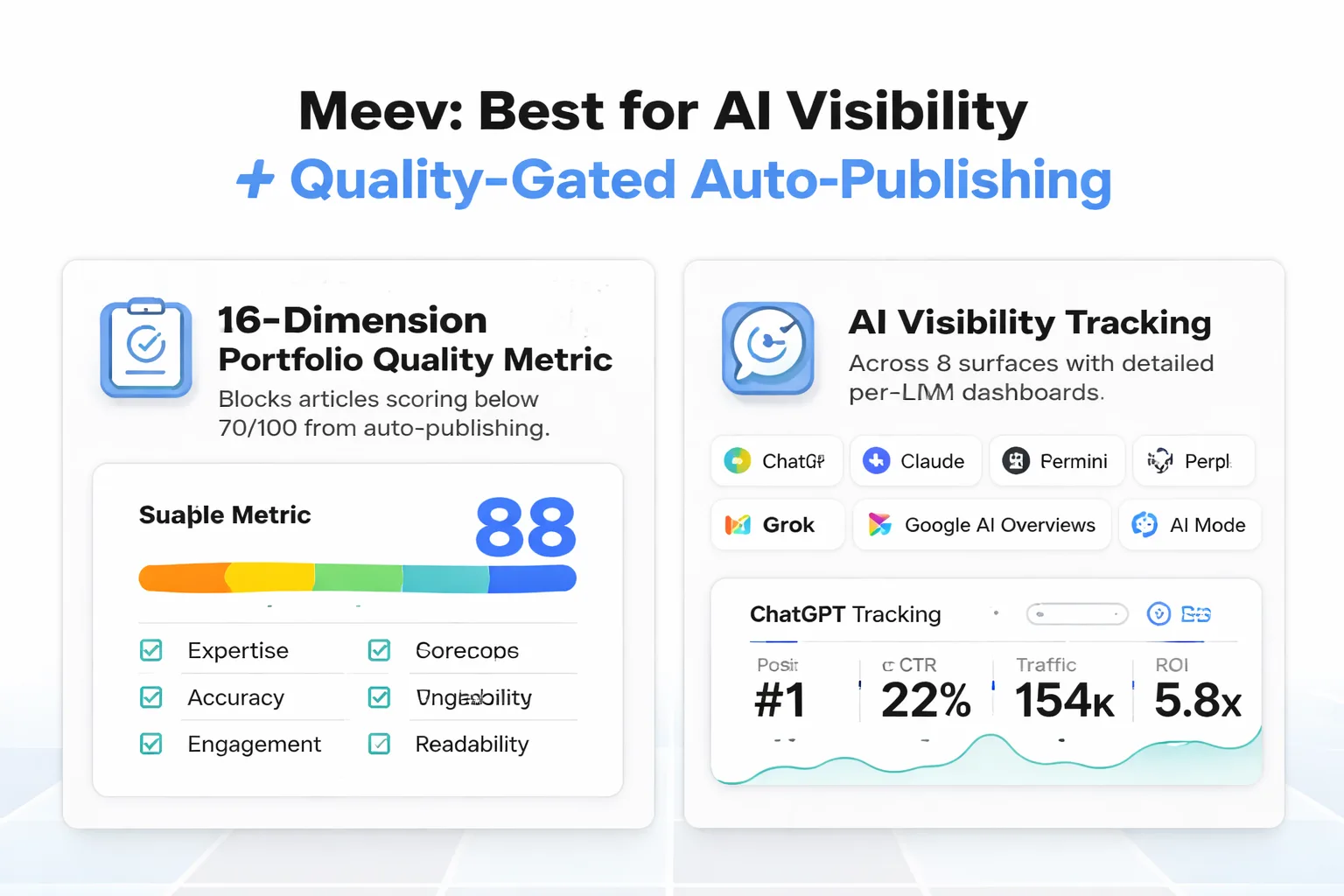
Meev is the only platform in this list that closes the loop between content generation and AI citation tracking. Every other tool stops at publish. Meev tracks what happens after: whether ChatGPT, Claude, Gemini, Perplexity, Grok, Google AI Overviews, AI Mode, or DeepSeek actually cites your content, where in the answer your brand appears, and which competitors are getting cited instead.
Key features: - 16-dimension Portfolio Quality Metric blocks articles scoring below 70/100 from auto-publishing. The only quality firewall of its kind in the auto-blog space. AI visibility tracking across 8 surfaces (ChatGPT, Claude, Gemini, Perplexity, Grok, Google AI Overviews, AI Mode, DeepSeek) with per-LLM drill-down dashboards and weekly trend sparklines. Citation Path workflow: finds publishers AI engines cite for your topics, resolves verified contacts, and drafts personalized outreach pitches grounded in your knowledge base. IndexNow + Google Search Console sitemap submission on every publish, plus multi-platform CMS support (WordPress, Ghost, Shopify, Wix, custom webhook)
Pricing: Lite at $49/month (10 articles, 10 prompts); Starter at $99/month (30 articles); Pro at $269/month (80 articles, 5 domains, Citation Path); Agency at $599/month (150 articles, 15 domains, 10 seats). Annual billing saves 20%.
The honest assessment: Meev is the right tool if AI search visibility is a business priority, not just a content production quota. The quality firewall means you'll publish less than a raw auto-blogger. But what you publish will be structurally designed to get cited, not just indexed. For agencies managing multiple client domains, the multi-domain dashboard and white-label reporting at the Agency tier are genuinely differentiated. For a detailed feature comparison, the Meev vs Surfer SEO breakdown covers the auto-blogging tradeoffs directly.
2. Jasper — Best for enterprise brand governance
Best for: Mid-market to enterprise marketing teams with strict brand governance requirements producing dozens of assets weekly across multiple channels.
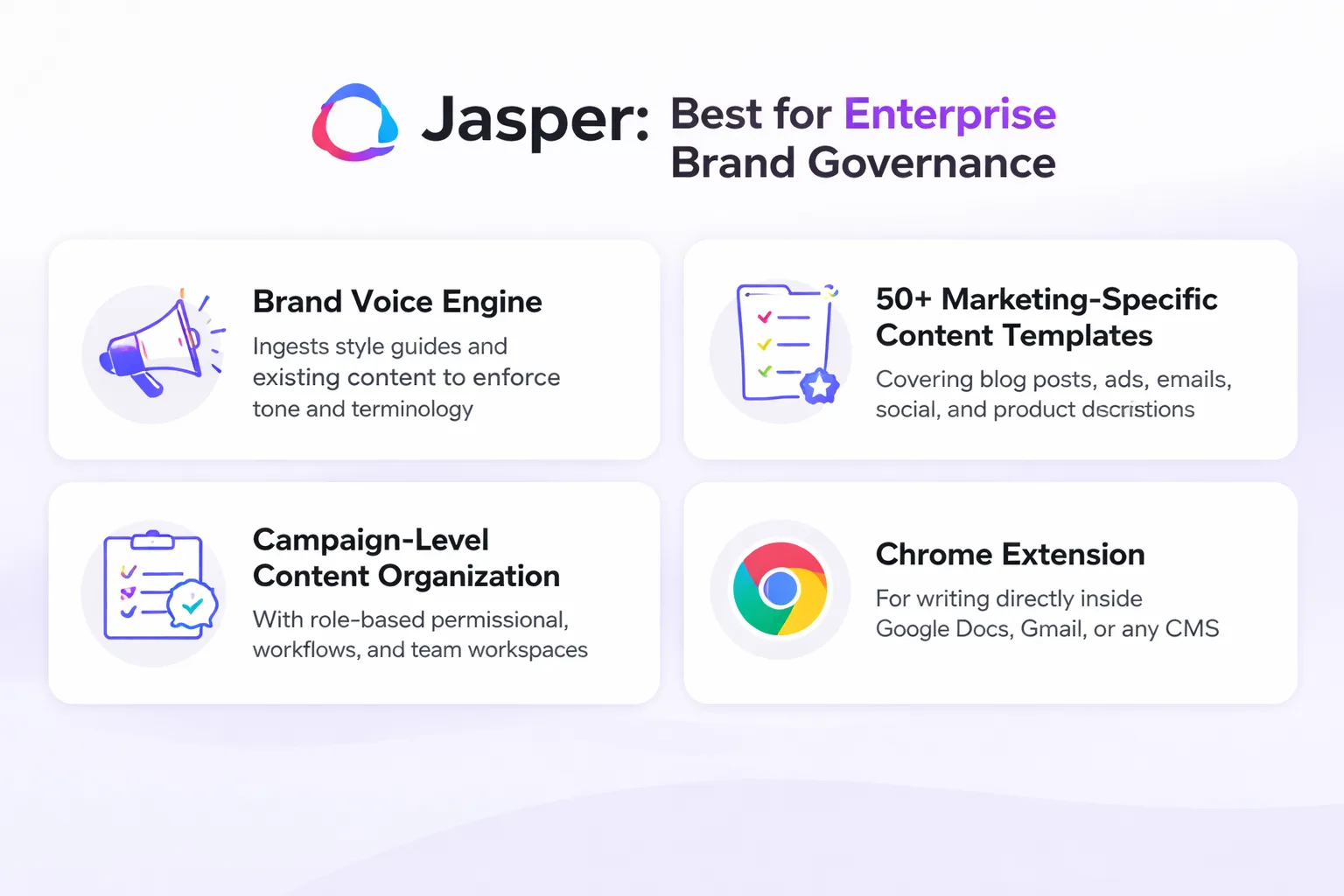
Jasper built its reputation on brand voice enforcement, and in 2026 that's still its strongest card. The Brand Voice Engine ingests your style guides and existing content to maintain tone consistency at scale. A genuine operational advantage for teams where off-brand copy creates legal or compliance exposure.
Key features: - Brand Voice Engine: ingests style guides and existing content to enforce tone and terminology across all team outputs. 50+ marketing-specific content templates covering blog posts, ads, emails, social, and product descriptions. Campaign-level content organization with role-based permissions, approval workflows, and team workspaces. Chrome extension for writing directly inside Google Docs, Gmail, or any CMS without tab-switching
Pricing: Creator plan starts at $49/month; Pro plan from $69/month (up to 5 seats, 3 brand voices); Business/Enterprise tier custom-quoted, typically starting around $499/month with Content Pipelines and AI App Builder.
Jasper has no native AI visibility tracking or GEO/LLM citation monitoring. If you need to know whether your content is being cited by Perplexity or Google AI Overviews, you'll need a separate tool. Per-seat pricing also escalates quickly for larger teams, and the Business tier requires a sales conversation. It's excellent for what it does; it just doesn't do the citation-awareness work that defines the 2026 competitive surface.
3. Copy.ai — Best for GTM automation teams
Best for: Growth-stage and enterprise GTM teams where content creation, sales enablement, and marketing automation need to operate from a single AI-powered workflow platform.
Copy.ai has repositioned hard toward go-to-market automation, and the pivot is coherent. If your content team is deeply integrated with sales. Generating outreach sequences, CRM-personalized emails, and campaign assets from the same workflow. Copy.ai's multi-step automation builder is genuinely powerful.
Key features: - Multi-step AI workflow builder: chain research, content creation, and distribution tasks without manual handoffs. 90+ copywriting tools and GTM workflow templates covering ads, emails, product descriptions, and social content. CRM integrations (Salesforce, HubSpot) that pull prospect data for contextually personalized content at scale. Infobase: central brand knowledge repository ensuring consistent voice and product details across all outputs
Pricing: Free tier with 2,000 words/month; Starter/Pro plans from $49/month with unlimited words and workflow access; Enterprise pricing custom. Annual billing saves approximately 20%.
Pure content marketers focused on blog-first workflows may find Copy.ai over-engineered for their needs. The GTM repositioning means the product's center of gravity is sales enablement, not SEO or AI search visibility. There's no native GEO optimization, no LLM citation tracking, and no auto-publishing to CMS. Strong tool for the right use case; wrong tool if your primary goal is organic AI search presence.
4. Writesonic — Best for high-volume SMB teams
Best for: Content teams and SMBs producing high volumes of diverse content formats who need predictable word-based pricing and multi-model flexibility without paying enterprise rates.
Writesonic's multi-model switching. Between GPT-4, Claude, and other LLMs. Gives content teams flexibility that single-model platforms can't match. For teams that produce diverse format mixes (blog posts, ads, social, product copy), the 100+ template library covers most use cases without requiring custom workflow setup.
Key features: - Multi-model switching between GPT-4, Claude, and other LLMs based on content type and quality requirements. Chatsonic: conversational AI assistant with real-time web search and image generation bundled into the platform. 100+ content templates spanning blog posts, ads, social media, emails, and product descriptions. Bulk generation mode for creating multiple articles simultaneously. Suited for high-volume auto-blog engine workflows
Pricing: Free tier at 10,000 words/month; Individual plan at $20/month (100,000 words); Teams plan at $99/month (400,000 words). Word limits reset monthly; additional words purchasable on demand.
Word-limit pricing creates cost unpredictability for teams with variable monthly output. More importantly, Writesonic has limited native SEO or GEO optimization depth. Bulk generation without quality scoring is the pattern that gets sites penalized under Google's Helpful Content System. Use it for volume; pair it with a quality audit process if you're publishing at scale.
5. Frase — Best for research-first content teams
Best for: Solo content creators and small teams who want data-driven, research-backed content workflows optimized for both traditional search and AI answer engines without paying enterprise prices.
Frase's core strength is the research phase. Before a word gets written, it analyzes the top-ranking SERP pages, extracts topics and content gaps, and builds an NLP-driven brief. That front-loaded research discipline produces content that's structurally informed by what's actually ranking. Which is a meaningful advantage over platforms that generate from a prompt alone.
Key features: - Automated SERP research: analyzes top-ranking pages to extract topics, questions, and content gaps before writing begins. AI content briefs with NLP-driven outlines, keyword targets, and competitive structure recommendations. Answer Engine Optimization (AEO) features that structure content specifically for featured snippets and AI-generated search results. Real-time content scoring and optimization suggestions as you write, benchmarked against top-ranking competitors
Pricing: Solo plan at $15/month (4 articles); Basic plan at $45/month (30 articles); Team plan at $115/month (unlimited articles). Free trial available.
Frase's article limits on lower tiers (4/month on Solo) make it impractical for high-frequency auto-blogging. It also has no native CMS publishing, no AI visibility tracking, and no LLM citation monitoring. It's a research and brief-generation tool that happens to include AI writing. Excellent at that job, limited outside it. The Meev vs Frase comparison breaks down where the two tools diverge on auto-blogging depth.
6. Surfer SEO — Best for topical authority building
Best for: SEO strategists, content directors, and established sites focused on building topical authority and outranking competitors through data-driven, quality-gated content publishing.
Surfer SEO's Content Editor is the most mature real-time NLP scoring tool in this list. Writing against a live benchmark of top-ranking competitors. With keyword density, heading structure, and information gain signals updating as you type. Produces articles that are structurally competitive from the first draft. The one-click AI article generation informed by live SERP data is a genuine workflow accelerator.
Key features: - Content Editor with real-time NLP scoring that benchmarks your article against top-ranking competitors as you write. Keyword Analyzer with competitive difficulty scoring and content gap identification for topical authority building. One-click AI article generation informed by live SERP data, competitive keyword analysis, and information gain signals. Auto-interlinking suggestions and on-page SEO recommendations built directly into the writing workflow
Pricing: Essential plan at $19/month; Scale plan at $49/month; Scale AI at $79/month; Enterprise custom. Annual billing available with savings.
Surfer SEO optimizes for traditional Google search. It has no native GEO features, no LLM citation tracking, and no AI visibility monitoring for Perplexity or ChatGPT. Higher tiers are required to unlock AI writing and bulk generation. If your primary goal is Google rankings and topical authority, it's excellent. If you're trying to track DeepSeek visibility or Grok citation patterns, you'll need additional tooling.
Want to see whether your current content is actually getting cited by ChatGPT, Perplexity, or Google AI Overviews?
7. RightBlogger — Best for solo multi-site operators
Best for: Solo founders, bloggers, and small agencies managing content across multiple sites who need a quality-gated, end-to-end auto-blog engine without stitching together separate tools.
RightBlogger is the most complete end-to-end auto-blog engine for solo operators in this list. The full workflow. Keyword research through long-form generation through bulk scheduling through multi-CMS publish. Runs inside a single platform, and the $29.99/month entry price makes it accessible for operators managing several smaller sites.
Key features: - Full auto-blog engine workflow: keyword research → long-form article generation → bulk scheduling → multi-CMS auto-publishing in one platform. MyTone brand voice training for matching your specific writing style across all generated content. Built-in AI image generation included with articles. No separate image tool subscription required. YouTube video and podcast repurposing: converts existing media into SEO-optimized blog posts automatically
Pricing: Plans start at $29.99/month with unlimited word use on paid tiers. Annual billing available. Free trial offered.
RightBlogger has no native AI visibility tracking or LLM citation monitoring. For enterprise teams needing approval workflows, role-based permissions, or brand governance at scale, it's undersized. But for a solo operator running a portfolio of content sites who needs hands-off publishing to WordPress, Webflow, Ghost, Wix, Shopify, and Duda simultaneously, it's the most practical option at this price point.
8. Anyword — Best for performance marketers
Best for: Performance marketers and paid media teams who need AI-generated copy validated by conversion prediction data before deploying to ads, landing pages, or email campaigns.
Anyword's Predictive Performance Score is the differentiator that no other platform in this list has: it estimates conversion likelihood for different copy variations before you publish, based on historical performance data. For paid media teams where copy decisions have direct budget implications, that pre-publish validation is genuinely valuable.
Key features: - Predictive Performance Score: estimates conversion likelihood for different copy variations before publishing, based on historical performance data. Brand Voice customization with style guide ingestion for consistent tone across all content types. Multi-format generation covering ads, landing pages, email campaigns, blog posts, and social content. A/B copy variation generation with performance prediction to identify highest-converting messaging before spend
Pricing: Starter plan at $49/month (1 seat, unlimited words); Data-Driven Teams plan at $99/month; Enterprise custom. Annual billing available.
Anyword's conversion prediction models are most accurate for ad and email copy. Their validation for long-form SEO or GEO content performance is less established. There's no auto-blogging, no CMS auto-publishing, and no AI visibility tracking. It's a specialized tool for a specific buyer profile; wrong choice if content volume or AI search presence is the goal.
9. Rytr — Best for budget-constrained solo creators
Best for: Freelance writers, solo founders, and small business owners with limited budgets who need a reliable AI writing assistant for short-to-medium-form content without committing to premium platform pricing.
At $9/month for 100,000 characters, Rytr is the most accessible entry point in this list. The 40+ use case templates and 20+ tone options cover most short-to-medium content formats, and the built-in plagiarism checker removes the need for a separate Copyscape subscription.
Key features: - 40+ content use case templates covering blog posts, emails, product descriptions, social posts, and landing pages. 20+ tone-of-voice options for matching content style to audience and context without manual rewriting. Built-in plagiarism checker included at no extra cost. No separate Copyscape subscription needed. Browser extension for AI writing assistance directly inside web-based platforms and CMS editors
Pricing: Free plan available (10,000 characters/month); Saver plan at $9/month (100,000 characters); Unlimited plan at $29/month with no character limits and full feature access.
Rytr is not designed for long-form SEO content at scale. It has no SERP research, no content scoring, no GEO optimization, and no auto-publishing. If you need to build topical authority or track LLM citations, Rytr isn't the tool. But for a freelancer or small business owner who needs a reliable writing assistant at a price that doesn't require budget approval, it delivers exactly what it promises.
10. ContentBot — Best for agencies with variable volume
Best for: Freelance writers and content agencies with inconsistent monthly volumes who need flexible credit-based pricing, white-label delivery, and direct WordPress publishing without a fixed subscription commitment.
ContentBot's prepaid credit model is genuinely unusual in this space. Credits don't expire, which means agencies with feast-or-famine content calendars aren't paying for capacity they're not using. The white-label options. Rebrand the platform with your agency's logo, colors, and domain. Make it a practical client-facing delivery tool.
Key features: - Prepaid credit model with no expiration. Buy only what you need, ideal for agencies with variable monthly content volumes. Long-form content generation up to 3,000+ words per article in a single generation pass. White-label options: rebrand the platform with your agency's logo, colors, and domain for client-facing delivery. WordPress direct publishing with automatic formatting and image handling for streamlined multi-site workflows
Pricing: Prepaid credits start at $1 per 1,000 words with no expiration; subscription plans begin at $19/month for regular users. White-label agency plans available at higher tiers.
ContentBot has no native SEO or GEO content scoring, no SERP research, and no AI visibility tracking. Content quality at scale benefits from human editorial review. This isn't a fully automated quality-gated pipeline. For agencies that need flexible pricing and white-label delivery more than they need AI citation tracking, it's a practical fit.
Making the Right Choice for Your Use Case
The buyer profile determines the right platform. Here's how I'd map the decision.
Solo founder needing hands-off publishing. If your goal is consistent content output across one or two sites with minimal manual intervention, RightBlogger at $29.99/month covers the full auto-blog engine workflow at a price that makes sense. If you're also trying to build AI search visibility and track Grok or Perplexity citations, Meev's Lite tier at $49/month adds the visibility layer that RightBlogger doesn't have.
Agency managing 20+ clients. The multi-domain requirement narrows the field fast. Meev's Agency tier (15 domains, 10 seats, white-label reports) is the only option in this list that combines quality-gated auto-publishing with AI visibility tracking and citation outreach across a full client portfolio. ContentBot is a reasonable complement for variable-volume clients who need white-label delivery on a credit basis.
In-house content team scaling topical authority. If your primary metric is Google rankings and topical authority, Surfer SEO's real-time NLP scoring is the best content optimization tool in this list. Pair it with Meev for AI visibility tracking if LLM citation rates are also a KPI. Jasper makes sense if brand governance and approval workflows are the operational constraint.
One thing I want to be direct about: the contrarian take that most buyers miss. The instinct when evaluating ai powered content creation platforms is to optimize for the lowest cost-per-article. That's the wrong metric. The right metric is cost-per-cited-article. How much does it cost to produce content that actually gets referenced by an AI engine answering a question in your space? A platform that publishes 100 articles for $20/month but generates zero citations has an infinite cost-per-cited-article. A platform that publishes 30 articles with quality gating and AI visibility tracking, and earns 5 citations, has a real, measurable return. Build your evaluation around that number.
The pattern I keep seeing in 2026: teams that treat content generation and AI visibility as separate workstreams are losing ground to teams that close that loop in a single platform. Maya's 200 articles weren't a content problem. They were a visibility architecture problem. The fix isn't publishing less. It's publishing with a system that knows whether the output is working.
Frequently Asked Questions
What is an AI-powered content creation platform?
An AI-powered content creation platform is software that uses large language models to generate, optimize, and publish written content. Typically blog posts, landing pages, or marketing copy. In 2026, the term spans a wide range: from basic text generators to full-stack systems that include quality gating, SERP research, CMS auto-publishing, and AI search visibility tracking. The meaningful differentiator is whether the platform connects content output to measurable outcomes like rankings or LLM citations, or just produces text and stops there.
Can these platforms track AI citations?
Most can't. Of the ten platforms in this list, only Meev natively tracks whether your content is cited by ChatGPT, Claude, Gemini, Perplexity, Grok, Google AI Overviews, AI Mode, and DeepSeek. The others generate content but don't measure what happens after publish. If LLM citation tracking is a requirement, that narrows your shortlist to one option in this roundup. For a direct comparison on this dimension, the Meev vs Peec AI breakdown covers the AI visibility tracking differences in detail.
How do I avoid Google penalties with auto-published content?
Google's Helpful Content System targets content that provides 'little or no value to users' — not automation itself. The practical defense is a quality gate upstream of publishing: a scoring system that blocks weak drafts before they reach your CMS. Cadence doesn't appear to be the primary penalty trigger; value does. That means every URL you publish needs to answer a real search intent with enough depth that users don't immediately return to Google. Platforms without a quality threshold make this hard to guarantee at scale.
Which platforms support multi-CMS publishing?
Meev supports WordPress, Ghost, Shopify, Wix, and custom webhooks. RightBlogger supports WordPress, Webflow, Ghost, Wix, Shopify, and Duda. ContentBot publishes directly to WordPress. Jasper, Copy.ai, Writesonic, Frase, Surfer SEO, Anyword, and Rytr don't have native CMS auto-publishing. They generate content that you then transfer manually or via third-party integrations. If multi-CMS auto-publishing is a hard requirement, the shortlist is Meev, RightBlogger, and ContentBot.
Does publishing AI-generated content hurt E-E-A-T?
Not inherently. But publishing AI-generated content without E-E-A-T signals does. Author entity profiles, outbound citations to authoritative sources, fact-verified claims, and a named human reviewer are the structural inputs that signal expertise and trustworthiness to Google. Platforms that let you publish anonymously without source attribution are removing those signals by default. The fix is choosing a platform that builds E-E-A-T into the generation workflow: author profiles, inline citations, and knowledge base retrieval that grounds claims in verifiable sources.
What's the difference between SEO optimization and GEO optimization in these tools?
SEO optimization targets traditional Google rankings. Keyword density, NLP scoring against SERP competitors, backlink signals. Generative Engine Optimization (GEO) targets AI search surfaces: structuring content so ChatGPT, Perplexity, and Google AI Overviews extract and cite it in generated answers. Most platforms in this list do SEO optimization only. GEO requires different structural choices: answer-dense openers, Q&A formatting, schema markup, and outbound citations to authoritative sources. Tracking whether GEO efforts are working requires monitoring your AI search visibility across LLM surfaces. Something only a handful of platforms currently support.
About the Author
Judy Zhou, Head of Content Strategy
Judy Zhou leads content strategy at Meev, where she oversees AI-driven content research and publishing for hundreds of brands. With a background in SEO and editorial operations, she focuses on building content systems that rank on Google, get cited by AI search engines, and drive measurable business results.
Stop publishing into a black box. Track your AI search visibility, gate your content quality, and close citation gaps — all in one platform.