

By Judy Zhou, Head of Content Strategy
Key Takeaways
- Semrush analysis shows E-E-A-T signals deliver a +30.64% correlation with AI citations, so 2026 platforms must enforce topical authority and clear summarization.
- LLM-driven referral traffic remains only 1% of total website visits as of mid-2025, shifting platform priorities from ranking to measurable citation tracking.
- Reddit earns ~40% citation rates across major AI models, requiring content tools that help brands create similarly citable, niche-specific footprints.
- "If you want LLMs to mention you, you cannot be good at everything," advises Ann Smarty—choose platforms that build one definitive, easy-to-understand digital footprint.
A solo founder in Austin spent four months publishing three articles a week. Traffic climbed, rankings held, and her newsletter list grew. Then she typed her niche's core question into ChatGPT and read the response carefully. Her brand wasn't mentioned once. Three competitors she'd never heard of were cited as authoritative sources. She hadn't lost a Google ranking. She'd lost an entirely different game she didn't know she was playing. That moment is exactly why picking the right content marketing website in 2026 demands a completely different checklist.
The game has changed faster than most content teams realize. Semrush's analysis of thousands of AI citations found that content with E-E-A-T signals shows a +30.64% correlation with AI citations, and clarity with summarization shows +32.83%. LLM-driven referral traffic sits around 1% of total website traffic as of mid-2025, per Statista. Measurable, but not yet meaningful for most businesses. Reddit pulls citation rates around 40% of sourced content across major AI models, dwarfing brand-owned pages. Ann Smarty at Wix's AI Search Lab puts it plainly: "If you want LLMs to mention you, you cannot be good at everything. You need a definitive digital footprint that is easy to understand."
These four facts together define what a content marketing platform needs to do in 2026. Not just publish. Not just rank. Track citations, enforce quality, and build the kind of topical authority for AI content that engines actually trust.
The Platforms Compared: At a Glance
Before diving into each tool, here's how the nine platforms stack up on the dimensions that matter most in 2026.
| Platform | AI Citation Tracking | Content Generation | Quality Gate | Multi-CMS Publishing | Starting Price |
| Meev | Yes (every major AI surface) | Yes (quality-gated) | 16-dimension firewall | WordPress, Ghost, Shopify, Wix, webhook | $49/mo |
| Profound | Yes (10+ engines) | No (monitoring only) | No | No | $99/mo |
| Scrunch | Yes (multi-LLM) | No | No | Agent delivery layer | Contact sales |
| Peec AI | Yes (4 engines) | No | No | No | Free tier available |
| OtterlyAI | Yes (3 engines) | No | No | No | $99/mo |
| AthenaHQ | Yes | Recommendations only | No | No | Contact sales |
| Semrush AI Toolkit | Yes (keyword-focused) | Yes (SEO assistant) | No | Via integrations | $99/mo add-on |
| HubSpot Content Hub | No | Yes (AI-assisted) | No | Via CMS | $20/mo |
| Contently | No | Via talent network | Editorial review | No | ~$3,000/mo |
| CoSchedule | No | No | No | Social scheduling | $29/mo/user |
The table reveals something uncomfortable: most platforms do one thing well. The question is which one thing your operation actually needs right now.
1. Meev — Best for Teams That Need AI Visibility Plus a Publishing Engine
Best for: Teams that want AI citation tracking plus a content engine they can trust to publish. Not just a dashboard that surfaces problems.
As Head of Content Strategy at Meev, I'm obviously not a neutral observer here. So I'll keep this factual and let the feature set speak. Meev tracks where your brand appears across ChatGPT, Claude, Gemini, Perplexity, Grok, Google AI Overviews, AI Mode, and DeepSeek. With daily refresh on SERP-driven surfaces and rolling refresh on LLM-driven surfaces. That's the monitoring half. The publishing half is what separates it from every other tool in this list: every article passes a 16-dimension quality firewall before it reaches your CMS. Articles scoring below 70/100 on the Portfolio Quality Metric are blocked from auto-publishing. No competitor in the auto-blog space has an equivalent gate. They ship whatever the model produces.
Key features: - Citation tracking across every major AI surface including ChatGPT, Claude, Gemini, Perplexity, Grok, and DeepSeek, with mention position tracking and per-LLM drill-down dashboards. 16-dimension Portfolio Quality Metric (11 article-quality signals + 5-dimension Google Penalty Risk Matrix) blocking weak drafts before publish. Knowledge Base enforcement with archetype-aware retrieval. Articles grounded in your approved claims, not AI hallucination. Multi-platform publishing to WordPress, Ghost, Shopify, Wix, or any custom webhook with IndexNow and Google Search Console submission on every publish. Closed-loop Citation Path: find the publisher AI engines cite, resolve verified contact, draft a Knowledge Base-grounded outreach pitch in one workflow
Pricing: 7-day free trial. Lite $49/mo, Starter $99/mo, Pro $269/mo, Agency $599/mo. 20% annual discount. Cancel anytime; hard-cap quotas with no overage fees.
The honest limitation: the full Citation Path feature and premium LLM tracking require Pro ($269/mo) or above. The Lite and Starter tiers are solid for solo founders and small teams, but agencies managing multiple brands will want the Agency tier for the 15-domain dashboard and team seats. If you're comparing options, the Meev vs Profound comparison breaks down exactly where the two platforms diverge on tracking depth and content workflow.
2. Profound — Best for Enterprise AI Visibility at Scale
Best for: Enterprise marketing teams and Fortune 100 brands that treat AI search visibility as mission-critical and need SOC 2-compliant, multi-engine coverage.
Profound is the platform I'd recommend to any enterprise team where compliance and data governance are non-negotiable. Its 400M+ anonymized real user conversations give you actual prompt volume data. Not simulated queries. Across 10+ AI engines including ChatGPT, Gemini, Claude, and Perplexity. The Profound Workflows automation layer handles content operations at scale, and GA4 attribution means you can connect AI visibility changes to downstream traffic outcomes.
Key features: - Real-time capture of actual AI responses across 10+ engines including ChatGPT, Gemini, Claude, and Perplexity. 400M+ anonymized real user conversations showing actual prompt volumes and citation patterns. Profound Workflows automation layer for content operations at scale. GA4 attribution, multilingual tracking, and GPT-5.2 response tracking
Pricing: Starter at $99/month (limited features); Professional at $499/month (up to 100 prompts tracked daily); Enterprise custom pricing.
The gap to understand: Profound is primarily a monitoring and analytics platform. Content creation requires separate tooling or the Workflows add-on, which means your content stack stays fragmented. For teams that already have a content production system and just need best-in-class AI visibility data, that's fine. For teams trying to consolidate their stack, it's a real limitation.
3. Scrunch — Best for Enterprise Brands Needing an LLM Content Delivery Layer
Best for: Enterprise brands and digital agencies that need both AI visibility monitoring and a dedicated content delivery layer optimized for LLM ingestion.
Scrunch is the only platform in this list that pairs multi-LLM monitoring with an Agent Experience Platform. A content delivery layer designed specifically for LLM crawlers. If your concern isn't just "are we being cited?" but "are LLMs even able to parse our content correctly?", Scrunch addresses the infrastructure problem directly. The full AEO/GEO audit suite goes beyond mention tracking into how your content architecture is being read by AI engines.
Key features: - Multi-LLM monitoring across ChatGPT, Gemini, Claude, Perplexity, and more. Agent Experience Platform. AI-optimized content delivery layer designed specifically for LLM crawlers. Full AEO/GEO audit and optimization suite beyond basic mention tracking. Multi-brand management and fast client setup for agency workflows
Pricing: Not publicly listed; contact sales for a demo and quote.
The lack of public pricing is a real friction point. You can't evaluate cost without a sales conversation, which makes it difficult for smaller teams to self-qualify. If you're already operating at enterprise scale with developer resources, that conversation is worth having. If you're a 3-person agency, start elsewhere.
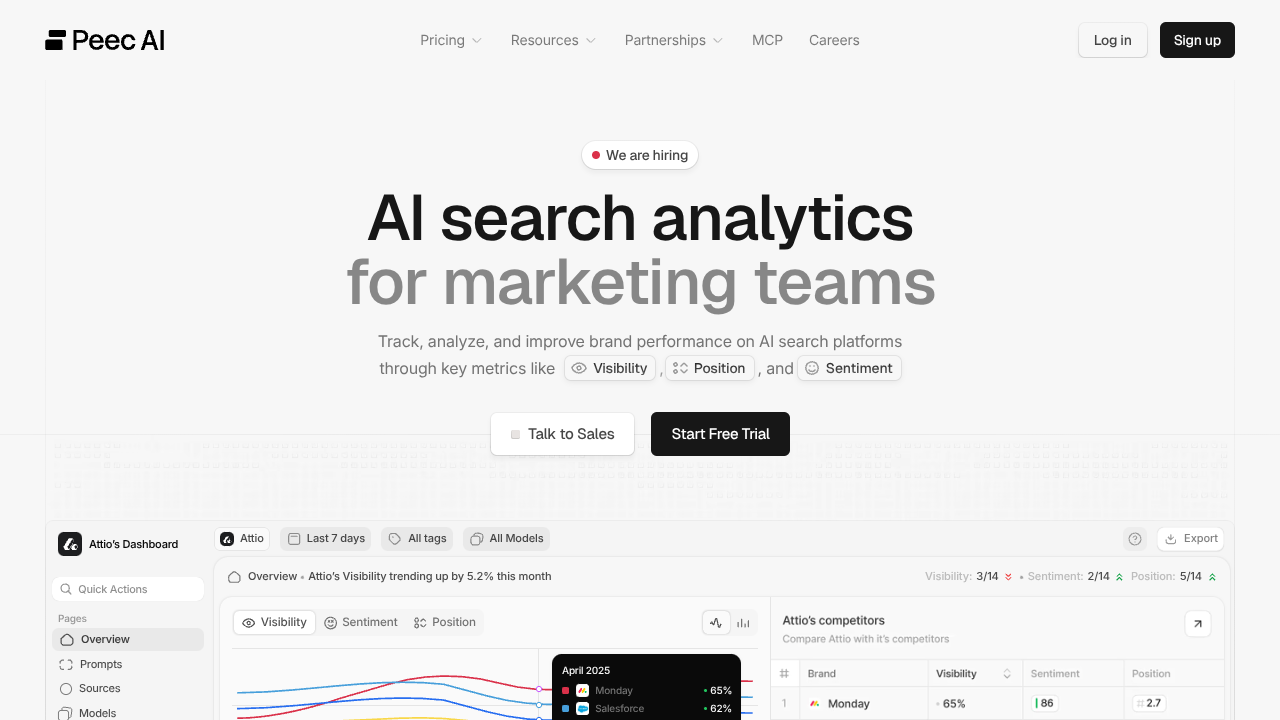
4. Peec AI — Best for SEO Agencies Needing Entity Graph Auditing
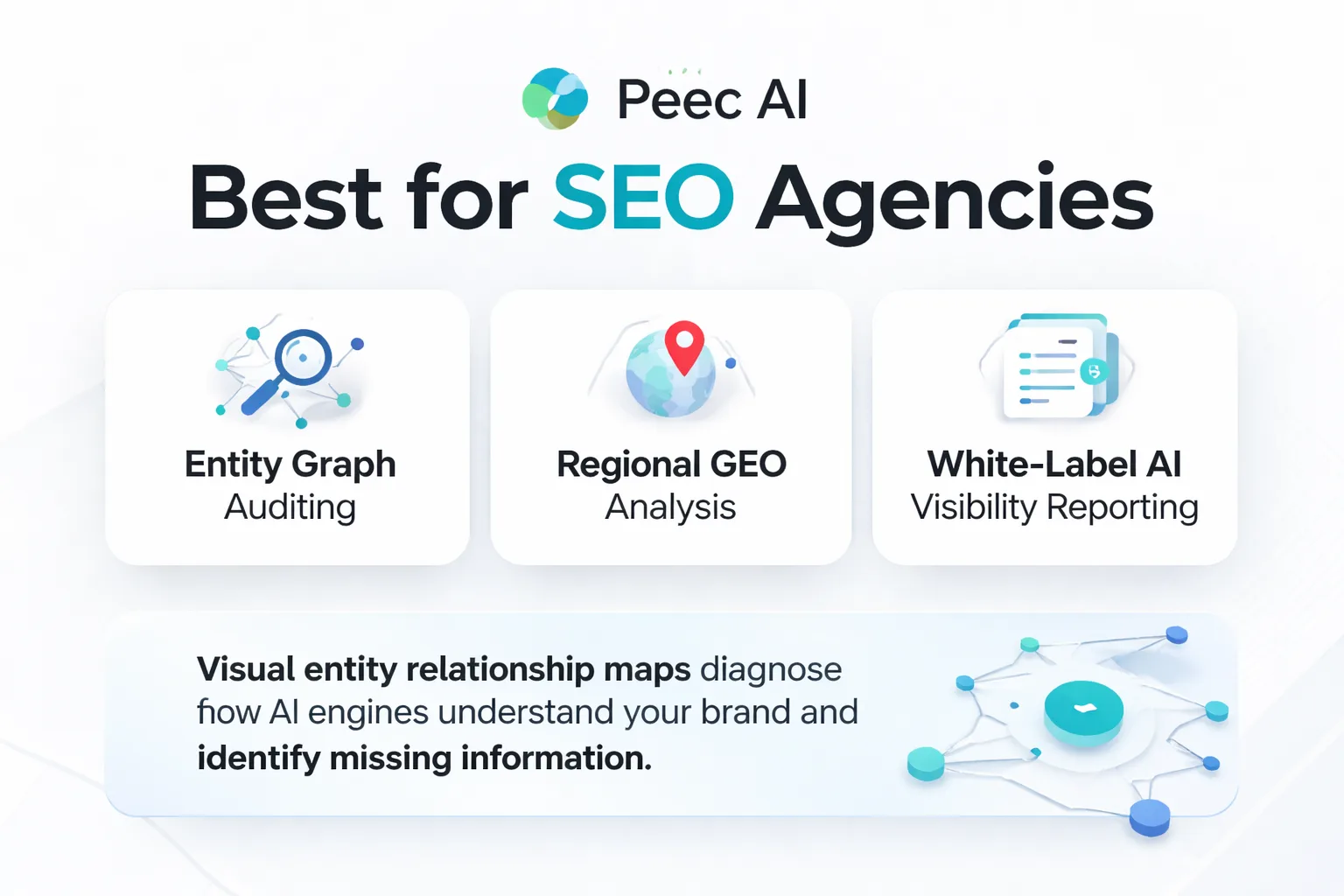
Best for: SEO agencies managing multiple client brands that need entity graph auditing, regional GEO analysis, and white-label-ready AI visibility reporting.
Peec AI's visual entity relationship maps are genuinely useful for diagnosing why an AI engine doesn't understand your brand correctly. Most citation tracking tools show you whether you're cited. Peec shows you how the AI model conceptually categorizes your brand. And what's missing from that picture. For agencies doing GEO audits across multiple clients with regional targeting requirements, that's a meaningful differentiator. The Meev vs Peec AI comparison covers the tracking depth and outreach workflow differences in detail if you're deciding between the two.
Key features: - Visual entity relationship maps to identify gaps in how AI engines understand your brand. Multi-engine citation tracking across ChatGPT, Gemini, Claude, and Perplexity. GEO audit for region- and language-specific AI visibility. Actionable prioritized recommendations (e.g., structured data fixes, missing prompt coverage)
Pricing: Free plan available (100 prompts, limited insights); Pro plan with multi-engine tracking and unlimited seats; Enterprise with custom limits, regional targeting, and dedicated onboarding.
The free plan only covers a single AI engine with capped prompt volume, so meaningful agency use requires Pro or Enterprise. Advanced entity mapping. The feature that actually differentiates Peec. Lives behind the paid tier.
5. OtterlyAI — Best for SMBs Entering AI Visibility Monitoring
Best for: SMBs and growing marketing teams looking for an accessible, well-recognized entry point into AI visibility monitoring without enterprise-level complexity.
OtterlyAI earned a Gartner Cool Vendor recognition for AI in Marketing, which gives it institutional credibility that matters when you're pitching AI visibility investment to a skeptical CFO. The platform tracks brand mention rate, citation rate, and share of voice across AI platforms with competitor benchmarking baked in. Onboarding is designed for teams new to generative engine optimization workflows. You don't need a technical setup to get running.
Key features: - Brand mention rate, citation rate, and share of voice tracking across AI platforms. Competitor benchmarking and sentiment analysis in AI-generated responses. Accessible onboarding designed for teams new to AEO/GEO workflows. Gartner Cool Vendor recognition validating platform maturity
Pricing: Starter at $99/month (ChatGPT only, 50 prompts); Growth at $399/month (3 engines, 100 prompts); Enterprise custom pricing.
The Starter plan's single-engine limitation is a real constraint. If you're serious about AI search visibility, ChatGPT-only tracking gives you a narrow view of a multi-engine reality. The Growth tier at $399/month is where the platform becomes genuinely useful. Budget accordingly.
6. AthenaHQ — Best for B2B SaaS Startups with Growth-Stage Budgets
Best for: B2B SaaS companies and growth-stage startups that want a credible, VC-backed AI visibility platform with documented ROI case studies.
AthenaHQ's Y Combinator backing matters in a market where AI visibility platforms are proliferating fast and many won't survive the next 18 months. The documented case studies. 10x citation growth and 50% more demos for brands optimizing for LLM search. Are the kind of outcome data that makes internal budget conversations easier. Content optimization recommendations are tied directly to citation gap analysis, which is more actionable than generic "improve your E-E-A-T" advice.
Key features: - LLM citation tracking and share-of-voice measurement across major AI engines. Content optimization recommendations tied directly to citation gap analysis. Proven case studies with measurable outcomes (10x citation growth, 50% demo lift) - Y Combinator-backed with institutional credibility for fast-growing B2B brands
Pricing: First-month discount available; full pricing available on request via athenahq.ai.
Pricing opacity is the friction point here. Like Scrunch, you need a sales conversation before you can evaluate whether AthenaHQ fits your budget. For a growth-stage startup watching every dollar, that's a meaningful barrier. The documented case studies help justify the conversation. But go in with specific questions about what the numbers actually cost to replicate.
Why AI Search Visibility Is Now Non-Negotiable
I want to be direct about something the industry is getting wrong. Most content teams are treating AI search visibility as a future concern. Something to address once LLM traffic becomes significant. That's backwards thinking.
The pattern I keep seeing is that brands which build citation presence early establish a compounding advantage. AI engines develop trust signals over time, and those signals are influenced by how consistently and accurately a brand appears across authoritative sources. Waiting until LLM-driven traffic hits 5% or 10% of your total sessions means you're starting the trust-building process 12 to 18 months late.
That said, I'd push back equally hard on the other extreme. I've reviewed citation-building research that claims 300% citation increases in 60 days and 587 backlinks in two weeks. Every single source is a success story. There are no penalty disclosures, no cases where aggressive outreach tanked E-E-A-T signals. That's not a clean track record. It's a publication bias problem. I build 30-day review checkpoints into any citation-building campaign specifically to catch signal degradation before it compounds.
The right posture: build AI visibility systematically, gate the content you publish, and measure what's actually changing. Which brings us to the tools that handle the measurement side.
Is your brand showing up when customers ask ChatGPT or Perplexity about your category?
7. Semrush AI Visibility Toolkit — Best for SEO Teams Already in the Semrush Ecosystem
Best for: SEO-focused content teams already using Semrush who want to extend their existing workflow into AI search visibility without adopting a separate platform.
Semrush's AI Visibility Toolkit is the most pragmatic choice for teams already paying for a Semrush subscription. The SEO Writing Assistant with real-time on-page scoring integrates directly into Google Docs and WordPress, which means zero workflow disruption. The Topic Research tool identifies content gaps based on competitor keyword rankings, and the Content Audit connects topics to engagement outcomes. For teams optimizing for Google AI Overviews specifically, Semrush's analysis of AI citations provides benchmark data on what actually correlates with citation gains.
Key features: - AI visibility tracking across Google AI Overviews, Gemini, ChatGPT, and more. SEO Writing Assistant with real-time on-page scoring integrated into Google Docs and WordPress. Topic Research tool identifying content gaps based on competitor keyword rankings. Content audit and SEO Content Template powered by live search data
Pricing: AI Visibility Toolkit add-on costs $99/month per domain; requires an active Semrush subscription starting at $129.95/month (Guru plan includes content marketing tools).
The honest limitation: the AI Visibility Toolkit is keyword-focused rather than prompt-level, which limits the depth of generative engine optimization analysis. It's a solid extension of an existing SEO workflow, not a replacement for dedicated AI citation tracking. If you're tracking Grok or DeepSeek visibility specifically, you'll need supplemental tooling. Meev's DeepSeek visibility tracking and Grok visibility tracking cover those surfaces directly.
8. HubSpot Content Hub — Best for CRM-Integrated Content Operations
Best for: Mid-size to enterprise B2B companies already using HubSpot's CRM or marketing automation who need tight alignment between content strategy and customer lifecycle management.
HubSpot Content Hub is the right answer to a specific question: "How do we personalize content based on where each contact is in our sales cycle?" The native CRM integration enables content personalization by contact lifecycle stage and behavioral triggers. A capability that no other platform in this list offers. If that's your problem, HubSpot solves it better than anyone. If your problem is AI citation tracking or quality-gated publishing at scale, HubSpot isn't built for that.
Key features: - Native CRM integration enabling content personalization by contact lifecycle stage and behavioral triggers. AI-powered content creation tools including blogging software, video marketing, and in-editor SEO recommendations. Marketing automation with personalized email drip campaigns and lead nurturing. Unified campaign planning workspace with direct multi-channel publishing
Pricing: Free tools available for basic blogging; Content Hub Starter from $20/month; Professional from $500/month; Enterprise from $1,500/month.
Pricing scales steeply with contact database size. For high-volume list holders, HubSpot's cost structure can become painful fast. And the core value proposition depends entirely on ecosystem lock-in. If you're not using HubSpot's CRM, you're paying for a content platform that's missing its most important feature.
9. Contently — Best for Enterprises Managing High-Volume Freelance Content
Best for: Large enterprises and agencies producing hundreds of content pieces monthly who need both external talent sourcing and editorial governance in a single platform.
Contently solves a specific operational problem: coordinating large volumes of external content contributors without losing brand governance. The vetted freelance network, workflow engine, and brand compliance tools are genuinely enterprise-grade. If you're running a content operation that publishes hundreds of pieces monthly across multiple contributors, Contently's revision cycle management and approval routing save real hours. What it doesn't do is anything related to AI search visibility. No citation tracking, no GEO optimization, no quality scoring for LLM ingestion.
Key features: - Access to a curated network of vetted freelance writers, designers, and videographers. Workflow engine handling assignment distribution, revision cycles, approval routing, and compliance checks. Brand compliance and governance tools enforcing style guides across all contributors. Content performance analytics connecting topics and formats to engagement and conversion outcomes
Pricing: Custom enterprise pricing only; typically starts around $3,000/month for mid-market companies.
At $3,000/month minimum, Contently is only viable for organizations with serious content production volume. There's no self-serve option, so smaller teams can't evaluate it without a sales process. If your content problem is quality governance at scale with external contributors, it's worth the conversation. If you're looking for AI visibility or automated publishing, look elsewhere.
10. CoSchedule — Best for Multi-Channel Content Calendar Management
Best for: Marketing teams juggling content across multiple channels and campaigns who need a structured, visual coordination system to replace scattered spreadsheets and email threads.
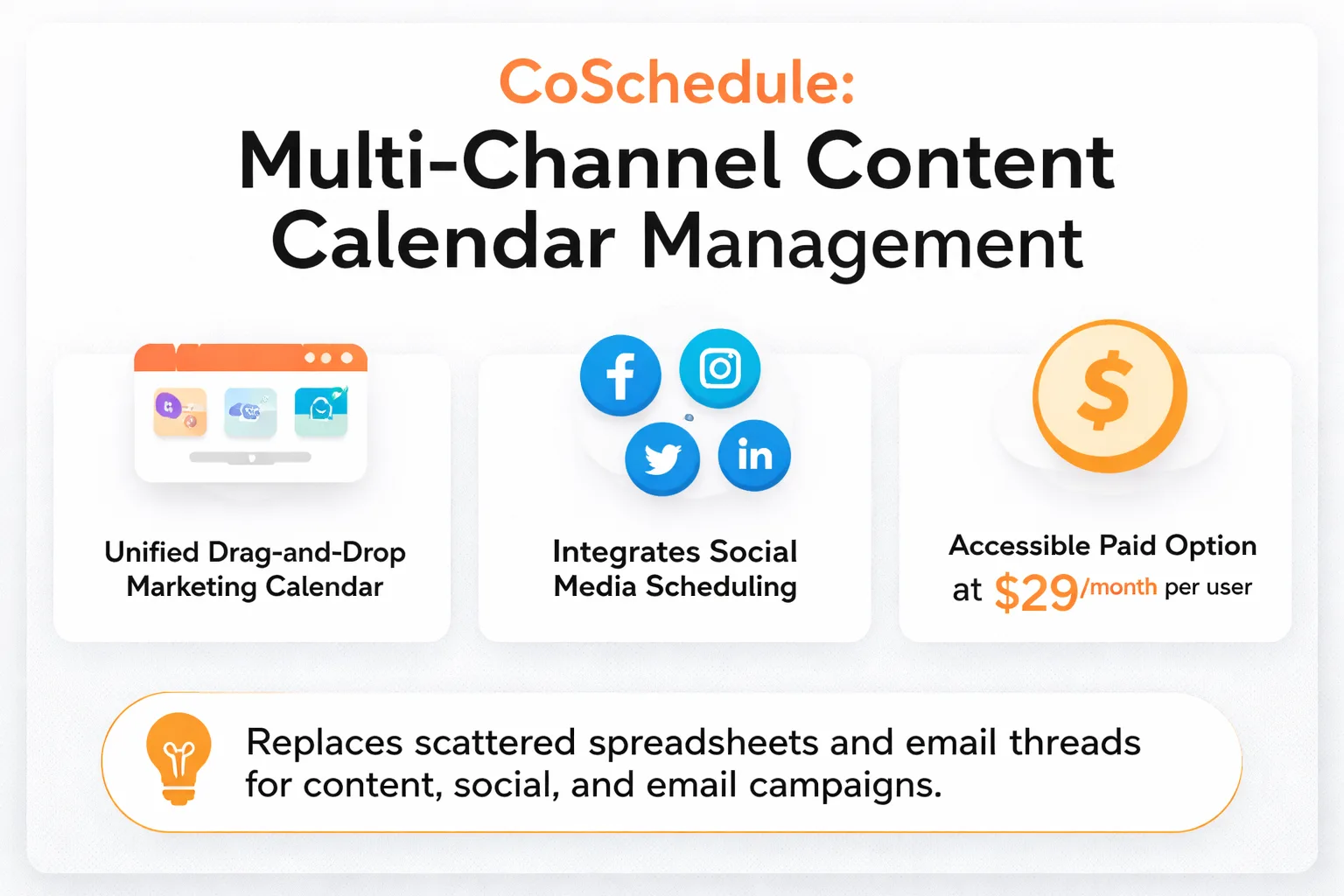
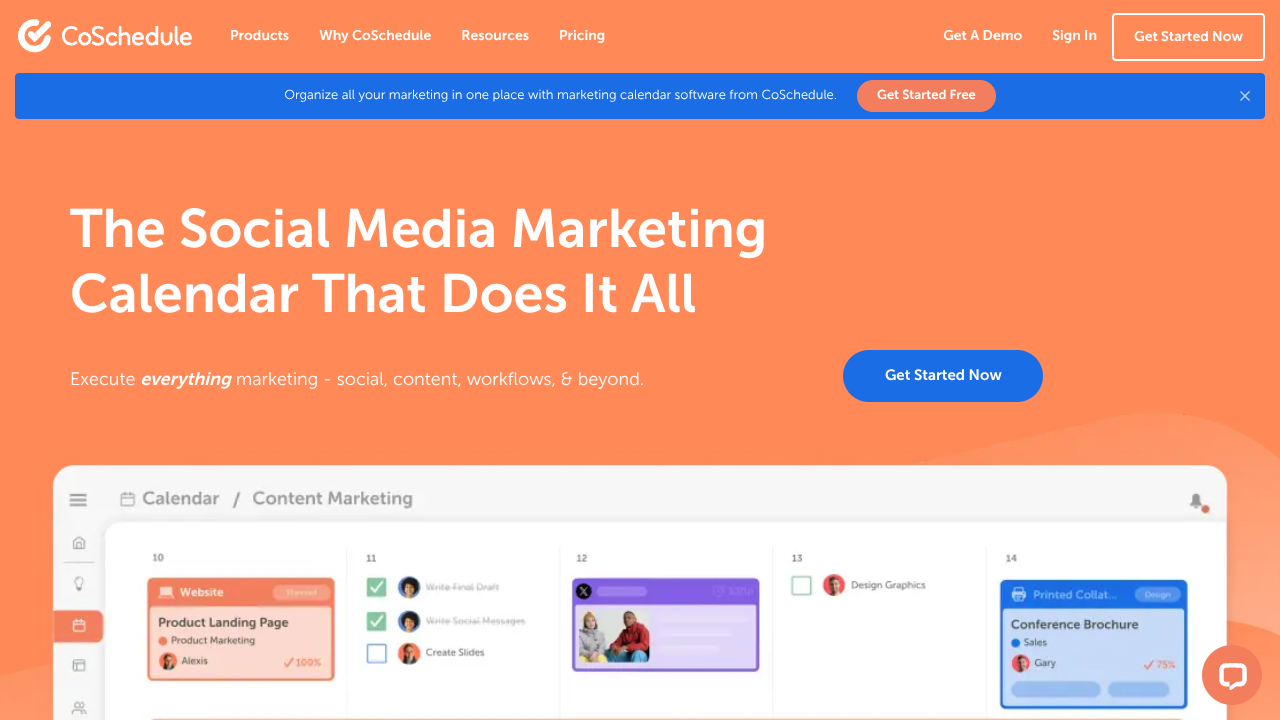
CoSchedule is the most focused tool in this list. It does one thing. Marketing calendar and workflow coordination. And it does it well. The drag-and-drop calendar showing all content, social, and email campaigns in a unified timeline is genuinely useful for teams that are losing track of what's publishing when. Social media scheduling integrates directly into the editorial calendar, which eliminates the context-switching between planning and publishing tools. At $29/month per user, it's the most accessible paid option here.
Key features: - Unified drag-and-drop marketing calendar showing all content, social, and email campaigns in one visual timeline. Collaborative task assignments and status tracking to eliminate scheduling conflicts across teams. Social media scheduling and direct publishing integrated into the editorial calendar. Workflow automation for recurring content types and campaign templates
Pricing: Free plan available for basic calendar features; Marketing Calendar Pro starts at $29/month per user; Marketing Suite with advanced automation available at custom pricing.
CoSchedule has no native content creation, AI visibility tracking, or SEO optimization capabilities. It's a coordination layer, not a content engine. Advanced automation requires the higher-tier Marketing Suite, which is custom-priced. Use it alongside a content creation and visibility platform. Not instead of one.
How Does AI Citation Tracking Actually Work?
AI citation tracking works by querying AI engines with prompts relevant to your brand, topic, and competitive space, then analyzing which sources appear in the generated responses. The mechanics vary by platform: some use direct API access (which preserves measurement validity), others use browser-based capture of live responses. The distinction matters because API responses can differ from what real users see, and some engines weight sources differently based on the query context.
What I've found in practice is that tracking alone isn't the insight. The gap analysis is. Knowing your brand appears in 12% of relevant ChatGPT responses is a number. Knowing your top competitor appears in 47% of those same responses, and that the gap is driven by three specific publisher domains where they have citations and you don't, is actionable. That's the difference between a monitoring dashboard and a content marketing platform that actually changes your citation trajectory.
The Ahrefs overview of AI-generated content covers the mechanics of how LLMs select sources in useful detail. Worth reading if you're building a citation strategy from scratch.
Why Does Topical Authority Still Matter for AI Search?
Topical authority for AI search works differently than it does for traditional SEO, and most practitioners are applying the wrong mental model. In traditional SEO, topical authority is roughly "do you have a lot of content covering this subject area?" In AI search, the question is closer to "does the AI engine have a consistent, unambiguous understanding of what you are authoritative about?"
Chris Long's analysis of Google API leak data describes topical authority as a "precise mathematical model" — not a fuzzy reputation signal. The implication: you can't build AI citation presence by publishing broadly across adjacent topics. You build it by going deep on a specific domain until the AI engine's internal model of your brand has enough consistent signal to trust you as a source.
That's the logic behind the Wix AI Search Lab's guidance on definitive digital footprints. It's also why I'm skeptical of content marketing platforms that optimize purely for keyword volume without any mechanism for enforcing topical coherence. Publishing 150 articles across 15 different topic clusters doesn't build topical authority. It fragments it.
When Should You Invest in a Dedicated AI Visibility Platform?
Not every business needs a dedicated AI visibility platform right now. Here's the honest decision framework I use.
You need dedicated AI visibility tracking if: your brand operates in a category where AI engines are actively fielding purchase-intent queries, you have at least one competitor who is visibly showing up in AI responses, or you're running a content operation at sufficient scale that citation gaps represent real revenue risk.
You can wait if: you're pre-product or pre-revenue, your category is so niche that AI engines rarely generate responses about it, or your entire content operation is still in the "get the basics right" phase.
The middle ground. And where most SMBs actually sit. Is to start with a platform that bundles tracking with content generation. Paying for a monitoring-only platform and a separate content platform separately is almost always more expensive than a unified solution, and the integration overhead is real. For Gemini-specific visibility, the Gemini visibility tracking breakdown covers what signals actually move the needle on that surface.
Making the Right Choice
The content marketing website you choose in 2026 is a bet on where the attention economy is heading. Google rankings still matter. They matter a lot. But the Austin founder's story at the top of this article is playing out across thousands of brands right now. Ranking on page one doesn't guarantee a citation in the AI response that answers the same query.
The platforms that win in this environment are the ones that close the loop: track where you're cited (and where you're not), publish content that meets the quality bar AI engines actually respect, and build the topical authority that makes you the obvious source for your category's core questions.
For most teams, that means choosing a platform based on one primary criterion: what's your biggest gap right now? If it's visibility tracking, Profound or Peec AI are strong choices depending on your scale. If it's content quality and publishing consistency, Meev's quality firewall and multi-CMS publishing solve that directly. If it's workflow coordination across a large team, CoSchedule or Contently address the operational layer.
What I'd caution against: buying a monitoring-only platform and assuming the insight alone will change your citation trajectory. Data without action is just a more expensive way to watch your competitors get cited instead of you.
Frequently Asked Questions
What's the difference between a content marketing platform and an AI visibility platform?
A content marketing platform handles the creation, scheduling, and distribution of content. Tools like HubSpot, Contently, and CoSchedule fall here. An AI visibility platform tracks where your brand appears in AI-generated responses across engines like ChatGPT, Perplexity, and Gemini. In 2026, the most useful platforms for most teams combine both: they publish quality-gated content and track whether that content is moving your citation numbers. Meev and Scrunch are examples of platforms that attempt this combination.
How many AI engines should I track for meaningful visibility data?
At minimum, track ChatGPT, Gemini, and Perplexity. These three account for the majority of AI search queries most brands care about. If you're in a technical or developer-adjacent category, add Claude and DeepSeek. Grok matters for brands with significant Twitter/X audience overlap. Tracking all major surfaces gives you the most complete picture, but even three-engine coverage is dramatically better than tracking none.
Is generative engine optimization (GEO) different from SEO?
Yes, meaningfully so. Traditional SEO optimizes for keyword relevance and backlink authority as signals to a ranking algorithm. GEO optimizes for how clearly and authoritatively your content answers questions that AI engines field. Which correlates more strongly with E-E-A-T signals and topical depth than with keyword density. Semrush's citation analysis found a +30.64% correlation between E-E-A-T signals and AI citations, which suggests the two disciplines share some foundations but diverge in what they reward.
Can small teams or solo founders realistically compete for AI citations?
Yes. And in some ways, the focus required for topical authority actually advantages smaller operators. A solo founder who publishes 30 deeply authoritative articles on one narrow topic will build a clearer AI engine footprint than a large brand publishing 300 articles across 20 topic clusters. The constraint is quality, not volume. A quality-gated AI-powered content creation platform that blocks weak drafts before they ship is more valuable for a solo founder than raw publishing speed.
How long does it take to see AI citation improvements after changing content strategy?
The pattern I keep seeing is a 60 to 90 day lag between meaningful content changes and measurable citation shifts. AI engines update their knowledge and citation patterns on varying schedules. Google AI Overviews refreshes more frequently than some LLM-based surfaces. Set 30-day review checkpoints to catch early signals, but don't draw conclusions until you have at least 90 days of post-change data. Any vendor claiming 300% citation growth in 30 days deserves scrutiny.
What's the minimum viable content marketing platform stack for an agency?
For an agency managing multiple client brands in 2026, the minimum viable stack is: an AI visibility tracking tool with multi-domain support (Meev Agency, Profound Enterprise, or Peec AI Enterprise), a quality-gated content generation system, and a workflow coordination layer. The biggest mistake agencies make is running monitoring and content creation as completely separate workflows with no shared data layer. You end up with visibility insights that never actually inform what gets written.
About the Author
Judy Zhou, Head of Content Strategy
Judy Zhou leads content strategy at Meev, where she oversees AI-driven content research and publishing for hundreds of brands. With a background in SEO and editorial operations, she focuses on building content systems that rank on Google, get cited by leading AI search engines, and drive measurable business results.
See exactly where your brand appears across 8 AI search surfaces — and what content gaps are costing you citations.