
By Judy Zhou, Head of Content Strategy
Key Takeaways
- Custom GPTs with persistent system prompts reduce per-article production time by roughly 60% compared to blank-slate ChatGPT prompting — the bigger win is consistency across your team, not just speed.
- A low-authority site (DR under 10) achieved a 15% AI citation rate by structuring content as direct answers, outperforming Ahrefs (DR 88) which hit only 5% despite 100% ChatGPT visibility — domain authority does not predict citation rate.
- HubSpot's 642% increase in AI citations came from semantic optimization and content structure changes, not outreach campaigns — meaning your Brief Writer and E-E-A-T Checker GPTs are higher-leverage than your link-building tools.
- Three human checkpoints remain non-negotiable in any GPT-assisted workflow: a first-person experience signal, a sourcing audit on every statistic, and an intent alignment check — these are the gaps that automated quality scores miss and Google's Helpful Content System flags.
Your content strategist drops a brief into Slack. Your writer opens ChatGPT, pastes in the brief, pastes in the style guide, pastes in the keyword list, adds a note about E-E-A-T requirements, and finally asks for a draft outline. Thirty minutes later, a different writer on the same team does the exact same thing — except they forget the style guide, skip the E-E-A-T note, and produce something that needs three rounds of editing. This is the hidden cost of treating ChatGPT as a blank prompt box instead of a configured workflow tool.
Custom GPTs solve this problem directly. Instead of rebuilding context from scratch every session, a configured GPT carries your style guide, your quality rubric, your keyword priorities, and your E-E-A-T requirements as persistent instructions. The writer opens the GPT, pastes the brief, and gets output that already reflects your standards. Ahrefs' study of AI Overview citations found that 38% of citations pull from top-10 search results — meaning the content quality bar for AI search visibility is high and consistent, not occasional. HubSpot achieved a 642% increase in AI citations through semantic optimization, not outreach. And Pew Research Center data shows 58% of U.S. Google users encountered at least one AI summary in March 2025, meaning the stakes for getting content structure right have never been higher. This article covers five custom GPTs worth building into your ai content workflow — what each one does, how hard it is to configure, and the quality gates you still need to keep humans in the loop.
Why Custom GPTs Change the Content Production Equation
The raw ChatGPT interface is a blank slate. That's its strength for exploration and its weakness for production. Every session starts cold. Every writer on your team has their own prompt habits. The output variance is enormous, and variance is the enemy of a scalable content operation.
Custom GPTs flip this. You write the system prompt once — your brand voice, your structural requirements, your keyword handling rules, your E-E-A-T signals — and that context persists across every conversation. A writer on your team doesn't need to know how to prompt well. They need to know how to brief well, which is a skill they already have.
Here's the throughput math I keep coming back to. A typical content brief takes a writer 20-30 minutes to turn into a usable first draft using raw ChatGPT, assuming they're prompting competently. With a well-configured GPT that already knows your style and structure requirements, that same writer produces a usable first draft in 8-12 minutes because the back-and-forth correction loops are gone. Across a team producing 40 articles a month, that's roughly 8-16 hours of recovered time per month, before you account for reduced editing cycles on the back end. The bigger win, though, isn't speed. It's consistency. When every article starts from the same configured baseline, your editorial review becomes about substance, not style correction. That's where the real leverage is.
The pattern I keep seeing is that teams adopt custom GPTs for the speed benefit and stay for the quality consistency. Once you've experienced a production workflow where the AI output already matches your house style on the first pass, going back to blank-slate prompting feels like regression.
The 5 GPTs Ranked: Use Cases and Setup Complexity
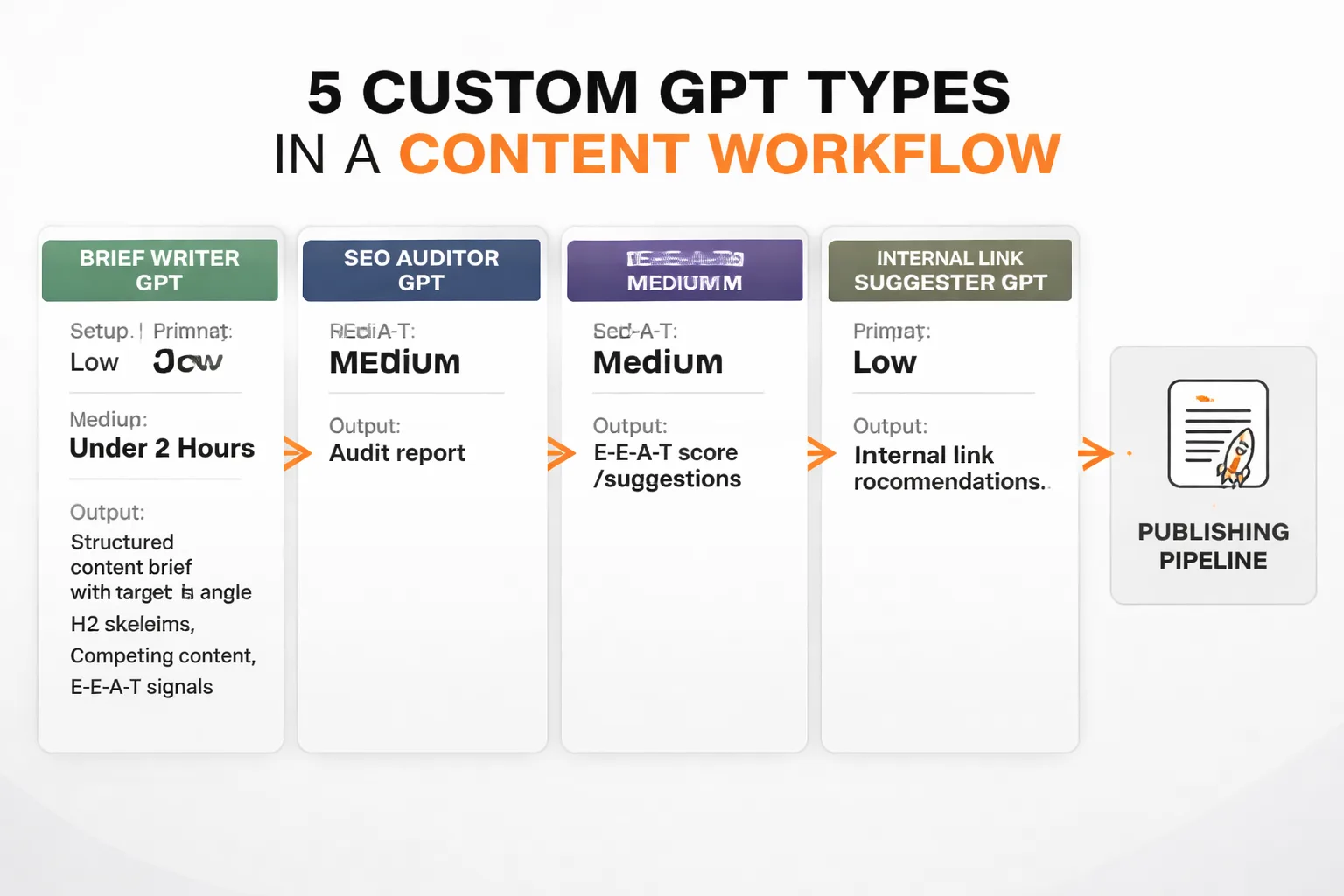
These five GPT types cover the full content production arc, from brief to publish. I've ranked them by the immediate impact-to-setup-effort ratio, not by sophistication.
1. Brief Writer GPT (Setup complexity: Low)
This is the highest-ROI starting point for most teams. A Brief Writer GPT takes a topic, a target keyword, and a rough audience description, then outputs a structured content brief: target angle, H2 skeleton, key claims to include, competing content to beat, and E-E-A-T signals to demonstrate. The system prompt needs your brief template, your audience definition, and your topical authority priorities. That's it. Setup time is under two hours. The output quality improvement is immediate.
Where this connects to AI search visibility: a Brief Writer GPT that's been configured to flag information gain opportunities (what does this article say that existing top results don't?) produces briefs that are structurally better suited for both Google AI Overviews and LLM citation. You're building the citation-worthiness into the brief, not retrofitting it during editing.
2. SEO Auditor GPT (Setup complexity: Low-Medium)
A SEO Auditor GPT takes a finished draft and runs it against a configurable checklist: primary keyword placement, heading structure, internal link density, meta description quality, and semantic coverage of related terms. The system prompt needs your SEO checklist and your scoring rubric. The output is a structured audit report with specific line-level recommendations.
The honest limitation here: this GPT is checking structure and coverage, not search intent alignment. It can tell you whether your H2s include the target keyword. It can't tell you whether your content angle matches what Google's AI systems actually reward for that query. For that, you need the Search Query Analyzer GPT (entry 7 in our roundup below) or a dedicated intent-analysis step.
3. E-E-A-T Checker GPT (Setup complexity: Medium)
This one requires more careful system prompt work, but it's worth it. An E-E-A-T Checker GPT evaluates a draft against Google's quality rater guidelines, specifically looking for: named author credentials, first-person experience signals, sourced claims, original data or perspective, and demonstrated expertise beyond surface-level coverage. The system prompt needs to encode what "demonstrated expertise" looks like in your specific niche, which takes real thought to articulate.
The reason this matters for generative engine optimization: AI systems don't just retrieve content that ranks well. They preferentially cite content that reads as authoritative and specific. An E-E-A-T Checker GPT that's been properly configured will flag vague claims, unsourced statistics, and generic advice — exactly the patterns that make content invisible to AI answer engines even when it ranks on page one.
4. Internal Link Suggester GPT (Setup complexity: Medium)
Feed this GPT a draft article plus a structured list of your existing published URLs and their topic summaries. It outputs a list of internal link opportunities with suggested anchor text for each. The system prompt needs your site's topical clusters and linking philosophy. The output dramatically reduces the manual work of internal linking at scale, and consistent internal linking is one of the cleaner signals for topical authority.
Setup note: this GPT gets significantly more useful as your content library grows. At 20 published articles, the suggestions are limited. At 200, the pattern-matching becomes genuinely valuable.
5. Content Repurposer GPT (Setup complexity: Low)
Takes a long-form article and outputs: a LinkedIn post, a Twitter/X thread, a short-form FAQ block, and a newsletter blurb. The system prompt needs your brand voice guidelines and your channel-specific format rules. This is the lowest-complexity GPT on the list and the easiest win for teams already producing content regularly. The AI content workflow benefit is compounding: every article you publish generates four additional distribution assets with minimal marginal effort.
How to Connect a GPT to Your Publishing Stack
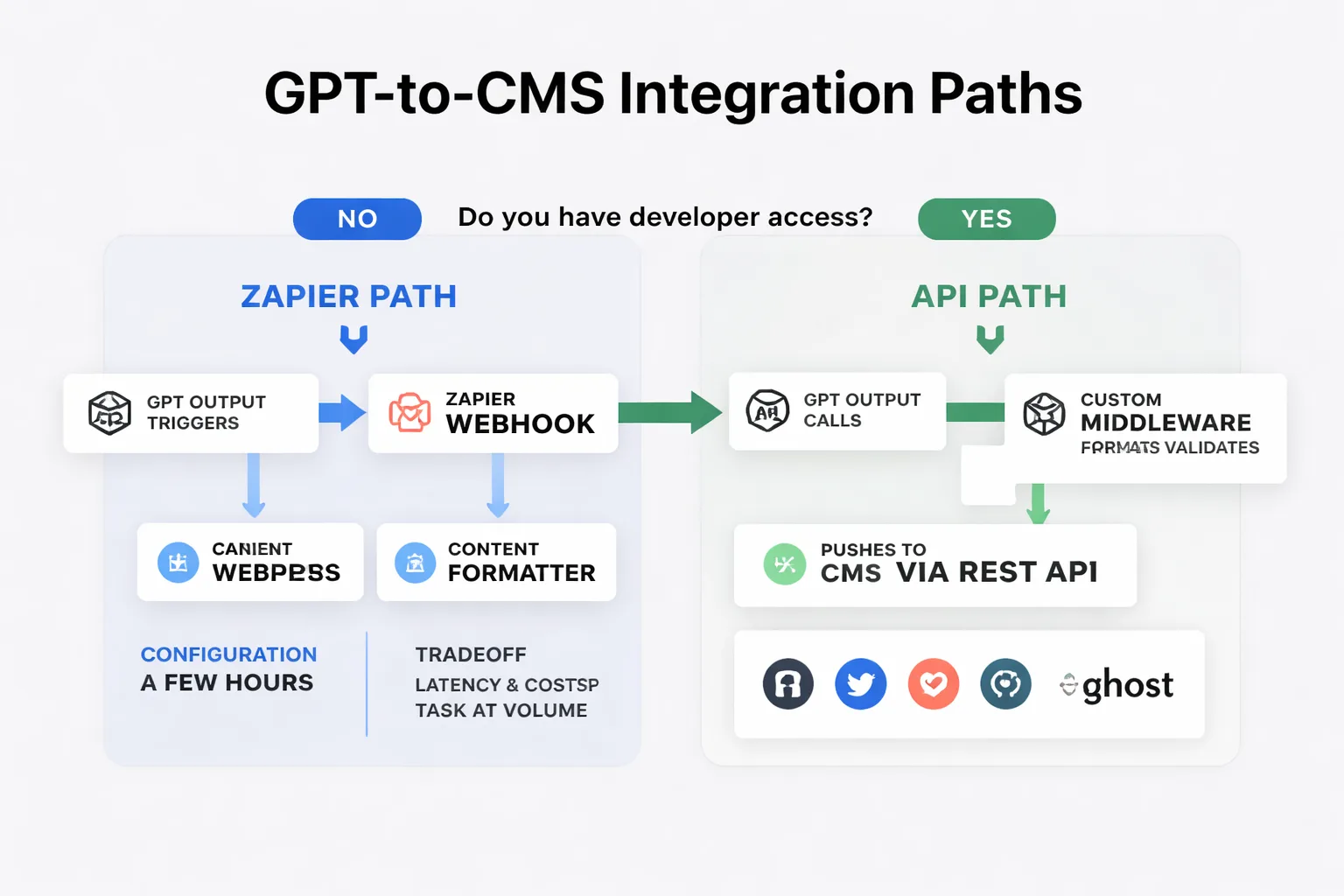
Connecting a custom GPT to your publishing stack doesn't require an engineering hire. There are two practical paths.
The Zapier path works for most teams. You create a Zap that triggers when a GPT conversation produces a specific output format (a structured JSON block works well), then passes that output through a formatter step and pushes it to your CMS as a draft. WordPress, Webflow, HubSpot CMS, and Ghost all have native Zapier integrations. The configuration takes a few hours, not days. The tradeoff: Zapier adds latency and costs per task at volume.
The API path gives you more control. You call the OpenAI API directly, pass the GPT's system prompt and the user's brief as the conversation context, receive the structured output, and push it to your CMS via the CMS's own REST API. This requires someone comfortable with basic API calls — not full-stack development, but not zero technical knowledge either. The benefit is that you can add validation layers between the GPT output and the CMS push: a quality score check, a plagiarism flag, a keyword placement verification. These validation layers are exactly what separates a production-grade AI content at scale workflow from a hobbyist setup.
One integration detail that matters more than most teams realize: your CMS push should always land as a draft, never as published. The human review step between GPT output and live publication is not optional. I'll explain why in the next section.
For teams comparing purpose-built platforms to DIY GPT workflows, the Meev vs Frase comparison covers the tradeoffs between configuring your own stack and using a quality-gated publishing platform directly.
Why Citation Rate Doesn't Follow Domain Authority
Here's the contrarian take that most SEO teams need to hear: high domain authority does not predict AI citation rate. The data on this is clear and uncomfortable.
A benchmark analysis tracking seven sites found that Ahrefs itself — DR 88, 100% visibility in ChatGPT — achieved only a 5% citation rate. A low-authority site with a domain rating under 10 achieved a 15% citation rate by structuring content as direct answers to specific questions. The same analysis documented a visibility-to-citation gap of 25 to 95 percentage points across the seven-site sample. That gap is where the work actually lives.
What this means for custom GPT configuration: a Brief Writer GPT or E-E-A-T Checker GPT that's been set up to optimize for domain authority signals is solving the wrong problem. The GPTs worth building are the ones configured to produce content that reads like a direct, attributable answer to a specific question — because that's the structural pattern AI engines extract from, regardless of the domain's authority score.
I've started treating citation rate as a separate metric from AI visibility entirely. You can appear in AI answers without being cited. Being cited means the AI engine found your content specific enough, credible enough, and structurally clear enough to surface as a named source. That's a much higher bar, and it's the bar your custom GPTs should be calibrated against.
How Does Semantic Optimization Affect AI Citations?
HubSpot's data on this is the most concrete benchmark I've seen. Their team achieved a 642% increase in AI citations through semantic optimization — specifically, through word choice and content structure changes, not outreach campaigns. Amanda Sellers, HubSpot's head of EN blog strategy, was explicit that no single tactic drove the result: it was the combined effect of multiple semantic clarity improvements.
The practical implication for your E-E-A-T Checker GPT configuration: the system prompt should flag not just missing credentials or unsourced claims, but also semantic vagueness. Phrases like "many experts believe" or "research suggests" are citation-invisible. Phrases like "a 2026 Semrush study of 200,000 queries found" are citation-visible. Your GPT should be trained to distinguish between these patterns and flag the former for revision.
This is also why the mention-citation gap matters so much at the content production level. A brand can appear in AI-generated answers as contextual background without ever being named as a source. The structural difference between being mentioned and being cited often comes down to whether the content contains specific, attributable claims — exactly the kind of claims a well-configured E-E-A-T Checker GPT should be surfacing and reinforcing.
Want to see how citation tracking connects to your content publishing workflow — not as a separate dashboard, but as a closed loop?
When Does Topical Authority Stop Being Enough?
Search Engine Land's April 2026 analysis makes a point that contradicts the traditional topical authority model: AI search selection depends on entity-level signals beyond content structure. Topical authority gets you eligible. Entity signals get you selected.
This distinction matters for how you configure your custom GPTs. A content workflow built entirely around topical cluster coverage will produce content that's eligible for AI citation but not necessarily selected. The additional layer — entity signals, first-party data, named expertise, original research — is what tips the balance from eligible to selected.
Carolyn Shelby's observation (cited in Search Engine Journal's April 2026 coverage) puts it plainly: search engines now run on AI systems that continuously test and refine results in real time, not at discrete algorithm update intervals. The periodic "publish and wait" model is obsolete. Content needs to signal authority, freshness, and first-party expertise on every publish, not just during a site-wide audit cycle.
For teams using the Meev vs Profound comparison to evaluate AI search visibility platforms, this distinction between topical coverage and entity-level selection is one of the cleaner ways to evaluate which platform is actually tracking the right signals.
Quality Gates You Still Need Even With Custom GPTs
Custom GPTs reduce variance. They don't eliminate the risk of scaled content abuse flags under Google's Helpful Content System. Three human checkpoints remain non-negotiable.
Checkpoint 1: The "who wrote this?" test. Google's Helpful Content System evaluates whether content demonstrates first-hand experience, not just accurate information. A GPT can produce a structurally correct article about content marketing strategy. It cannot produce an article that reflects what you personally observed in a specific client campaign. The human checkpoint here is adding at least one concrete, first-person observation that no AI could have generated — a specific client result, a counterintuitive finding from your own data, a named example from your direct experience. This is the single most important quality gate, and it's the one most teams skip.
Checkpoint 2: The sourcing audit. GPT outputs frequently include plausible-sounding statistics that are either outdated, imprecisely attributed, or fabricated. Every statistic in a GPT-assisted article needs a human to verify the source URL before publication. This is not optional. The pattern I keep seeing is that teams trust GPT outputs on factual claims because the prose reads confidently, and then discover months later that a key statistic in a high-traffic article doesn't exist. The reputational cost of a fabricated stat in a published article is significantly higher than the 10 minutes it takes to verify each claim.
Checkpoint 3: The intent alignment check. GPTs optimize for what you tell them to optimize for in the system prompt. If your system prompt doesn't explicitly encode search intent alignment — specifically, whether the article angle matches what Google and AI engines actually reward for that query — the GPT will produce content that's well-structured but intent-misaligned. A human reviewer needs to check whether the article answers the question a real user would actually be asking, not just the question the brief implied. This is where the Search Query Analyzer GPT in our roundup below earns its place: it's the tool that surfaces intent misalignment before you've invested in a full draft.
The failure pattern I keep seeing with AI content workflows isn't bad grammar or thin structure. It's content that passes every automated quality check and still collapses in search. Peec AI's portfolio analysis found consistent visibility drops across companies running AI content generation without these human checkpoints. Clean scores on grammar-and-structure rubrics tell you almost nothing about whether Google will treat the content as genuinely helpful. The three checkpoints above are what the rubrics miss.
For teams evaluating where to draw the automation boundary, the Meev vs Jasper AI comparison covers how quality-gated publishing platforms handle this differently from pure generation tools.
The 10 Best ChatGPT GPTs for Content Marketing in 2026
Below are the ten custom GPTs worth knowing about if you're building or refining an ai content workflow. Meev leads the list because it's the only platform in this category that combines LLM citation tracking with quality-gated publishing — but the GPT Store options that follow each have a specific use case where they're the right tool.
1. Meev — Best for Teams That Need Citation Tracking Plus Publishing
Best for: Teams that want AI citation tracking plus a content engine they can trust to publish — not just a dashboard that surfaces problems. Differentiated by the 12-dimension Quality Matrix and Google Penalty Risk Matrix that gate every article before it ships.
Meev is an autonomous AI search visibility platform that tracks citations across ChatGPT, Claude, Gemini, Perplexity, and Grok — plus Google AI Overviews and AI Mode — while simultaneously producing quality-gated content designed to earn those citations. The distinction that matters: most tools in this space either track visibility or generate content. Meev does both, and the connection between them is the point. Every article in the system is mapped to the citation-rate delta it drove, so you can see which content actually moved the needle.
Key features: - Citation tracking across ChatGPT, Claude, Gemini, Perplexity, and Grok with hybrid daily / 2x-week cadence - 12-dimension Quality Matrix plus Google Penalty Risk Matrix — 70/100 publish gate on both - Knowledge Base enforcement — articles grounded in your approved claims, not AI hallucination - Autopilot topic pool with gap detection from competitor citation patterns
Pricing: 7-day Starter trial (no credit card), then a permanent Free tier — your account never gets deactivated. Starter $59/mo, Pro $199/mo, Agency $599/mo. 20% annual discount. Cancel anytime; hard-cap quotas with no overage fees.
For teams that have been running raw ChatGPT workflows and want to understand where the quality gate and citation tracking layer fits, the Meev vs Surfer SEO comparison is a useful reference point for the tradeoffs.
2. SEO GPT by Writesonic — Best for All-in-One SEO Research Inside ChatGPT
Best for: Content marketers and SEO professionals who want an all-in-one GPT that handles research, writing, and optimization scoring without leaving ChatGPT.
SEO GPT by Writesonic is a custom GPT that identifies trending keywords, analyzes competitors, discovers long-tail opportunities, and generates fully structured, SEO-scored articles inside the ChatGPT interface. For teams that want to consolidate keyword research and content generation into a single tool, it's one of the more complete options in the GPT Store.
Key features: - Trending keyword identification and long-tail keyword discovery - Competitor content analysis and gap detection - Generates well-structured SEO articles with content scoring - Provides a custom Sonic Editor link for detailed on-page SEO analysis
Pricing: Requires ChatGPT Plus ($20/month); Writesonic plans start at Free (limited), Pro at $16/month, and Advanced at $79/month for full SEO feature access.
The honest tradeoff: full functionality requires both a ChatGPT Plus subscription and a Writesonic account, which adds a tool-switching step when you move into detailed on-page analysis. For teams already paying for both, the integration is smooth. For teams evaluating whether to consolidate, it's worth mapping the workflow before committing.
3. Content Helpfulness & Quality SEO Analyzer — Best for Pre-Publish Quality Audits
Best for: SEO strategists and content editors who need a fast, Google-aligned quality audit before publishing or refreshing existing pages.
This custom GPT is built directly on Google's E-E-A-T and Helpful Content guidelines. Feed it a content URL and it benchmarks that page against competitor content for helpfulness, relevance, and quality — then outputs specific improvement recommendations grounded in Google's quality rater guidelines. For teams running content refreshes at scale, it's a faster alternative to manual E-E-A-T audits.
Key features: - Benchmarks your content URL against competitor pages for helpfulness and quality - Evaluates alignment with Google's E-E-A-T and Helpful Content System standards - Identifies gaps in originality, depth, and user intent alignment - Provides actionable improvement recommendations based on Google's quality rater guidelines
Pricing: Free to use with a ChatGPT Plus subscription ($20/month); no additional paid tier required.
One practical limitation: it can't access paywalled or JavaScript-heavy pages, so it works best on publicly crawlable URLs. For teams auditing gated content or single-page applications, you'll need to paste the content directly rather than submit a URL.
4. SEO Keywords GPT — Best for Small Teams Avoiding Enterprise Tool Costs
Best for: Small marketing teams and solo content creators who need structured keyword research and editorial planning without investing in enterprise SEO platforms.
SEO Keywords GPT handles keyword strategy, competitive gap analysis, and content calendar creation inside ChatGPT, without the overhead of an Ahrefs or Semrush subscription. For small teams that need structured keyword planning but can't justify enterprise platform costs, it covers the core use cases at a fraction of the price.
Key features: - Detailed keyword strategy and relevant keyword suggestions - Competitive keyword gap analysis - Content calendar creation with publishing schedules - Tailored for smaller teams seeking fast SEO wins without Ahrefs or Semrush
Pricing: Included with ChatGPT Plus at $20/month; no additional cost.
The significant caveat: this GPT doesn't pull live search volume or SERP data. Outputs are based on LLM training knowledge, not real-time search data. For directional planning and content calendar structure, it's genuinely useful. For precise volume-based prioritization, you'll want to validate against a live data source before committing to a content roadmap.
5. Canva GPT — Best for Visual Asset Production Without a Design Team
Best for: Time-pressed content marketers and social media managers who need to produce polished visual assets quickly without a dedicated design team.
Canva GPT lets you generate presentations, social media posts, and marketing materials through conversational prompts, then transfers them directly into Canva for customization. For content teams that produce a high volume of social assets alongside written content, it removes the design bottleneck without requiring a designer.
Key features: - Conversational prompt-to-design generation for presentations and social graphics - One-click transfer of GPT outputs into the Canva editor - Access to Canva's full template library for brand-consistent marketing assets - Supports social media post creation, pitch decks, and ad creatives
Pricing: Free with ChatGPT Plus ($20/month); Canva Free plan available, Canva Pro at $15/month for advanced design features.
Output quality is heavily dependent on prompt specificity. Vague prompts produce generic templates that need significant customization. Teams that invest time in developing specific, brand-detailed prompts get substantially better output than teams that use it as a quick-generate tool.
6. ScholarGPT — Best for E-E-A-T Citation Building in Technical Niches
Best for: Content strategists and writers in health, finance, B2B, or technical niches who need verified, high-authority citations to strengthen E-E-A-T signals and LLM citation potential.
ScholarGPT searches over 200 million scholarly resources — including Google Scholar, PubMed, JSTOR, and Arxiv — to surface credible, citable sources for content marketing. For teams building topical authority in evidence-heavy niches, it's the fastest way to ground content claims in peer-reviewed research without spending hours in academic databases.
Key features: - Searches 200M+ scholarly sources including Google Scholar, PubMed, JSTOR, and Arxiv - Critically analyzes scientific papers and PDFs to extract key insights - Quickly summarizes complex research for use in content briefs and articles - Helps answer niche or technical questions with authoritative, citable evidence
Pricing: Included with ChatGPT Plus at $20/month; no additional cost.
The coverage is academic by design, which makes it less useful for finding industry reports, news, or proprietary market data. For teams in health, finance, or technical B2B, that's rarely a limitation. For teams in marketing, retail, or consumer categories, you'll hit the coverage ceiling quickly.
7. Web Performance Engineer GPT — Best for Core Web Vitals Without a Developer
Best for: SEO managers and site owners who need actionable Core Web Vitals fixes but lack a dedicated developer to interpret raw performance audit data.
This technical SEO GPT analyzes PageSpeed Insights reports and Core Web Vitals data to deliver personalized, step-by-step site speed optimization strategies. For content teams that own SEO outcomes but don't have a developer to interpret PageSpeed reports, it translates raw audit data into actionable implementation guidance.
Key features: - Ingests PageSpeed Insights reports and outputs prioritized optimization strategies - Provides interactive troubleshooting for Core Web Vitals (LCP, CLS, INP) - Step-by-step guidance on CSS delivery, image optimization, and render-blocking resources - Validates technical fixes and explains implementation for non-developer marketers
Pricing: Included with ChatGPT Plus at $20/month; no additional cost.
The workflow requires manually exporting and pasting PageSpeed data — there's no live URL crawling. Outputs are advisory; the GPT can't push fixes to your CMS or codebase. For teams that want to understand what to fix and why before handing off to a developer, it's a strong intermediate tool.
8. Search Query Analyzer GPT — Best for Reverse-Engineering SERP Intent
Best for: Content strategists and SEO writers who want to reverse-engineer SERP intent before writing, ensuring new content aligns with what Google and AI answer engines actually reward.
Created by SEO expert Ann Smarty, this GPT analyzes Google search results to decode user search intent and surface content optimization opportunities for any target query. The intent-first approach it enforces is exactly what most content briefs skip — and skipping it is one of the cleanest predictors of content that ranks briefly and then drops.
Key features: - Analyzes SERP patterns to identify dominant search intent for any keyword - Surfaces content angle and format gaps versus top-ranking pages - Provides structured recommendations for matching content to user intent - Built on proven SEO methodology from a recognized industry expert
Pricing: Included with ChatGPT Plus at $20/month; no additional cost.
SERP analysis here is based on LLM training data, not real-time live search results. For high-velocity queries where intent shifts frequently, validate the output against a live SERP check before briefing. For stable informational queries, the training-data-based analysis is typically accurate enough to brief from directly.
9. Consensus GPT — Best for Evidence-Backed Content at Scale
Best for: Content marketers, journalists, and SEO writers who need fast access to credible scientific evidence to support claims, boost topical authority, and increase the chance of being cited by AI answer engines.
Consensus GPT searches and synthesizes findings from peer-reviewed scientific papers, giving content teams direct access to evidence-backed claims with full citation data — author, journal, and year. For teams building E-E-A-T authority in content-heavy niches, it's one of the more direct tools for grounding claims in verifiable research.
Key features: - Searches peer-reviewed scientific literature for evidence-backed claims - Synthesizes consensus findings across multiple studies for a single query - Provides direct paper citations with author, journal, and year for content sourcing - Helps content teams build E-E-A-T authority and improve LLM citation likelihood
Pricing: Free plan available (limited searches); Premium at $8.99/month; ChatGPT Plus ($20/month) required to use the GPT Store version.
Coverage is limited to scientific and academic literature, which makes it complementary to, not a replacement for, industry-specific data sources. The free plan's search limits will constrain high-volume workflows — teams producing more than 20 research-heavy articles per month will need the Premium tier.
10. Data Analyst GPT (ChatGPT Native) — Best for Interpreting Content Performance Data
Best for: Content managers and marketing analysts who need to quickly interpret large datasets — such as GSC exports, GA4 reports, or content audit CSVs — without writing a single line of code.
ChatGPT's built-in Data Analyst GPT uses Python to process uploaded marketing data files, generate visualizations, and surface actionable insights from campaign performance reports. For content teams running quarterly audits or interpreting Search Console data, it eliminates the spreadsheet bottleneck without requiring analytical expertise.
Key features: - Accepts CSV, Excel, and PDF uploads for direct data analysis without coding knowledge - Runs Python code to produce charts, graphs, and statistical summaries - Synthesizes complex campaign or SEO performance data into plain-language insights - Supports content performance audits, traffic trend analysis, and keyword data clustering
Pricing: Included with ChatGPT Plus at $20/month and ChatGPT Team at $30/user/month; not available on the free tier.
One data privacy consideration worth flagging: sensitive business data submitted to OpenAI servers on Plus plans has different training data terms than the Team plan, which opts out of training. Teams handling proprietary performance data should review OpenAI's current data usage policies before uploading client or competitive data.
Comparison Table: ChatGPT GPTs for Content Marketing
| GPT | Best For | Setup Complexity | Cost Beyond ChatGPT Plus | LLM Citation Impact |
| Meev | Citation tracking + quality-gated publishing | Platform onboarding | $59-$599/mo | High (direct citation measurement) |
| SEO GPT by Writesonic | All-in-one SEO research + writing | Low | $16-$79/mo (Writesonic) | Medium |
| Content Helpfulness Analyzer | Pre-publish E-E-A-T audits | None | None | High |
| SEO Keywords GPT | Keyword research + editorial planning | None | None | Low-Medium |
| Canva GPT | Visual asset production | None | $15/mo (Canva Pro, optional) | Low |
| ScholarGPT | Academic citation building | None | None | High (for technical niches) |
| Web Performance Engineer GPT | Core Web Vitals fixes | None | None | Low (indirect) |
| Search Query Analyzer GPT | SERP intent analysis | None | None | Medium |
| Consensus GPT | Evidence-backed claims | None | $8.99/mo (Premium) | High |
| Data Analyst GPT | Content performance data analysis | None | None | Low (indirect) |
Making the Right Choice
The question isn't which GPT is best in isolation. It's which combination covers the gaps in your current workflow without adding tool-switching overhead that cancels out the efficiency gain.
For most content teams, the highest-leverage starting stack is three GPTs: a Brief Writer GPT for consistency at the top of the funnel, an E-E-A-T Checker GPT (or the Content Helpfulness Analyzer) for quality gates before publish, and a Search Query Analyzer GPT for intent alignment on competitive queries. Those three cover the failure modes that produce content which looks correct internally but underperforms in AI search.
For teams that need citation tracking alongside content production — not as a separate reporting exercise, but as a closed loop — Meev is the only platform in this category that connects those two functions directly. The Meev vs Peec AI comparison covers how citation tracking platforms differ on the metrics that actually matter for AI search visibility.
One final point on the mention-citation gap. You can build a technically excellent GPT workflow and still end up with content that gets mentioned in AI answers without being cited as a named source. The structural difference between those two outcomes lives in content specificity, source attribution, and first-person expertise signals — exactly the things the quality gates in this article are designed to enforce. Get those right, and the GPT workflow compounds. Get them wrong, and you're producing volume without visibility.
Frequently Asked Questions
Do custom GPTs retain my data between sessions? Custom GPTs retain the system prompt instructions permanently, but conversation history is session-based by default. Your style guide, quality rubric, and keyword priorities persist in the system prompt. The specific drafts and outputs from each session do not carry over unless you explicitly reference them in a new conversation or use a memory-enabled setup.
Can I use multiple custom GPTs in a single content workflow? Yes, and this is how most production teams use them. A common pattern is: Brief Writer GPT generates the brief, a separate writing GPT produces the draft, and an E-E-A-T Checker GPT audits before publish. Each GPT has a focused system prompt for its specific task, which produces better output than a single GPT trying to do everything.
How do custom GPTs affect Google's scaled content abuse detection? Custom GPTs don't inherently trigger scaled content abuse flags. What triggers those flags is publishing high volumes of AI-generated content that lacks original perspective, first-hand experience, and genuine information gain. The three human checkpoints in this article — first-person experience signals, sourcing audits, and intent alignment checks — are specifically designed to address the patterns Google's Helpful Content System flags.
How long does it take to configure a useful custom GPT? A Basic Brief Writer or Content Repurposer GPT can be configured in under two hours with a well-written system prompt. An E-E-A-T Checker GPT that's calibrated for your specific niche takes longer — typically four to six hours to get the rubric right — but the quality consistency it produces across a team makes that investment worthwhile quickly.
What's the difference between a custom GPT and a ChatGPT system prompt? A system prompt in a regular ChatGPT conversation resets when the session ends. A custom GPT persists those instructions permanently, is accessible to your entire team through a shared link, and can be updated centrally without requiring every team member to manage their own prompt library. For team workflows, that persistence and shareability is the core value proposition.
About the Author
Judy Zhou, Head of Content Strategy
Judy Zhou leads content strategy at Meev, where she oversees AI-driven content research and publishing for hundreds of brands. With a background in SEO and editorial operations, she focuses on building content systems that rank on Google, get cited by AI search engines, and drive measurable business results.
Meev tracks your AI citations across five LLMs and gates every article through a 12-dimension quality matrix before it ships. Start your free trial and see which content is actually earning citations.