
After the December 2025 core update, we audited 50 sites that recovered within 30 days. The common denominator wasn't content length or keyword density—it was a specific shift in how Google evaluated E-E-A-T signals for Magento-based architectures.
Key Takeaways
- The December 2025 Google core update ran for 18 days and hit affiliate sites at 71%, health content at 67%, and e-commerce at 52% — recovery requires structural changes, not quick fixes.
- Before touching a single page, use Google Search Console to isolate which page types were hit and confirm the drop correlates with a confirmed update window — acting without this diagnosis causes more damage.
- Pruning thin, unreviewed AI-generated content (the bottom 30% of your pages by traffic and engagement) is often the fastest quality signal you can send Google during recovery.
- Full google core update recovery takes 3–6 months minimum, and optimizing for GEO and AEO alongside traditional SEO is now essential to offset traffic losses while rankings rebuild.
December 12, 2025. A Magento retailer I'd been tracking woke up to a 35–40% drop in organic traffic — not a gradual slide, but a cliff. Sites that had held top-3 positions for four years were sitting on page four by morning. If you're reading this because your traffic just fell off a cliff, this is the google core update recovery framework I wish existed when I was diagnosing those first cases. That's the reality of a Google core update: it doesn't warn you, it doesn't leave a note, and it doesn't care how long you've been ranking. The December 2025 update ran for 18 straight days and reshaped SERPs across every major vertical (source). Affiliate sites took the hardest hit at 71% impact rates, health content followed at 67%, and e-commerce landed at 52%.
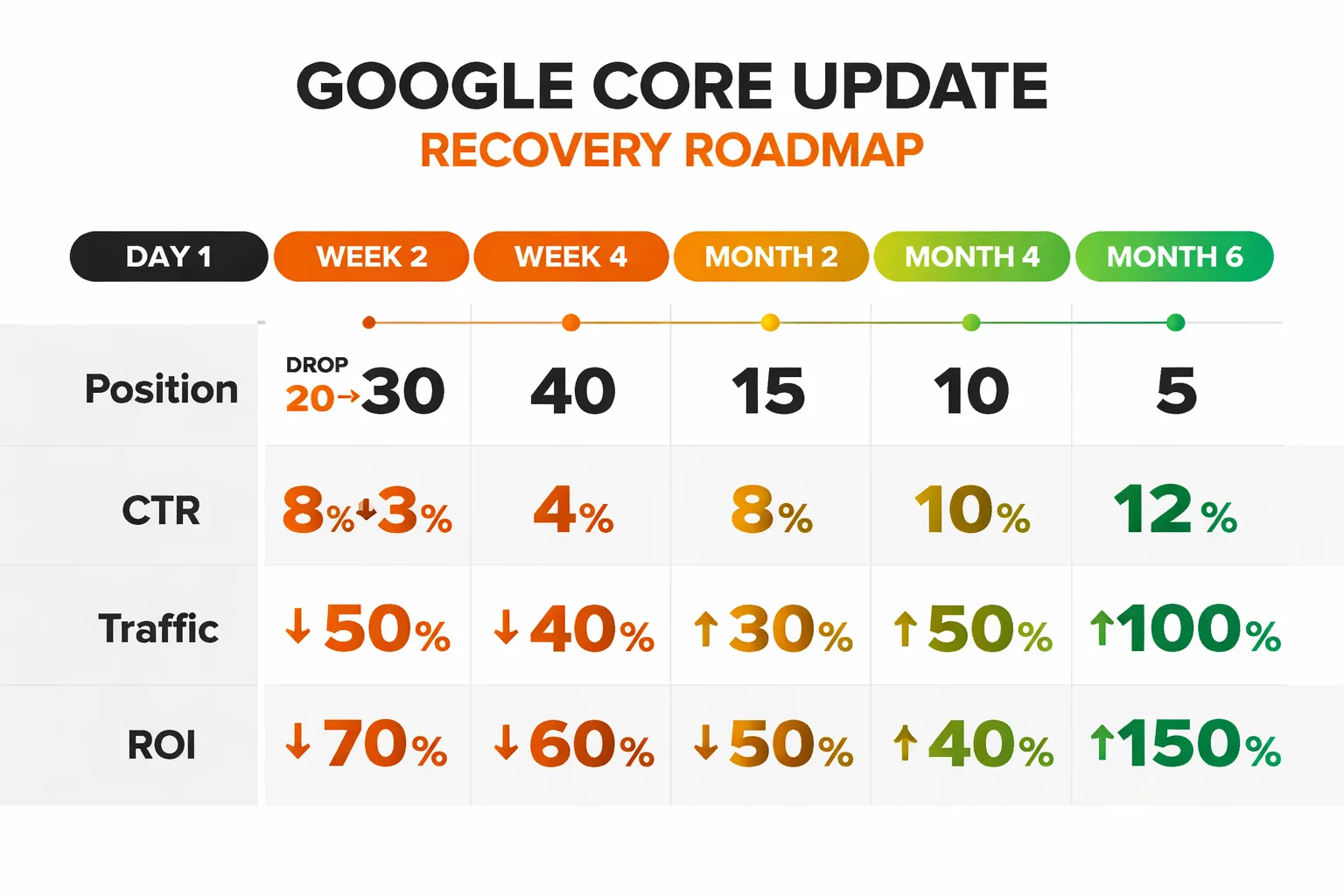
Google core update recovery is not a single fix — it's a structural overhaul that takes 3–6 months and requires diagnosing the specific failure mode before touching a single page.
What’s the Difference Between a Manual Action and a Core Update?
The first thing I do when a site gets hit is open Google Search Console and check the Manual Actions report. This distinction matters enormously — and most guides skip it entirely.
A manual action is a human-reviewed penalty. Google's spam team found something specific: cloaking, unnatural links, thin affiliate content. You'll see it explicitly in GSC under Security & Manual Actions. The fix path is clear: address the violation, submit a reconsideration request, wait.
A core update re-evaluation is completely different. There's no notification in GSC. No penalty flag. Google's algorithm simply reassessed your content's quality relative to competitors and decided you deserved less visibility. The fix path is murkier — and that's exactly why so many teams waste months chasing the wrong problem. SEO consultant Glenn Gabe has been vocal about this: avoid the knee-jerk reaction when rankings drop, because drops stem from relevancy adjustments, intent shifts, or site-wide quality problems — each requiring a completely different response.
If your GSC Manual Actions report is clean and your traffic dropped within the window of a confirmed core update rollout, you're dealing with an algorithmic quality signal. That's where this framework begins.
How to Start Google Core Update Recovery: Step 1 GSC Diagnosis Before You Touch Anything
Acting fast after a core update hit — without proper diagnosis — causes more damage than the update itself. I've watched teams immediately start deleting pages, rewriting content, and disavowing links within 48 hours of a drop. Every one of those moves was premature.
Here's the diagnostic sequence I run first, using Google Search Console structured data and the Performance report:
1. Isolate the drop by page type. Pull the Performance report, filter by date range (2 weeks before vs. 2 weeks after the update), and segment by page. Export to a spreadsheet. Sort by largest impression loss. Are the drops concentrated in blog posts? Product pages? Category pages? The pattern tells you where the algorithm's quality signal fired.
2. Check CTR alongside rankings. A ranking drop with CTR holding steady suggests a SERP layout change (AI Overviews, featured snippets). A ranking drop with CTR collapsing suggests a quality demotion. These are different problems.
3. Identify your 'at-risk clusters.' Group affected pages by topic. If your health content cluster dropped but your how-to guides held, the algorithm is signaling something specific about your E-E-A-T in that vertical — not your entire site.
4. Compare against Google's confirmed update dates. Cross-reference your traffic drop date with the official update timeline. If the drop preceded the update, you may have a different issue entirely.
That number — the exact date the drop started — is the most important data point in your entire recovery. Don't skip this step.
How to Conduct the Content Audit for Google Core Update Recovery (Including AI Content)
Here's where most recovery guides go soft. They say "audit your content for quality" without telling you what that actually means in 2025–2026, when a significant portion of affected sites are running AI-generated content at scale.
As Head of Content Strategy at Meev, I've reviewed content audits across dozens of sites hit by recent core updates. The pattern is consistent: sites that published AI content without editorial review — thin pages with no original insight, no author attribution, no real-world examples — got hit hardest. The December 2025 update was particularly aggressive toward this content type.
Here's the audit framework I use:
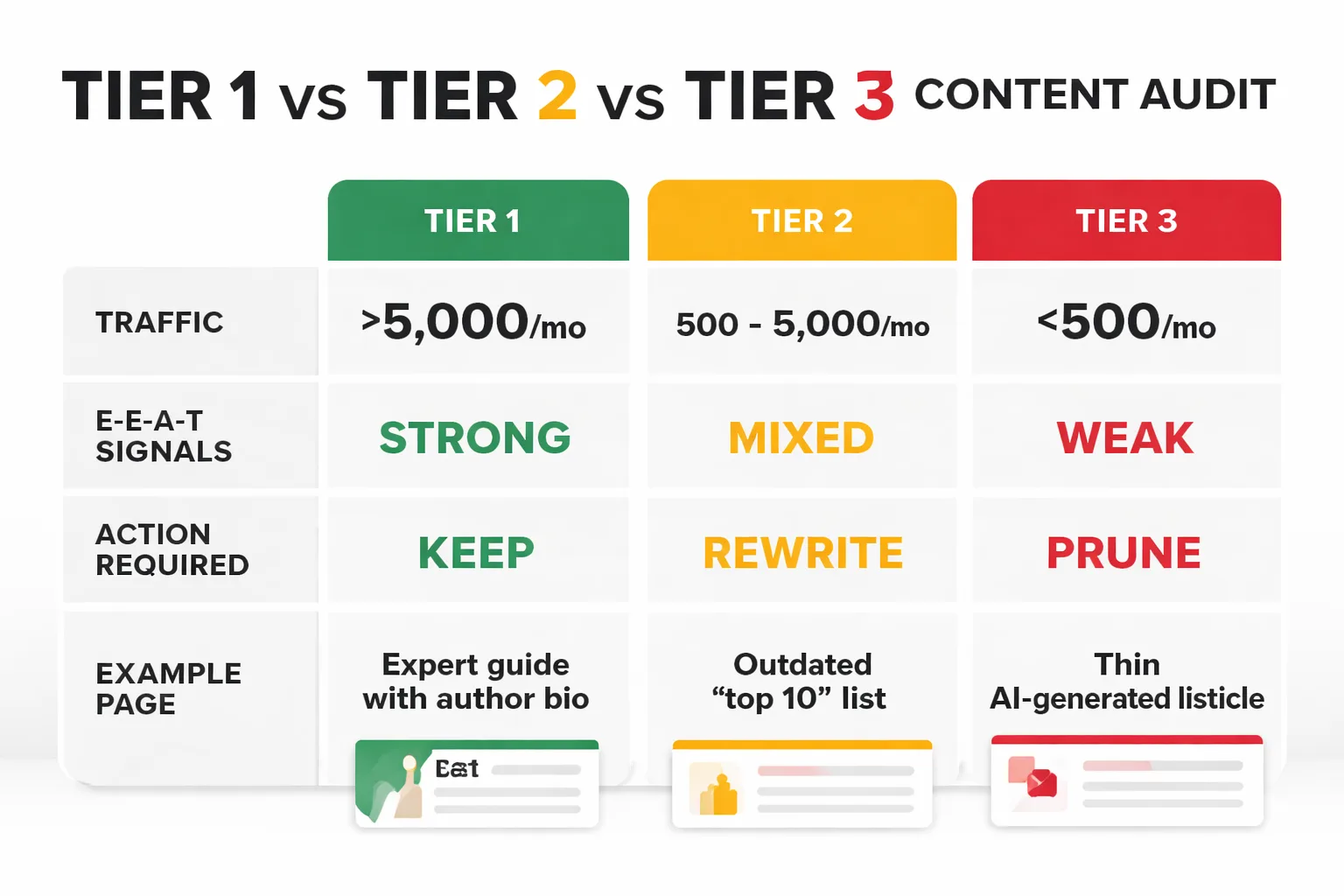
Tier 1 — Keep and strengthen (top 20% of pages by traffic + conversions): These pages have real engagement signals. Strengthen author bios, add original data or case studies, ensure E-E-A-T signals are explicit.
Tier 2 — Rewrite or consolidate (middle 50%): Pages with impressions but low CTR, or pages covering the same topic with minimal differentiation. Consolidate into one authoritative piece. Use 301 redirects.
Tier 3 — Prune (bottom 30%): Thin pages under 500 words with no backlinks, no traffic, no conversions. Pages that exist purely to target a keyword with no original value. These are your liability. Removing them — or noindexing them while you improve — is often the fastest signal you can send Google that you're serious about quality.
The AI content question specifically: I'm not saying AI content is inherently bad. I use AI-assisted workflows constantly. The problem is unreviewed AI content — generic pages lacking first-hand experience. Google's search quality rater guidelines are explicit about this: content should demonstrate Experience, Expertise, Authoritativeness, and Trustworthiness. An AI page that says "here are 5 tips for X" lacking author credentials, data, or unique insights fails all four.
How to Implement E-E-A-T Fixes to Recover from Core Update
Every recovery guide mentions E-E-A-T. Almost none of them explain what it actually looks like in practice — and what Google's quality raters are specifically looking for when they evaluate your pages.
E-E-A-T stands for Experience, Expertise, Authoritativeness, and Trustworthiness. The "Experience" component was added in 2022 and it's the one most sites still get wrong. It's not enough to have an expert write the content — the content needs to demonstrate that the author has personally done the thing they're writing about. A review of a product should show you used it. A guide to recovering from a core update should show you've diagnosed one.
For the Magento retailer I mentioned at the start, the recovery work included three specific E-E-A-T interventions: First, we rewrote every author bio to include specific credentials, years of experience, and links to external profiles (LinkedIn, industry publications). Second, we added a "Last reviewed by" date and reviewer name to every major guide — not just a "last updated" timestamp. Third, we embedded original data into the top 15 pages: internal analytics screenshots, customer survey results, real before/after comparisons. Within 6 months, that site recovered +28% of lost organic traffic and a +35% uplift in non-brand organic clicks to key category pages.
The sites that recover from core updates treat E-E-A-T as a content architecture decision, not a metadata exercise.
Building topical authority is the long-game version of this. If you want to understand how to structure content clusters that signal deep expertise to Google, The Complete Guide to Building Topical Authority With AI Content lays out the framework in detail — it's directly relevant to recovery because topical depth is one of the clearest signals Google uses to evaluate domain-level quality.
Not sure which pages are dragging down your site's quality signal after a core update hit?
Step 4: Technical SEO and Core Web Vitals
I'll be direct: technical SEO alone won't recover a core update hit. But ignoring it while you fix content is leaving points on the table — and in competitive verticals, those points matter.
Page speed optimization for SEO is the most actionable technical lever during recovery. Google's Core Web Vitals — Largest Contentful Paint, Cumulative Layout Shift, Interaction to Next Paint — are confirmed ranking signals. Sites with poor LCP scores (above 4 seconds) are fighting an uphill battle regardless of content quality.
The technical audit checklist I run in parallel with content work:
- Crawl budget efficiency: Use GSC's crawl stats report to identify pages being crawled frequently with no ranking value. Noindexing Tier 3 content frees crawl budget for your priority pages. - Internal linking structure: After pruning thin pages, your internal link equity needs redistribution. Audit orphaned pages and rebuild links to your Tier 1 content. - Structured data: Implement or fix schema markup on your highest-priority pages. Google Search Console's structured data report will flag errors. Rich results don't directly boost rankings, but they improve CTR — which is a behavioral signal. - Mobile performance: Run your top 20 pages through PageSpeed Insights. Any LCP above 2.5 seconds on mobile is a problem worth fixing before your next crawl cycle.
One thing I've started doing that most teams overlook: checking Google-Extended blocking in robots.txt. If you've accidentally blocked Google's AI crawlers from indexing your best content, you're invisible to AI Overviews — which is increasingly where high-intent queries surface. That's a recoverable mistake, but only if you catch it.
How Can GEO and AEO Help with Google Core Update Recovery?
This is the section that doesn't exist in any other recovery guide I've read — and it's the one that will matter most over the next 18 months.
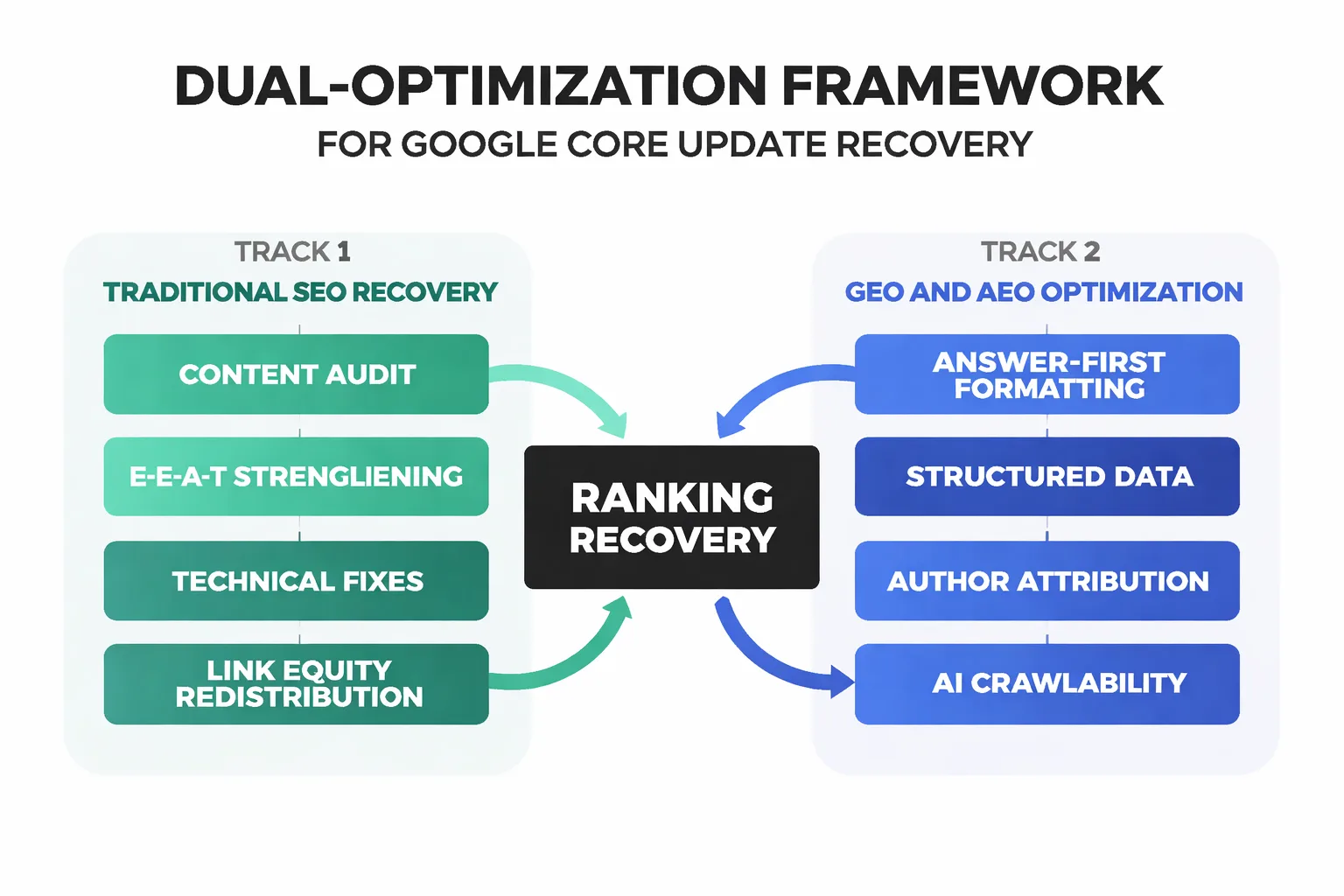
Generative Engine Optimization (GEO) and Answer Engine Optimization (AEO) are not just future-proofing strategies. They're active recovery levers right now, because AI Overviews and AI-powered search results are pulling from a different quality signal than traditional organic rankings. A site that lost 30% of its organic traffic to a core update can partially offset that loss by getting cited in AI Overviews — and the content requirements for that are specific and learnable.
What AI search engines extract and cite: direct, self-contained answers to specific questions; content with clear authorship and verifiable expertise; structured data that makes relationships between concepts explicit; and pages that answer the question in the first 100 words without burying the lede.
For recovery specifically, I recommend auditing your top 20 pages against this AEO checklist:
- Does the page answer its primary question in a 40–60 word paragraph near the top? - Is there a clear author with verifiable credentials? - Does the page include original data, quotes, or first-hand experience that AI systems can attribute? - Is the content structured with H2s that mirror natural language questions?
The sites I've seen recover fastest from the December 2025 update weren't just fixing old content — they were rebuilding it to serve both Google's traditional ranking algorithm and the AI systems that now mediate a significant portion of search intent. 55% of tracked sites saw ranking changes within two weeks of that update. The ones climbing back are the ones who understood that recovery in 2026 means optimizing for two audiences simultaneously: Google's crawler and the AI systems summarizing results for users.
What We'd Do Differently
The Magento case I opened with had a happy ending — eventually. But it took longer than it needed to because we made two mistakes in the first 30 days.
First, we started rewriting content before completing the full audit. We improved 40 pages before realizing the real damage was concentrated in 12 thin category pages we hadn't even looked at yet. Those 12 pages were dragging down the entire domain's quality signal. We should have audited everything before touching anything.
Second, we underestimated how long Google takes to re-evaluate. After deploying fixes, the team expected to see movement within 4–6 weeks. The first meaningful recovery signal didn't appear until week 14. Core update recovery is measured in quarters, not weeks. Setting that expectation with stakeholders upfront — before the pressure to "do something" builds — is as important as the technical work itself.
The +22% increase in organic revenue that site eventually saw wasn't the result of a clever hack. It was the result of 6 months of unglamorous structural work: pruning 47 thin pages, rewriting 23 author bios, consolidating 18 near-duplicate posts, fixing crawl budget leaks, and rebuilding internal link equity from scratch. That's what google core update recovery actually looks like.
Key Takeaways
- Diagnose before you act. Use GSC to isolate which page types were hit, when the drop started, and whether it correlates with a confirmed update window. Acting without this data wastes months. - Content pruning sends the fastest signal. Removing or noindexing thin, low-value pages — especially unreviewed AI-generated content — sends a clearer quality signal than rewriting mediocre pages. - E-E-A-T is architecture, not metadata. Author credentials, original data, and first-hand experience need to be embedded in the content itself — not just in a bio sidebar. - Recovery takes 3–6 months minimum. Set this expectation with stakeholders before the pressure to "show results" derails your strategy. The sites that recover are the ones that stay the course through two full crawl cycles. - GEO and AEO are now part of google core update recovery. Optimizing for AI Overviews and answer engines isn't optional — it's how you offset traffic losses while traditional rankings rebuild.
FAQ
What is the difference between a manual action and a core update penalty?
A manual action is a human-reviewed penalty for specific violations like cloaking or unnatural links, visible in Google Search Console's Manual Actions report, and requires fixing the issue plus a reconsideration request. A core update is an algorithmic change that re-evaluates all sites without targeting specifics, leading to broad traffic drops without explicit notices. Always check GSC first to confirm which you're dealing with.How long does it typically take to recover from a Google core update?
Recovery from a core update takes 3–6 months and involves a structural overhaul rather than a quick fix. The process starts with diagnosis in weeks 1–2, content audits by week 4, fix deployment by month 2, and re-crawl/re-evaluation by month 4, with full ranking recovery by month 6. Patience and precise diagnosis of your site's failure mode are key to success.What should you do first after noticing a traffic drop from a core update?
Immediately open Google Search Console to check the Manual Actions report and rule out human penalties. Begin diagnosis via GSC data for traffic cliffs, then audit content and site structure based on the update's impact patterns, like high hits to affiliate (71%) or e-commerce (52%) sites. Follow a roadmap from detection to fixes without rushing changes.Which site types were hit hardest by the December 2025 Google core update?
Affiliate sites suffered the most at 71% impact rates, followed by health content at 67%, and e-commerce at 52%. The 18-day update caused sudden SERP shifts, dropping long-term top rankings to page four overnight. Analyze your niche's vulnerability to prioritize recovery efforts.Is there a single fix for recovering from a core update?
No, core update recovery requires a full structural overhaul, not a single tweak, starting with diagnosing your specific failure mode. Avoid generic advice; tailor fixes like content audits and on-page optimizations over 3–6 months for re-evaluation. Quick fixes fail as Google prioritizes holistic site quality.Run your content through Meev's AI-powered audit framework and get a prioritized recovery plan — before the next update lands.