
In 2026, the 'AI content' debate has shifted from whether you should use it to why your current implementation is actively hurting your domain authority. If your traffic has plateaued despite a high volume of AI-generated posts, the issue isn't the technology—it's the strategy of treating AI as a replacement for expertise rather than a force multiplier for it.
Key Takeaways
- 90% of SEO content never reaches page one — AI has made it easier to produce this 'digital dust' faster, not smarter.
- Pure AI content ranks in the top position only 9% of the time versus 80% for human-written content; hybrid approaches close most of that gap.
- Over 30% of Google searches now trigger an AI Overview, meaning your content must be structured for Answer Engine Optimization (AEO), not just traditional SEO.
- The winning strategy in 2026 is fewer, deeper articles built with a research-first workflow — one competitor generated 452% more leads with 81% less content.
I see this constantly. And the frustrating part? The problem isn't that teams are using AI. It's how they're using it — and the assumptions baked into most content strategies that were already outdated before the ink dried.
Most content strategies in 2026 are failing not because of AI, but because of volume thinking dressed up in AI clothing.
"90% of SEO content is just digital dust — it never reaches page one, never generates a lead, and never gets read by a human being." — Igor Volovoy
That number hit me hard when I first saw it. Nine out of ten articles — gone. Invisible. And AI has made it easier than ever to produce that invisible content at industrial scale.
TLDR: - 90% of SEO content never reaches page one — AI has made it easier to produce this "digital dust" faster, not smarter. - Pure AI content ranks in the top position only 9% of the time versus 80% for human-written content; hybrid approaches close most of that gap. - Over 30% of Google searches now trigger an AI Overview, meaning your content must be structured for Answer Engine Optimization (AEO), not just traditional SEO. - The winning strategy in 2026 is fewer, deeper articles built with a research-first workflow — one competitor generated 452% more leads with 81% less content.
Is Volume-Based AI Content Dead?
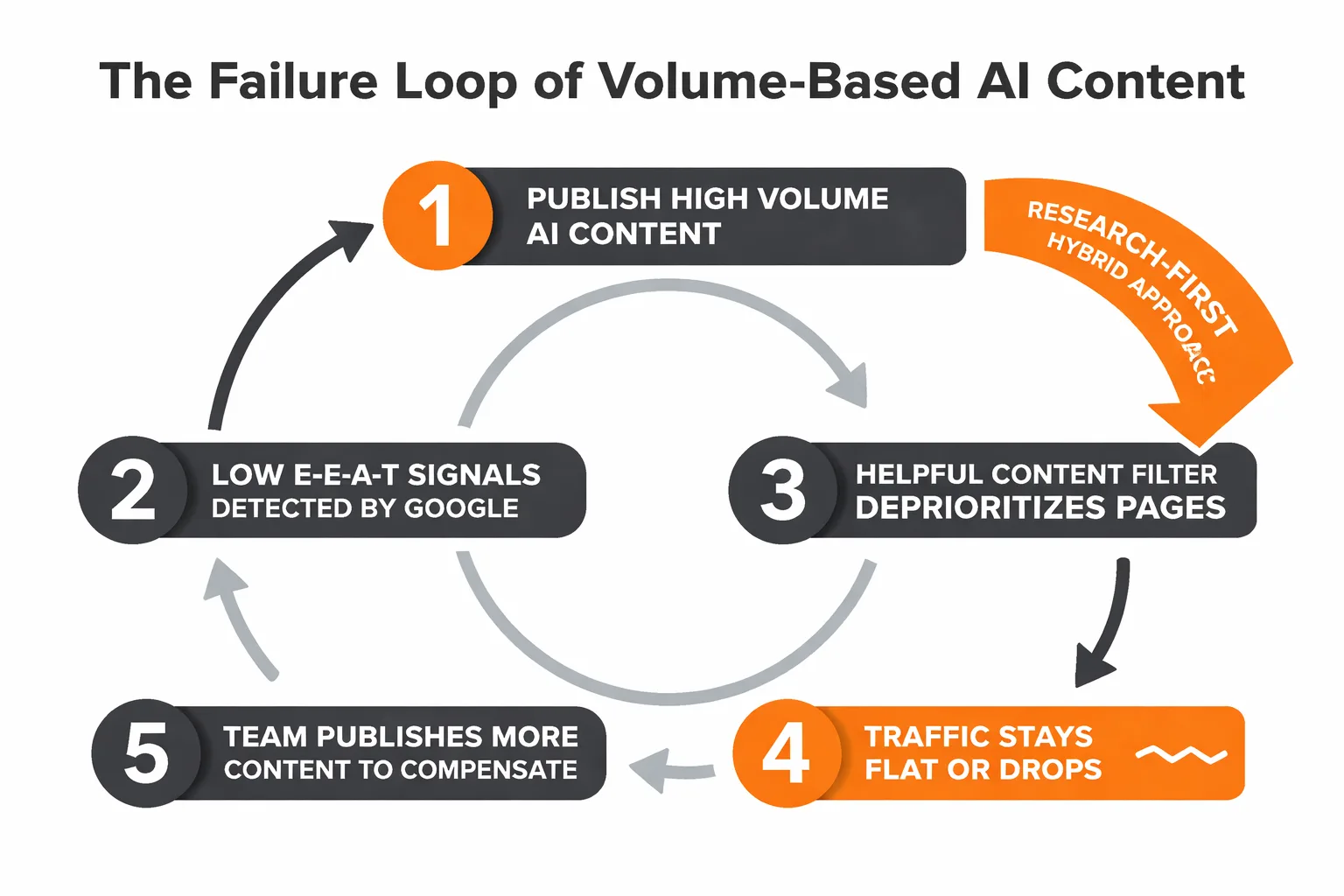
Volume-based AI content is the strategy of publishing as many articles as possible, as fast as possible, on the assumption that more content equals more traffic. In 2026, this approach is not just ineffective — it actively damages your site's standing with Google's quality systems.
Here's what I've watched happen to sites that went all-in on AI volume plays: they saw a short-term traffic bump, sometimes impressive, then a cliff. Google's Helpful Content system — now deeply embedded in its core ranking infrastructure — doesn't just ignore thin content. It uses it as a signal against your entire domain.
I've found that the teams most burned by this are the ones who confused output with strategy. They had a content calendar full of AI-generated articles, each hitting 1,500 words, each technically covering a keyword — and none of them answering a real question better than what already existed on page one. That's the trap. AI makes it trivially easy to produce content that looks complete but adds zero marginal value to the internet.
The data I keep coming back to: pure AI content ranks in the top position only 9% of the time, compared to 80% for human-written content. That's not a small gap — that's an 8x difference in ranking probability. And while 72% of SEO professionals say AI-assisted content performs as well or better than purely human content, the keyword there is assisted. Human judgment in the loop. Not AI running unsupervised at scale.
What Google's Algorithm Actually Rewards Now?
Google's quality systems in 2026 are evaluating content along dimensions that volume-based AI strategies structurally cannot satisfy. The Google Search Quality Rater Guidelines have always emphasized Experience, Expertise, Authoritativeness, and Trustworthiness — but the enforcement mechanisms are sharper now.
What I'm seeing rewarded: specificity, original data, named sources, first-hand experience signals, and content that demonstrates the author has actually done the thing they're writing about. What I'm seeing penalized: generic advice, smooth uniform tone with no personality, hedged language on every claim, and articles that could have been written about any industry without changing a word.
Here's the part that surprises most teams: it's not about whether AI wrote the words. It's about whether the content demonstrates genuine expertise. I've seen fully AI-generated articles rank well when they were built on original research, real data, and a clear editorial point of view. And I've seen human-written content tank because it was just as generic as the AI slop it was competing against.
The technical SEO audit question you should be asking isn't "how many articles did we publish?" It's "how many of our articles are the single best resource on the internet for their target query?"
Why AEO Changes Everything in 2026?
Answer Engine Optimization (AEO) is the practice of structuring content to be extracted and cited by AI-powered answer engines — including Google's AI Overviews, ChatGPT, Perplexity, and Gemini. In 2026, AEO is not optional. It's the primary distribution channel for informational content.
Over 30% of Google searches now trigger an AI Overview. That means for roughly one in three queries your content targets, Google is synthesizing an answer at the top of the page — and either your content is being cited in that answer, or someone else's is. There is no neutral outcome.
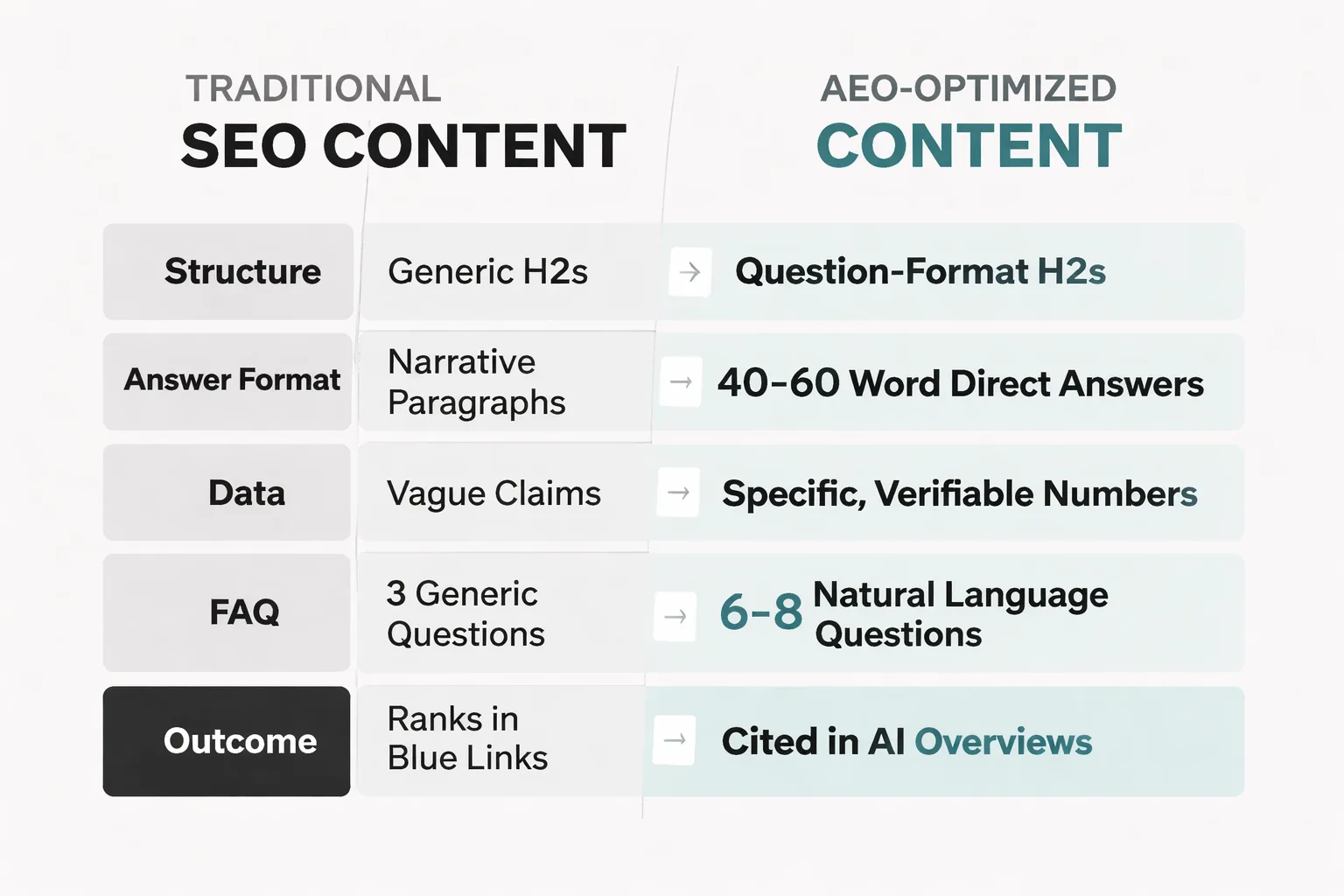
I've been watching the click behavior shift in real time. AI-generated answer experiences consume 40-60% of clicks on position zero. If you're not structuring your content to be cited — with direct definitions after every H2, 40-60 word self-contained answer paragraphs, numbered steps for processes, and FAQ sections that mirror real search queries — you're invisible to the fastest-growing traffic source in search.
This is the gap I see in almost every content strategy I review. Teams are still writing for the 2022 search experience: long-form articles designed to rank in the blue links. But the blue links are increasingly below the fold, below an AI Overview that already answered the question. The content that wins in 2026 is written to be the source that AI Overviews cite — not just to rank beneath them.
Building this kind of authority requires a different approach to content architecture entirely. If you want to go deeper on how to structure content for topical authority in the AI era, The Complete Guide to Building Topical Authority With AI Content covers the framework I'd recommend starting with.
Is your current content strategy built for AI Overviews and AEO — or is it still optimizing for a search experience that's already changed?
The Real Reason Most Content Strategies Fail
I want to be direct about something that most content marketing advice dances around: the failure isn't technical. It's strategic. Most content strategies fail because they're built around what's easy to produce, not what's valuable to the reader.
AI made this problem worse by making production trivially easy. When publishing an article costs 4 minutes instead of 7 hours, the temptation to publish everything — every keyword variation, every tangentially related topic, every "what is" definition post — becomes almost irresistible. I understand the logic. More surface area, more chances to rank. But that's not how Google's quality systems work anymore.
The pattern I keep seeing in successful content operations is almost the opposite of what most teams do. One case I find genuinely instructive: a competitor strategy that generated 452% more leads with 81% less content. That's not a rounding error. That's a fundamentally different philosophy — fewer articles, each one built to be the definitive resource on its topic, each one structured for both traditional ranking and AI citation.
I've seen this play out with our own clients. An outdoor gear e-commerce brand came to us publishing 2 blog posts per month, each taking their team 6-8 hours to research and write. After implementing a research-first automated pipeline, they scaled to 12 articles per month — but the key wasn't the volume increase. It was that every article was built around keywords with verified search volume, low competition, and a clear gap in existing content quality. The result: 340% organic traffic growth in 6 months, 23 articles on Google page one within 90 days, and a single article — "Best Hiking Boots for Pacific Northwest Rain" — that generated 12,000 organic visits and $8,400 in attributed revenue in its first month. The speed came from AI. The results came from strategy.
That's the distinction most teams miss. Seventy percent of SEO teams cite speed as the top benefit of AI for content — and speed is real. But only 19% report improvements in content quality. Speed without quality is just faster failure.
What Separates the Best Content Strategies from Most Content Strategies?
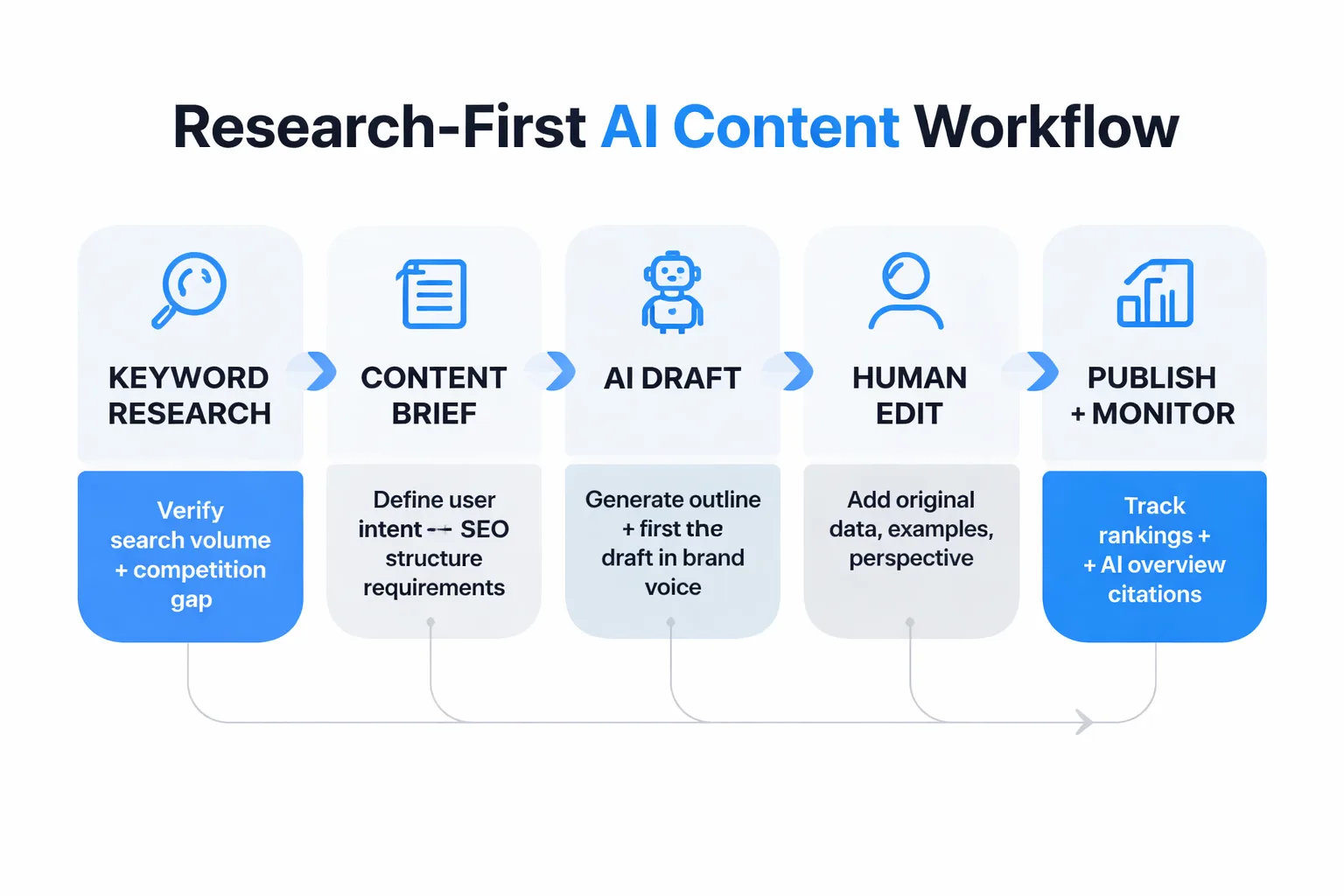
A working AI content strategy in 2026 has three non-negotiable components: research-first keyword targeting, hybrid human-AI production, and AEO-native formatting.
Research-first keyword targeting means you're not publishing on topics because they're adjacent to your niche or because a content calendar template suggested them. You're targeting queries with verified search volume, identifiable user intent, and a content gap you can actually fill better than what's currently ranking. High-potential keyword research isn't glamorous, but it's the difference between content that compounds and content that disappears.
Hybrid human-AI production means AI handles the structural heavy lifting — outlines, first drafts, formatting, semantic variations — while human judgment handles the things AI consistently gets wrong: original perspective, specific examples, emotional tone, and the editorial decisions that make content feel like it was written by someone who actually knows the subject. The 72% of SEO professionals who say AI-assisted content performs as well as human-written aren't using AI to replace thinking. They're using it to accelerate execution.
AEO-native formatting means every article is built from the ground up to be extractable. Question-format H2 headings. Direct 40-60 word answers immediately after each heading. Numbered steps for any process. FAQ sections with 6-8 questions phrased the way people actually search. Comparison tables when evaluating options. This isn't just good for AI Overviews — it's good for featured snippets, People Also Ask boxes, and voice search. It's the formatting layer that makes your content useful across every surface where search is happening.
Is AI content creation Worth It?
AI content creation is worth it when it's used to accelerate a quality-first strategy — and it's a liability when it's used to substitute for one. The teams seeing real results aren't publishing more; they're publishing smarter, faster.
The productivity gains are real. Over 70% of marketers using AI for content report spending less time on manual tasks, and 70% of business leaders report positive ROI on productivity. But productivity gains only translate to business results when the underlying strategy is sound. Publishing 10x more mediocre content doesn't compound — it dilutes.
The honest answer I give every team I work with: if you can't articulate why your article is the best resource on the internet for its target query, don't publish it. Most content fails this test. AI or human, that standard applies equally. The teams winning in 2026 are the ones who've internalized that question — and built their entire production workflow around answering it.
FAQ
Why do most AI content strategies fail?
Most AI content strategies fail because they prioritize volume over value. Teams use AI to publish more content faster without ensuring each piece is meaningfully better than what already ranks. Google's Helpful Content system penalizes thin, generic content at the domain level — meaning a high volume of low-quality AI articles can suppress your entire site's rankings, not just the individual posts.What is AEO and why does it matter for content in 2026?
Answer Engine Optimization (AEO) is the practice of structuring content to be cited by AI-powered answer engines like Google AI Overviews, ChatGPT, and Perplexity. It matters because over 30% of Google searches now trigger an AI Overview, and AI answer experiences consume 40-60% of clicks on position zero. If your content isn't formatted to be extracted and cited, you're invisible to the fastest-growing traffic channel in search.Does pure AI content rank on Google?
Pure AI content ranks in the top position only 9% of the time, compared to 80% for human-written content — an 8x difference. However, hybrid AI-human content, where AI handles drafting and structure while humans add original perspective and specific examples, performs comparably to fully human-written content according to 72% of SEO professionals surveyed by Semrush.How much content should I be publishing in 2026?
There's no universal number, but the direction is clear: fewer, deeper articles outperform high-volume thin content. One documented strategy generated 452% more leads with 81% less content. The right question isn't how many articles per month — it's how many articles you can produce that are genuinely the best resource on the internet for their target query.What makes a content strategy 'research-first'?
A research-first content strategy starts with verified keyword data — real search volume, competition analysis, and an identifiable gap in existing content quality — before a single word is written. It means you're only publishing on topics where you can demonstrably outperform what currently ranks, rather than publishing on topics because they're adjacent to your niche or easy to generate.How does Google's Helpful Content system affect AI content?
Google's Helpful Content system evaluates content for genuine expertise, original value, and user-first intent. It operates at the domain level, meaning a pattern of thin or unhelpful content can suppress rankings across your entire site. AI-generated content that lacks original data, specific examples, and a clear editorial perspective is particularly vulnerable to these signals.What's the difference between SEO and AEO optimization?
Traditional SEO optimization targets ranking in the blue link results through keyword placement, backlinks, and technical signals. AEO optimization targets being cited in AI-generated answers through direct answer formatting, question-format headings, 40-60 word self-contained answer paragraphs, and structured FAQ sections. In 2026, effective content strategies require both — but AEO is the faster-growing distribution channel and the one most teams are currently ignoring.Can AI content creation actually improve ROI?
Yes — when the workflow is built correctly. Over 70% of business leaders using AI for content report positive ROI on productivity, and teams using research-first AI pipelines have documented dramatic results: 340% organic traffic growth, 23 page-one rankings in 90 days, and individual articles generating thousands in attributed revenue. The ROI comes from the strategy, not the AI itself.Stop publishing content that disappears. Meev's research-first pipeline builds every article to rank and get cited — try it and see the difference in 90 days.