
Content Marketing: The Real Definition That Actually Works
Content marketing is the practice of creating and distributing genuinely useful, relevant information to attract and retain a specific audience — with the end goal of driving profitable customer action. That's the definition. Everything else is either a subset of it or a distraction from it.
In my experience, that definition has been stretched and diluted into meaninglessness over the years. Every brand with a blog now calls itself a "content marketing powerhouse." Every social media post gets labeled "content." And somewhere along the way, the actual discipline — the one with real strategy and measurable outcomes — got buried under an avalanche of noise.
TLDR - Content marketing is defined by intent and outcome, not format — a blog post that doesn't serve a specific audience at a specific stage is just publishing, not marketing. - The word "content" in a marketing context means any information asset designed to move a specific person closer to a specific decision. - AI and automation tools like AI agents and GEO optimization for AI search don't replace content marketing strategy — they amplify whatever strategy (or lack thereof) already exists. - A minimum viable content marketing strategy for 2026 typically includes four things: a defined audience, intent mapping, a distribution plan, and a measurement framework tied to business outcomes.
What Is the One-Sentence Definition of Content Marketing Most Marketers Get Wrong?
Content marketing is not "creating valuable content" — it's creating content that creates value for a specific audience in a way that ultimately creates value for your business. The distinction sounds subtle. It isn't.
The Content Marketing Institute defines it as "a strategic marketing approach focused on creating and distributing valuable, relevant content to attract and retain a clearly defined audience." That's close, but one word warrants pushback: "consistent." Consistency without strategy is just scheduled mediocrity. I've seen brands publish three blog posts a week for two years and generate zero pipeline when the content is never connected to a business outcome. Consistency is a tactic. Strategy is the reason consistency matters.
Here's where most marketers go wrong: they confuse the vehicle with the destination. A blog post is a vehicle. A YouTube video is a vehicle. A newsletter is a vehicle. Content marketing is the system that decides which vehicles go to which destinations, carrying which passengers. Without that system, you're just running buses with no routes.
The sharper one-sentence definition that holds up across every context: Content marketing is the practice of earning attention and trust through information, rather than buying it through interruption. That's what separates it from advertising (which interrupts), PR (which borrows credibility), and general publishing (which informs without a commercial objective).
What Does 'Content' Actually Mean in a Marketing Context?
Content, in a marketing context, is any information asset — text, audio, video, interactive tool, or visual — designed to move a specific person closer to a specific decision. It is not synonymous with "stuff we publish." The word carries intentionality that most people strip out of it.
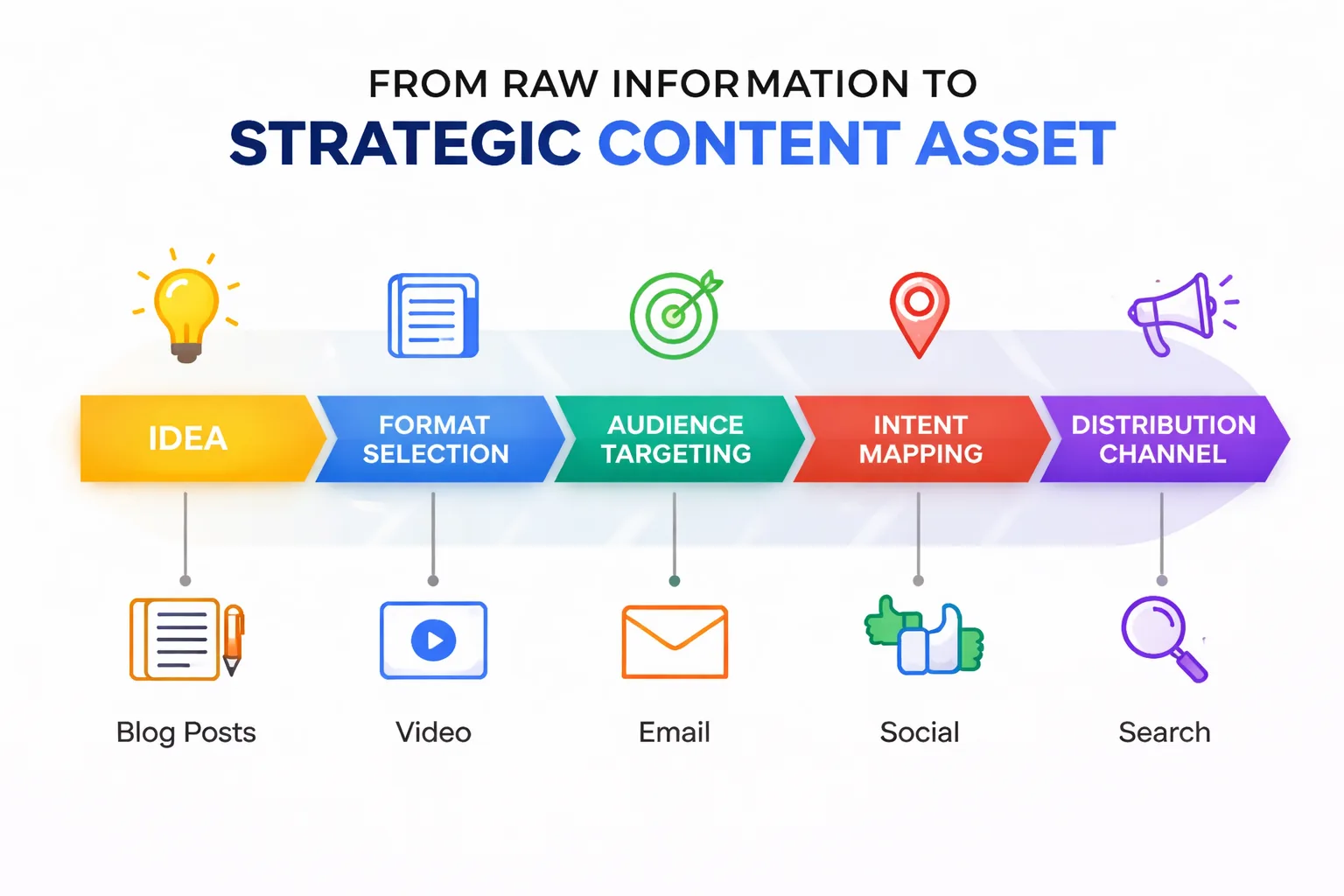
This is where the definition of content gets genuinely complicated — and genuinely interesting. The meaning of content shifts based on three variables:
Channel. A long-form guide on Google Search is an awareness asset. That same information compressed into a short Reel is a consideration asset. The information is identical; the context changes everything about how it functions as a marketing tool.
Intent. Content written for someone searching "what is content marketing" serves a completely different function than content written for someone searching "content marketing agency pricing." The first is educational; the second is commercial. Treating them the same way is one of the most expensive mistakes content teams make — and one I've seen repeatedly in my work leading content strategy at Meev.
Audience stage. A first-time visitor to a site needs different content than a prospect who's already read six articles and downloaded a template. The word "content" covers both — but they require entirely their own brief, CTA, and metrics.
In practice, when I work through a content audit, my starting point is to classify every asset by these three variables before discussing performance. Nine times out of ten, the "underperforming content" isn't bad — it's just mismatched. Awareness-stage content being measured by conversion rate. Commercial-intent content written like a thought leadership essay. The content itself is fine; the strategy around it is broken.
"The definition of content in marketing isn't about format — it's about function. If it doesn't serve a specific audience at a specific stage toward a specific outcome, it's not content marketing. It's just publishing."
Where Is the Line Between Content Marketing and Just Publishing?
The line between strategic content and random publishing is intent — and I can see the difference clearly when I look at real examples.
HubSpot's blog is the canonical example of content marketing done right. Every piece they publish maps to a keyword with commercial intent, targets a specific buyer persona at a specific funnel stage, and connects to a free tool or product that converts readers into users. Their "What is CRM?" article isn't there because someone thought it was interesting. It's there because millions of people search that phrase every month, and HubSpot sells CRM software. The content exists to capture that intent and route it toward a business outcome. That's content marketing.
Contrast that with a mid-size B2B company I audited — hundreds of blog posts published consistently over several years. When I pulled the Google Search Console data, the vast majority of those posts had fewer than 10 impressions per month. The team was publishing consistently, professionally, and completely into the void. No keyword research. No audience persona. No connection between the topics chosen and the problems their buyers actually had. They had a publishing operation. They did not have a content marketing strategy.
The clearest real-world comparison:
| Strategic Content Marketing | Random Publishing | |
| Topic selection | Based on audience intent + business goals | Based on what the team finds interesting |
| Success metric | Pipeline, leads, organic traffic growth | Pageviews, social shares |
| Distribution | Planned across channels with purpose | Posted and forgotten |
| Audience | Defined persona at a specific funnel stage | "Anyone who might be interested" |
| ROI timeline | 6-18 months of compounding returns | Rarely measured |
| Real example | HubSpot, Intercom, Ahrefs blog | Most corporate blogs |
The brands that do this well — Ahrefs, Intercom, Wistia — share one thing: every content decision traces back to a documented audience problem and a measurable business outcome. The brands that do it poorly are usually substituting volume for strategy, hoping that publishing more will somehow produce results that publishing smarter would actually deliver.
For a deeper look at building the kind of content operation that compounds over time, this guide on building topical authority with AI content covers exactly how to structure a content program that search engines — and AI systems — actually reward.
How Are AI and Automation Rewriting the Content Marketing Playbook?
Here's the uncomfortable truth about AI content creation: it doesn't change the definition of content marketing at all. It changes the cost and speed of production — which changes everything about competitive dynamics, but nothing about strategy.
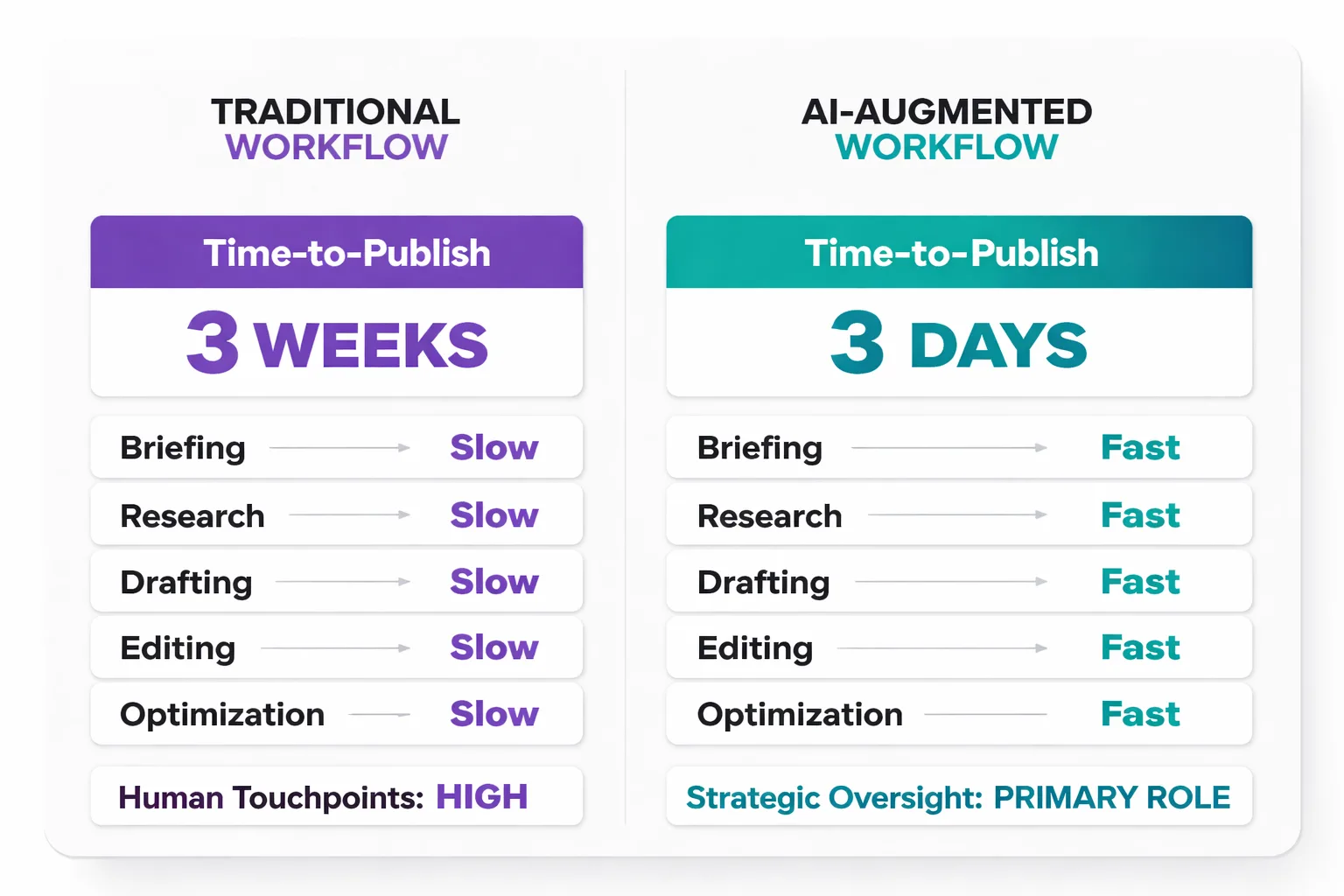
At Meev, we've seen teams adopt AI agents and automation tools with enormous enthusiasm and, too often, disappointing results. Not because the tools don't work — they do, remarkably well — but because teams are using them to accelerate a broken strategy rather than to execute a good one. AI amplifies whatever's already there. If a content strategy is sound, AI makes it faster and cheaper. If the content strategy is "publish more stuff and see what sticks," AI just helps miss the target more efficiently.
The specific shifts that actually matter for content marketers in 2026:
GEO optimization for AI search is now a real discipline. As ChatGPT, Perplexity, and Google's AI Overviews pull answers directly from web content, the rules for what gets cited have changed. Content needs to be structured for extraction — clear definitions and direct answers up front, backed by specific facts that AI systems can verify and quote. This isn't a replacement for SEO; it's an additional layer that rewards the same things Google has always rewarded: expertise and clarity.
AI content creation for social media has become table stakes. The teams I've seen winning on LinkedIn and YouTube in 2026 aren't the ones writing every caption manually — they're the ones who've built systems that repurpose core content assets into channel-native formats at scale. One well-researched pillar piece can become multiple social posts, several email newsletters, and a short-form video script. The strategy is human. The production is increasingly automated.
Google-Extended blocking has created a new strategic variable. Some publishers are now blocking AI crawlers from training on their content — a decision that affects both their visibility in AI-generated answers and their long-term content moat. I don't think there's a universal right answer here, but it's a decision that needs to be made deliberately, not by default.
What hasn't changed: the need for a human who understands the audience, maps the intent, and makes the editorial judgment calls that determine whether a piece of content earns attention or gets ignored. AI can write. It cannot — yet — genuinely understand why a specific reader at a specific moment in their journey needs a specific piece of information. That's still strategy. That's still the job.
What Is the Minimum Viable Content Marketing Strategy for 2026?
A minimum viable content marketing strategy isn't about doing less — it's about doing the right things in the right order so that everything produced compounds instead of evaporates.
Here's the framework I recommend for building from scratch today:
Step 1: Define your audience with uncomfortable specificity. Not "small business owners." Not "marketing managers at B2B companies." The person you're writing for has a job title, a problem keeping them up at night, and a gap between their current state and their goal. Write that down in one paragraph before briefing a single piece of content. If you can't describe your reader that specifically, you're not ready to publish anything.
Step 2: Map intent before you map topics. For every content idea, ask: what is the person searching for this actually trying to do? Are they trying to understand something (informational intent)? Compare options (commercial intent)? Make a purchase (transactional intent)? The answer determines the format, the depth, the call to action, and the success metric. In my experience, keyword research without intent mapping is just a list of words.
Step 3: Build a distribution plan before you hit publish. Content without distribution is a tree falling in an empty forest. For every piece I publish, I decide in advance: Which channels will this go to? Who will share it and why? Does it support an email sequence, a paid amplification campaign, or an organic social push? If you can't answer those questions before writing begins, you're optimizing for creation instead of impact.
Step 4: Measure outcomes, not outputs. Pageviews are an output. Pipeline contribution is an outcome. Email subscribers are an output. Revenue influenced by content is an outcome. Pageviews matter as a leading indicator — but if your content reporting stops at traffic, you're flying blind on the metrics that actually justify the investment. Connect content analytics to the CRM. Track which pieces of content appear in the journey of closed-won deals. That data will tell you more about what to create next than any keyword tool.
Step 5: Build for compounding, not for campaigns. The biggest strategic mistake I see in 2026 is treating content like advertising — bursts of activity around a product launch or a campaign, then silence. Content marketing compounds. A well-optimized article published today will generate traffic in three years. A well-structured email sequence will nurture leads you haven't acquired yet. Build assets, not events.
| Strategy Element | Minimum Viable Version | Full Version |
| Audience definition | One detailed persona doc | Full ICP + persona matrix |
| Keyword/intent mapping | 20 target queries with intent tags | Full topical authority map |
| Content types | Blog + email | Blog + email + video + social + tools |
| Publishing cadence | 2 posts/month, consistently | 4-8 posts/month + repurposing |
| Distribution | Organic search + email list | Search + email + paid + partnerships |
| Measurement | Traffic + leads by source | Full revenue attribution |
The minimum viable version isn't glamorous. It won't win any awards. But it will compound — and in content marketing, compounding is the whole game.