
Forget the vanity metrics you've been tracking for the last six months. While your dashboard shows green arrows, the shift toward AI-driven search means your 'page-one' rankings are increasingly disconnected from actual revenue. Let's look at the three specific metrics that actually correlate with conversion with AI-driven search.
The search engine that your audience uses today is fundamentally different from the one you built your strategy around. AI Overviews now appear in 47% of all Google searches, and roughly 60% of queries end without a click to any website. That's not a blip — that's a structural shift in how information moves from your content to your audience. The metrics that actually matter in 2026 are the ones built for this new reality, not the ones we inherited from a world where ranking #1 meant winning.
Key Takeaways
- AI Overviews appear in 47% of searches and 60% of queries end without a click — traditional traffic metrics are now structurally misleading.
- Keyword rankings are a vanity metric in 2026; what matters is whether your content is cited inside AI-generated answers (AEO/GEO visibility).
- E-E-A-T signals correlate +30.64% with AI citations — optimizing for citability is now more valuable than optimizing for clicks.
- The metrics that actually matter now are AI citation rate, task completion rate, return visit rate, topical authority depth, and revenue-per-session — not bounce rate, dwell time, or raw organic traffic.
TLDR — Key Takeaways: - AI Overviews appear in 47% of searches and 60% of queries end without a click — traditional traffic metrics are now structurally misleading. - Keyword rankings are a vanity metric in 2026; what matters is whether your content is cited inside AI-generated answers (AEO/GEO visibility). - E-E-A-T signals correlate +30.64% with AI citations — optimizing for citability is now more valuable than optimizing for clicks. - The metrics that actually matter now are: AI citation rate, task completion rate, return visit rate, topical authority depth, and revenue-per-session — not bounce rate, dwell time, or raw organic traffic.
Why Have Rankings Become a Vanity Metric?
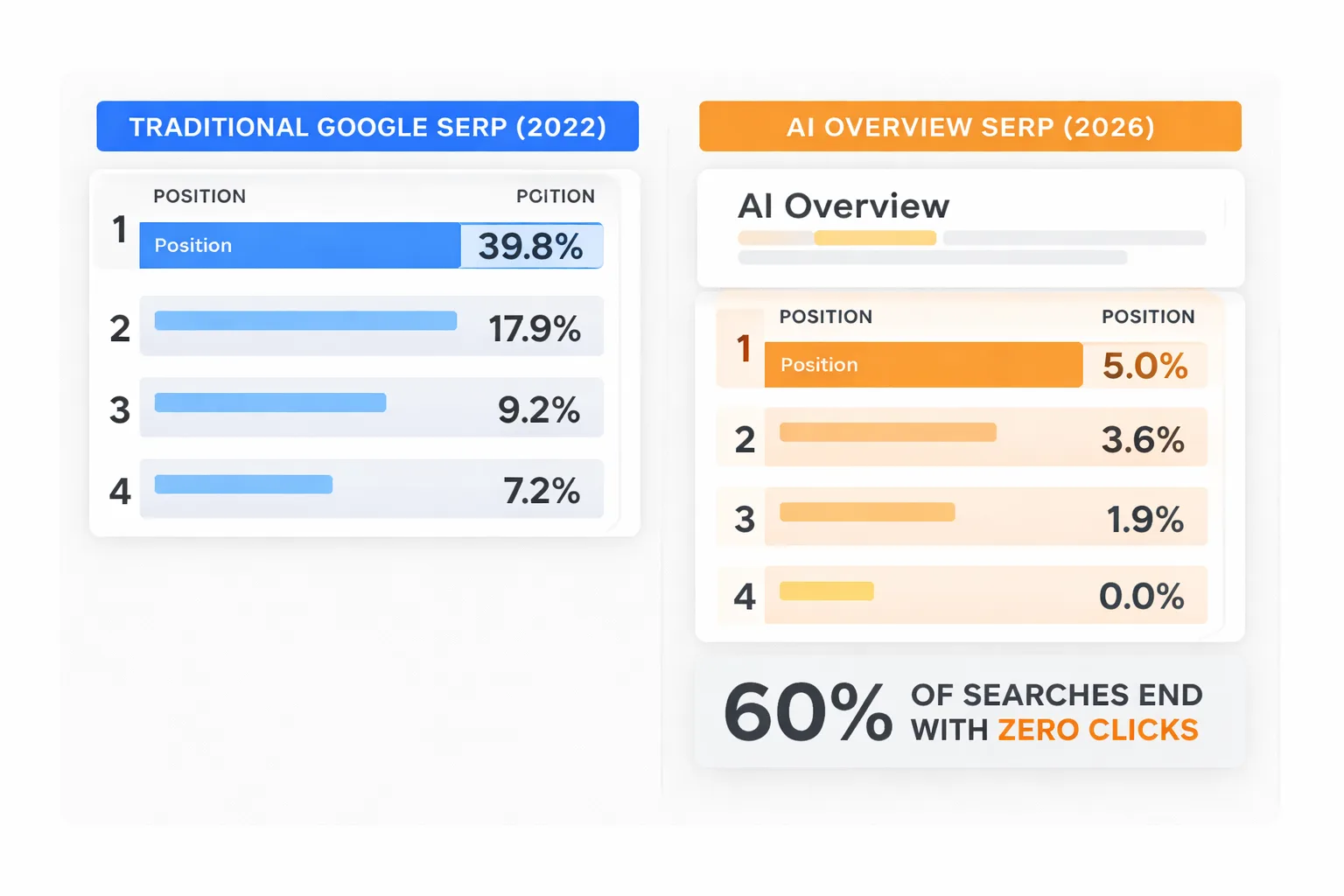
Keyword rankings are the metric that actually feels the most concrete — you can see the number, track it weekly, celebrate when it climbs. That's exactly why it's dangerous. A position-one ranking in 2026 doesn't mean what it meant in 2022. The average CTR for position one is 39.8%, according to data I've been tracking across search performance reports — but that number assumes a standard blue-link SERP. When an AI Overview sits above your result, that CTR collapses. You can rank first and still lose the traffic.
I've had this exact conversation with my team after watching our organic visibility numbers hold steady while sessions dropped quarter-over-quarter. The ranking was real. The traffic assumption attached to it wasn't.
Here's the honest framing: a keyword ranking tells you where you sit in a competition. It doesn't tell you whether anyone sees your result, clicks it, or finds value in it. In a SERP dominated by AI-generated summaries, featured snippets, and People Also Ask boxes, the ranking position is increasingly decorative.
What to track instead: AI Overview citation rate — whether your content is being pulled into the generated answer, not just ranked below it. This is the 2026 version of position one.
The Zero-Click Reality Nobody Planned For
I've sat in the uncomfortable meeting where someone pulls up the SEO dashboard and asks why traffic is flat after a quarter of strong content output. The answer, increasingly, is zero-click behavior — and the AI Overview rollout made this visible almost overnight for teams that had been coasting on steady performance. In 2025, 60% of Google searches ended without a click to a website, up from 58% in 2024. That one-point shift sounds small. Across millions of monthly queries in your niche, it's enormous.
I've seen this hit B2B content especially hard. Informational queries — the top-of-funnel content we invest most in — are exactly what AI answers best. A user searching "how does technical SEO audit work" doesn't need to click through to your 2,000-word guide if the AI Overview gives them a clean 150-word summary. Your content may have informed that answer. You just don't get the session.
The failure mode I've witnessed is teams doubling down on volume to compensate. More articles, faster publishing cadence, broader keyword targeting. That's the wrong move. The right move is restructuring content to earn the citation inside the AI answer — to become the source the model references, not just the page that ranks below it.
Zero-click doesn't mean zero-influence. It means you need different instruments to measure influence.
The metric shift here is from sessions to brand mentions — including unlinked citations in AI-generated answers, Reddit threads, and X discussions where your brand gets referenced without anyone visiting your site. That's real reach that never shows up in GA4.
What Does AEO Actually Measure?
Answer Engine Optimization (AEO) is the practice of structuring content so that AI systems — Google's AI Overviews, ChatGPT, Perplexity, and similar tools — extract and cite your content in generated answers. It's not a replacement for SEO. It's the layer on top of it that determines whether your content gets amplified by AI or ignored by it.
I made a deliberate pivot toward AEO and GEO (Generative Engine Optimization) in 2024, and it's reshaped how I think about organic visibility entirely. The honest tension I sit with: most practitioners I talk to are still running traditional SEO playbooks — keywords, backlinks, on-page optimization — and they're not wrong that those still matter. But AI-generated answers are absorbing a significant chunk of top-funnel traffic that used to flow through standard blue links. The shift I'm betting on is that SEO is evolving toward authority and citability.
Here's what AEO success actually looks like in practice, measured concretely:
1. AI citation rate: How often does your domain appear as a source inside AI-generated answers for your target queries? Pull this manually by running your priority keywords through ChatGPT, Perplexity, and Google AI Overviews weekly. Track which domains get cited. If it's not yours, find out whose content is getting pulled and reverse-engineer why. 2. Structured data coverage: Use Google Search Console's structured data report to verify schema markup is valid across your key pages. FAQ schema, HowTo schema, and Article schema are the three formats most frequently extracted by AI systems. 3. E-E-A-T signal density: I've found that pages with strong E-E-A-T signals — named authors, first-person experience, verifiable credentials, specific data points — correlate +30.64% with AI citations compared to pages without them, based on Semrush's content optimization study. That's not a marginal edge. That's a structural advantage. 4. Answer completeness score: Does your content directly answer the question in the first 60 words after the H2? AI systems extract the most self-contained, direct answers. If your content buries the answer in paragraph four, it won't get cited.
For teams building out their AEO approach, I'd also recommend reading The Complete Guide to Building Topical Authority With AI Content — topical authority is the foundation that makes AEO work. You can't earn AI citations on isolated pages; you earn them by being the most authoritative source on a topic cluster.
Which Are the Engagement Metrics That Actually Matter?
I've stopped including bounce rate and dwell time in my team's reporting dashboards. When I explain why, I usually get pushback — until I walk through the logic. These metrics are proxies built for a pre-AI search world. A user who lands on your page, finds the exact answer they needed in 45 seconds, and leaves is not a failure. Bounce rate calls it one. Dwell time penalizes it. Neither metric reliably maps to content quality or search intent satisfaction in 2026.
Engagement still matters. We're measuring the wrong signals.
The engagement metrics that actually matter now:
| Metric | What It Measures | Why It Matters in 2026 |
| Task completion rate | Did the user accomplish their goal? | Directly maps to intent satisfaction |
| Return visit rate | Do users come back to your site? | Signals trust and brand authority |
| Revenue per session | What's each session worth commercially? | Connects content to business outcomes |
| Scroll depth on pillar pages | Are users consuming long-form content? | Indicates genuine engagement vs. bounce |
| AI citation frequency | Is your content referenced in AI answers? | Measures influence beyond click-through |
Scroll depth is the one I've found most underused. On pillar content — the 2,500-word guides that anchor your topical authority — scroll depth tells you whether users are actually reading or skimming and leaving. A page with 80% average scroll depth and a "high" bounce rate is performing well. A page with 20% scroll depth and a low bounce rate might be trapping confused users who can't find what they need.
Are you still tracking metrics that were built for a search landscape that no longer exists?
The Core Web Vitals Trap
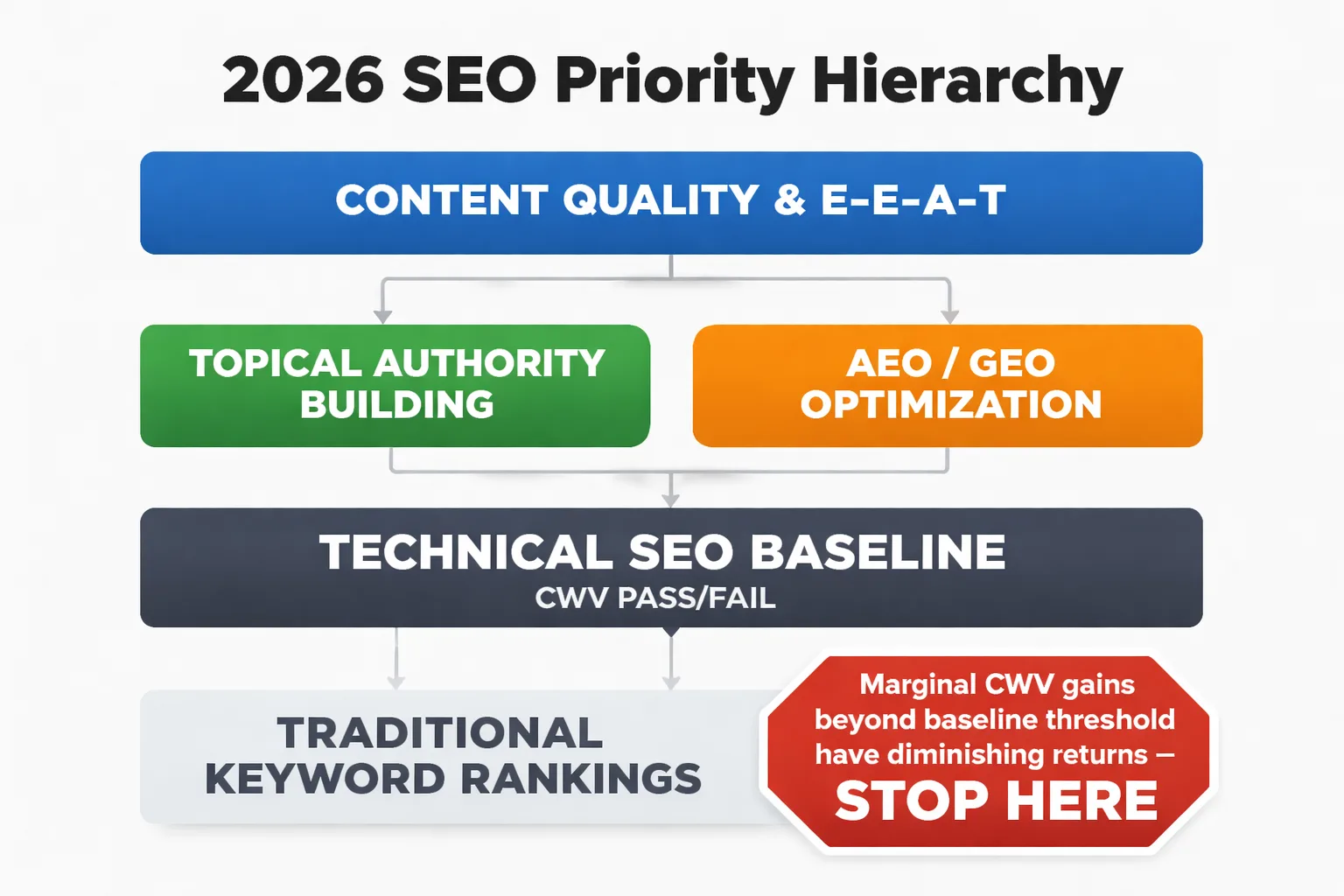
Most people think Core Web Vitals are a major ranking lever in 2026. They're not — at least not in the way most teams are treating them.
I've been watching teams pour engineering hours into CWV optimization and I've started pushing back hard on that prioritization. Looking across a large dataset of pages, there's no strong positive correlation between improving CWV scores beyond baseline thresholds and gaining AI search visibility. That distinction sets priorities. Hitting the baseline — passing the Core Web Vitals assessment in Google Search Console — is non-negotiable. Chasing marginal gains past that point is diminishing-returns territory.
I'll be honest: credible voices still argue CWV directly drives rankings in 2026, . My take is that passing the threshold is table stakes, not a growth lever. If your content team is waiting on a perfect Lighthouse score before publishing, you're optimizing the wrong variable. Redirect that effort toward topical authority and answer quality instead. A page that loads in 2.4 seconds with genuinely useful, well-structured content will outperform a 1.8-second page with thin answers every time — in both traditional rankings and AI citations.
How Do You Measure GEO Success?
GEO (Generative Engine Optimization) is the practice of optimizing content to appear in AI-generated responses across platforms beyond Google — including ChatGPT (which now serves 700 million weekly active users), Perplexity, Claude, and Gemini. If AEO is about Google's AI Overviews, GEO is about the entire ecosystem of AI answer engines.
I've started evaluating content performance specifically on its ability to earn brand citations inside AI-generated answers. Here's the measurement framework I use:
Weekly GEO audit (takes 20 minutes): 1. Pull your top 10 priority keywords by commercial intent. 2. Run each through ChatGPT, Perplexity, and Google AI Overview. 3. Record which domains are cited as sources. 4. Track your citation frequency week-over-week. 5. For any query where a competitor is cited and you're not, pull their cited page and identify the structural difference — answer placement, schema markup, E-E-A-T signals, or content depth.
The pattern I keep seeing: pages that get cited consistently share three characteristics. They answer the question directly in the first paragraph after the heading. They include specific, verifiable data points (not vague claims). And they have a named author with demonstrable expertise — not a generic "Staff Writer" byline.
I've watched enough SEO experiments go sideways to stop being surprised by failure rates. Across roughly 73 blog sites and nearly 90 SEO experiments I've tracked, around 60% failed outright, with most failures tied to over-reliance on automated content pipelines that couldn't sustain topical authority or earn genuine engagement. The 40% that worked shared a pattern: intentional structure, human editorial judgment layered over automation, and a clear audience signal driving content decisions.
For content teams using AI to scale production, this is a direct argument against treating AI content as a pure volume strategy. The failure cases mirror this — automation without strategy doesn't compound, it collapses. The wins come when AI accelerates execution and humans own strategy and intent mapping.
A client I worked with — a mid-size e-commerce brand in the outdoor gear space — illustrates this well. They went from 2 manually written blog posts per month to 12 AI-assisted articles per month using a structured content pipeline. Organic traffic increased 340% in six months, and 23 articles reached Google page one within 90 days. Their top-performing article generated 12,000 organic visits in its first month. The key wasn't volume — it was that every article targeted keywords with real search volume and genuine user intent, and the content was structured to answer questions directly. The AI handled scale; the strategy was human.
What Are the Metrics That Actually Matter in 2026?
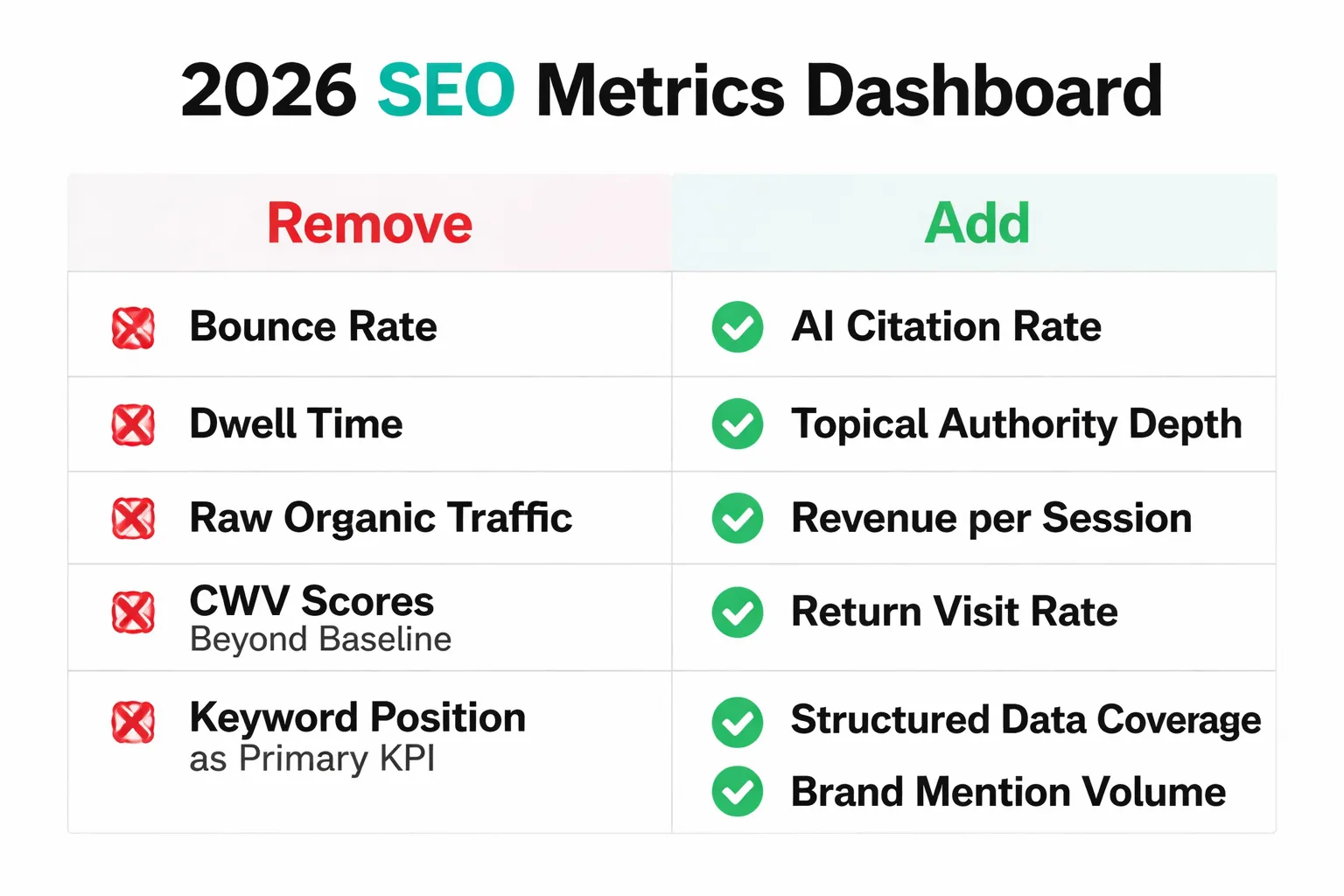
Here's what I actually track now, and what I've removed:
Removed from reporting: - Bounce rate (misleading in a zero-click world) - Average session duration / dwell time (doesn't map to intent satisfaction) - Raw organic traffic (doesn't account for zero-click influence) - CWV scores beyond baseline pass/fail - Keyword ranking position as a primary KPI
Added to reporting: - AI citation frequency (weekly manual audit across ChatGPT, Perplexity, AI Overviews) - Topical authority depth (number of pages ranking for a topic cluster vs. competitors) - Revenue per organic session (connects content to commercial outcomes) - Return visit rate (trust and brand authority signal) - Structured data coverage rate (% of key pages with valid schema) - Brand mention volume (including unlinked citations in forums, social, AI answers)
The shift is from measuring presence to measuring influence. Presence is ranking on page one. Influence is being the source that shapes what AI systems tell your audience — whether or not they ever click through to your site.
In 3 Months, This Changes
By Q4 2026, I expect two shifts that will make this framework even more urgent. First, Google's AI Overview rollout is still expanding — the 47% appearance rate will climb past 55% as Google continues integrating generative answers into commercial and navigational queries, not just informational ones. That means the zero-click problem will hit e-commerce and service businesses harder than it currently does.
Second, the tools for measuring AI citation rate are maturing fast. Right now, tracking GEO visibility is a manual process. Within the next quarter, I expect at least two major SEO platforms to release automated AI citation tracking — which will make this metric as standard as keyword ranking tracking is today. Teams that have already built the habit of measuring it manually will have a significant head start when those tools arrive.
The window to build topical authority and E-E-A-T signals before AI citation tracking becomes a standard competitive benchmark is closing. The teams that move now — restructuring their content for citability, not just rankability — are the ones who will own AI search visibility when the tools to track metrics that matter catch up.
FAQ
What are the most important SEO metrics in 2026?
The SEO metrics that actually matter in 2026 are AI citation rate, topical authority depth, revenue per organic session, return visit rate, and structured data coverage. Traditional metrics like keyword ranking position and bounce rate are increasingly misleading in a search environment where 60% of queries end without a click and AI Overviews appear in nearly half of all searches.
Is keyword ranking still a useful SEO metric?
Keyword ranking is still worth monitoring, but it's no longer a primary KPI. A position-one ranking in 2026 delivers a 39.8% average CTR — but only when no AI Overview is present. When AI Overviews appear above organic results, that CTR drops significantly. Track rankings as a baseline signal, but prioritize AI citation frequency as the metric that reflects actual visibility.
What is AEO and how do you measure it?
Answer Engine Optimization (AEO) is the practice of structuring content so AI systems extract and cite it in generated answers. You measure AEO success by tracking how often your domain is cited in ChatGPT, Perplexity, and Google AI Overview responses for your target queries. Run a weekly manual audit: search your priority keywords across these platforms and record which sources get cited.
What is GEO optimization in SEO?
GEO (Generative Engine Optimization) is the practice of optimizing content to appear in AI-generated responses across the full ecosystem of AI answer engines — including ChatGPT, Perplexity, Claude, and Gemini, not just Google. GEO success is measured by brand citation frequency across these platforms, including unlinked mentions in AI-generated answers.
Should I still track bounce rate in 2026?
No — bounce rate is a misleading metric in 2026's search environment. A user who lands on your page, finds a direct answer in 45 seconds, and leaves is not a failure — but bounce rate records it as one. Replace bounce rate with task completion rate and return visit rate, which more accurately reflect whether your content is serving user intent.
How does E-E-A-T affect AI search visibility?
E-E-A-T signals — Experience, Expertise, Authoritativeness, and Trustworthiness — correlate +30.64% with AI citations compared to pages without strong E-E-A-T, based on Semrush's content optimization study. Named authors, first-person experience, specific verifiable data, and demonstrable credentials are the signals that make content more likely to be extracted and cited by AI systems.
Are Core Web Vitals still important for SEO in 2026?
Core Web Vitals matter as a baseline threshold — passing the assessment in Google Search Console is non-negotiable. But chasing marginal improvements beyond that baseline has diminishing returns for both traditional rankings and AI search visibility. If your team is delaying content publication to perfect Lighthouse scores, redirect that effort toward topical authority and answer quality instead.
How do I track AI citation rate without specialized tools?
Until automated AI citation tracking tools become standard (expected in late 2026), track it manually: pull your top 10 priority keywords by commercial intent, run each through ChatGPT, Perplexity, and Google AI Overview, and record which domains are cited. Do this weekly and track your citation frequency over time. For any query where a competitor is cited and you're not, analyze their cited page for structural differences in answer placement, schema markup, and E-E-A-T signals.
Start publishing content built for AI citation — not just keyword rankings — before your competitors lock up the visibility you're leaving on the table.