
Keyword Cannibalization: What It Is, How to Find It, and How to Fix It
You've been publishing consistently for months. Traffic is climbing, the content calendar is full, and then — nothing. Rankings plateau, or worse, two of the best posts start trading positions in the SERPs like they're playing musical chairs. A check of Google Search Console reveals the same keyword triggering impressions across three different URLs. That's not a content strategy. That's keyword cannibalization — and it's quietly eating rankings from the inside.
What is keyword cannibalization? It's one of the most common self-inflicted SEO wounds on content-heavy sites. It's especially brutal for teams using AI content creation workflows at scale, where publishing velocity outpaces strategic oversight. Here's exactly what it is, why it happens, and — most importantly — how to fix it without nuking pages that are already driving traffic.
What is SEO cannibalization for beginners?
- Keyword cannibalization happens when two or more pages on your site compete for the same search intent, splitting authority and confusing Google about which URL to rank.
- Not all cannibalization is equal — intent overlap is more damaging than keyword overlap alone.
- You can identify it for free using Google Search Console's Performance report and the site: search operator.
- The fix isn't always a redirect — consolidation, canonical tags, noindex, and intent rewriting each serve different situations.
What is Keyword Cannibalization
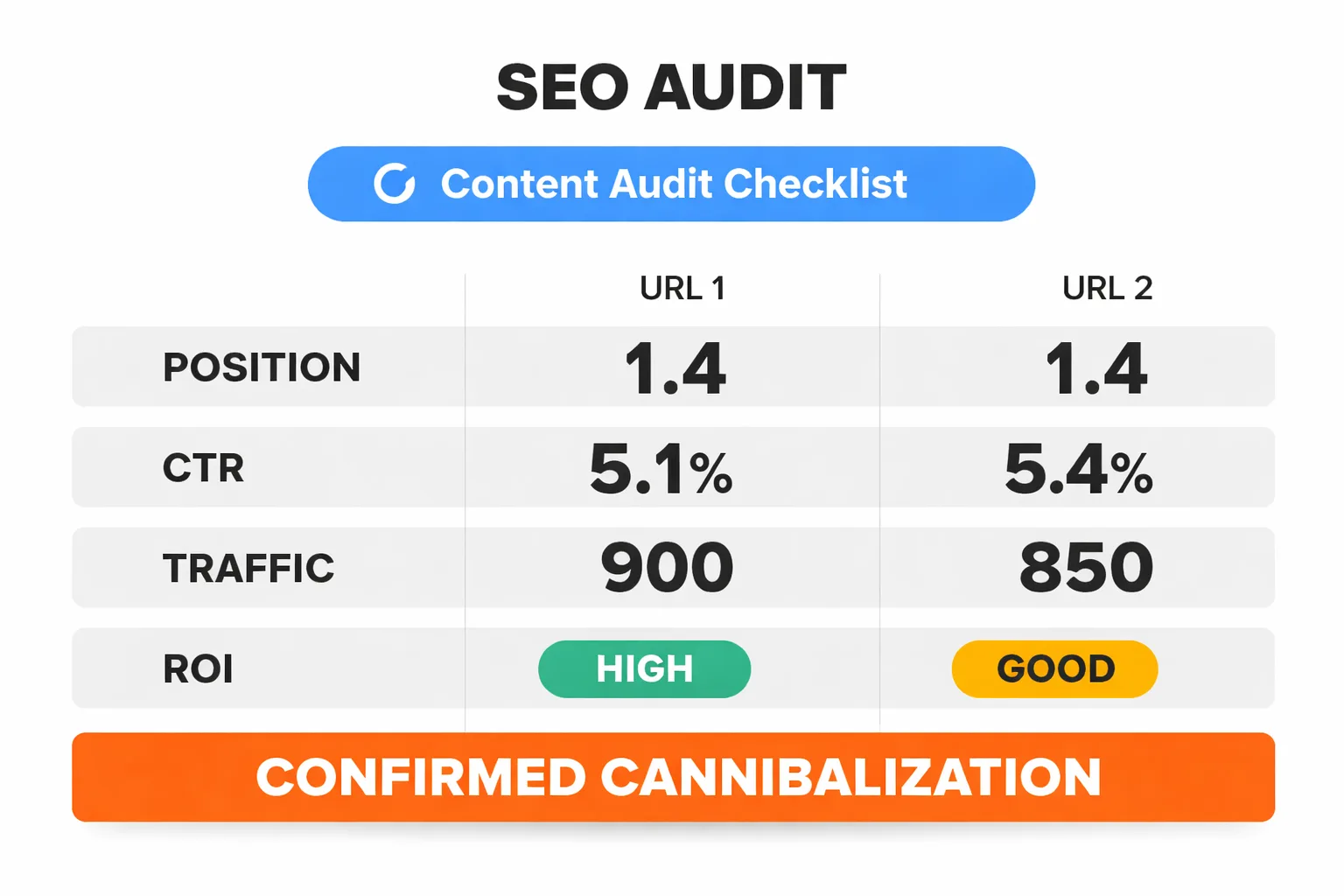
Keyword cannibalization is what happens when two or more pages on the same website compete against each other for the same search query. Instead of one strong page ranking well, the result is two weaker pages splitting link equity, click-through rate, and Google's trust — and neither performs as well as a single consolidated page would. Here's a concrete example I come back to often: imagine an SEO blog that has published "The Ultimate Content Audit Checklist" and "How to Do a Content Audit Step-by-Step." Both pages target searchers who want a structured process for auditing content. Google sees two pages with overlapping intent, doesn't know which one is considered authoritative, and ranks neither as high as one consolidated definitive page would rank. That's cannibalization in its simplest form.
Keyword Cannibalization Explained
Cannibalization rarely happens on purpose. It creeps in over time — a new writer publishes a post without checking what already exists, a product page and a blog post end up targeting the same transactional query, or an AI content creation workflow generates topically similar articles faster than any editorial review can catch them. In my work leading content strategy at Meev, I've surfaced single topics with five variations published across two years, each slightly different in title but nearly identical in search intent.
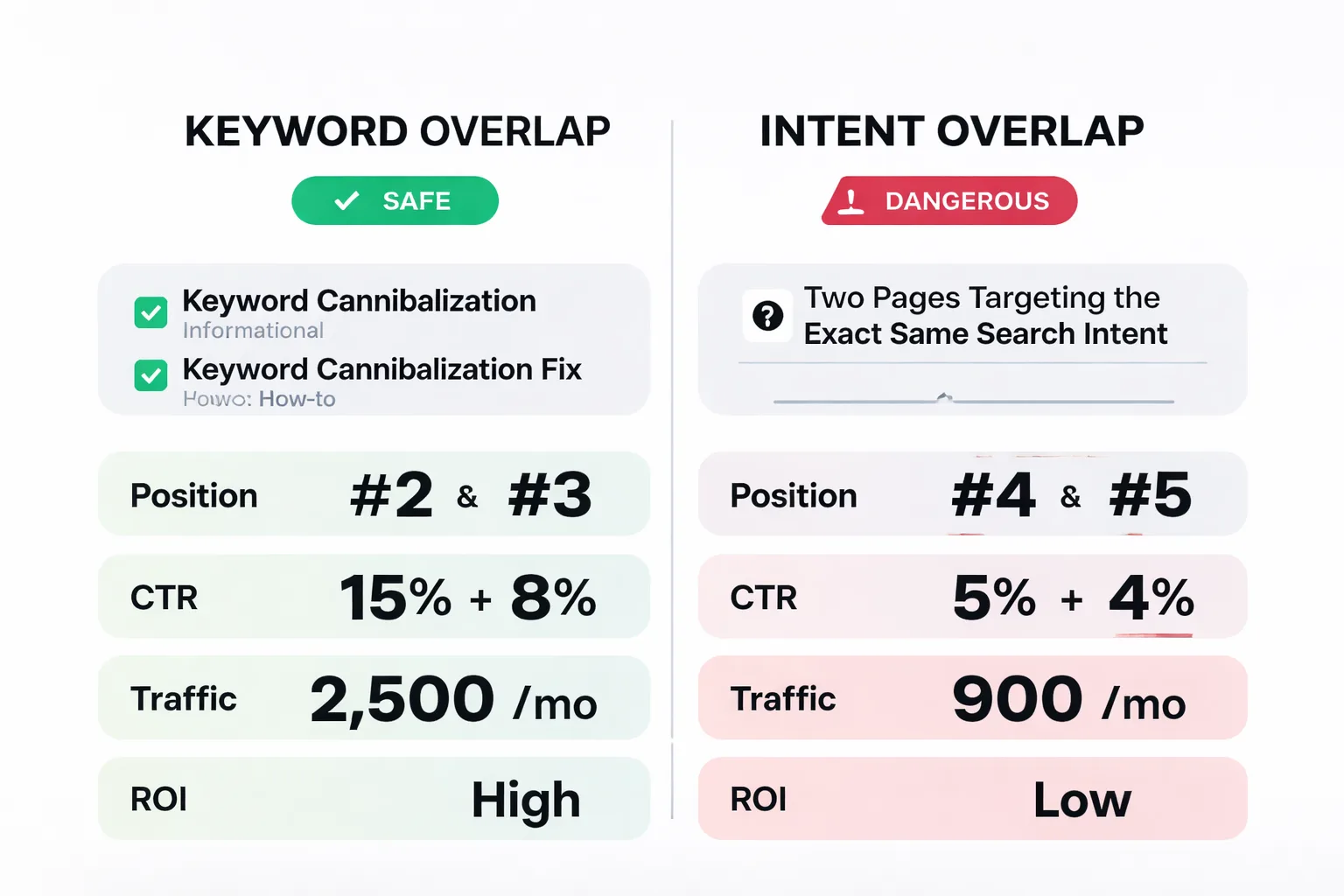
Here's the distinction that most beginner guides miss: keyword overlap and intent overlap are not the same thing, and only one of them is truly dangerous.
Two pages can share a keyword without cannibalizing each other if they serve different intents. A page targeting "keyword cannibalization" as an informational explainer (what it is, why it matters) and a page targeting "keyword cannibalization fix" as a how-to guide (step-by-step remediation) can coexist. Google's crawlers are sophisticated enough — especially post-Helpful Content updates — to distinguish between informational, navigational, commercial, and transactional intent. What Google cannot cleanly resolve is when two pages have the same intent AND the same primary keyword. That's when ranking volatility kicks in: Google alternates between the two URLs, neither accumulates consistent authority, and click-through rate gets split between them.
The AI era has made this significantly worse. Teams using automated publishing pipelines — whether through tools that generate blog posts at scale or repurpose content across formats — are producing intent-duplicate content faster than ever. At Meev, I've seen sites where Google Search Console's structured data reports flag the same schema markup appearing on three near-identical URLs. If content production is scaling, cannibalization prevention needs to be baked into the workflow, not treated as a quarterly cleanup task.
The 4 Most Common Cannibalization Patterns
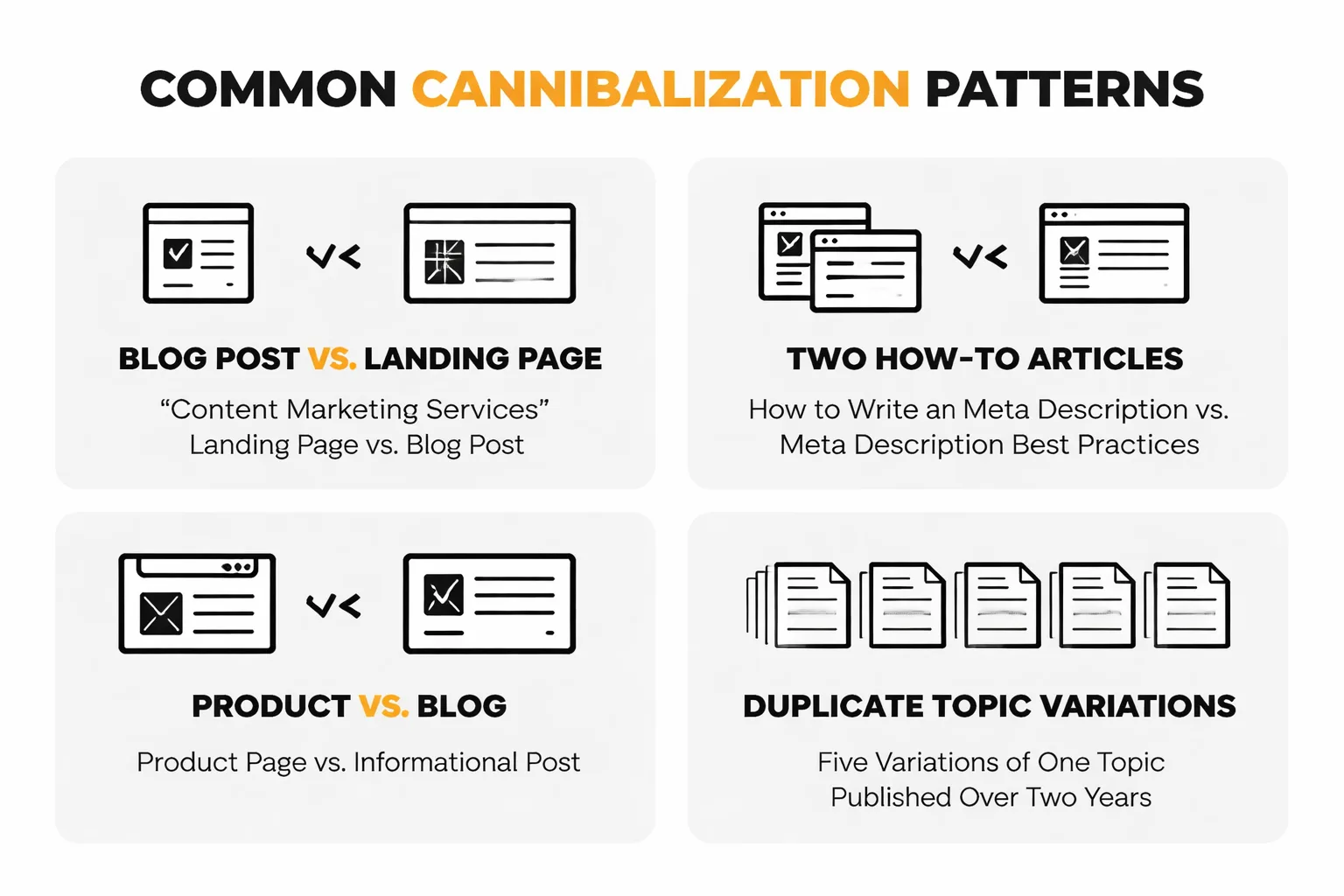
Not all cannibalization looks the same. Here are the four patterns I encounter most often, each with a real-world example:
1. Blog Post vs. Landing Page A sales landing page targets "content marketing services" and so does a blog post titled "What Are Content Marketing Services?" The landing page is commercial intent; the blog post is informational. In theory, they serve different purposes — but if the blog post is optimized aggressively with conversion copy, Google gets confused about which URL to surface for commercial queries. I've seen this pattern regularly kill conversion rates on landing pages that should be dominating their niche.
2. Two How-To Articles with Near-Identical Intent This is the most common pattern I find on content-heavy blogs. "How to Write a Meta Description" and "Meta Description Best Practices" sound like different articles. They're not. Both target someone who wants to write better meta descriptions. Both will compete for the same SERP position. The fix here is almost always consolidation — pick the stronger performer and fold the other into it.
3. Category Page vs. Individual Post A category page for "SEO Tips" and a cornerstone post "50 SEO Tips for Beginners" are both trying to rank for "SEO tips." Category pages are often thin on content, but they accumulate internal links naturally from every post in that category. This creates a weird authority split where neither the category nor the post dominates. In my experience, building a proper content cluster strategy — where the pillar page clearly owns the broad term and individual posts target specific subtopics — is the structural fix here.
4. Paginated Content Page 1, Page 2, and Page 3 of a long listicle or product catalog all share the same title tag and meta description. Google sees three URLs with identical signals and no clear canonical. This is especially common on e-commerce sites and older WordPress blogs that never implemented pagination SEO correctly. The fix is canonical tags pointing paginated pages back to the root URL, or consolidating the content into a single long-form page.
How to Spot Cannibalization Without Paid Tools
You don't need paid tools like Ahrefs or Semrush to find cannibalization. Here's the exact process I use for a free audit:
Method 1: Google Search Console Performance Report
1. Open Google Search Console and navigate to Search Results under the Performance tab. 2. Click + New and add a Query filter. Type in the suspected keyword (e.g., "content audit checklist"). 3. Click the Pages tab. If more than one URL appears for that query, there's a cannibalization signal. 4. Check the Impressions and Clicks columns for each URL. If impressions are split relatively evenly between two URLs, that's a strong indicator Google is alternating between them — classic cannibalization behavior. 5. Export this data to a spreadsheet. Repeat for the 20-30 highest-traffic keywords.
This method surfaces the cannibalization that's already causing damage — the queries where Google is actively confused right now.
Method 2: The site: Search Operator
Open Google and search: site:yourdomain.com "keyword phrase"
For example: site:meev.ai "keyword cannibalization"
If Google returns more than one result for that query on the domain, there's a potential cannibalization issue. This method is faster for spot-checking specific keywords but less systematic than the GSC approach. I use it when I need quick verification on a specific term.
I recommend combining both methods. GSC shows where Google is already splitting authority. The site: operator shows where the structural risk exists, even before rankings are visibly affected.I'll be direct about one thing: high-potential keyword research is where cannibalization prevention starts, not ends. When keyword research is done correctly — mapping every target keyword to a single URL before publishing — most cannibalization gets caught before it happens. The audit methods above are for cleaning up what already exists.
The Fix Isn't Always a Redirect: Choosing the Right Solution
This is where most guides go wrong. They recommend "just 301 redirect the weaker page to the stronger one" as a universal solution. In my experience, that's the right answer maybe 40% of the time. Here's the actual decision framework I use:
Step 1: Determine which page is the "winner." In GSC, compare the two cannibalizing URLs on the same keyword. Which has more clicks? More impressions? More backlinks (check in any free backlink checker)? The winner is the page to keep and strengthen. The loser is the one to act on.
Step 2: Choose the fix based on the situation.
| Situation | Best Fix |
| Loser page has no backlinks, thin content | 301 redirect to winner, delete loser |
| Loser page has valuable backlinks | Consolidate content into winner, then 301 redirect |
| Both pages serve slightly different intents | Rewrite each to clearly own its distinct intent |
| Loser page is important for UX but not SEO | Add noindex tag to loser page |
| Paginated content | Add canonical tag pointing to root URL |
| Blog post vs. landing page (different intent) | Add canonical from blog post to landing page OR rewrite blog post to target informational intent only |
Step 3: Execute and monitor. After implementing the fix, give Google 4-6 weeks to recrawl and reindex. Then return to the GSC Performance report and check whether the winning URL is now capturing the full impression share for that keyword. If the old URL is still appearing, verify that the redirect or canonical is implemented correctly — a misconfigured canonical is one of the structured data mistakes I've seen consistently undermine rich results.
One thing I want to emphasize: consolidation is almost always better than deletion. When two cannibalizing posts are merged into one definitive page, the result isn't just a technical SEO fix — it's a stronger, more authoritative resource that's more likely to earn links, rank for long-tail variations, and satisfy Google's quality rater guidelines. In my work with content teams, the combined page typically outperforms either individual page within 60-90 days.
Preventing Cannibalization at Scale
For content operations running at any meaningful scale — especially those using AI-assisted publishing — reactive audits aren't enough. I've learned this firsthand: a prevention system is required.
The single most effective prevention tool I recommend is a keyword-to-URL mapping document. It's not glamorous. It's a spreadsheet where every target keyword is assigned to exactly one URL on the site. Before any new piece of content is briefed, written, or published, the keyword gets checked against this map. If it's already assigned, the new content either targets a different keyword or gets folded into the existing piece. This one habit eliminates the majority of cannibalization before it starts.
For teams using AI content creation workflows, this check needs to happen at the brief stage — before the AI generates anything. The speed advantage of AI-assisted publishing disappears fast when hours are spent untangling cannibalization problems that a 30-second keyword map check would have prevented. At Meev, we've built this check directly into our content briefing process for exactly that reason.
The other prevention layer is internal linking structure. Consistently linking to the same URL for a given keyword across a site sends a clear signal to Google about which page is considered authoritative for that topic. Inconsistent internal linking — sometimes pointing to Post A, sometimes to Post B for the same keyword — amplifies cannibalization signals. I give internal links the same audit attention as content.
One trend I'm watching closely: how Google's Search Generative Experience and AI Overviews handle sites with cannibalization issues. From what I'm seeing in site data, AI Overviews pull from a single, clearly authoritative URL rather than synthesizing across multiple competing pages. Sites with clean, non-cannibalizing content structures are getting cited more consistently in AI-generated answers. That's a strong incentive to get this right now, before the shift to AI-mediated search accelerates further.
What exactly is keyword cannibalization in SEO?
Keyword cannibalization is when two or more pages on the same website compete for the same search query and intent. This splits link equity, confuses Google about which URL to rank, and typically results in both pages performing worse than a single consolidated page would.
Does keyword cannibalization always hurt rankings?
Not always — keyword overlap without intent overlap is usually harmless. The real damage happens when two pages target the same keyword AND serve the same user intent. That's when Google alternates between URLs, rankings become volatile, and neither page accumulates consistent authority.
How do I find keyword cannibalization for free?
Use Google Search Console's Performance report: filter by a specific query, then click the Pages tab to see how many URLs are appearing for that keyword. Also use the site:yourdomain.com "keyword" search operator in Google to spot competing pages. Both methods are free and require no paid tools.
Should I always redirect the weaker cannibalizing page?
No. A 301 redirect is the right fix when the weaker page has no backlinks and thin content. But if the weaker page has valuable backlinks, consolidate its content into the stronger page first, then redirect. If both pages serve genuinely different intents, rewriting each to clearly own its distinct angle is often better than redirecting either.
How does AI content creation cause keyword cannibalization?
AI publishing workflows generate content at a speed that outpaces editorial oversight. Without a keyword-to-URL mapping system in place, AI tools will produce topically similar articles that target the same search intent — creating cannibalization at scale. The fix is building the keyword map check into the brief stage, before any content is generated.
FAQ
What is keyword cannibalization?
Keyword cannibalization occurs when two or more pages on the same website compete for the same search query or user intent, splitting the site's authority and confusing Google on which page to rank. This leads to weaker performance overall, as traffic, clicks, and trust signals get divided instead of concentrated on one strong page. It's especially common on content-heavy sites using high-volume publishing like AI workflows.How can I identify keyword cannibalization for free?
Use Google Search Console's Performance report to spot the same keyword triggering impressions across multiple URLs, or run asite:yourdomain.com "keyword" search in Google to see competing pages. Look for pages trading SERP positions or plateauing rankings despite consistent publishing. Intent overlap, not just exact keyword matches, is the real red flag.