
You've been staring at the Ahrefs pricing page for twenty minutes. Then you opened a Semrush tab. Then someone in Slack dropped a link to a new AI-native tool that "does everything for $29/month." Now you have six browser tabs open, a mild headache, and zero clarity on what you actually need.
I've been there — and in my work leading content strategy at Meev, I've watched content teams burn through $800/month in overlapping subscriptions, paying for three tools that each do keyword research, none of which anyone checks consistently. The search engine optimization tool market is genuinely crowded right now, and the noise is getting worse as AI-native platforms flood in alongside legacy giants. This article isn't a ranked list. It's a decision framework — because the "best" SEO tool is the one that fits your workflow, not the one that won a G2 badge.
The real cost of a bad SEO tool isn't the subscription fee — it's the six months of misdirected content strategy that follows.
Why Are Most Search Engine Optimization Tool Reviews Useless?
Most SEO tool comparison articles are written by people who've never had to justify a $400/month line item to a CFO. They rank tools by feature count, not by fit. In my experience, a solo blogger and a 12-person content agency have very little in common in terms of what they need from an SEO platform — but they're handed the same listicle.
Here's what those reviews consistently get wrong. First, they ignore team size. Semrush's collaboration features are genuinely excellent — if you have a team using them. For a solo operator, you're paying for seats you'll never fill. Second, they ignore content volume. If you're publishing four posts a month, a $199 enterprise crawl tool is overkill. If you're running a high-volume blog automation pipeline such as 40+ articles per month, a tool without bulk export and API access will become a bottleneck. Third, they ignore workflow integration. A tool that doesn't connect to your CMS, your Google Search Console data, or your content calendar creates friction — and friction means the tool gets abandoned.
Rather than identifying which tool is "best," my goal here is to help you determine which tool is best for you — based on what you actually need it to do.
What Are the 4 Jobs a Search Engine Optimization Tool Actually Needs to Do?
Every search engine optimization tool on the market is trying to be everything to everyone. Don't let that confuse you. I strip it back to the four core jobs and evaluate tools against those — not against each other.
Job 1: Keyword Research. This is the foundation. The minimum bar here is real search volume data (not inflated estimates), keyword difficulty scores that account for SERP features, and the ability to cluster related terms. High-potential keyword research — finding low-competition, high-intent queries — is where I've seen most teams leave traffic on the table. Tools that do this well: Ahrefs (best-in-class keyword explorer), Semrush (strong for competitive gap analysis), and Mangools (underrated for budget-conscious teams). The AI-native entrants like Surfer SEO and NeuronWriter are adding keyword clustering features, but their raw volume data still pulls from third-party sources.
Job 2: Technical Auditing. Crawl your site, find broken links, flag Core Web Vitals issues, identify crawl budget waste. The minimum bar: substantial crawl depth such as 10,000 pages, structured data validation (Google Search Console structured data reports are free but limited), and actionable priority scoring. Screaming Frog is still the gold standard for technical depth. Sitebulb is excellent for visual reporting. Semrush's site audit suits most content teams who don't need forensic-level crawl data.
Job 3: Rank Tracking. Daily or weekly position tracking for target keywords, with SERP feature visibility (featured snippets, People Also Ask, AI Overviews). The minimum bar: accurate local tracking, mobile vs. desktop splits, and historical data going back several months such as 12 months. AccuRanker is the most accurate standalone rank tracker I've tested. Most all-in-one platforms include rank tracking, but accuracy varies — Ahrefs and Semrush both perform well here.
Job 4: Content Optimization. This is where the market has exploded. Tools like Clearscope, MarketMuse, and Surfer SEO analyze top-ranking pages and tell you what topics, entities, and semantic terms to include. For teams doing GEO optimization for AI search — structuring content to appear in ChatGPT, Perplexity, and Google AI Overviews — this layer is no longer optional. The minimum bar: NLP-based content scoring, competitor content gap analysis, and integration with your writing workflow.
Solo Operator vs. Content Team vs. Agency: Different Needs, Different Stacks
This is the section most reviews skip entirely. Here's my direct breakdown of what each segment actually needs.
The Solo Operator (one person, under 10 posts/month, budget of $100/month or less) needs simplicity over depth. There's no need for enterprise crawl limits or white-label reporting. The priority is fast keyword research, basic rank tracking, and content optimization guidance. My recommended starting point: Ahrefs Lite ($99/month) — it covers keyword research and rank tracking well enough for most solo use cases. Pair it with the free tier of Google Search Console for technical monitoring. If you're writing AI-assisted content and want optimization guidance, Surfer SEO's basic plan adds content scoring without breaking the budget. Total stack: under $150/month.
The Content Team (3-10 people, 15-50 posts/month, budget $200-$600/month) has a different problem: coordination and consistency. What's needed are shared keyword lists, content briefs that multiple writers can access, and reporting that connects content output to organic traffic outcomes. This is where Semrush's collaborative features start earning their price. I also strongly recommend adding a dedicated content optimization layer — Clearscope integrates cleanly with Google Docs and keeps writers on-brief without requiring them to understand SEO deeply. For teams running a content pipeline at scale, the efficiency gains from AI-native tools are real. At Meev, we've seen this pattern play out directly: an outdoor gear brand scaling from 2 posts/month to 12 posts/month after automating their content pipeline — 23 of those articles hit Google page 1 within 90 days, and organic traffic grew 340% in six months. That kind of output requires tools that support automation, not just manual workflows.
The Agency (serving multiple clients, 50+ pages/month across accounts, budget $500+/month) needs white-label reporting, multi-account management, and API access. Semrush Agency plan or Ahrefs' team seats are the baseline. DataForSEO is worth knowing — it's a raw API layer that powers many third-party tools and gives agencies direct data access at scale. For AI Agents and automated reporting workflows, having API access isn't a nice-to-have; it's a requirement.
| Segment | Primary Need | Recommended Core Tool | Budget Range |
| Solo Operator | Speed + simplicity | Ahrefs Lite | $99–$150/mo |
| Content Team | Coordination + output | Semrush + Clearscope | $250–$500/mo |
| Agency | Scale + white-label | Semrush Agency or Ahrefs Teams | $500–$1,200/mo |
| AI-Native Pipeline | Automation + volume | Meev + GSC + Ahrefs | $50–$200/mo |
What Red Flags Signal a Search Engine Optimization Tool Isn't Worth the Subscription?
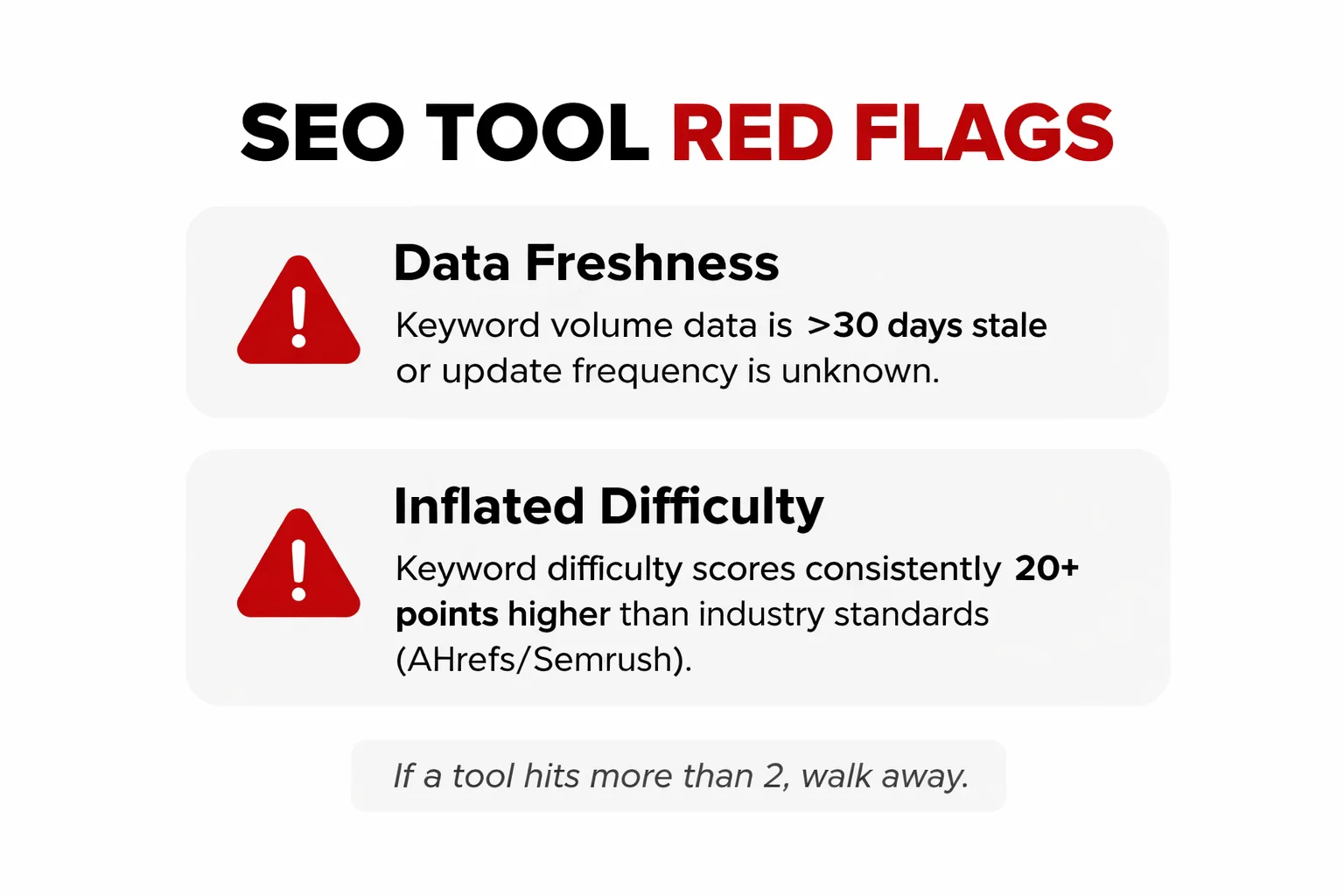
After evaluating enough tools and canceling enough subscriptions, I've identified clear warning signs. Here's a practical checklist — if a tool hits more than two of these, walk away.
Data freshness issues. If the keyword volume data is more than 30 days stale, or if the tool can't tell you when its index was last updated, that's a problem. Stale data leads to chasing keywords that have already peaked or avoiding opportunities that have just emerged. I recommend asking the sales team directly: "How often is your keyword database refreshed?" If they hedge, that's your answer.
Inflated difficulty scores. Some tools systematically overstate keyword difficulty to make their "easy win" suggestions look more impressive. I cross-reference any tool's difficulty scores against Ahrefs or Semrush for the same keywords. If a tool consistently rates keywords 20+ points higher than the industry standard, its recommendations will steer you toward low-competition terms that are actually competitive — and the content won't rank as expected.
Poor or no API access. In 2025, a tool without a documented, accessible API is a tool that doesn't trust its own data. API access is what allows you to build automated reporting, connect to content pipelines, and integrate with AI Agents for workflow automation. If API access is locked behind an enterprise tier that costs 3x the standard plan, that's a red flag about the company's priorities.
No AI integration or roadmap. Not every tool needs to generate content. But a tool that has made zero moves toward AI-assisted analysis, content scoring, or GEO optimization for AI search is a tool that's falling behind. Google's AI Overviews are now appearing in 15% of searches according to recent Semrush data. If your SEO tool isn't helping you understand how to appear in those results, it's already a generation behind.
Clunky export and reporting. If getting data out of the tool requires more than three clicks or a manual CSV download, teams won't use it consistently. Good tools make data portable. Bad tools make data hostage.
How to Audit Your Current Stack Before Adding Another Tool
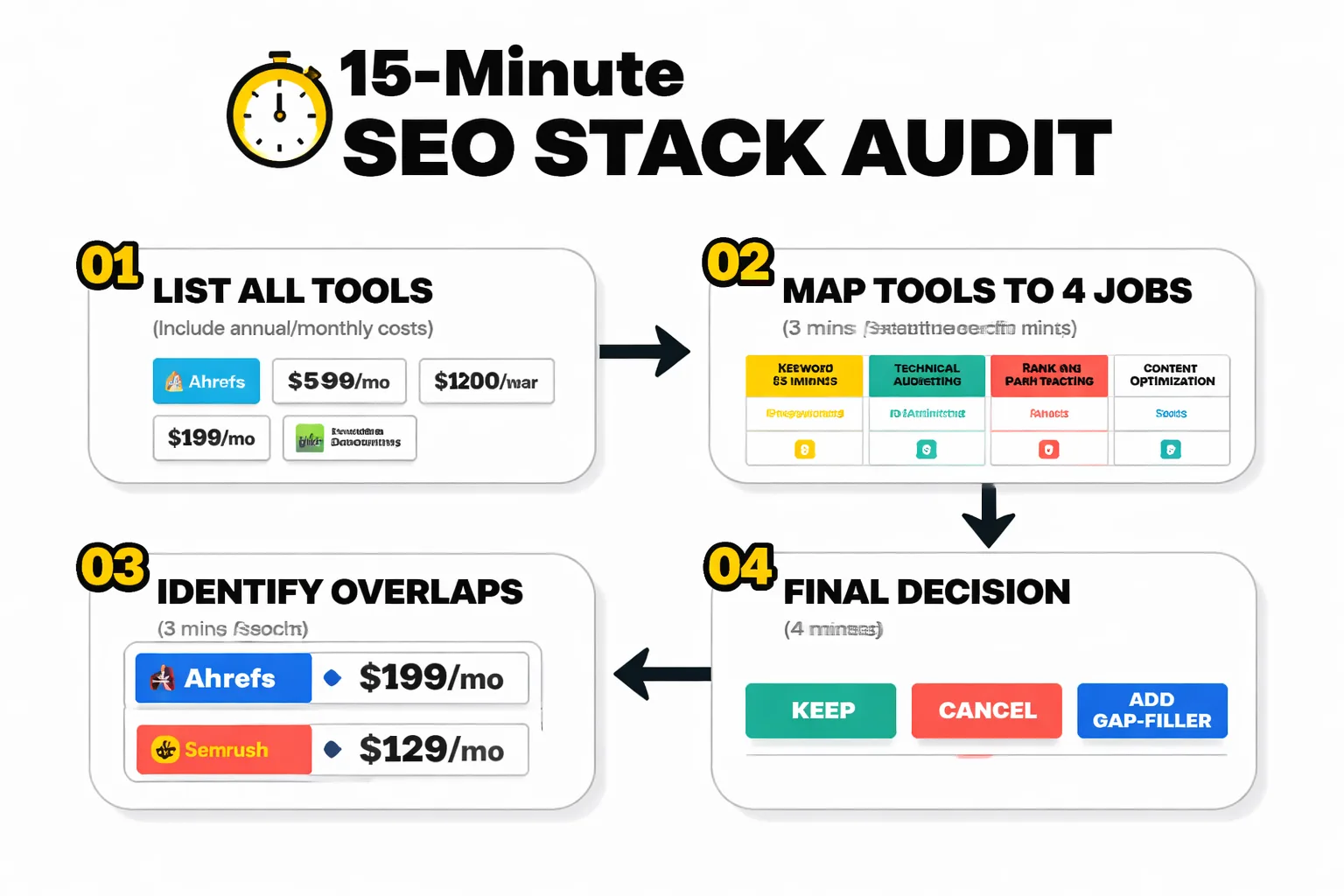
Before adding anything, I recommend spending 15 minutes on this audit. Teams I've worked with that run this process almost always find the same thing: at least one tool is redundant, and at least one critical gap exists that no current tool covers.
Step 1: List every tool you're currently paying for (5 minutes). Include annual subscriptions divided by 12. Include free tools you rely on. Write down the monthly cost next to each one.
Step 2: Map each tool to one of the four jobs — keyword research, technical auditing, rank tracking, content optimization (3 minutes). If a tool doesn't clearly map to one of these four jobs, it's either a specialty tool (fine) or it's redundant (cut it).
Step 3: Identify overlaps (3 minutes). If two tools both do keyword research, ask: which one does the team actually open? The other one is a candidate for cancellation. I've seen teams paying for both Ahrefs and Semrush when they only actively use one — that's $200-$400/month in pure redundancy.
Step 4: Identify gaps (4 minutes). Which of the four jobs has no tool covering it? For most content teams I've worked with, the gap is content optimization — they have keyword research and rank tracking covered, but no tool is helping writers produce content that's semantically complete. For solo operators, the gap is often technical auditing — a proper crawl has never been run and there's no visibility into what's broken.
Once you've done this audit, you'll know whether you need to add a tool, swap a tool, or just cancel something. For teams building toward a more automated content pipeline, How to Build a Content Pipeline That Runs Without You covers how to structure your toolset so content production scales without adding headcount.
The honest truth about SEO tool stacks: most teams are over-tooled on data and under-tooled on execution. They have three ways to find keywords and no systematic way to turn those keywords into published, optimized content at scale. That imbalance is where content teams lose.
The One Thing Most Teams Get Wrong
Most people think the goal is to find the single best SEO tool. They're wrong. The goal is to find the minimum viable stack that covers all four jobs without creating workflow friction.
A $49/month tool used every day beats a $400/month tool opened twice a month. I've watched this play out repeatedly. Teams get sold on enterprise feature sets, onboard the tool with good intentions, and then watch it collect dust because they never figured out the workflow integration. The tool wasn't bad — the adoption was.
When I evaluate any new search engine optimization tool, I ask three questions before signing up: Does it cover a job that nothing in my current stack covers? Will the team actually open it as part of their normal workflow? Does it have API access or integrations that connect to how the team already works? If the answer to any of these is no, I keep looking.
The search engine optimization tool market will keep fragmenting. AI-native platforms will keep launching. Legacy tools will keep adding AI features of varying quality. The teams that win won't be the ones with the most tools — they'll be the ones with the clearest process for turning keyword data into published content that ranks.