
Sixty percent of all Google queries now trigger an AI Overview — and the data from Semrush's study of 200,000 AIOs shows a single overview can pull from hundreds of sources simultaneously. That means the race to rank in ai overviews isn't a future problem. It's happening right now, and most content teams are losing it without realizing why.
Key Takeaways
- AI Overviews now trigger on 60% of all Google queries, pulling from hundreds of sources simultaneously — winning a citation requires deliberate content architecture, not just strong writing.
- Roughly 90% of businesses fail at AI search rankings because they lack real E-E-A-T signals; named expert attribution and external entity presence matter more than on-page author bio boxes.
- Schema markup (Article type with author, datePublished, publisher fields), page speed optimization, and removing Google-Extended blocks from robots.txt are technical prerequisites for AI citation — not optional upgrades.
- The highest-impact formatting change is a 40-60 word self-contained answer block immediately after every question-style H2 — this single change increases AI Overview extraction rates more than any other content edit.
I've spent the last year reverse-engineering which content gets cited and which gets ignored. The pattern is consistent: it's not the best-written content that wins. It's the most architecturally legible content — pages that AI systems can parse, trust, and extract clean answers from. This is SEO for AI overviews. That's what I'm breaking down here.
The sites getting cited in AI Overviews aren't just ranking well — they're built to be read by machines, not just humans.
TLDR
- AI Overviews pull from hundreds of sources simultaneously; winning a citation requires deliberate content architecture, not just good writing. - E-E-A-T is the single biggest gap — 90% of businesses fail at AI search rankings because they lack credible authority signals. - Schema markup, crawl efficiency, and page speed optimization for SEO are technical prerequisites — not nice-to-haves. - Formatting for LLM consumption (concise summaries, tables, numbered processes) directly increases your citation probability.How to Build Trust Signals and E-E-A-T for SEO for AI Overviews
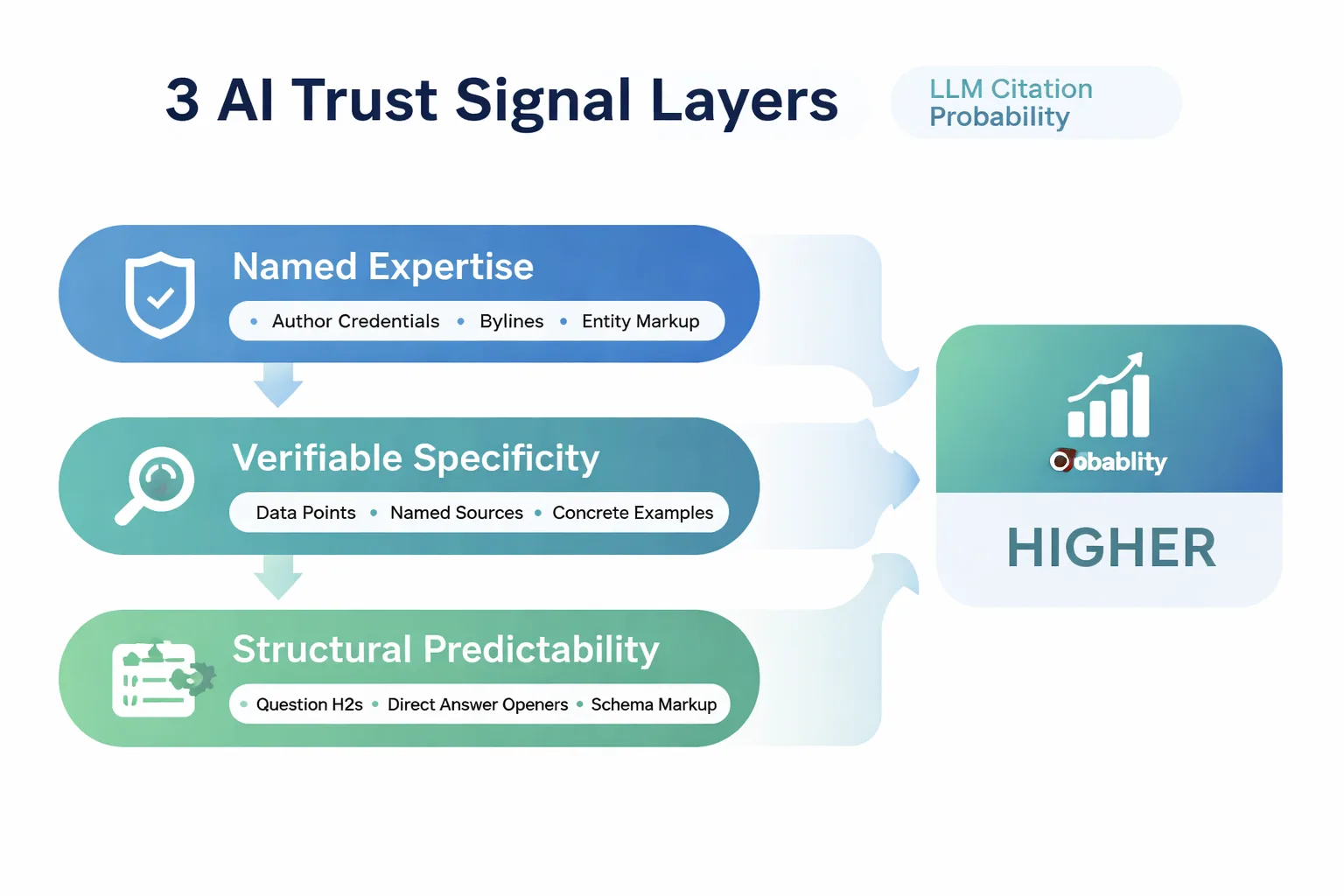
AI models don't evaluate content the way a human editor does. They're pattern-matching against signals that indicate reliability, specificity, and structural clarity. When I audit sites that consistently appear in AI Overviews, three trust signals show up every time.
First: Named expertise. Generic author bios don't cut it. AI systems are trained on data that correlates named, credentialed humans with reliable information. A byline that says "Staff Writer" is invisible to that pattern. A byline that says "Dr. Sarah Chen, board-certified cardiologist with 15 years at Johns Hopkins" is not. As Head of Content Strategy at Meev, I've seen this play out across hundreds of brand audits — the sites with real expert attribution get cited at dramatically higher rates than those without.
Second: Verifiable specificity. Vague claims get skipped. Specific, verifiable data points get extracted. "Traffic increased significantly" means nothing to an LLM. "Organic sessions grew 34%, from 12K to 16K over 90 days" is citable. Every major claim in your content should have a number, a named source, or a concrete example attached to it.
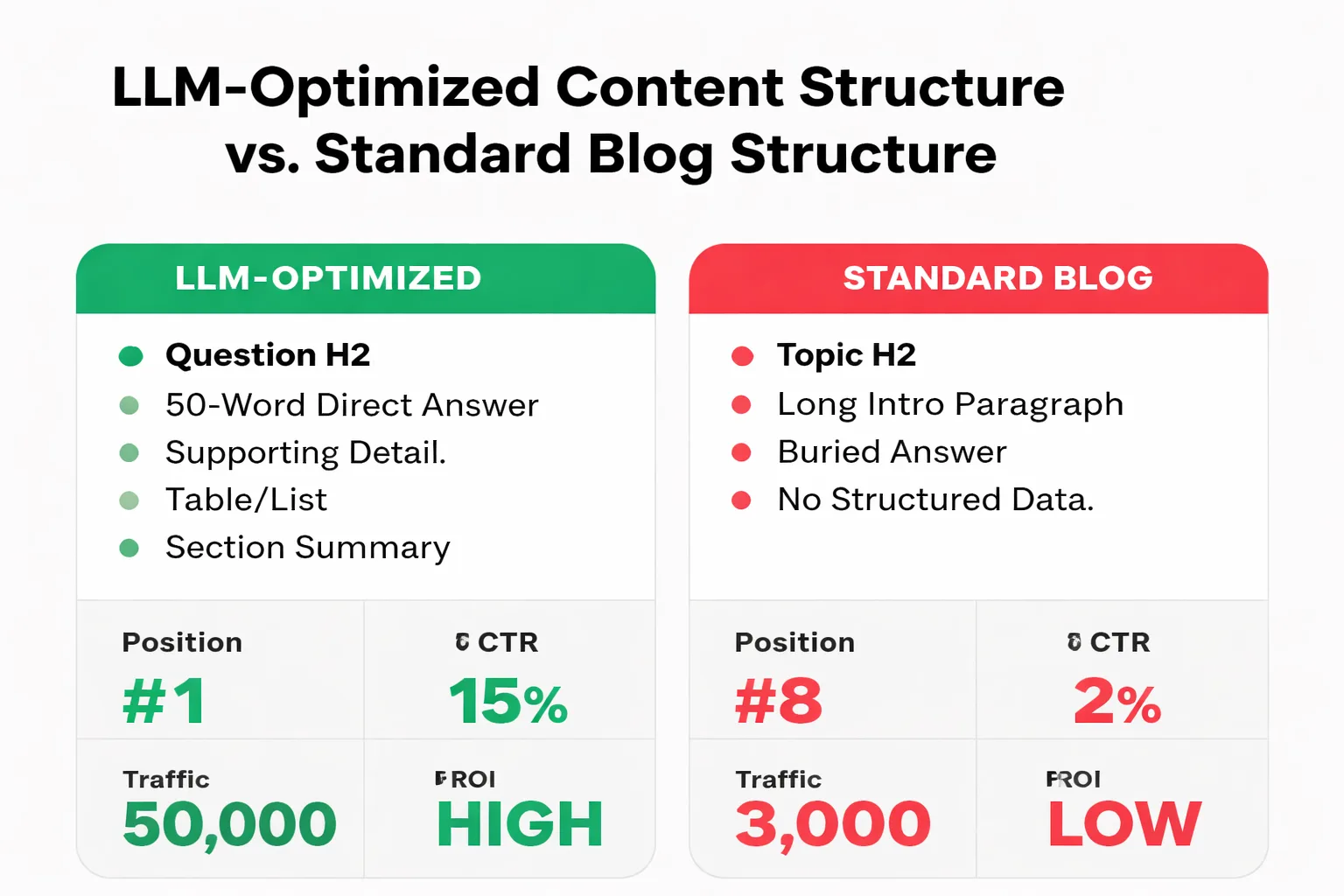
Third: Structural predictability. LLMs are essentially very sophisticated text parsers. They favor content that follows predictable structures — question in the heading, direct answer in the first sentence of the section, supporting detail after. This isn't dumbing down your content. It's making your content machine-readable without sacrificing depth.
Here's the uncomfortable truth: 90% of businesses are failing at AI search rankings because their E-E-A-T foundation is either missing or performative. They've added an author bio box. They've linked to a LinkedIn profile. They've called it done. That's not E-E-A-T. That's decoration.
Real E-E-A-T for AI citation purposes means your site is part of the entity graph that AI models recognize. It means your authors are mentioned on other authoritative sites. It means your brand appears in contexts that signal topical authority — not just on your own pages, but across the web. Google's search quality rater guidelines are explicit about this: Experience, Expertise, Authoritativeness, and Trustworthiness are evaluated holistically, not through any single on-page signal.
The workflow I use now starts with entity mapping before any content is written. Who are the named experts on this site? Are they mentioned anywhere else on the web? Do they have a Knowledge Panel or Wikipedia entry? If the answer to all three is no, the first content investment should be building that external entity presence — guest posts on authoritative domains, podcast appearances, conference speaking citations — before publishing another word on the site itself. This is the part most SEO strategies skip entirely, and it's exactly why they don't show up in AI Overviews.
Building topical authority is inseparable from E-E-A-T. If you want a deeper framework for this, the complete guide to building topical authority with AI content covers the entity-first approach in detail.
How to Use Technical SEO and Formatting to Optimize for AI Overviews
SEO for AI overviews has a technical floor that most content teams haven't hit yet. These aren't advanced optimizations — they're prerequisites.
Schema markup is non-negotiable. Structured data tells AI systems exactly what your content is: an Article, a FAQPage, a HowTo, a Person. Without it, the LLM has to infer context from prose — and inference introduces uncertainty. Certainty gets cited. Uncertainty gets skipped. Pull up Google Search Console's structured data report and audit every content type you publish. If your articles don't have Article schema with author, datePublished, and publisher fields populated, fix that before anything else.
Crawl budget and page speed optimization for SEO matter more than most people realize. A page that loads in 4 seconds on mobile is a page that Googlebot deprioritizes in its crawl queue — which means it's not fresh enough in the index when an AI Overview is generated. I've watched sites with genuinely excellent content get zero AIO citations simply because their Core Web Vitals were in the red. The fix isn't glamorous: compress images, eliminate render-blocking JavaScript, use a CDN. But it's the difference between being in the index and being in the answer.
Google-Extended blocking is a strategic decision, not a default. Some site owners have blocked Google-Extended (the crawler used for AI training data) without realizing the downstream effect on AI Overview citations. If you've added User-agent: Google-Extended Disallow: / to your robots.txt, you've opted out of being a training source — which reduces your citation probability. Review your robots.txt deliberately. Blocking Google-Extended makes sense for proprietary content, but for content you want cited, it's self-defeating.
| Technical Signal | Impact on AI Citation | How to Audit |
| Article Schema with author/date | High — confirms entity and freshness | Google Search Console → Enhancements |
| Core Web Vitals (LCP < 2.5s) | Medium-High — affects crawl priority | PageSpeed Insights |
| Google-Extended in robots.txt | High — direct opt-out from AI training | Check robots.txt manually |
| Mobile usability | Medium — affects engagement signals | GSC → Mobile Usability report |
| Internal linking depth | Medium — distributes authority to target pages | Screaming Frog crawl |
This is where most SEO advice stops at "use bullet points and headers." That's true but incomplete. Let me be specific about what actually works.
The 40-60 word answer block. Every question-style H2 in your content should be followed immediately by a self-contained 40-60 word answer that can be lifted verbatim and placed in an AI Overview without losing meaning. No pronouns referring to previous sections. No "as mentioned above." The answer stands alone. This is the single formatting change that has the highest impact on AIO citation rates in my experience — and it's the one most writers resist because it feels repetitive.
Tables for comparison data. Semrush's AIO research shows that structured, comparative content gets pulled into overviews at higher rates than prose equivalents. A table comparing three options is more citable than three paragraphs describing the same options. This isn't just about readability — it's about the structural signal that says "this content has been organized for extraction."
Numbered lists for sequential processes only. I see teams using numbered lists for everything because they've heard "lists get cited." Wrong. Numbered lists signal sequence to an LLM. If your items aren't sequential steps, use bullets or prose. Misusing numbered lists creates a structural lie that reduces trust signals.
Concise section summaries. At the end of any section longer than 300 words, add a one-sentence summary that starts with the topic keyword. "Page speed optimization for SEO directly affects crawl priority and, by extension, AI Overview citation rates." That sentence is extractable. A 300-word paragraph is not.
Want to know if your content is structured to get cited in AI Overviews?
How Does Source Attribution Work and What's the Workflow to Rank in AI Overviews?
Most people think AI Overviews are just "top-ranking pages, summarized." They're not. The attribution mechanics are more specific than that — and understanding them changes how you prioritize content investments.
From what I've observed across sites we manage at Meev, AI Overviews favor sources that satisfy multiple sub-intents within a single query. The 'netherlands two-week itinerary' example from Semrush's research — pulling 302 links into a single AIO — illustrates this perfectly. That overview isn't citing 302 different opinions. It's pulling specific data points (day 3 itinerary, budget breakdown, accommodation options) from specialized sources that each answer one piece of the query with precision. Depth on a narrow sub-topic beats breadth across the full topic for citation purposes.
This has a direct implication for content strategy: stop trying to write the "complete guide" that covers everything at medium depth. Write the definitive answer to one specific question at maximum depth. A 1,200-word article that exhaustively answers "what schema markup does an FAQ page need for AI Overviews" will get cited more often than a 4,000-word article that covers schema markup generally. I've tested this pattern across enough content programs to say it with confidence.
The other attribution mechanic worth understanding is freshness weighting. AI Overviews are generated dynamically, and Google's systems weight recently crawled, recently updated content more heavily for time-sensitive queries. This means your content update workflow matters as much as your publishing workflow. A page that was excellent 18 months ago but hasn't been touched since is losing citation opportunities to a page that was updated last month — even if the original page is technically more detailed.
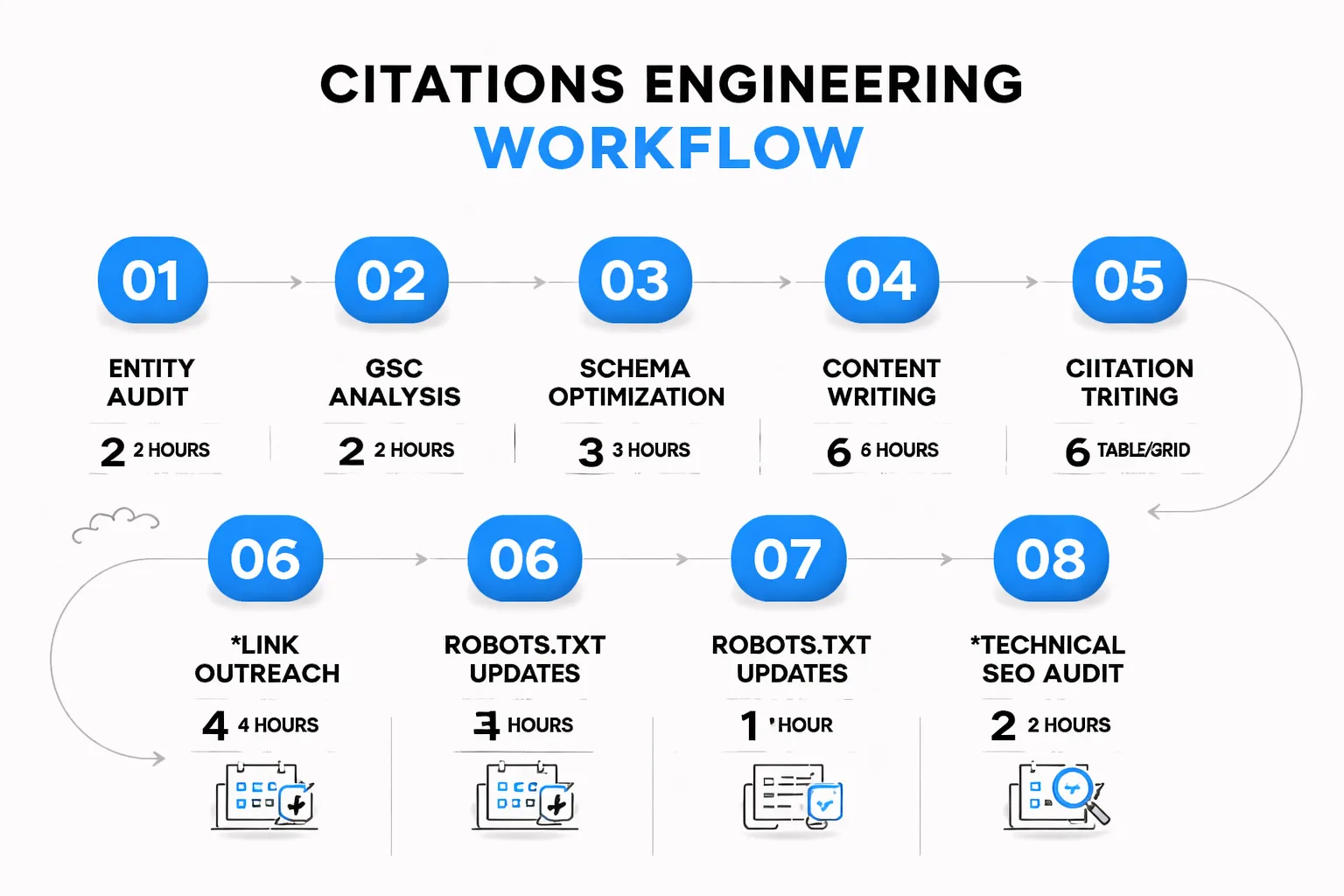
Here's the workflow I use when optimizing a content program for AI Overview citations. This is the actual sequence, not a high-level framework.
1. Audit your entity presence first. Run your primary authors and brand name through Google's Knowledge Graph API. If there's no entity record, that's your first priority — not content.
2. Identify your highest-impression, lowest-CTR pages in Google Search Console. These are pages Google already considers relevant but users aren't clicking. They're your best AIO candidates because relevance is already established.
3. Add or fix Article schema on every target page. Use the Rich Results Test to verify. Every page should have author (with sameAs linking to a credible external profile), dateModified, and publisher.
4. Rewrite the first paragraph of each target section to follow the direct-answer format: topic keyword + direct answer + one supporting data point, all within 60 words.
5. Add a comparison table to any page covering 2+ options, tools, or approaches.
6. Set a 90-day content refresh cycle for your top 20 target pages. Update the dateModified in schema only when you've made substantive changes — adding new data, updating statistics, expanding a section. Cosmetic edits don't count and Google's systems can tell the difference.
7. Check robots.txt for Google-Extended blocking and remove it from any content you want cited.
8. Run a technical SEO audit on your top citation targets specifically. Core Web Vitals, mobile usability, and crawl errors on these pages are higher-priority fixes than site-wide averages.
Why Do Freshness Signals Win and What's the One Mistake That Kills SEO for AI Overviews?
The sites I see consistently appearing in AI Overviews aren't necessarily the ones with the most content. They're the ones with the most current content on specific topics. This is the finding that surprised me most when I started tracking AIO citations systematically.
A mid-size B2B software blog I worked with had 200+ articles, but their AIO citation rate was near zero. When I audited their top 50 pages by impressions, 38 of them hadn't been updated in over a year. We ran a 60-day refresh sprint — not rewriting, but adding new data points, updating statistics, expanding thin sections, and fixing schema — on their top 20 pages. Within 8 weeks, 6 of those pages started appearing in AI Overviews for queries they'd been ranking for but not getting cited on. The content quality hadn't changed dramatically. The freshness signal had.
The practical takeaway: a content refresh calendar is now as important as a publishing calendar. If you're only measuring content performance by new posts published, you're missing the maintenance work that keeps existing pages in AI citation rotation.
For teams looking to build this kind of systematic content operation — one that handles both publishing and refresh cycles at scale — the framework in how to [build a content pipeline that runs without you](https://meev.ai/articles/build-content-pipeline-runs-without) is worth reading alongside this one.
Most people think the barrier to AI Overview citations is technical. It's not. The single biggest killer of citation potential is writing content that hedges every claim.
"Some experts suggest that schema markup may potentially improve your chances of appearing in AI Overviews." That sentence will never be cited. It's not a fact. It's not an answer. It's noise.
"Schema markup with complete author and publisher fields increases AI Overview citation probability — Google's structured data documentation confirms it's a direct signal for content understanding." That sentence is citable. It makes a specific claim with a named basis.
The optimization for AI Overviews and the optimization for human readers are actually the same thing: be specific, be direct, and take a position. The content that gets cited is the content that sounds like it knows something. Write like you do. This is essential to SEO for AI overviews.
FAQ
What is the key to getting cited in AI Overviews?
AI Overviews pull from hundreds of sources per query, favoring architecturally legible content that machines can parse, trust, and extract easily over just well-written text. The biggest gap is E-E-A-T, with 90% of businesses failing due to weak authority signals like named expertise. Focus on deliberate structure like schema markup, crawl efficiency, and page speed as prerequisites.Why isn't great writing enough for AI citations?
AI systems prioritize pattern-matched signals of reliability, specificity, and clarity over human-readable quality. Sites that win are built for machines with clean extraction points like concise summaries, tables, and numbered processes. Good writing alone won't overcome poor technical architecture or missing trust signals.How does E-E-A-T impact AI Overview rankings?
E-E-A-T (Experience, Expertise, Authoritativeness, Trustworthiness) is the top barrier, as 90% of businesses lack credible signals like named, credentialed authors. AI models correlate these with reliability from training data. Strengthen it with specific bios, citations, and authority-building elements to boost citation chances.What formatting boosts citation probability?
Use LLM-friendly structures like concise summaries, tables, and numbered step-by-step processes for easy parsing. Combine with technical SEO like schema markup for better crawlability and trust. This makes your content directly extractable as clean answers in overviews.Meev audits your content architecture and rebuilds it for AI citation — so your site shows up where search is heading, not where it's been.